


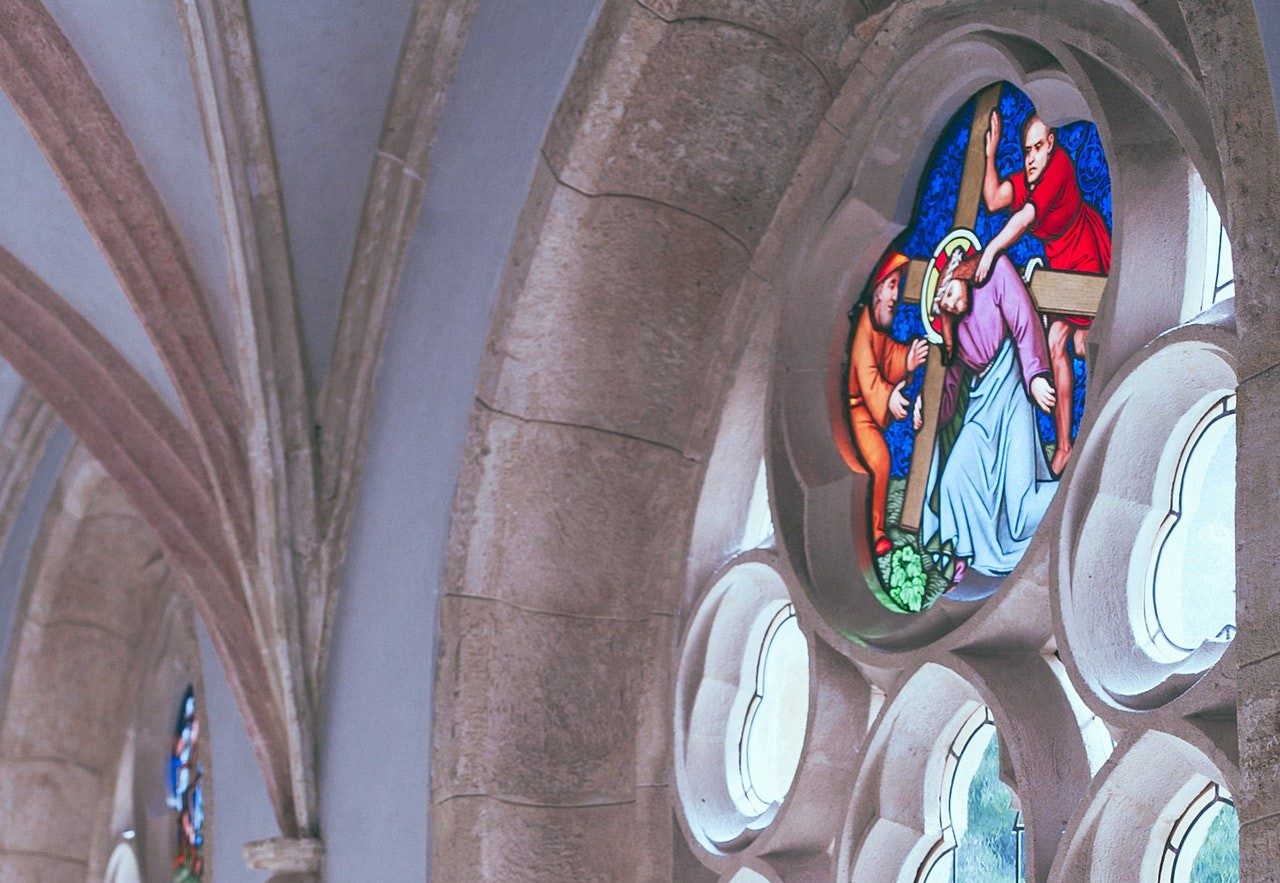
Easter is: Christus Invictus
At Easter, we celebrate Christ’s ultimate, eternal victory over sin and death. He seals the New Covenant with His own Blood, redeeming us from the grave and eternal damnation. Despite sorrow, pain and suffering, God has the final word.
On Wednesday of the final week of Lent, The Book of Common Prayer reads:
‘Where a testament is, there must also of necessity be the death of the testator: for a testament is of force after men are dead; otherwise, it is of no strength at all.’
Its authors were quoting Hebrews 9:16-17, where it tells us the ‘first covenant’ was concerned with ‘external regulations regarding worship’ and the earthly dwelling place of Yahweh.
Enter the new covenant.
He Paid the Price
‘But Christ,’ Hebrews attests, ‘by His own blood,’ which ‘obtained eternal redemption,’ has become the ‘mediator — like a high priest,’ dying ‘as a ransom to set free those who are called from the sins committed under the first covenant.’
The blood of Christ sets free. The sinless one becomes the all-sufficient price paid for the sins of the many.
Hebrews’ author argued that this is because ‘the law requires that nearly everything be cleansed with blood, and without the shedding of blood there is no forgiveness.’
In kind, Jesus Christ — Who is very God and very man — representing all of humanity, ‘now appears for us in God’s presence, and He will appear a second time, not to bear sin, but to bring salvation to those who are waiting for Him.’
Reconciled
The Lenten season realigns Christians with the love of God. A love as fierce in its “yes,” as it is in its “no.”
Easter is mercy and wrath.
Just as the author of Hebrews describes: in Christ, God takes into Himself the punishment we would otherwise have to bear.
Jesus Christ becomes priest, sacrifice and temple. He replaces Solomon’s sanctuary with His uncreated Self, Who ‘does not dwell in houses made by hands.’ (Isaiah 66:1-2; Acts 7:47)
On the cross hung, and outside the vacated tomb stood the Son of Man, the “Lamb of God who takes away the sin of the world” — the Word become flesh; self-revealing of God in time and space.
In his descriptions of what was to come, Daniel described God as the Ancient of Days, the fiery One who takes His seat surrounded by thrones.
From what Daniel saw, the Ancient of Days was clothed in white, served by the armies of Heaven, and from a throne of fire handed the Son of Man ‘an everlasting dominion, which shall not pass away, nor be destroyed.’
Easter is, Christus Invictus! (Christ unconquerable).
Victory
Bounce back to Genesis 49, and there Jacob tells Judah, ‘the sceptre shall not depart from Judah, nor the ruler’s staff from between his feet.’
Similarly, the Apostle John in Revelation 5:5 reaffirms:
‘Weep no more; behold, the Lion of the tribe of Judah, the Root of David, has conquered.’
Donald Bloesch, writing in Jesus as Victor, reflected,
‘What occurs in the cross is more than the defeat of sin and the vindication of righteousness: there sin is removed from the life of man, and replaced by righteousness.’
Bloesch called this a ‘dramatic reversal in the history of humanity and its destiny irrespective of human attitudes or responses.’
Simply stated: what Christ, through the cross, undoes, and does, cannot be undone.
In his book The Apocalypse, ex-Marxist Jacques Ellul expressed it in this way:
‘Man can invent what he will, be delivered to whatever aberrations he desires; he will no longer evade what God has decided in Jesus Christ; he will no longer evade the love of God.’
Just as Christ puts on our flesh, we are to clothe ourselves in His righteousness by way of the ‘eternal Spirit’.
The new covenant — the New Testament — comes alive, through the death of the testator.
In light of the resurrection, John Calvin explained, ‘this is the striking contrast between the living God and dead works.’
The great benefit of Christ’s victory is that ‘the virtue of the one sacrifice is eternal and extends to all ages.’
Jesus is Victor!
___
Photo by Maria Orlova.
Recent Articles:
15 October 2026
3.6 MINS
An 80,000-strong gathering in Texas signals a hunger for revival, as Pastor Philip Anthony Mitchell warns that Christian indifference could leave future generations without the faith.

15 October 2026
4.2 MINS
Many Australian Christians don’t know a single Aboriginal person. Robyn Murray argues that reconciliation begins with honest history, prayer and a shared life in Christ.
15 October 2026
6.1 MINS
Historian Frank Furedi warns that the West is waging a war against its own past, censoring books, rewriting history and severing future generations from their heritage.

15 October 2026
7.2 MINS
A man’s death in a tiger enclosure sparks chilling online reactions, exposing a growing willingness to judge human worth by usefulness, behaviour and ideology.
15 October 2026
2.6 MINS
Before anything else, we must make prayer central. I urge the Church in Australia to awaken to, first of all, prayer.
14 October 2026
5.5 MINS
As Christianity fades from public life, Marxism or Communism offers a substitute faith built on oppression, liberation and political salvation — but at what cost?
14 October 2026
2.8 MINS
Australia needs a courageous Church that never separates courage from Christian love — the courage of Peter and John, who, when ordered to cease speaking about Jesus, responded: “We can't stop.”


