


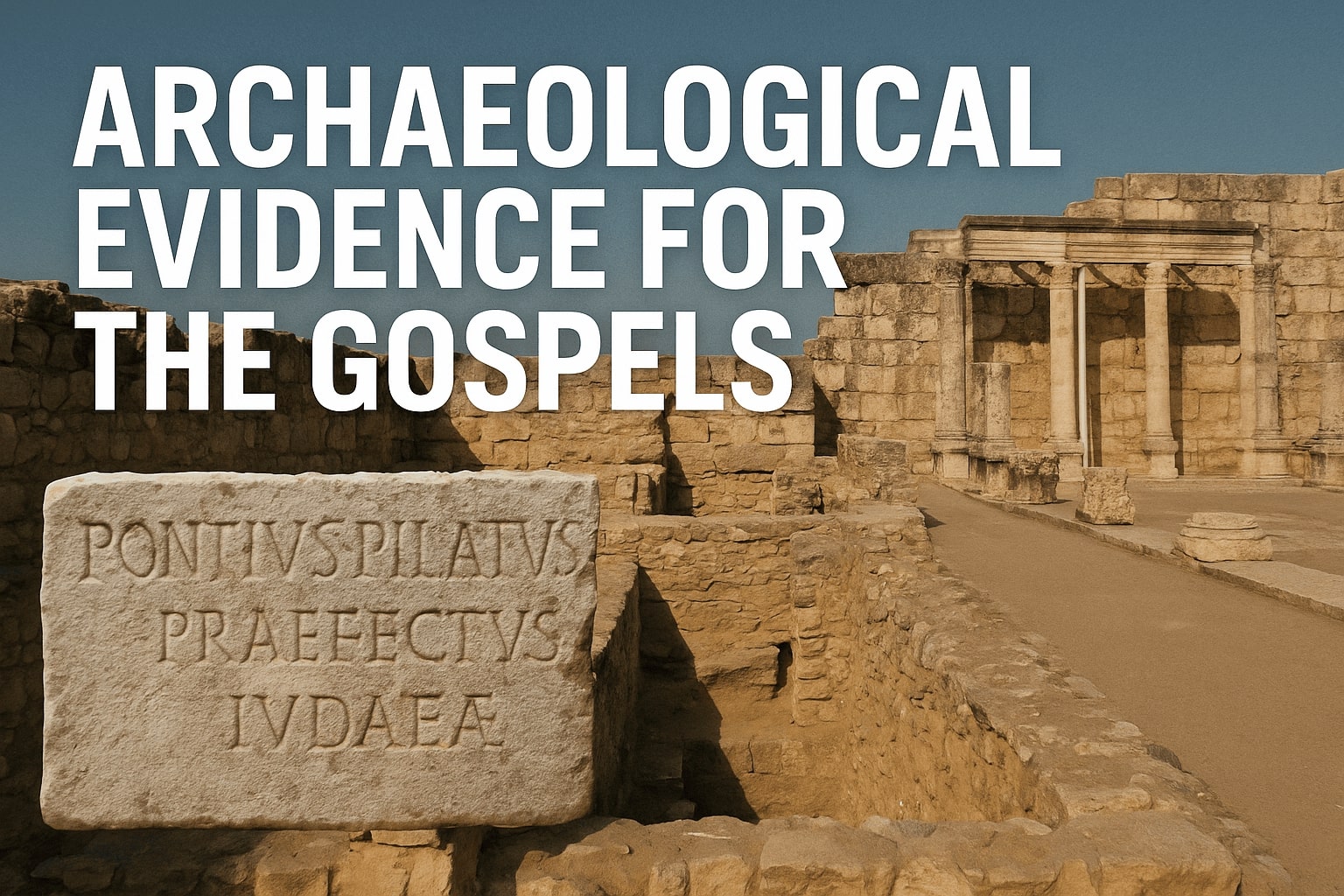
3 Archaeological Discoveries That Confirm the Reliability of the Gospel
Archaeological evidence for Jesus and the New Testament continues to mount. These three discoveries offer tangible confirmation that the Gospels are trustworthy historical sources, not mere religious legends.
Debates about the historical reliability of the books contained in the New Testament—and especially the Gospels—are longstanding. Accordingly, historians use a variety of tools to test the credibility and reliability of the accounts in the Bible.
One of these tools is archaeology.
In this article, I will briefly outline three significant archaeological discoveries that show that the Gospels are reliable as history.
As a caveat, it is important to note that Jesus and the events of the New Testament—while they are of the utmost historical significance in retrospect—were relatively obscure at the time. It is not as though Jesus was a well-known political or military leader—or even a local government official, for whom we may expect to see common archaeological remains like stelae, inscriptions bearing his name, or coins—as we do for Roman emperors.
While such artefacts may work well to directly confirm details about, say, Alexander the Great, they are less useful for Jesus. After all, Jesus was a Judean carpenter and rabbi, relatively well-known in his own region, but not the sort of person for whom historians would expect to find much direct archaeological evidence.
That said, direct archaeological evidence—artefacts that mention Jesus, for example—is not the only kind of archaeological evidence historians have to work with.
The three examples I will provide are instances where archaeological discoveries have confirmed something in the Gospels—in effect, reinforcing or bolstering the claim that the Gospels are credible or trustworthy.
History is, in many ways, about figuring out who we can trust—like in a court case. Whose testimony is reliable? Archaeology helps us to do this.
Just one final note before we launch in: while there are many more examples, the three I’ve chosen are provided by John Dickson in his highly readable and concise book on the evidence for Jesus—Is Jesus History?
You can find that book here.
Example 1: The Pool of Bethesda
In John 5:1–8, the Apostle John recounts a story about Jesus healing a lame man near a pool in Jerusalem:
“Now there is in Jerusalem by the Sheep Gate a pool, in Aramaic called Bethesda, which has five roofed colonnades. In these lay a multitude of invalids—blind, lame, and paralysed.”
What is interesting about this passage is the specific detail we are provided about this pool.
These sorts of incidental, offhand details are what interest historians. They allow us to check up—if you will—on how familiar the author was with the landscape, geography, layout, and context of the narrative they are describing—and how trustworthy their account generally is.
If we can trust them to get the incidental and unimportant details right, it tells us that we can take them seriously as witnesses to the events they are describing.
In the case of the Jerusalem pool, we know from John’s account that it is supposed to have been near the Sheep Gate—so archaeologists know where to start looking. However, for a long time, archaeologists were unable to find any such pool—leading some more sceptical scholars to speculate that the geographical details in John’s account were symbolic or even made up.
That changed in the late 1950s and early 60s, investigators uncovered a pool matching the description in John’s Gospel—exactly where he says to expect it.
Since that time, excavations have continued to support the conclusion that John not only got the general setting right but also the finer details. To quote one New Testament scholar:
“Now, after careful examination of [the archaeologist’s] evidence, we see that, just as the general accuracy of the Johannine account in chapter 5 was confirmed by the discovery of the pools over fifty years ago, we can now see that the details of the Johannine account are also confirmed by a closer study of the details of the Pools […] our present conclusions are not a naïve reading of the text but a critical one, based on the archaeology of the site…”
So when John describes a pool near the Sheep Gate in Jerusalem with five colonnades, he’s not just being symbolic, or making stuff up. Archaeological evidence suggests that he know what he’s talking about. And he gets the details right.
Example 2: Pontius Pilate — Prefect or Procurator?
The New Testament and a range of other sources claim that Pontius Pilate was the leading Roman official in Judea during the time of Jesus.
The Roman historian, Publius Cornelius Tacitus, writing in the second century, calls Pilate the ‘procurator’ of Judea, but as John Dickson points out, this is not strictly true. In reality, Pilate was a prefect or governor—holding a title that stressed the military nature of his role and his equestrian status.
At the time, in contrast, a procurator was a financial administrator in the Roman provinces, and only after about AD 40 and the reign of the Emperor Claudius did the term start to be used more widely to refer to governors.
While Tacitus gets the detail wrong, as Dickson highlights, “the Gospels rightly call Pilate hegemon, a general Greek term for governor or prefect” (emphasis in original).
This distinction was confirmed by the excavation of a stone inscription in Caesarea Maritima on the coast of Israel.
That inscription dedicates a building in the city to the Emperor Tiberius (who was emperor when Jesus was alive, see Luke 3:1) and mentions Pontius Pilate—calling him the governor, or praefectus, of Judea, not the procurator.
Again, the Gospels get the detail right, even where extra-Biblical sources slip up.
Example 3: Why was the New Testament Written in Greek?
Critics (both popular and academic) have long highlighted the fact that the Gospels were written in Greek as a fact that undermines their reliability as an accurate testimony of Jesus’ life. After all, if Jesus was a thoroughly Jewish man—and spoke Hebrew or Aramaic as his first language—wouldn’t it seem odd that the accounts about him were written in Greek rather than Hebrew or Aramaic?
And it’s a fair enough question.
As Dickson notes, “such a basic cultural discrepancy between a figure and the writings about him would be more significant to the historian than any particular error of fact in the accounts”.
But here is where archaeology has again helped answer such questions—and demonstrated the trustworthiness of the Gospels.
Extensive archaeological work both where Jesus was from (in Lower Galilee) and in wider Judea has shown that the region where Jesus spent much of his time was devoutly Jewish—just as the Gospels say.
That’s important, but it doesn’t resolve the question of why the Gospels were written in Greek.
Thankfully, it’s not all that archaeology has shown us. Archaeologists have uncovered extensive evidence that suggests that the Greek language was actually used widely within Israel at the time. In fact, as many as fifteen per cent of Jerusalem’s population may have spoken Greek as a first language.
For instance, the excavation of a large synagogue inscription right next to the temple in Jerusalem has shown us, in Dickson’s words, “that Greek was so prevalent in Jesus’ day that the holy city itself was catering for Jews whose preferred language was Greek”.
Burial inscriptions show the same thing—with ossuaries often listing both a Jewish and a Greek name. To quote Dickson again, “this means… that a significant portion of the population had both Aramaic and Greek as ‘heart languages’—languages they literally took to the grave”.
This matches the fact that the Gospels only provide Greek names for two of Jesus’ Galilean disciples—Andrew and Philip (John 12:22).
So there is no ‘cultural’ or ‘time gap’ between the Jewish context of Jesus and the Greek language within which the Gospels were written.
And archaeology has helped to verify that for us.
Those are just three of the archaeological discoveries that help historians to confirm the details—and credibility—of the Gospel accounts.
Know of more?
Leave a comment below with your top examples.
___
Bibliography:
- John Dickson, Is Jesus History? (The Good Book Company: 2019)
- Caroline Barron, “Dedication by Pontius Pilate in Judea (CIIP II, 1277)“, 2019.
- Urban C. von Wahlde, “The Pool(s) of Bethesda and the Healing in John 5: A Reappraisal of Research and the Johannine Text“, 2009.
Image generated by ChatGPT (supplied by author).
8 Comments
Leave A Comment
Recent Articles:

19 October 2026
12.4 MINS
Greta Gerwig’s "Narnia: The Magician’s Nephew" trailer raises questions about C. S. Lewis’s Christian vision and the faithfulness of the new Netflix adaptation. Here are my initial impressions and concerns.

19 October 2026
3 MINS
Paul prayed that we would be awakened to a deeper revelation of the Father and who we are in Christ, so that we will make Jesus known to others more passionately.

18 October 2026
2.7 MINS
Every season of life belongs to Christ, and we don't retire from discipleship as we grow older. In fact, our older years hold unique gifts for the younger generations.

17 October 2026
3.4 MINS
Seeking the face of God means surrender, laying aside our agenda and wants. Revival begins when we want God himself more than we want the outcome.
16 October 2026
3.3 MINS
Jesus is calling us to love one another “just as I have loved you”. And if the Church does awaken to that agape (love), the world will see a great and powerful witness to Christ and his kingdom.

15 October 2026
3.6 MINS
An 80,000-strong gathering in Texas signals a hunger for revival, as Pastor Philip Anthony Mitchell warns that Christian indifference could leave future generations without the faith.

15 October 2026
4.2 MINS
Many Australian Christians don’t know a single Aboriginal person. Robyn Murray argues that reconciliation begins with honest history, prayer and a shared life in Christ.



The famine mentioned in Acts 11 was real. It happened during the reign of Emperor Claudius (Ad 41-54) During his reign there were a series of famines throughout the empire which together fit the term ‘great famine’ See Acts 11:28.
Josephus the Jewish historian refers to a famine in Palestine probably around 46Ad.
Thanks for your thoughts, James.
Great article Cody!!!!
Thanks, Warwick
Thank you, Cody for your helpful article. I like to throw some of these facts into my SRE lessons from time to time. I also try to avoid referring to the ‘story’ and rather to use the term ‘account’ when speaking to my students.
Thanks, Leonie. I am pleased to hear that you found the article helpful!