


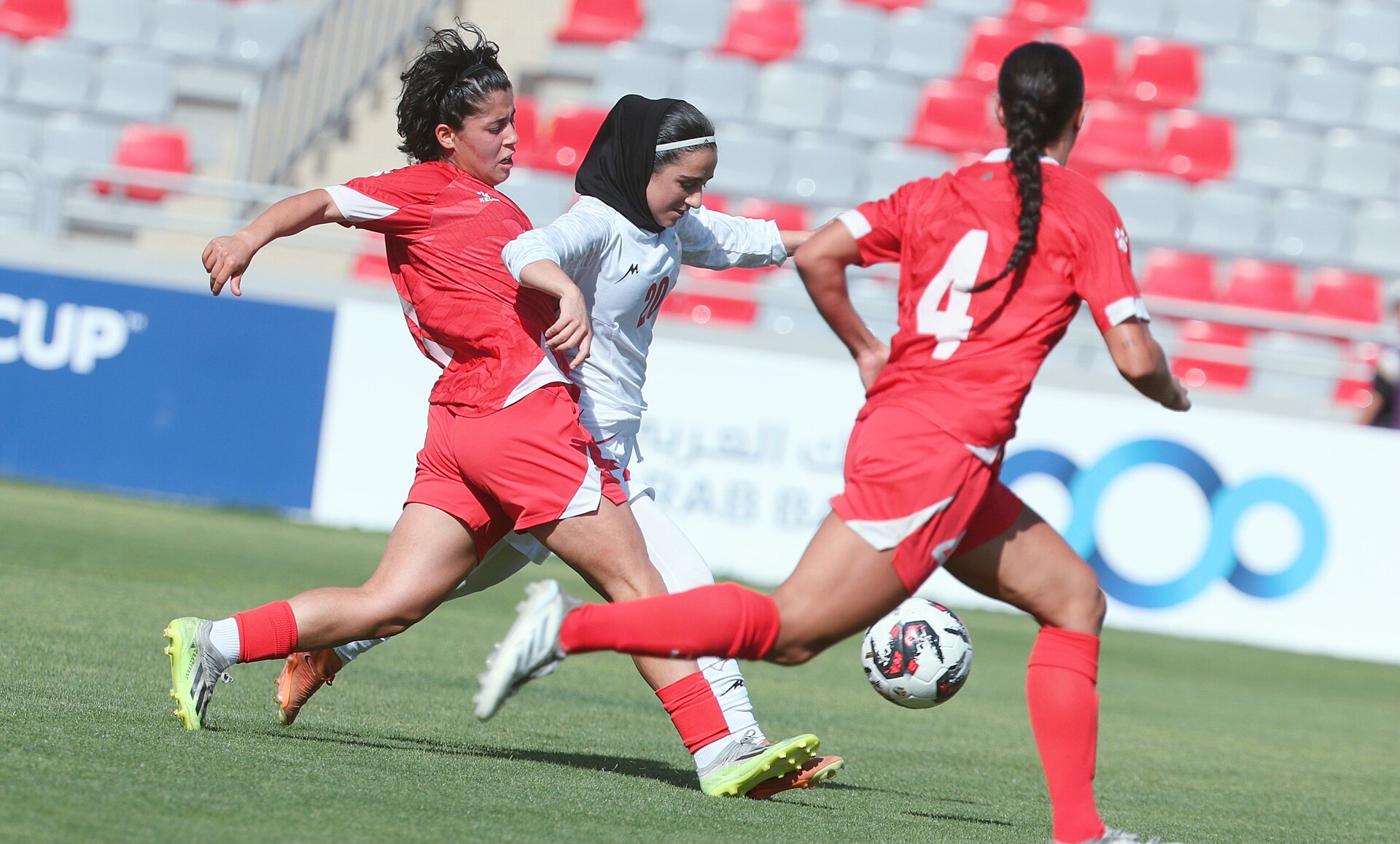
Women’s Soccer Team Disappears into Iran as the Threat of Executions Loom
For Iranian women’s soccer players, competing at Australia’s Asia Cup was never just about the game — it became a moment of impossible choice between personal freedom and the lives of everyone they love.
For most international athletes, the biggest concern is losing the game. For Iranian women, the real fear is losing your life. That’s how dangerous the situation has become for a group of national soccer players, whose story at Australia’s Asia Cup quickly became the very human face of the regime at war with America.
Torn by the chance to run from the cruelty of their homeland, but knowing their families could die for it, all but two girls made the ultimate sacrifice — turning their backs on a chance for freedom to embrace a fate even they know is uncertain.
A Silent Protest Heard Around the World
For the last two weeks, the world has been riveted by the international soccer tournament Down Under for one reason: the hijab-wearing team from Iran. Days after bombs started raining down on their homeland, the players stood a half a world away on the turf in defiant silence as their national anthem played.
Their quiet protest sent a powerful message on the global stage, but it also put them in the crosshairs of a murderous regime that spent the last several months slaughtering thousands of its own for less brazen acts.
Despite their hero status in Australia, the women were labelled “wartime traitors” by Iranian state media — a not-so-subtle ultimatum that led the team to sing the anthem for the rest of the tournament.
Instead of boarding a plane for Tehran after their three straight losses, the women lingered for days at their stopover in Malaysia, alarmed about what awaited them when they touched down.
Asylum Offered, But Family Held Hostage
Riveted by their courage, several world leaders weighed in, including President Donald Trump, warning the girls not to go home. Forcing them to go back to Iran could be a death sentence, he insisted. “Don’t do it, Mr Prime Minister,” he urged Australia’s Anthony Albanese, “give ASYLUM. The U.S. will take them if you won’t.”
Albanese was already on it, promising anyone in the Iranian women’s delegation a chance at a new life with humanitarian visas. Seven accepted.
Within 48 hours, five changed their minds, including the team’s captain. The players were “given repeated chances to talk about their options” but ultimately faced “incredibly difficult decisions”, Australia Home Affairs Minister Tony Burke announced last Saturday.
Tina Kordrostami, a councillor for the Australian City of Ryde, explained that it was an “upsetting update”, but confirmed that “they are heavily intimidated and being communicated to directly by the regime.”
“I know families have even been detained,” Kordrostami said somberly. “I know family members are missing.” And one thing she wants people in the West to understand is that “Iranians within the country have in many ways given up on the West, and they are only relying on one another to survive this regime. So, when we do offer them a way out, it’s not often that easy for them to understand that it is, in fact, a way out.”
She paused before adding, “We are very worried about them. We know for a fact that they will not be safe. I’ve mentioned this before. When you do break a contract as an athlete in Iran, you can face the death penalty. So, I know these women are young. I know that they are making an incredibly difficult decision, and I have the utmost respect for them.”
“Coercion is being used here, intimidation tactics,” Kordrostami stressed. “And we even had an individual amongst the girls within Sydney and Brisbane who was influencing them constantly in their ear, letting them know that whatever Australia is offering them, it will not work.” Asked if the players are being threatened, she answered unequivocally, “I don’t think that, I know that.”
The Regime’s Warning: Return or Else
In a sobering interview with Iranian Olympian Saeid Mollaei, who defected to Germany in 2019 after defying an order to withdraw from his semi-final against an Israeli, he painted a grim future for the women.
“Ninety-nine percent, maybe 100 percent, they are not safe for sure when they go back,” he told CNN. “Maybe, they’ll be killed. Maybe, they’ll go to prison. I don’t know,” he said. “They’re fighting the regime for one word: freedom.”
And freedom, as thousands of slain protestors know after being gunned down in the streets this January, is not a word the Iranian radicals tolerate. Shiva Amini knows. She was in their shoes. “I lost everything — my family, my safety, my home, even my dog,” she told CNN Sports.
A national soccer player, she was caught playing with some male friends in Switzerland without a hijab, both acts considered criminal. “It wasn’t long before she was receiving text messages like: ‘We will cut your head off and send a picture of it to your family.’”
Knowing she faced torture, prison, or worse, Shiva never went home again. She lost all the money she’d been saving in Iranian accounts. “You are in a new country with new people, with new culture, with new language, and you have to start from zero.”
Worse than that, she explained, “While we are here talking, I don’t know if my family are alive or not. I don’t know if the regime has them hostage or not. I’m so worried about them, I don’t know what to do. But at the same time, I cannot be silenced.”
Shiva talked to members of this team, who broke under the weight of the decision to stay in Australia or go home — both of which could lead to the execution of people they love.
“Some have messaged to say they cannot communicate because they are under the control of their travelling minders, quickly deleting text messages after sending them. Some admitted they ‘froze’ while trying to determine their future, grappling with the enormity of their decision. ‘I’m crying when they said, ‘Yes, we wanna stay.’ I was screaming, saying, ‘You have to stay, please!’” she recalled.
“At the same time, I felt guilty if something happened to their family. It’s really complicated, it’s really hard.”
A World Watches, Powerless to Protect
The threat isn’t hypothetical. To most people’s horror, a teenage wrestler who’d joined the January protests against his government, 19-year-old Saleh Mohammadi, was publicly hanged in a barbaric display of the regime’s ruthlessness on Thursday.
“His execution was a blatant political murder, part of the Islamic Republic’s pattern of targeting athletes to crush dissent and terrorise society, as seen with Navid Afkari and others executed despite international outcry,” decried Nima Far, a human rights activist and Iranian combat athlete.
The killing of the young champion wrestler sent shockwaves across the West, where Trump had publicly demanded the end of protestors’ executions.
“Three young [men], Saleh Mohammadi, Mehdi Ghasemi, and Saeed Davoudi, were hanged in Qom after a sham trial. Reports indicate torture. Forced confessions. No access to chosen lawyers. Closed-door proceedings. No right to appeal.
“I call on Global Athlete Headquarters to stand with Iranian athletes who are being silenced, imprisoned, and executed simply for raising their voices,” an outraged Masih Alinejad urged. “This is not just about sports. This is about human dignity.”
Far pushed for a ferocious global response. “The IOC [International Olympic Committee] and UWW [United World Wrestling] should have intervened forcefully with public ultimatums, threatening immediate suspension of Iran’s NOC [National Olympic Committee] and federations if the killing proceeded rather than relying on ineffective quiet diplomacy, given their own commitments to protect athletes from politically motivated harm.”
Despite Thursday’s gut-wrenching news, Iranian first Vice President Mohammad Reza Aref publicly waved away concerns that the women’s team would be unsafe if they returned home, saying, their country “welcomes its children with open arms and the government guarantees their security.”
But the tension was palpable at the Kuala Lumpur airport, where players and embassy staff refused to talk to reporters while they waited for their flight home. After landing in Turkey and then driving to the Iranian city of Bazargan Wednesday, Western media outlets noticed how “terrified” the girls looked in the footage of their arrival.
Windsor John, the Asian Football Confederation general secretary and one of the millions of concerned onlookers, promised the AFC and FIFA would do everything they can to keep an eye on the team and “check up on them regularly, as they are our girls as well,” he said poignantly.
That promise, along with the world’s attention, might be the players’ only saving grace in the short term. But the reality is a harrowing one: once they fade into the clutches of an evil nation cloaked in a communications blackout, there’s only so much anyone can do.
For now, we can only pray that these women and their families don’t pay with their lives for the one thing our own nation takes so for granted — freedom.
“Heroes die once,” Mollaei said emotionally in Persian to his Iranian sisters, “but cowards die every day. You are courageous. You stood up for your future and for what your heart truly wants. Soon,” he promised, “we will all celebrate victory together in Iran.”
___
Republished with thanks to The Washington Stand. Image courtesy of Wikimedia Commons.
3 Comments
Leave A Comment
Recent Articles:
8 October 2026
3.6 MINS
John Anderson warns that Australia’s decline is rooted in spiritual and cultural disintegration, calling for a recovery of Christian foundations, social cohesion and national purpose.
8 October 2026
1.6 MINS
A blackout at Australia’s $150 million Pre-COP climate summit in Fiji delivered an awkward lesson in energy reliability to delegates preaching the renewable transition.
8 October 2026
4.1 MINS
Aboriginal communities in Central Australia already know the gospel message. What they need now, Robyn Murray writes, is discipleship, encouragement and Christians willing to pray and participate.
8 October 2026
4.1 MINS
Italy honours St Francis of Assisi 800 years after his death, celebrating a saint whose devotion to Christ, radical simplicity and message of peace continue to shape generations.
8 October 2026
2.8 MINS
The MDBA’s case for further water buybacks rests on climate projections increasingly challenged by climate scientists, historical rainfall data and evidence of a greener Basin.

8 October 2026
4 MINS
Christ’s authority and concern is not limited to the four walls of the church. They extend to the life of the nation, and we are called to take up our part in seeking its righteousness.

7 October 2026
3.6 MINS
Victoria’s 18th March for the Babies will bring families together to peacefully affirm the value of every human life and call for a cultural change towards life.



Watching the Iranian team walking over the flag of Israel and the US on their return to Iran, I thought that the girls probably wished they had remained in the West…
Suzanne, your piece is a much needed analysis of a terrible ‘Catch-22’. Whatever these girls do there is almost certain tragedy. That is their reality, but our reality is simple. We can pretend this war with Iran is about egotistical leadership and the price of diesel, or we open our eyes to what the war is really about – a fight against diabolical evil that has clear plans and goals to take on, and subjugate, the whole of humanity. The sooner the West sees the parallels with Nazi Germany and Stalin’s Russia the better.
Succinct and true. Well said Jim.