


PHPA Calls Outs Misleading Statements against Pro-Life Bill Made by Pro-Abortion Medical Bodies
Pro-life Health Professionals Australia (PHPA) has issued two statements critiquing claims made by two medical institutions opposing moves to see late-term abortion restricted in South Australia. PHPA will support a public pro-life rally outside Parliament House, Adelaide, on 17 June.
Media Release 1: PHPA Calls Out RANZCOG for Misleading Statements on SA Bill for Later Abortion Restrictions
Pro-life Health Professionals Australia (PHPA) are concerned that the statement by the Royal Australian and New Zealand College of Obstetricians and Gynaecologists (RANZCOG) regarding the legislation currently before the South Australian Parliament on later abortions, misleads the public to oppose MLC Sarah Game’s proposed amendment of the current Termination of Pregnancy Act 2021.
Asserting that “abortion is essential healthcare” is an attempt to obscure the fact that intentionally ending the life of the in-utero patient, when the baby can survive outside their mothers, in cases where there is no maternal medical emergency, cannot be ethically defended.
Dr Melissa Lai, senior Neonatologist and President of PHPA reminds RANZCOG that “stating that these decisions must not be dictated by political intervention, fails to acknowledge that this practice was facilitated by politicians in 2021, when all legislative protection of in-utero infants was removed”.
“At the time the media reports focused on the decriminalisation of abortion, but inadequately informed the public that termination of pregnancy was now available throughout all 9 months with few safeguards,” Dr Lai said.
“RANZCOG misleadingly states that the 2024 South Australian Annual Report of 48 infants terminated after 22 weeks and 6 days were due to a life-limiting condition of the foetus or to save the life of the mother. If you look closely at the table they’re referring to, it states only 16 of the 48 infants were terminated for foetal anomaly or to save the life of the mother, meaning more than 60% were normally developed.”
“At 25 weeks, after which this Bill seeks to restrict this practice, survival of normal infants is over 82% in a neonatal intensive care. RANZCOG have not provided any sound justification why these infants need to die,” Dr Lai said.
Using the reason that this is already a distressing time and that this Bill would increase distress and delays is disingenuous, as parents who are given the option to terminate their pregnancy are often distressed with the suggestion. This brings into question whether this option should be offered at all, if it causes that much maternal distress. Reports of families feeling pressured by healthcare providers to electively terminate their pregnancies, and the negative psychological impacts of this experience, would be minimised by this Bill.
Media Release 2: PHPA Responds to RACGP Regarding the SA Bill for Later Abortion Restrictions
Pro-life Health Professionals Australia (PHPA) are concerned that the The Royal Australian College of General Practitioners’ (RACGP) public statement mischaracterises the legislation currently before the South Australian Parliament.
Dr Melissa Lai, senior Neonatologist and President of PHPA said the Bill seeks to restore a balance in considering the medical safety of the mother’s pregnancy, and providing ethically compassionate care for the in-utero infant, the second patient. “It fundamentally addresses the separate question of whether the life of an unborn child should be electively ended when they can survive apart from their mothers”, she said. After 22 weeks, this elective termination is typically achieved by feticide, prior to delivery of the infant stillborn, when there is no maternal emergency.
Despite repeated references to “restricting reproductive healthcare”, the RACGP provides no evidence that requiring the delivery of a foetus without first inducing foetal death would undermine patient care, nor does it explain why an additional invasive procedure intended solely to ensure the death of the unborn child should be regarded as medically necessary.
“The RACGP says that abortion care is healthcare, but ignoring one patient in the mother-infant dyad is not healthcare,” Dr Lai said. The issue under consideration is whether intentionally ending the life of an unborn child, particularly one capable of being born alive, should automatically be regarded as healthcare, simply because it occurs within a medical setting.
The RACGP also asserts this practice is “evidence-based care” while providing no evidence that later abortions improve maternal health outcomes, with no regard for neonatal outcomes. As with any medical intervention, the burden should rest on those advocating the procedure to demonstrate that its benefits outweigh its risks.
The statement further elevates patient autonomy as though it were the only ethical principle relevant to medicine. Autonomy is important, but medical ethics has always balanced autonomy with obligations to protect vulnerable human beings and prevent harm. In abortions, there are two human beings directly affected by the procedure, yet the RACGP statement acknowledges only one.
“RACGP need reminding that Australia is a signatory to the United Nations Convention on the Rights of the Child, which recognises that children require appropriate legal protection before as well as after birth,” Dr Lai said. This principle should not be ignored when considering legislation involving viable unborn children.
The South Australian Parliament warrants a respectful and evidence-based discussion of the actual proposal before it. Public debate should focus on whether feticide is medically necessary, ethically justified, and consistent with our obligations toward vulnerable human life, rather than incorrectly suggesting that any scrutiny of this practice constitutes an attack on healthcare itself.
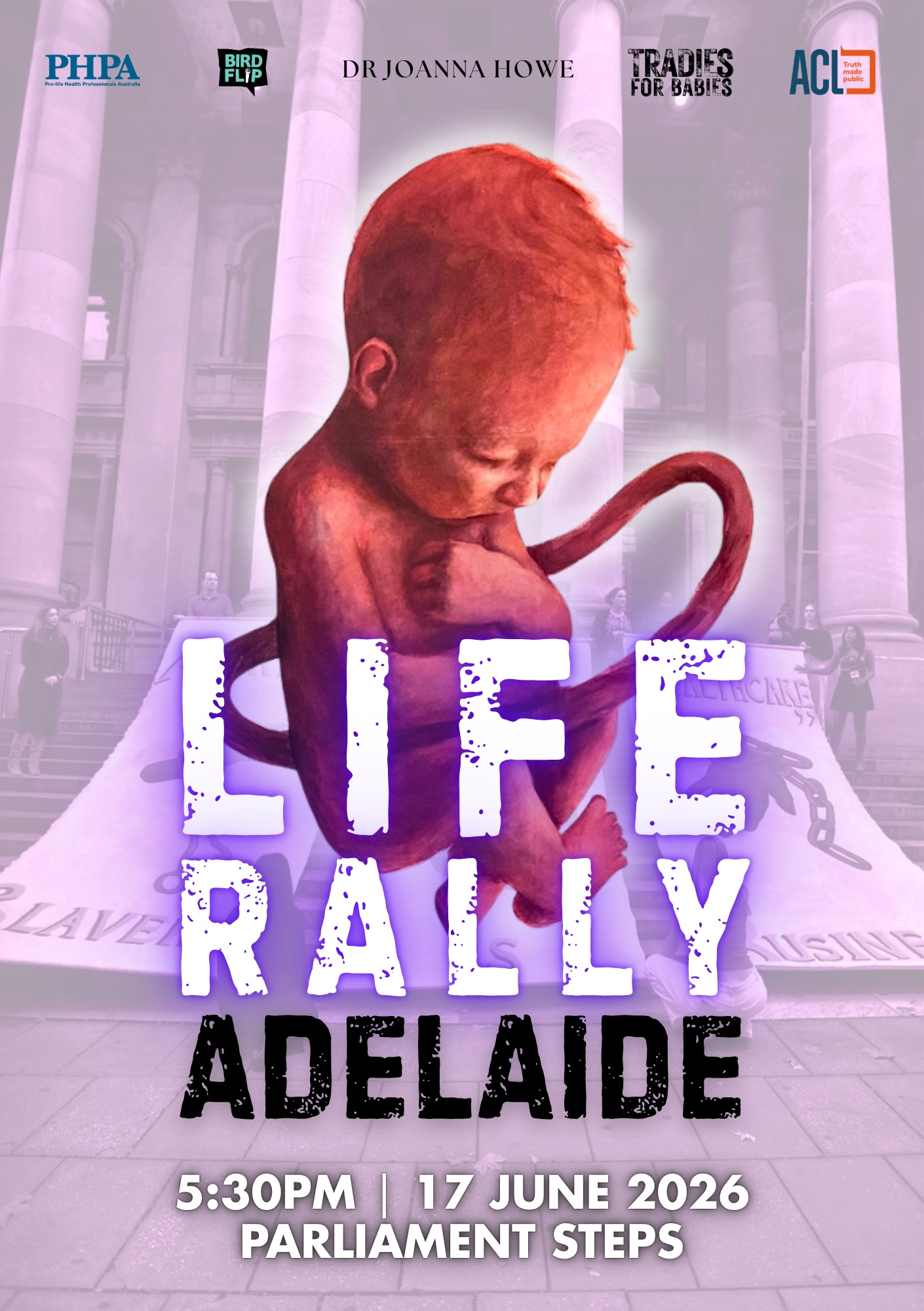
Parliament House Public Rally: 17 June
Thousands are expected to rally next Wednesday night (17th June) at 5.30pm, outside Parliament of South Australia at the time this amendment will be debated.
___
Image via Adobe.
2 Comments
Leave A Comment
Recent Articles:

4 October 2026
3.5 MINS
As children of the day, let us live freely out of our identity and awaken those around us from spiritual sleep. We carry more than faith for a great awakening — we are the awakeners.

3 October 2026
3.7 MINS
The Church is called to be counter-cultural not to be merely contrarian, but because we love God and people. In this world, that will mean going against culture that is contrary to God.

2 October 2026
2.6 MINS
NSW Libertarian Gemma Noiosi is challenging taxpayer-funded activist events, arguing government grants should not bankroll controversial projects or private cultural ventures.

2 October 2026
11.6 MINS
New evidence challenges prevailing assumptions about adolescent sexuality and gender medicine, urging parents, clinicians and Christian leaders to prioritise honest inquiry, careful care and scientific integrity.

2 October 2026
4.3 MINS
John Cleese’s views on multiculturalism, Christianity and criticism are resurfacing, offering a provocative challenge to assumptions about immigration, cultural identity and the West’s Christian foundations.

2 October 2026
6.6 MINS
A foiled airline attack highlights the courage of passengers and crew who confronted danger, while raising urgent questions about jihadist terrorism and the ideology behind it.

2 October 2026
3.4 MINS
New research highlights the strong links between active Christian faith, marital happiness, sexual satisfaction, family stability and the formation of future generations.



Since when does the rights of a person living in the womb be overruled by people outside the womb. People are people no matter where they are.
The most dangerous place for a baby shouldn’t be inside their mother’s womb, do you think?
Life is a gift from Jesus Christ – read John chapter 1.