


New Study Finds No Global Acceleration in Sea Level Rise, Exaggerated Predictions by IPCC
Examining over 200 tide gauge stations worldwide, researchers have found no global acceleration in sea level rise, contrary to wild predictions by climate alarmists and the Intergovernmental Panel on Climate Change.
For decades, the public has been warned that human-driven climate change is causing sea levels to surge at alarming rates, threatening to swallow coastal cities by the end of the century. But a landmark new peer-reviewed study has found no evidence that sea level rise is accelerating worldwide.
Published in the Journal of Marine Science and Engineering, the paper by Dutch engineer Hessel Voortman and researcher Rob de Vos analysed hundreds of tide gauge records. Their conclusion is stark: “Our analysis of more than 200 tide gauge stations around the world shows that there is no global acceleration of sea level rise”.
A First-of-Its-Kind Global Analysis
Unlike previous studies that relied heavily on climate models, Voortman and de Vos used observed data from tide stations stretching back at least 60 years. They found that the mean rate of sea level rise remains steady at around 1.5 mm per year — about 15 cm per century — similar to rates observed in the 20th century.
“The average rate of sea level rise in 2020 is around 1.5 mm per year,” Voortman explained. “This is significantly lower than the 3 to 4 mm per year often reported by climate scientists in scientific literature and the media.”
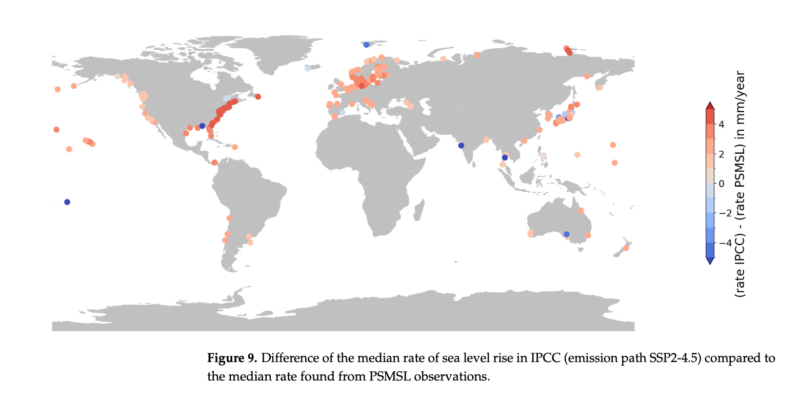
Their analysis showed that claims of acceleration are confined to a handful of isolated sites, typically explained by local conditions such as earthquakes, groundwater extraction or sediment shifts. “This pattern is inconsistent with sea level acceleration driven by global phenomena,” the authors wrote.
Models v Reality
One of the study’s most significant findings is the gap between observed sea level data and projections from the United Nations’ Intergovernmental Panel on Climate Change (IPCC).
The IPCC’s 2021 report projected much higher rates of sea level rise, yet Voortman and de Vos found that “on average, the rate of rise projected by the IPCC is biased upward with approximately 2 mm per year in comparison with the observed rate”.
In other words, widely circulated claims of seas rising by three to ten feet this century are not supported by measured data. Instead, the study suggests that sea levels could rise by only six inches — about the same increase seen in the previous century.
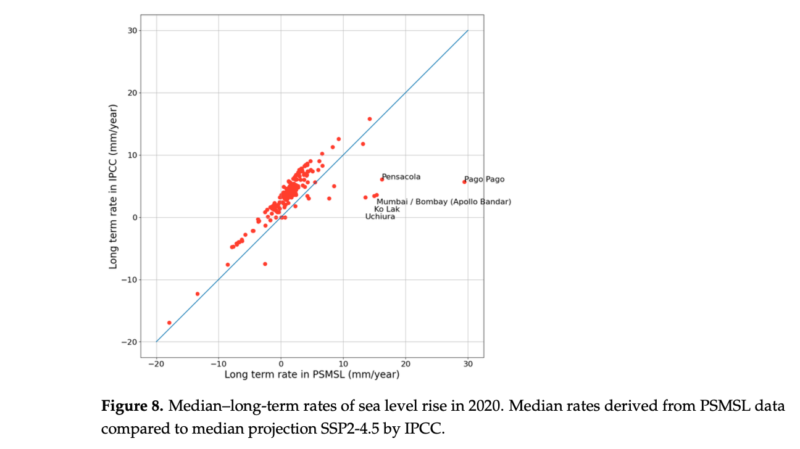
“The graph shows the majority of locations to be above the blue line,” the authors noted of their comparison chart. “This indicates that the rate of sea level rise in the projections is too high compared to the empirical rate”.
Local Factors, Not Global Warming
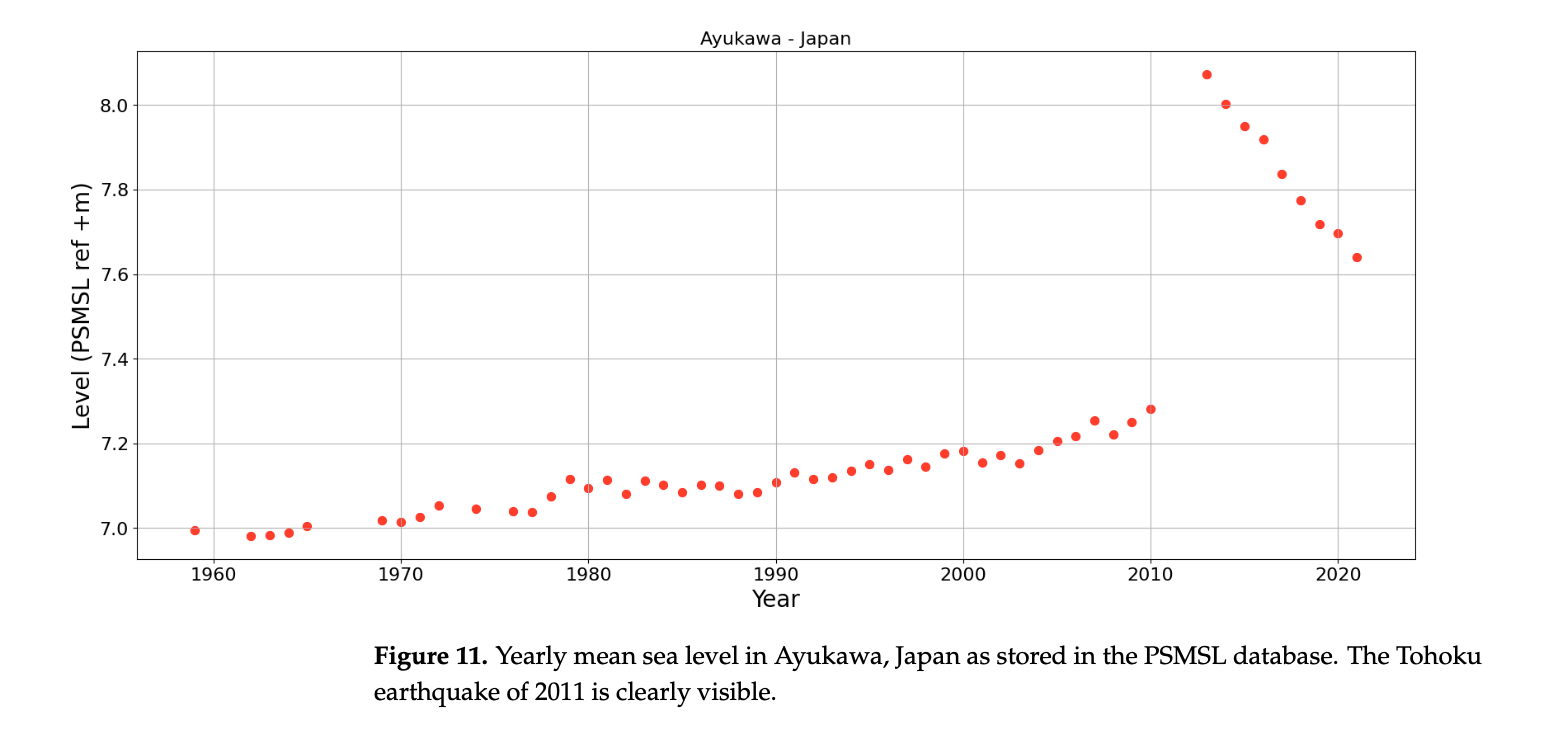
Where acceleration was detected, it was almost always linked to localised factors rather than a global climate signal. For example, at Ayukawa in Japan, the 2011 Tohoku earthquake caused the land to drop suddenly by more than 80 cm, leading to a sharp spike in recorded sea levels.
In Bangkok and Mumbai, excessive groundwater extraction and rapid urban development explained unusual patterns of rise.
Voortman stressed that such anomalies should not be confused with evidence of global acceleration. “Nine stations did show an acceleration,” he explained. “But these stations are mostly located near stations that show no acceleration in sea level rise, making it unlikely that a global phenomenon such as global warming caused by CO2 is the underlying cause.”
A Stark Contrast with Media Warnings
These findings stand in sharp contrast with decades of dire headlines.
In 2019, New York Times columnist David Wallace-Wells warned, “We will see at least four feet of sea level rise and possibly ten by the end of the century.” That same year, The Atlantic declared, “The oceans we know won’t survive climate change.” The latter cited Princeton scientist Michael Oppenheimer, who predicted that sea levels would rise by more than 2 feet 9 inches by 2100.
Voortman was blunt about the failure to test projections against reality: “It is crazy that it had not been done,” he said, describing his review of whether any global study had actually compared projections with observations. “There were none.”
His work began with a 2023 paper focused on the Dutch coast, where he found no acceleration despite repeated warnings. That led to this global analysis with de Vos, revealing the same result worldwide.
De Vos, in an article reflecting on the research, criticised what he called the “IPCC narrative” around sea level rise. “One of the ‘crown jewels’ of the IPCC narrative is rising sea levels,” he wrote. “But our analysis shows that acceleration is not statistically demonstrable at almost all stations.”
Implications for Climate Policy
The authors are not “climate sceptics” — they made it clear they believe in climate change and believe their findings don’t undermine that belief. What they hope for is a more honest use of data in public debates and policy.
“A prudent designer of coastal infrastructure will want to know how the local projections compare to local observations,” they note. “That comparison, to date, has not been made”.
Because sea walls, ports, and flood defences are built to last up to a century, engineers need accurate information. Overstating risks could lead to unnecessary costs, while understating them could expose communities to danger.
The authors urged policymakers to test models against real-world data, rather than assuming worst-case projections. “Practitioners using the projections should be aware of this fact and take their design decisions recognising the conservatism in the projections,” they concluded.
A Challenge to Consensus
The study is already being described by some commentators as a monumental embarrassment. Michael Shellenberger, a prominent climate analyst, called it “a massive scientific scandal” for showing that widely repeated claims of acceleration were unsupported by observational data.
Climate change will make oceans rise 3 – 10 feet by the end of this century, said scientists and the media. Nonsense. A new, first-ever global study of real world data, not models, finds no evidence climate change accelerated sea level rise. This is a massive scientific scandal. pic.twitter.com/1hd1Hug5kF
— Michael Shellenberger (@shellenberger) September 2, 2025
Roger Pielke Jr, another expert in climate impacts, challenged policymakers’ heavy reliance on abstract global averages. “Most people are not aware that the scientific community uses different concepts to discuss sea level rise,” he said. “What matters for communities is what happens where they are located.”
For many Australians, the constant drumbeat of catastrophic climate warnings has been a source of fear, particularly for young people. The latest study raises important questions: if sea level rise is steady but not accelerating, how should Christians respond to narratives of crisis and alarm?
As believers, we are called to be people of truth. Scripture reminds us that God “did not give us a spirit of fear, but of power, love and self-discipline” (2 Timothy 1:7). While creation care remains vital, Christians can resist being swept along by exaggerated or misleading claims that foster anxiety rather than stewardship.
Voortman and de Vos’s research offers a rare moment of clarity in the climate debate. Their careful analysis of real-world data shows that global acceleration in sea level rise is simply not occurring. Instead, the seas are rising at the same modest pace as the last century, shaped more by local geology and human activity than by sweeping climate forces.
For policymakers, engineers, and families alike, the message is clear: do not build decisions on fear or exaggeration, but on truth grounded in evidence.
___
Image courtesy of Unsplash.
4 Comments
Leave A Comment
Recent Articles:

6 October 2026
3.4 MINS
Christians cannot afford to let headlines and social media shape their view of Israel. Scripture provides a foundation for understanding Israel, God’s promises and our response.

6 October 2026
6.7 MINS
Fresh revelations about the foiled FlyDubai terror plot expose the attacker’s alleged extremist history, while a courageous pilot’s actions prevented an unthinkable catastrophe.

6 October 2026
6.2 MINS
Britain’s grooming gang scandal exposes a devastating failure to protect vulnerable children, raising urgent questions about political correctness, accountability, immigration and the loss of moral courage.

6 October 2026
3.8 MINS
A grandmother’s disputed death has put Canada’s euthanasia regime under fresh scrutiny, as the Medical Assistance in Dying (MAiD) program passes 100,000 deaths with a further expansion slated for 2027.

5 October 2026
4.9 MINS
Free Speech Union co-founder Reuben Kirkham warns Australia’s proposed Digital Duty of Care could expand censorship powers, undermine free expression and bypass recent legal protections.

5 October 2026
6.8 MINS
A closer examination of Candace Owens’ evolving arguments asks whether conspiracy thinking can distort our ability to process evidence, and what Romans 1 teaches Christians.

2 October 2026
2.6 MINS
NSW Libertarian Gemma Noiosi is challenging taxpayer-funded activist events, arguing government grants should not bankroll controversial projects or private cultural ventures.



Its interesting to me that even these two well credentialed people find it necessary to include this caveat in their findings…. “The authors are not “climate sceptics” — they made it clear they believe in climate change and believe their findings don’t undermine that belief. What they hope for is a more honest use of data in public debates and policy.”
I’d suggest that ‘honest use of the data in public debates and policy’ needs to include serious questioning of the the hypothesis that climate change is being caused by increasing CO2 levels. Sadly, the ‘decarbonisation’ of western society, or at least in Australian Society, is something that cannot possibly be questioned, yet nobody can tell us what our present rush to destruction of our economy, our farmland, our wilderness areas, our coastline in the name of ‘decarbonisation’ is going to achieve or what it will actually cost.
I agree with this. The climate has changed in many locations over a very short period of time and ice at the poles is lessening. But the causes are not known and the CO2 reduction ideology that is driving our economies has an unknown – and possibly minimal – long term effect. Even in the last 1000 years there have been significant climate swings lasting decades…and CO2 was never a factor. Most of the money poured into the CO2 bowl would be better spent protecting vulnerable populations from heavier storms, heatwaves and floods. This will have a known and visible impact.
These scriptures come to mind, to allay anxiety and promote wisdom :
Proverbs 3:5 & 6
Genesis 8:22
2 Chronicles 7:14
Isaiah 40:28-31
Hebrews 2:14 & 15
Plus many others. The point being, our God is God. He loves all that He has created, and will ensure its continuance until ALL His purposes are fulfilled. Psalm 145:9
And last but by no means least :
Isaiah 46:8-10
The whole Climate Change narrative is a massive con!
Read this: https://dailydeclaration.org.au/2023/11/10/10-reasons-to-question-climate-alarmism/