


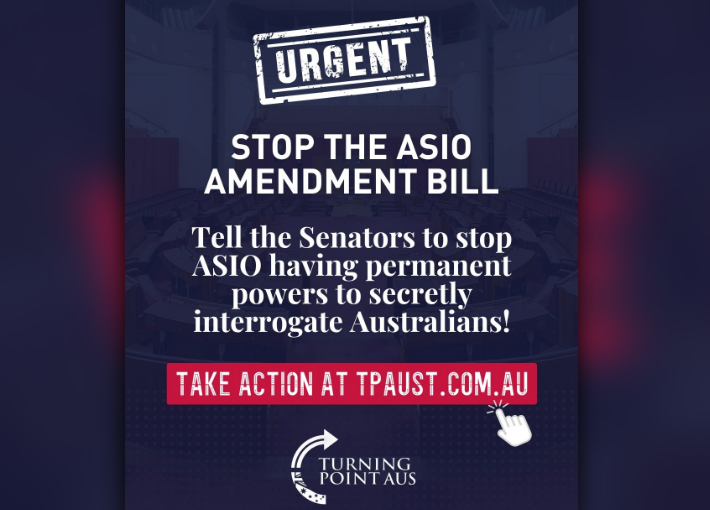
Turning Point Australia Calls on Senators to Stop Labor from Supercharging “War on Terror” Surveillance State
Australia’s post-9/11 surveillance powers face a Senate battle, as Labor moves to make temporary counter-terrorism measures permanent, raising serious civil liberties alarms.
Australia’s “War on Terror” surveillance legislation is set for expansion.
Currently, the counter-terrorism Intelligence Services Act 2001, which was amended in 2003, has a sunset clause.
This was recently extended to 7 March 2027.
If the Labor government amendments succeed in the Senate, they become permanent. So will some very nasty add-ons.
The bill already passed through the House of Representatives in February, without any opposition from the then Sussan Ley Coalition.
They seemingly saw no actual or potential clashes with civil liberties.
That civil liberties battle is now raging in the Senate.
Known as the Australian Security Intelligence Organisation Amendment Bill (No. 2) 2025 (or ASIO Amendment Bill No. 2 2025), the bill repeals the post 9/11 sunset clause.
The proposals additionally ask for an extension of powers that could supercharge the surveillance State.
What the New Powers Actually Mean for You
As it stands, while there are some checks and balances, Australia’s Security Intelligence Organisation’s temporary counter-terrorism powers side-step due process.
This means ASIO has the power to deploy coercive questioning tactics in an interrogation of both suspects and non-suspects.
The new bill makes this power permanent. Meaning parliament will no longer review these counter-terror powers because the law will no longer have a use-by date.
The ASIO Amendment also increases the power of the Attorney-General and adds to the range of activities for which a person can be detained and questioned.
Reasons ASIO can suspend a person’s rights will now include incitement to violence, and potentially so-called “hate speech”.
Packed into this, The Strategist explained, are “restrictions on a person’s ability to alert others to ASIO’s interest or destroy relevant material.”
For example, this could potentially apply to deleting a post on social media, after the AFP or ASIO dragged a person in for a “chat” because their words were considered “incitement”.
As Labor Home Affairs Minister Tony Burke’s office put it,
“The Bill would make compulsory questioning warrants a permanent part of ASIO’s intelligence collection powers.”
Compulsory questioning warrants (QW) have granted ASIO the power to question and detain anyone, regardless of whether or not they are a suspect.
Questioning warrants apply to both adults and minors who “are at least 14.” (See here.)
Civil Liberties Groups Sound the Alarm
For obvious reasons, the expansion of “war on terror” powers has civil rights groups deeply concerned.
The Law Council of Australia consider it problematic.
This is because of “a longstanding failure to strike an appropriate balance between responding to the gravity of evidenced threats to national security with compliance with the rule of law, Australia’s obligations under international law, and respect for human rights obligations.”
They want the sunset clause to remain, arguing that the law’s huge potential for abuse demands the need for constant review.
“Periodic opportunities to publicly make the case that exceptional powers that trespass on fundamental rights are necessary and proportionate,” the Law Council argued.
The use-by date provides “an essential democratic oversight function and should not be surrendered.”
“We maintain,” they added, “that ASIO must be required to regularly demonstrate to the Australian public that these powers continue to be both necessary and proportionate to the threat environment.”
Therefore, the Law Council declared, “We do not support the removal of the sunset clause for these powers.”
Keep in mind here the absence of a bill of rights in Australia.
Rights are, for the most part, considered “implied rights”.
Any protections for Australian civil liberties largely come under Australia’s commitment to uphold international law.
The Senate: Last Line of Defence
This weak layer of protection for civil liberties is also why Turning Point Australia is firmly opposing the proposed expansion of these extraordinary powers.
TPAUS boss Joel Jammal and TPAUS’s Chief of Operations, Saraya Beric, are petitioning senators to vote against it.
Outlining their concerns about removing the law’s use-by date, TPAUS listed 11.
Among those are the 2003 law’s “no right to stay silent. Refusing to answer is a criminal offence punishable by up to 5 years imprisonment.”
Secondly, the Attorney-General (a politician) approves the warrant, not a judge.
Third, “You can be questioned without a lawyer present, and your lawyer cannot properly advise you.”
A lawyer cannot record the interview, and any notes will be confiscated.
Fourth, you’re not allowed to report being questioned and face criminal charges if you do.
Lastly, the definitions of sabotage and incitement (promoting communal violence) are vague.
Stopping Labor from supercharging the “war on terror” surveillance state is now in the hands of the Senate.
So far, TPAUS’s campaign has garnered enough supporters to send over 580,000 emails asking Australian senators to “vote down the ASIO amendments.”
One Comment
Leave A Comment
Recent Articles:

27 October 2026
25.3 MINS
Labor’s Digital Duty of Care Bill threatens free speech, empowers covert online surveillance, and imposes potentially burdensome regulations on Australian businesses.

27 October 2026
10.3 MINS
As Tasmania and Western Australia consider conversion therapy bans, a former LGBT+ ministry leader warns of threats to religious freedom, personal choice and Christian discipleship.

27 October 2026
4.9 MINS
Nine Christians have been killed in a terrorist attack on a Jordanian church, prompting fierce condemnation, demands for justice and renewed concerns about religious persecution.

27 October 2026
3.6 MINS
For 25 years, the Mount Moriah Trust has supported struggling Christians across the Holy Land, bringing practical assistance, encouragement and hope to believers facing hardship and persecution.

27 October 2026
1.3 MINS
Moira Deeming’s re-election campaign has energised Family First supporters, raising $90,000 as the party prepares for a crucial Victorian election and a potential breakthrough.

27 October 2026
3.1 MINS
As the disciples discovered through a huge haul of fish, we can trust Jesus for a net-breaking, boat-sinking catch of people.
26 October 2026
4.5 MINS
OECD chief Mathias Cormann warns Australia is losing its competitive edge, as excessive regulation, housing pressures, immigration challenges and declining public trust threaten national prosperity.



Thank you Rod for exposing what is going on. May many pray the bill involving ASIO’s proposed extra rights to interrogate, is overturned. The Senate orginally was to be a ‘watch dog’ for the good of the nation and the Consititutional rights used to protect a person’s state of being innocent till found guilty. To interrogate a person without a lawyer was unalwful. ..so much is occuring while being shrouded in darkness from the public.