



Are You Being Shaped By This Subversive Ideology? (5)
‘Do not be conformed to this world, but be transformed by the renewal of your mind.’
~ Romans 12:2
This is part 5 of a multipart series exploring the ideas around the secular ideology of Critical Theory in the book ‘Cynical Theories: How Universities Made Everything About Race, Gender, and Identity — and Why This Harms Everybody’, by authors Helen Pluckrose and James Lindsay. You can read part 1 here, part 2 here, part 3 here, and part 4 here.
The San Diego school district recently adopted a policy whereby they’ll no longer grade their students on their marks, because it’s considered ‘racist’.
As NBC reports :
Students will no longer be graded based on a yearly average, or on how late they turn in assignments. Those are just some of the major grading changes approved this week by California’s second-largest school district.
It continues:
Board members say the changes are part of a larger effort to combat racism.
“This is part of our honest reckoning as a school district,” says SDUSD Vice President Richard Barrera. “If we’re actually going to be an anti-racist school district, we have to confront practices like this that have gone on for years and years.”
This is because non-white students tend to fail more than white students: By ethnicity, 23% of failing grades went to Native Americans. Another 23% of failing grades went to Hispanics. And 20% of D or F grades went to Black students.
By comparison, just 7% of failing marks went to White students.
And thus, practices such as handing in work on time are discriminating against non-white students.
This race-based focus on education is driven in large part by a branch of Critical Theory known as ‘Postcolonial Theory’, which sees the West — and everything associated with it (including western forms of education) as oppressive toward non-Westerners.
Here are some of the aims of Postcolonial Theory:
1) Rewriting History from the Perspective of the ‘Oppressed’
Postcolonial Theory reads power imbalances into interactions between dominant and marginalized (regional) cultural groups, and aims to rewrite history from the perspective of the oppressed. (Pluckrose and Lindsay, Cynical Theories, p. 71.) Sometimes this does result in a more accurate reading of history, when hitherto ignored voices are brought to the table.
However, often this is little more than a made-up subjective reading of history — such as the New York Times’ ‘1619 project’, which claims (among other things) that the United States is and always has been irredeemably racist.
2) ‘Decolonising’ Society
‘Decolonise everything!’ is the catchcry of Postcolonial Theory. ‘Decolonisation’ is the idea of devaluing — and indeed disparaging — knowledge (and ways of knowing) considered ‘Western’.
As Pluckrose and Lindsay point out:
[A postcolonial] mind-set says: “The West has constructed the idea that rationality and science are good in order to perpetuate its own power and marginalize nonrational, non-scientific forms of knowledge production from elsewhere. Therefore, we must now devalue white, Western ways of knowing for belonging to white Westerners and promote Eastern ones (in order to equalize the power imbalance).” (p. 76)
Problems with Postcolonial Theory
There are many problems with Postcolonial Theory. Here are but a few:
1) PT Doesn’t Help People in the Developing World
These are the very people it’s claims to help
One of the biggest criticisms of Postcolonial Theory is that it doesn’t help the people it purports to help: people living in the non-Western world. This is because it believes all cultures are equally valid, and it disparages science.
Culturally Relativist: No universal human rights
Because PT believes that no one culture’s values are any better than another’s, it ceases to believe in a universal moral standard, and thus universal human rights. This results in great ethical inconsistency in human rights activism, with serious real-world consequences.
So, for example, when feminists from Saudi Arabia, secular liberals from Pakistan, and LGBT activists from Uganda have attempted to raise the support of the English-speaking world against human rights abuses in their country, they have received little response from the postcolonial scholars and activists who might otherwise be assumed to be in their corners. (p. 86)
While this may seem baffling, there are two reasons for this:
a) Postcolonial Theory insists that getting a non-Western culture to accept that there are human rights abuses taking place locally requires ‘colonising’ that culture with Western notions of human rights. This is forbidden, because it reinforces the power dynamic that Postcolonial Theory exists to dismantle. (pp. 86-87)
b) PT frequently claims that any human rights abuses occurring in previously colonised countries are the legacy of colonialism, and the analysis stops there. Thus, when Islamic militants commit atrocities (even in their own countries), it’s only because of the oppression they must have suffered under colonialism/western interference. The fact that militant Islamists might do this because of their (non-Western) Islamic beliefs isn’t even considered an option in PT. Thus, PT hamstrings people’s ability to get to the root of real issues and address them. (p. 87)
Disparaging Science
PT threatens the development of non-Western countries through its disparagement of science. Since many developing countries would benefit from technological infrastructure, which could ameliorate some of the world’s most significant causes of human suffering (e.g., malaria, water shortages, etc), this disparagement is not only factually wrong, it is negligent and dangerous (especially if it starts affecting foreign aid etc). (p. 86. This problem is picked up by a number of non-Western scholars.)
2) PT Has a Distorted (Binary) View of History
If a person is imperfect, they’re all bad.
Postcolonial Theory is often a factor in the drive to smash statues and rewrite history. This is because it has a dangerously reductionist and binary view of reality: if someone in the past is found to have had attitudes or ideas that is not aligned to modern morality (read: Social Justice Theory), then they must be all bad, and banished from history. Thus, statues of people like Winston Churchill, Joseph Conrad, and Rudyard Kipling become nothing more than symbols of racist imperialism. (Even statues of people like Abraham Lincoln and Frederick Douglass are attacked).
Thus, we lose the potential for nuanced discussion of history and progress, but also of the positive contributions of the men themselves. (p. 86)
3) Postcolonial Theory Opposes Evangelism
Christian evangelism — the aim to convert people away from their indigenous beliefs to Christianity (seen by PT scholars as a western religion) is the essence of colonisation.
Thus, evangelism is a form of oppression in this view, and must not be allowed (I experienced this view firsthand from the student union of my campus where I used to work as chaplain).
Not only that, but the Bible itself is reduced to a cultural text, written by men from another time and era, and not containing any universal, let alone eternal, truths.
The Danger For Christians: Being Ashamed
As we consider Postcolonial Theory and other branches of Critical Theory, we need to evaluate them with our eyes open. These ideologies are becoming more mainstreamed. And thus will impact us in some way — perhaps even in our own thinking.
Probably the biggest danger Postcolonial Theory poses for Christians is shame.
Shame toward our history. Yes, Church history, with all its warts, has its fare share of mistakes and disasters. We should lament these, and learn from it.
But we need not be ashamed for the way Christianity has ‘colonised’ the Western mind. As many scholars (both Atheist and Christian) have pointed out, much of what we value in the west today — human rights, care for the poor, democracy — arose because of Christian influences on our culture.
But even more seriously, Postcolonial Theory tempts us to be ashamed of the Gospel: the exclusive claim that Christ Jesus alone is Lord and Saviour. And ashamed that we call on people of all nations and races to repent and worship Christ Jesus and no-one else. This call is a form of oppression, according to Postcolonial Theory.
But we’re never to be ashamed of the Gospel (Romans 1:16). It alone is the universal, eternal, power of God for the salvation of everyone: regardless of skin colour or cultural background.
Instead, like the apostle Paul, let’s boast in the Gospel:
May I never boast except in the cross of our Lord Jesus Christ, through which the world has been crucified to me, and I to the world.
~ Galatians 6:14
___
Originally published at AkosBalogh.com
Photo: Albert Pike Memorial, vandalised / Wikimedia Commons
2 Comments
Leave A Comment
Recent Articles:
8 October 2026
3.6 MINS
John Anderson warns that Australia’s decline is rooted in spiritual and cultural disintegration, calling for a recovery of Christian foundations, social cohesion and national purpose.

8 October 2026
4.1 MINS
Aboriginal communities in Central Australia already know the gospel message. What they need now, Robyn Murray writes, is discipleship, encouragement and Christians willing to pray and participate.
8 October 2026
4.1 MINS
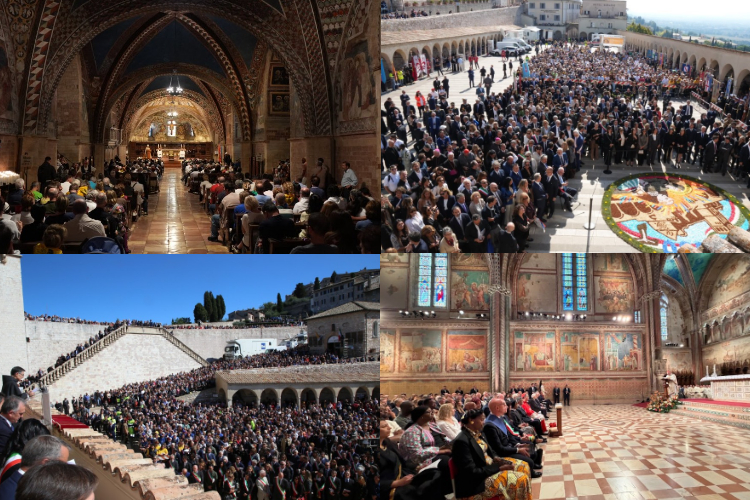
Italy honours St Francis of Assisi 800 years after his death, celebrating a saint whose devotion to Christ, radical simplicity and message of peace continue to shape generations.

8 October 2026
4 MINS
Christ’s authority and concern is not limited to the four walls of the church. They extend to the life of the nation, and we are called to take up our part in seeking its righteousness.
7 October 2026
1.5 MINS
Across the Middle East, North Africa and Anatolia, Christianity once shaped entire civilisations. Could Britain’s Christian heritage likewise become a memory rather than a reality?

7 October 2026
6 MINS
What can Tucker Carlson’s interview with Jacob Rees-Mogg teach us about political disagreement? Their clash over war, Russia and national defence highlights the importance of listening carefully and understanding an opponent’s position before attempting to refute it.

7 October 2026
8.5 MINS
Gerald McDermott’s work challenges Christians to approach Israel through Scripture first, exploring God’s covenant faithfulness, Christian Zionism, Jewish identity and antisemitism.



Akos, these have all been really informative & well laid out, so I’d be interested to know how many of these there will be in this series, as one day when it’s complete I’d like to share them all on my feed. But I want to do them close together, so would appreciate a ‘heads up’ on the total number if that’s possible.
He appears to have finished them all, you can see them on his blog at https://www.akosbalogh.com/ =)