


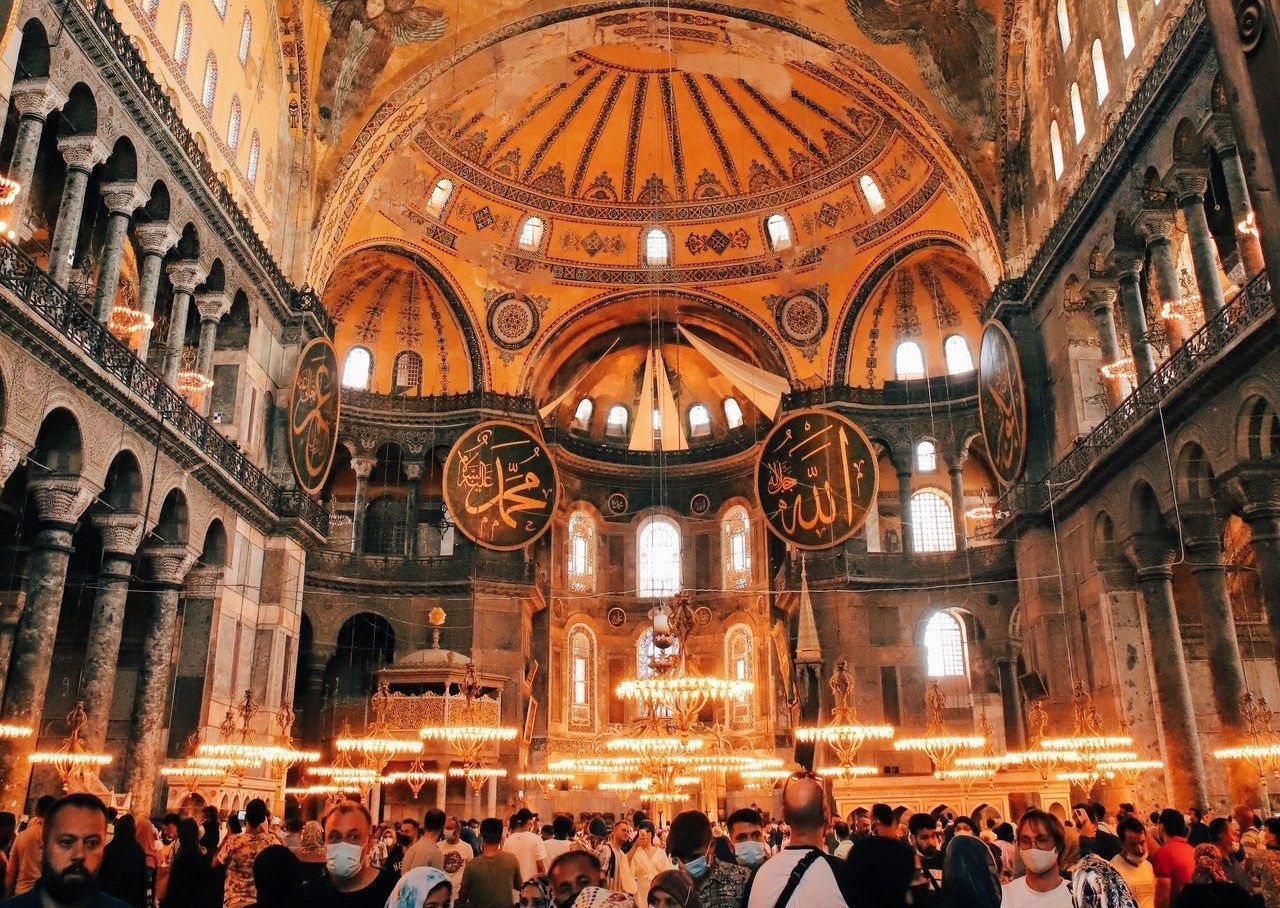
Vandalism and Neglect Could See the Hagia Sophia Lost Forever
A marvel of early medieval architecture, the Hagia Sophia is a monument well worth preserving. Unfortunately, politicking and bureaucratic bungling have endangered this magnificent place of worship.
The 6th-century Christian church, the Hagia Sophia (Αγία Σοφία — Holy Wisdom), one of the last visible vestiges of Byzantium, is in danger of disappearing forever.
Concerns about the condition of the church go back at least as far as 2008, when the Smithsonian raised alarm about the building’s neglect.
An investigation carried out by the Smithsonian determined the building to be on the ‘slow slide into decay.’
After a visit to the site, author and contributor Fergus Bordewich described the experience as ‘depressing.’ His ‘overall impression was one of dingy neglect and piecemeal repair.’
He recounted:
‘Huge sections of ceiling are peeling and flaking, stained by water seepage and discoloured by age and uneven exposure to light. Acres of stucco must be replaced. Windows must be repaired, new glass installed, warped frames replaced. Hundreds of marble panels, now grime-encrusted, must be cleaned. Irreplaceable mosaics must somehow be restored and protected.’
While there has been some restorative work done on the 1500-year-old church, an array of issues such as funding, and bewilderment over how to best preserve the architectural wonder, have slowed restoration attempts.
Natural Disasters
An added headache for those keen to preserve the church is the potential threat of earthquakes, and irreparable damage to the building’s structural integrity.
Constantinople (named Istanbul by its Ottoman occupiers) sits close to the North Anatolian fault line, which passes within 20km of the major Turkish metropolis.
If the Geological Society is right, a ‘major earthquake,’ much like, if not bigger than the ‘natural disaster which heavily damaged Istanbul in 1999, despite the epicentre being 110km away,’ is not a matter of if, but when.
Rich History
The Hagia Sophia was built on the site of earlier churches dating back to the 300s.
After the fall of Constantinople in 1453 — the 9/11 of the medieval world — the city’s subsequent Ottoman occupiers ordered that the church be converted into a mosque.
A jewel in the crown of the Byzantine Empire for around a century, post-1453, the church became a constant visual reminder of Constantinople’s Islamic conquest.
In 1934, the Hagia Sophia was turned into a museum under the direction of legendary statesmen, Turkey’s first President Kemal Ataturk.
The world heritage listed site stayed a museum up until 2020.
Turkey’s hardline Muslim majority government ordered that the Hagia Sophia once again serve as a mosque, after a court ruled in favour of a government-backed campaign targeting the ‘legality of Ataturk’s decision.’
UNESCO protested the reacquisition, taking particular issue with the Erdogan government for making the move without any ‘form of dialogue or notice.’
The UN communicated concern about how repurposing the Byzantine church from its rightful role as a museum impacts ‘inclusivity’, ‘physical access to the Hagia Sophia, the structure of the buildings, management of the site,’ and the potential loss of invaluable movable items that have immense historical worth.
By acting unilaterally, President Recep Tayyip Erdogan, now another face of institutional Islamic authoritarianism, breached World Heritage conventions.
The UN reminded the Erdogan government that it had an obligation to ‘ensure that modifications do not affect the Outstanding Universal Value’ of the church.
Little understood at the time, Erdogan’s decision was pure politics.
In 2019 the Turkish president used the eco-fascist mass shooting of Muslims in a Christchurch Mosque to push along the campaign against the Hagia Sophia.
It didn’t hurt that Erdogan would win some key political capital along the way.
Anti-Ataturk activists managed to associate the Hagia Sophia with the gunman’s actions, through hyping up the mass murderer’s alleged appreciation of the old church.
Thus, Erdogan was free and clear to declare that the Hagia Sophia should be turned into an Islamic cultural centre.
Defaced
Concerns about the care and condition of the building were compounded when the Hagia Sophia was vandalised in April.
Pinar Tremblay, writing for Al-Monitor, said, ‘the 1,400-year-old imperial gate of the edifice’ was significantly damaged.
Tremblay quoted critic Arie Amaya-Akkermans, who stated the building ‘was being treated like any other mosque and not a precious heritage site.”
Akkermans also noted that the current managers, the Ministry of Religion, had no real appreciation for the structural and environmental “risk factors that might compromise this enormous but so very fragile building.”
A 2016 civil engineering analysis published by Science Direct called the old church one of the ‘most sophisticated dome structures in the world.’
The paper’s authors relayed that there were three major factors contributing to the deterioration of the building.
Structural ‘violations’, both seen and unseen, internal and external were caused by a combination of neglect, underground water, and the building being hit by numerous earthquakes.
Serif Yasay, head of the Turkish Union of Art History, told Al-Monitor that the vandalism is a sign of more danger to come. If “no precautions are taken, the dome of the old church might collapse by 2050.”
Despite dissent from within Turkey, and formal protests from UNESCO and Greece, the Turkish government is yet to signal that it has any desire to take concerns about the proper preservation of the Hagia Sophia seriously.
Consequently, the 6th-century Christian church — one of the last visible vestiges of Byzantium — could be lost because the power of its political symbolism as an icon of Islamist conquest was too much of a temptation for power-hungry bureaucrats not to use.
___
Photo by Yunus Tuğ.
One Comment
Leave A Comment
Recent Articles:
8 October 2026
3.6 MINS
John Anderson warns that Australia’s decline is rooted in spiritual and cultural disintegration, calling for a recovery of Christian foundations, social cohesion and national purpose.
8 October 2026
4.1 MINS
Aboriginal communities in Central Australia already know the gospel message. What they need now, Robyn Murray writes, is discipleship, encouragement and Christians willing to pray and participate.
8 October 2026
4.1 MINS
Italy honours St Francis of Assisi 800 years after his death, celebrating a saint whose devotion to Christ, radical simplicity and message of peace continue to shape generations.

8 October 2026
4 MINS
Christ’s authority and concern is not limited to the four walls of the church. They extend to the life of the nation, and we are called to take up our part in seeking its righteousness.
7 October 2026
1.5 MINS
Across the Middle East, North Africa and Anatolia, Christianity once shaped entire civilisations. Could Britain’s Christian heritage likewise become a memory rather than a reality?

7 October 2026
6 MINS
What can Tucker Carlson’s interview with Jacob Rees-Mogg teach us about political disagreement? Their clash over war, Russia and national defence highlights the importance of listening carefully and understanding an opponent’s position before attempting to refute it.
7 October 2026
8.5 MINS
Gerald McDermott’s work challenges Christians to approach Israel through Scripture first, exploring God’s covenant faithfulness, Christian Zionism, Jewish identity and antisemitism.



Oh no, it would be horrible if we lost such an amazing historic site!