


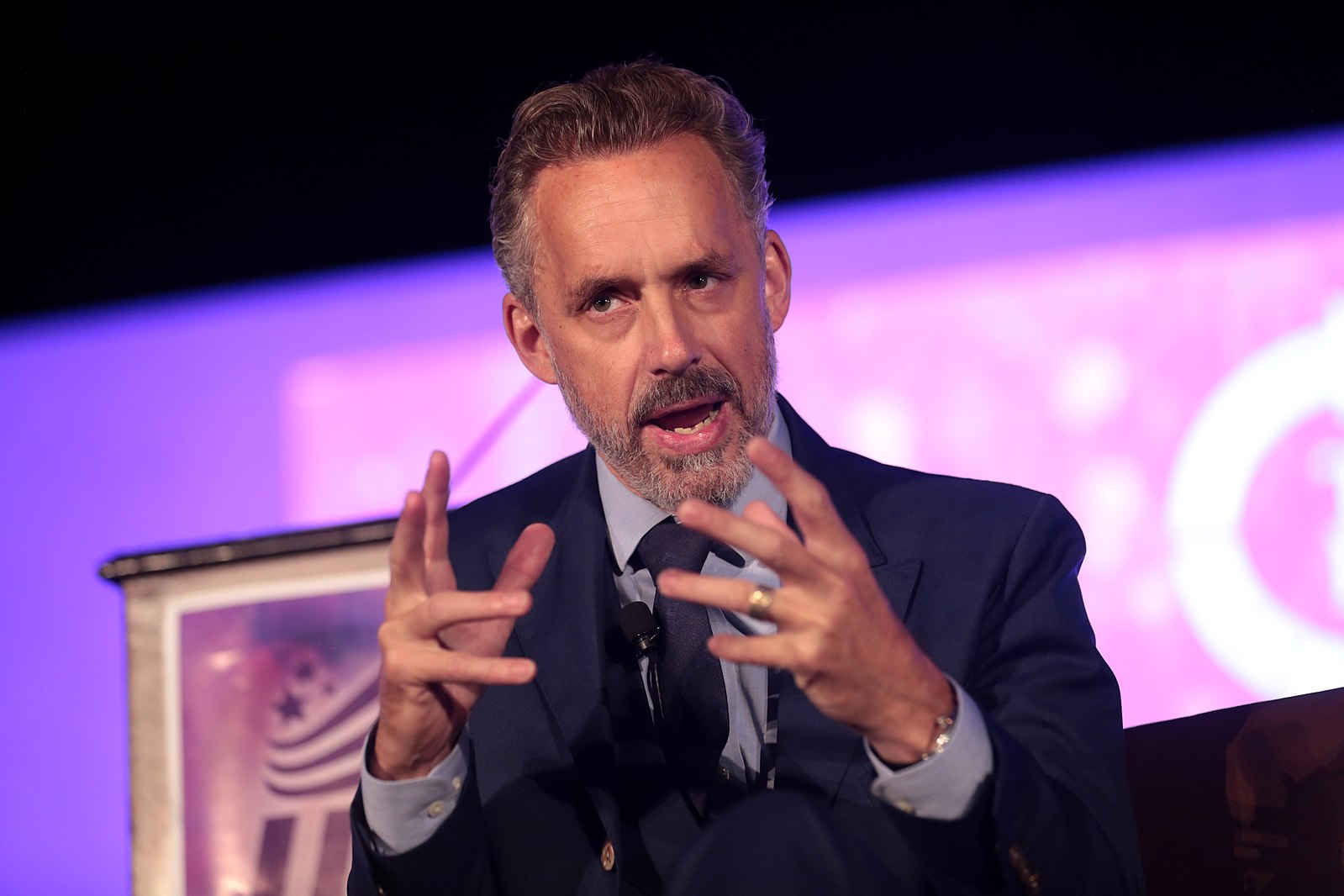
As a Christian, Here are My Thoughts on Jordan Peterson’s “Most Inspiring Speech He Has Ever Given”
Jordan Peterson recently gave a talk on ‘Tilting the world toward Heaven and away from hell’ that some people are calling ‘the most inspiring speech he has ever given’.
It was given at the recent ARC (Alliance for Responsible Citizenship) conference in London. ARC is an organisation begun by Peterson, which aims to offer a more compelling and hopeful vision for human society and human flourishing than what we’re hearing from many corners of (secular) society.
Peterson is always thought-provoking, and this speech is no different. I had a listen, and here are my thoughts, as a Christian:
1) Christians will resonate with much of Peterson’s talk
Peterson aimed to offer a better vision of human identity and flourishing than what our hedonistic, self-focused secular society offers us. Here is some of what resonated with me:
-
Take responsibility for your own life, and the lives of those around you
Peterson is big on this:
And so, by the time you start to operate as an adult, you can take responsibility for yourself… And then you take responsibility for your partner, and they do that with you, and the two of you take responsibility for your children. And that gives you the satisfaction and the adventure and the responsibility and the burden and the meaning of your family. And you embed that in your community, and you take responsibility for that, and you take responsibility beyond that for your town, and for your city, and your state. And you do that all in as balanced and harmonious a manner as you can.
In a culture where identity is increasingly found in your feelings, in entitlement and a victim mentality, I found his call to personal responsibility – and being responsible to those around you – refreshing. It echoes our God-given responsibility as stewards of creation (Gen 1:27-28; cf. Prov 6:6-1).
-
A meaningful life isn’t found in hedonism but in responsible service of others.
One of Peterson’s reasons for responsible living is that it’s meaningful.
A meaningful life isn’t found in being self-focused and hedonistic, but in responsible service. He’s going against the cultural flow with such a call: the western zeitgeist is all about comfort, and ease, and seeing responsibility as a burden more than a privilege. But hedonism doesn’t lead to a meaningful life: on the contrary, he says,
[M]eaning in your life doesn’t emerge as a consequence of your pursuit of your proximal hedonic subjective narrow purely self-serving goals and drives . There’s nothing in that that’s nourishing.
This aligns with God’s intent for humanity, that we not be selfish and chase our desires (e.g. 1 Peter 4:2-6), but to look outside ourselves, and serve others.
-
Being made in the image of God is not ‘foolish superstition’, but one of the most profound truths in human history.
It’s no small thing for a public intellectual of Peterson’s standing to unashamedly declare that:
‘[Modern western societies] regard those [Biblical] propositions as something approximating primitive superstitions, when in fact, they’re the most brilliant intuitions into the fundamental structure of reality that have ever been offered. We’ve predicated our civilization on those presuppositions…’
As a Christian, I say a hearty ‘Amen!’. Being made in God’s image is the only firm ground for universal human rights and dignity (which is why the Western world has such values, but the rest of the world less so).
-
We can make a positive difference to the world if we align our lives to our divinely-given identities.
Peterson wants us to act in line with our ‘divine responsibility’, as this will change the world:
‘[To] the degree that each of us acted out in the confines of our own lives, [we will] tilt the world towards heaven and away from hell’.
Again, as a Christian, there is much to affirm. As human beings, God has made us in His image and stitched his morality throughout the fabric of reality. To varying degrees, even fallen humanity can see some of the goodness and value of that morality – albeit, those who have come from a Christianised culture more so than others. If we live in line with that morality, society would indeed be better.
2) But his talk raised several questions in my mind:
-
What exactly does it look like to act as God’s image bearers? And says who?
Peterson made a lot of assertions about God, but it left me wondering: how do I know that what he says is true and worth believing?
Now, he brought in his own experience and professional authority as a psychologist – and I’m more than happy to defer to his psychological authority on psychological matters.
But when it came to his discussing Biblical issues – whether Jacob’s ladder, Abraham, and even the image of God – I was often left wondering how he came to his conclusions. There wasn’t much exegetical argument to back up his Biblical claims. And some of his arguments about Abraham seemed quite novel and unusual, at least as far as traditional evangelical interpretations go:
‘The biblical book [of Genesis] details out the life of Abraham. And I mentioned this when the conference opened. Abraham begins his life with all his proximal hedonic needs satiated, and the voice of God comes to him and says, says, ‘Go out into the world, get away from what’s merely infantile and satiating, and have the adventure of your life.’
Have the adventure of your life?
That’s an unusual interpretation of what God was telling Abraham. While it might be true as far as it goes (maybe God did, alongside his other plans for Abraham, send him on this ‘adventure’), it did feel like he was reading his interpretation into the text, rather than drawing it from the Biblical passages. [1] Thus, the question of truth – and God’s will – comes into play: is that what God was saying through the life of Abraham? Life is an ‘adventure’ that you must embark on?
-
Does meaning only come from our actions? If so, what about those who can’t do meaningful actions?
While heartily I agree that living a responsible life in service of others is more meaningful than a hedonistic self-focused life (and Peterson made this point well), I was left wondering about those who can’t take meaningful, responsible actions: are their lives still meaningful? For example: babies, or those with dementia, or significant disabilities?
-
Could we find a stable identity in our doing of things – even good, responsible things?
Should our core identity be based on our actions, our responsibilities, or our achievements? While psychologically speaking, it’s better than an identity based on our internal feelings, is a responsibilities-based identity stable enough? This is not a theoretical question for me. I grappled with this personally on an existential level when I had the proverbial ‘mid-life’ crisis: I realised that in the face of certain death, temporal, this-worldly identity and meaning were flimsy.
Again, let me say that there was much to love about Peterson’s talk. But maybe my concerns are around not so much what he said, but what he didn’t say. While he did mention the Bible, I think his talk would have been so much stronger if he brought in Jesus:
3) Why Jesus solves the problems raised by Peterson
As I was listening to Peterson, I resonated with much of what he said. But I couldn’t help thinking: what you’re saying is good, but is it enough to achieve what you’re after? Namely: True meaning. A stable, positive identity. And a world where suffering is ameliorated.
I think that only Jesus provides – in a truly satisfying way – the things that Peterson is looking for. [2]
When it comes to identity, in Jesus we find a stable identity that we don’t have to earn (and thus risk losing by our own or other’s actions), but an identity that is given to us, that Jesus has won for us at the cross. Nothing – not even our death – can take that identity away (cf. Rom 8:35-39).
When it comes to meaning, Jesus gives us meaning that will never fail. Why? Because it’s not based on us or our actions, but on what He’s done for us: forgiving our sins, and raising us to new (spiritual) life, as we look forward to new (physical) resurrection life. This means that the question that destroys modern notions of meaning – ‘what’s it all for?’ – has a compelling and rock-solid answer.
When it comes to tilting the world toward heaven, and away from hell, Jesus will make that happen. And in the meantime, by His Holy Spirit, He will use us to do good to others (Gal 6:10), sacrificing ourselves for our neighbours, and loving our enemies.
Furthermore, the very reason we have values and morals of the West – universal human rights, democracy, fair trials, etc – the very ‘air we breathe’ – is because of Jesus. Without Jesus, it’s hard to see how the values both secular and religious Westerners hold dear could have arisen.
Not so much what was said, but what wasn’t said
While Peterson’s talk was inspiring in many ways – and his vision of personal responsibility and sacrificial service is way better than the ‘You do You’ nonsense that we’re swimming in right now – I couldn’t help but feel that there was something, or rather Someone, missing: Jesus.
My hope and prayer is that the person and work of Jesus become more and more front and centre in Peterson’s life and work.
Because that would truly be revolutionary.
___
[1] I realise Peterson has given many lectures on the Bible, which are available online. Perhaps he gives his reasoning and exegesis in those lectures.
[2] Of course, doing the things that Peterson suggests will provide meaning, service, and a better life to some measure. He is taking advantage of the wisdom that God has stitched into the fabric of reality. But, as he’s putting the jigsaw pieces together of what a truly flourishing society looks like, I think he’s missing the ‘Jesus piece’, if I can put it that way.
___
Originally published at AkosBalogh.com. Photo: Gage Skidmore/Wikimedia Commons
10 Comments
Leave A Comment
Recent Articles:
26 October 2026
3.2 MINS
Following Paul's example in Ephesians 1, let us pray for the Father to open the eyes of our hearts so that we may grasp the hope of his calling, the riches of his glorious inheritance in the saints, and the greatness of his power towards us who believe.

25 October 2026
4 MINS
Prayer is active partnership with God, and he is awakening his body to prayer, not by might or by power, but by his Spirit.

24 October 2026
3.3 MINS
When we ask God, "What is in my hand?", and see our possessions, money and time as seed that God asks us to sow, life becomes simpler.

23 October 2026
6.8 MINS
Hillsong UNITED’s Joel Houston reflects on fame, faith and the burden of ministry, questioning performative Christianity as he seeks a more authentic walk with God.

23 October 2026
13.1 MINS
Tasmania’s proposed conversion practices legislation raises serious questions about religious freedom, pastoral care and whether Christians can freely pray with those seeking to live according to their faith.
23 October 2026
3.1 MINS
The one who is worthy of it all is awakening his Church to be captivated by him, so that we will honour one another and share his gospel with humility and courage.

22 October 2026
2.9 MINS
Victoria Labor’s promise to fund free abortions has drawn a forceful response from Presbyterian leaders, raising profound questions about unborn life, government priorities and Australia’s moral direction.



Thanks Akos, Agreeing with your hope and prayer for Jordan Peterson. Remembering occasional interviews of his watched over recent years, I think the way that he approaches the Bible has changed somewhat. Let’s trust that the Lord Jesus Christ, King of kings and Lord of lords, will reveal Himself to this man.
Amen to that, great comment! I too have seen the slow but certain shift in Peterson’s approach.
An uplifting presentation by Peterson as he often does. A wholesome framework. Not all the questions answered but the heart stirred.
Great article. Without JESUS we got nothing!!!!!
God says He will pour out his Spirit on all flesh in the last days! Peterson is a forerunner for that. Even the ‘secular’ world will receive His goodness, whether they acknowledge Him or not.
Thanks Akos. A fantastic analysis of that speech. I and my wife felt the same as you did when we heard it on YouTube.
It was great, inspiring, even awe-inspiring as far as it went when he spoke of identity in terms of responsibility. But it did not go far enough. As my wife immediately pointed out, as you have too, that our identity must be in Jesus.
Tony Abbot who also was at ARC declared in a piece in the Australian a couple of weeks ago that Peterson was a Christian. That declaration was the heading or the first line, I forget which.
Peterson, whom I greatly love, might think like a Christian in many ways, and more than most Christians, but I am afraid that unless he escapes the stronghold of Jungian psychology through which he also interprets the Bible , he cannot be a true one until He finds it in a personal relationship with Jesus.
I agree that Jordan Peterson is very inspiring but I listen to him fully aware of his desire to please God on his own strength as he doesn’t quite understand the divine exchange that took place on the cross.
Even when he had his encounter with God he didn’t follow through until conversion but stopped too fearful of what was going to be on the other side of that encounter. He mentioned that he could feel sadness when he didn’t allow the encounter to go any further. It’s an interesting share by Jordan.
I pray that he will let go and not be fearful of the fact that he is not perfect like everyone else but is still loved by God.
Anna, nailed it! Yes he is too focused on man achieving the breakthrough, rather than our energy and focus being in ‘response’ to what Jesus ‘has’ done. Nevertheless I loved the call to personal responsibility, which I think is the tipping point here for ARC.
I pray for Jordan Peterson, as a man who has been touched by Truth, who is seeking Truth, but whom has yet to fully commit to Truth, to arrive at the same destination as Søren Kierkegaard.
Some wise comments here. I myself am hopeful about Jordan Peterson total salvation. Jordan knows more about God, the Bible, good & evil than most Christians know. He might not or again he might have crossed the line??? Only God knows but if he contiues in his search for searing honesty he will meet the Truth (Jesus) and the Truth (Jesus) will set him free.