


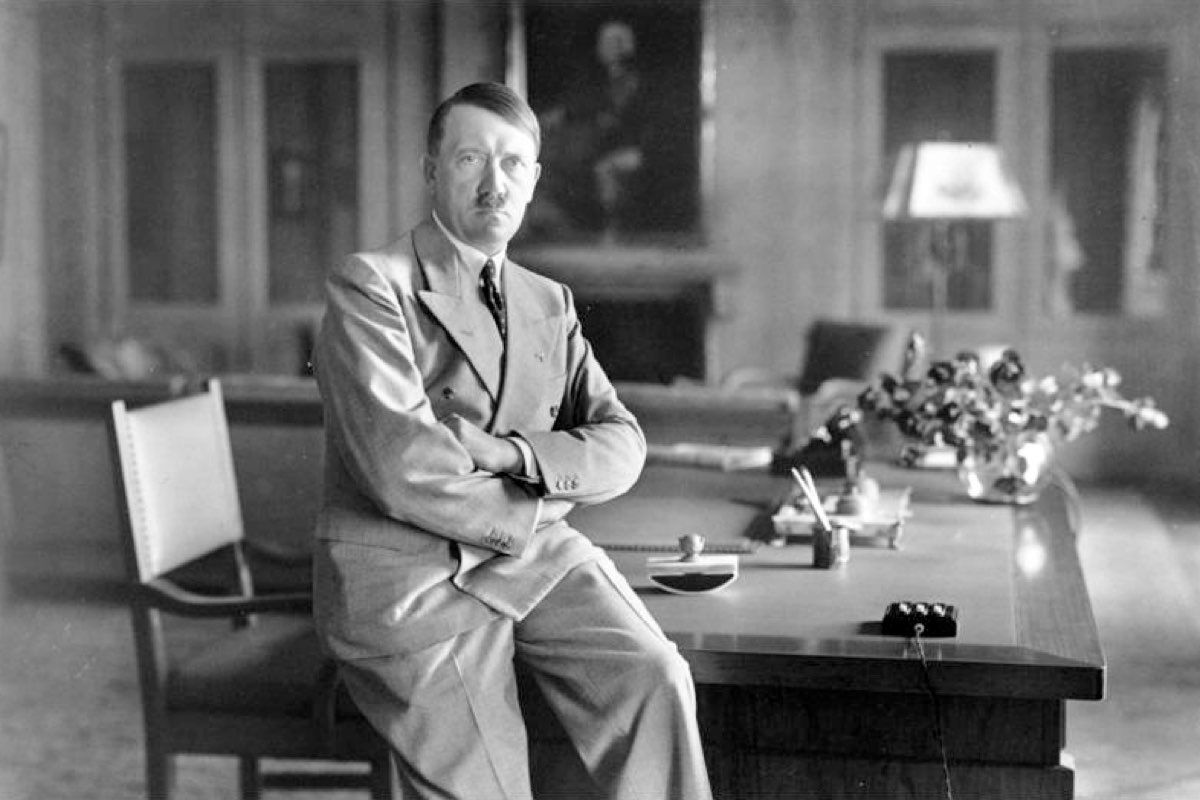
Why Hitler Loved ‘Social Justice’
Adolf Hitler’s worldview was not so different from Karl Marx’s. He believed the world was defined by power structures that made it too difficult for all Germans to rise, and that needed to be abolished.
In August 1920 in Munich, a young Adolf Hitler delivered one of his first public speeches before a crowd of some 2,000 people.
During his speech, which lasted nearly two hours and was interrupted nearly 60 times by cheers, Hitler touched on a theme he’d repeat in future speeches, stating he did not believe that “ever on earth could a state survive with continuing inner health, if it were not based on inner social justice.”
This was one of the first times Hitler spoke publicly of social justice—perhaps the first time.
In his recent book Hitler’s National Socialism, Rainer Zitelmann makes it clear that “social justice” (soziale Gerechtigkeit) was central to Hitler’s social objectives.
What precisely Hitler meant by “social justice” is not easily understood, so perhaps it’s best first to understand what Hitler did not mean. Hitler was not interested in a state or society that simply treated people equally, or a state that simply left individuals alone.
This would not achieve the social change he sought. Like Karl Marx, Hitler saw the world through power structures, and the prevailing power structures made it too difficult for all Germans to rise, in his view.
Zitelmann makes it clear that Hitler talked a great deal about concepts like social mobility and meritocracy. His speeches contain phrases that talk about a German state “in which birth is nothing and achievements and ability are everything.” Otto Dietrich, Hitler’s longtime press chief, noted that Hitler supported “the abolition of all privileges” and a “classless” state.
To this end, Hitler expressed his desire to “tear down all the social barriers in Germany without compunction,” as he explained in a 1942 conversation with Dutch national socialist leader Anton Mussert.
In other words, privilege was so pervasive in Germany that Hitler would root it out by destroying the entire class structure.
‘Tear Down the Walls which Separate the Classes’
If any of this sounds familiar, it should.
Social justice is an idea Americans hear virtually every day. It is praised in universities and advocated during NFL games. We hear the words “social justice” on the lips of politicians and in TV commercials.
To be clear, I’m not suggesting that today’s social justice advocates are Nazis. I have no doubt they despise Hitler and his ideas, as we all should. But I am saying today’s social justice advocates share an important trait with Hitler: an obsession with class.
This should come as little surprise. Class is something instrumental in virtually all of the different strains of socialism—communism, national socialism, democratic socialism, Peronism, etc.
In traditional Marxist theory, the capitalist stage of history consists primarily of two classes: the bourgeoisie (the capitalists, who own “the means of production”) and the proletariat (the workers). For Marx, class antagonism was the driving force of history, and his disciples share this view.
Defining social justice is a bit tricky, but you can see baked into the idea the notion that class must be rooted out.
“Social justice is justice in relation to a fair balance in the distribution of wealth, opportunities, and privileges within a society where individuals’ rights are recognised and protected,” Wikipedia explains.
This sounds reasonable. It appeals to our instinctive belief that society should be fair. Who likes “privilege,” after all? Who doesn’t want a more equal society?
Indeed, this is precisely what Hitler emphasised in his speeches: the creation of “equal opportunity” in society. Consider these February 1942 remarks from the Fuhrer:
Three things are vital in any uprising: to tear down the walls which separate the classes from each other in order to open the way for advancement for everybody; to create a general level of life in such a way that even the poorest has the secure minimum for existence; finally to reach the point where everybody can share in the blessings of culture.
A Problem of Means and Ends
In a sense, there’s nothing inherently wrong with many of the ends social justice advocates seek. There’s nothing intrinsically good about “privilege” or wealth concentration. The primary problem is one of means.
Social justice advocates—then and now—tend to seek to resolve what they see as structural inequities in society through illiberal and coercive means. In its most basic form, it means taking from those who have more (the privileged) and giving it to those who have less.
For Hitler, this meant confiscating the property of the wealthiest (most privileged) members of his society: the Jews. Wealth confiscation began in earnest after Hitler issued an order (“Decree for the Reporting of Jewish-Owned Property”) in April 1938 requiring Jews to register their wealth with the state.
Property rights might be the foundation of human prosperity, but they proved of little use to Jews who found themselves obstacles to the Fuhrer’s quest of achieving social justice in Germany.
Such a policy would be illegal in the United States, of course, and something few social justice advocates today would ever support. Yet many have shown an appetite for using the government to “level the playing field” in more subtle ways, including unlawfully allocating federal grants based on race.
Indeed, perhaps the most notable characteristic of social justice today is the illiberal means used to advance it. More than a half century ago, the Nobel Prize-winning economist F.A. Hayek observed the paradox of social justice, which seeks to create a more equal society by treating people unequally:
The classical demand is that the state ought to treat all people equally in spite of the fact that they are very unequal. You can’t deduce from this that because people are unequal you ought to treat them unequally in order to make them equal. And that’s what social justice amounts to. It’s a demand that the state should treat people differently in order to place them in the same position.… To make people equal a goal of governmental policy would force government to treat people very unequally indeed.
Hayek believed that treating people unequally was baked into the social justice cake, and recent historical events have proven him correct.
Since social justice was central to Hitler’s goals, he could not treat Jews, the bourgeoisie, and other privileged classes like everyone else. Only by abolishing “privilege” could he free the German people, he argued, and advance social progress.
“If we want to build a true national community, we can only do this on the basis of social justice,” he said in one 1925 speech.
Similarly, 21st-century social justice advocates can’t bring about social change by advancing the idea that all people should be treated equally regardless of their race or sex. If you read Robin DiAngelo (author of White Fragility) and Özlem Sensoy, who co-authored the book Is Everyone Really Equal? An Introduction to Key Concepts in Social Justice Education, it’s clear they are not interested in treating people equally.
For DiAngelo, the privileged class in America is white people, all of whom were born “into a racialised hierarchy,” a socio-economic system that is racist and must be dismantled.
“This system of structural power privileges, centralises, and elevates white people as a group,” says DiAngelo.
Precisely how social equality is to be achieved is unclear, but it’s safe to say DiAngelo does not believe the march toward equity will be achieved by embracing the idea that all humans are unique individuals who deserve equal treatment, or without using the power of the state.
The mistake DiAngelo and many other social justice advocates make is a common one in modern times. They prioritise the ends they seek over the means they use.
The philosopher and FEE founder Leonard Read understood the folly of this approach. This is why, in his 1969 book Let Freedom Reign, Read argued that a “hard look” at the means we use is far more important than the ends we seek:
Ends, goals, aims are but the hope for things to come… not… reality… from which may safely be taken the standards for right conduct…Many of the most monstrous deeds in human history have been perpetrated in the name of doing good—in pursuit of some “noble” goal. They illustrate the fallacy that the end justifies the means.
Hitler, of course, disagreed.
He didn’t worry about means; they were entirely justified (in his mind) by the ends he sought. And his grandiose vision for “social justice” in Germany conveniently came with a perk: it allowed him to use the immense power of the state to “correct” the inequities in German society, which had become a hotbed of resentment and decadence following World War I and years of hyperinflation.
___
Republished with thanks to Foundation for Economic Education. Image courtesy of Wikimedia Commons.
Recent Articles:
9 October 2026
5 MINS
During a recent dialogue between high profile legal experts, a top Australian constitutional law expert was asked if Australia should have a Bill of Rights. His answer may surprise you.

9 October 2026
1.8 MINS
Pen Power Australia has been busy confronting antisemitism and double standards, lodging letters, pursuing accountability and celebrating several important wins along the way.

9 October 2026
3.3 MINS
New South Wales healthcare workers who object to abortion and voluntary assisted dying face growing pressure, raising serious questions about conscience rights, employment and moral injury.
8 October 2026
3.6 MINS
John Anderson warns that Australia’s decline is rooted in spiritual and cultural disintegration, calling for a recovery of Christian foundations, social cohesion and national purpose.

8 October 2026
1.6 MINS
A blackout at Australia’s $150 million Pre-COP climate summit in Fiji delivered an awkward lesson in energy reliability to delegates preaching the renewable transition.

8 October 2026
4.1 MINS
Italy honours St Francis of Assisi 800 years after his death, celebrating a saint whose devotion to Christ, radical simplicity and message of peace continue to shape generations.
8 October 2026
2.8 MINS
The MDBA’s case for further water buybacks rests on climate projections increasingly challenged by climate scientists, historical rainfall data and evidence of a greener Basin.


