


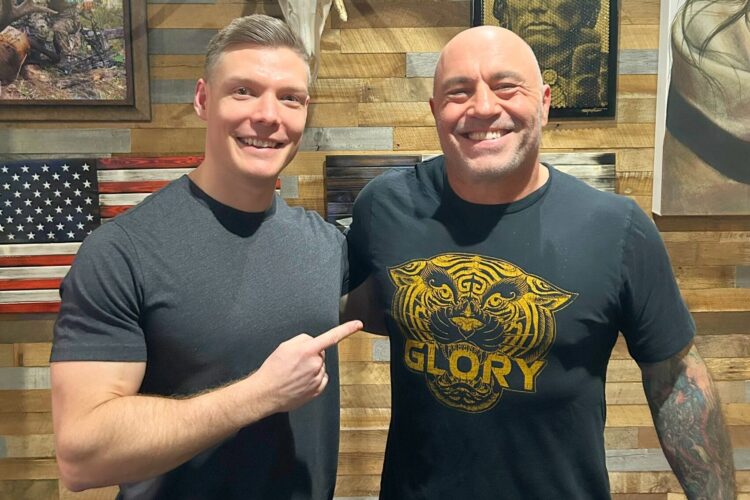
‘Such an Awesome Conversation’: Joe Rogan Discusses Jesus and the Bible with Apologist Wesley Huff
The world’s most popular podcaster gave an opportunity for the gospel that apologist and biblical scholar Wesley Huff took with both hands. It will be one of the largest audiences for the gospel in history.
The Joe Rogan Experience is the world’s most popular podcast. On average, 11 million listeners tune into every three-hour episode. In terms of numbers, it leaves TV shows and traditional media sources in the dust.
Not the Bee quipped that “Joe Rogan just dropped a new podcast with Christian apologist Wesley Huff and it is so full of truth and grace. More people might hear the Gospel in this single interview than any other interview/speech in human history.”
The author went on to conclude, “There’s a Holy Ghost-led vibe shift happening in America. It’s harvest time.”
Another headline reads, “Rogan episode likely to be furthest reaching gospel broadcast in history”.
That the podcast will be the furthest-reaching presentation of the gospel in history may be a little overstated. But there’s no denying that Joe Rogan has an incredible reach and influence that makes other content creators insanely jealous.
And there’s also little doubt that this podcast — which has already clocked up over 2.5 million views in one day — is part of a “Holy Ghost-led vibe shift”. God can use anyone, imperfect though they may be, to get His message out.
(Please note: Rogan often uses explicit language).
Rogan’s Journey Towards Jesus
Joe Rogan’s spiritual path has certainly changed trajectories over the past couple of years. In 2019, he interviewed the world’s most well-known atheist, Richard Dawkins, and commented, “I’m a huge fan of your work.”
In February last year, while discussing Western cultural decline in an interview with NFL quarterback Aaron Rodgers, Rogan remarked, almost accidentally, “We need Jesus. I think for real.”
The contrast between the 2019 and 2025 Rogan is quite stark.
The Joe Rogan Experience’s podcast episode #2252 with Wesley Huff certainly continues that incremental pathway towards a biblical worldview and an openness to Christ.
Miraculous Healing and the Pursuit of Truth
In the podcast, Rogan quizzes Huff about how he came to study biblical texts and early Christianity.
Huff’s answer was first personal, then academic.
Just before his twelfth birthday, Wes suffered a case of the flu, which led to his body’s immune system attacking the nerve endings at the base of his spinal code.
There was no communication in his nervous system between his legs and his brain. This rare neurological condition left him paralysed from the waist down.
Doctors gave him a small chance of recovery, but a much greater probability of permanent paralysis.
Exactly one month after his initial immobilisation, he woke up (quite normal) and walked over (quite astonishing) to his wheelchair — with no evidence of any muscle atrophy (even more incredible).
Wes credits this as “a miraculous recovery that the doctors themselves said they had no medical explanation for.” As Rogan remarks, “That’s crazy! Because I’ve broken limbs before and had them in casts. And just in the six weeks you have a cast on, you have massive atrophy.”
Huff continued, “Something happened that I can’t explain on naturalistic terms.”
But the event didn’t lead to an immediate all-in approach to Christianity. As Wes explains, “But how do we go from that [a miracle] to saying, ‘Well, okay, this worldview [Christianity] is correct’?”
During his later teenage years, he did “a great deal of study and soul searching” over a period of about a year and a half. He came to the conclusion that Christianity is true.
Then, while at university, Huff encountered challenges to the authenticity of the Bible and Christianity from atheists, Muslims, Mormons and Jehovah’s Witnesses. Wes realised, “If I’m wrong about the Bible, if the things [those sceptics] were saying were true, then it did undermine what I believed. And I needed to take those things seriously.”
Combining his curiosity with a desire for truth, he dove deeply into studying how the Bible came to be, and the evidence that it records historical reality.
His enthusiasm for studying the Bible through its early manuscripts and early Christian history has never subsided.
Rogan Impressed and Engaged
In previous years, Rogan would have attempted to steer the conversation away from Jesus and the Bible. But this is 2025. The Rogan of today is different from the one of old.
Rogan was so impressed by Huff’s depth of knowledge that he revealed, “I’ve probably watched 20 hours of your stuff over the last couple of weeks, and you’ve spent a lot of time on this.”
“This is not a casual cursory examination of these texts and religion. This is a long, long journey. That’s what’s particularly exceptional and really interesting to me. Because I’m always fascinated by people who have really, really gone down the road.”
Evidence for the Death and Resurrection of Jesus
At the 2 hour and 18-minute mark of the podcast, Huff begins explaining to Rogan why he believes that Jesus of Nazareth was crucified and rose from the grave.
Rogan believes that “there’s something else” going on in the universe that is more than matter and energy.
But then he incoherently followed that up with, “It’s very difficult for anybody who thinks of themselves as an intelligent person who’s secular [as Rogan would identify himself], to even entertain the possibility that somebody died and came back to life.”
However, Rogan conceded there’s something supernatural about the world we live in. It therefore does not follow that supernatural events — such as the resurrection of Jesus — cannot happen.
It was a logical mistake that Huff gently pulled the veteran podcaster up on. “I get that”, he replied, “but we’ve already talked about the fact that we don’t think that the only thing that exists is matter and motion.”
The reality is that there is much evidence for the resurrection of Jesus.
There’s no doubt that Jesus of Nazareth lived and died in the ancient homeland of the Jewish people. Then, individuals close to His inner circle claimed to see him alive — individuals who could have denied the resurrection and been much better off for it, but refused to recant what they had “seen and heard” (1 John 1:1).
In addition, the Gospels — Matthew, Mark, Luke and John — were “written in the lifetime of the eye-witnesses.” Matthew and John were Jesus’ disciples and travelled with Him, observing the things he did and said. Mark and Luke were not eyewitnesses, but Luke interviewed those who were (Luke 1:1-4), while Mark relied on Peter — one of Jesus’ closest companions — when compiling his account.
Huff also explains that the idea of a crucified god was so ridiculous in the first-century world (as it is today), that there’s only one reasonable explanation for this belief getting off the ground: Jesus was indeed crucified.
Both Christians and pagans believed it to be so. The former believed it was the most remarkable act of God to ever occur in history. The latter thought it made great content for ridicule, as the Alexamenos graffito demonstrates.
The etched depiction in plaster made somewhere around AD 200 mocks a Christian called Alexamenos. Portraying Jesus with a donkey’s head, the Roman graffiti translates as “Alexamenos worships his god.”
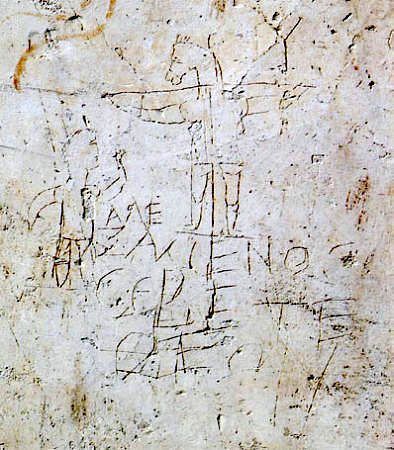
The Alexamenos graffito

The Alexamenos graffito enhanced
As Paul wrote to the Corinthians, “For the message of the cross is foolishness to those who are perishing, but to us who are being saved it is the power of God” (1 Corinthians 1:18).
There are also clues within the biblical text that reveal the authors were accurately reporting the facts. One such example is that women were the first witnesses to the resurrected Jesus.
As Huff points out, women were not regarded as reliable witnesses in the first-century world. So why does it record women — not men — as being present at the empty tomb? For one reason: because the biblical authors were truthful in reporting what happened.
Such is not the case for the so-called Gospel of Peter — a document thought to be from the second century, certainly not written by Peter, and with many historical inaccuracies. The Gospel of Peter is uncomfortable with women being the first witnesses to the empty tomb. So, it conveniently has ‘the right people’ — Roman and Jewish officials — camping out in front of the tomb. However, Huff correctly points out that there was no way Jewish priests would be residing near a dead body during a Jewish holy season (Passover, in this case).
The Gospel of Peter has clearly rewritten history to make an embarrassing story more palatable to the culture of the day. The four biblical Gospels take a very different path.
It is to this that Rogan remarks, “Wow, that’s what’s so interesting about trying to interpret this stuff. You have to think about it in terms of the culture of the time.”
Rogan is Searching
Joe Rogan is clearly searching. He finds people who think they “know for sure” that when you die, “that’s it”, as arrogant.
He also considers such a stance illogical. “How could you know what you don’t know?”, he questions.
Further, Rogan finds that the atheistic view of life, which he once firmly held, cannot explain the wonder of life. “Just the fact that you exist at all is so bizarre and so spectacular,” he explains.
Rogan also understands the modern pressure to conform to secular standards. “The problem is that there’s a social credit amongst academics, in particular, that’s ascribed to a person who’s atheist.”
“‘He’s brilliant, he doesn’t believe in myths.’ I get it. I get why there’s social pressure in that regard,” he explains.
“But to not look at the universe itself, this creation engine of planets… just the bizarreness of the epicness of it all, and to not wonder if maybe you have a very narrow perception of what this whole thing is about” — now seems too fantastical for Rogan to take seriously.
He continues, “I think a lot of what it means to be a human being in a meaningful way is not measurable. Most of it. Love and friendship and community.”
“Whatever love is, whatever good is, it’s a very real thing and it seems to not exist — certainly in the volume — in other animals. Their perception of life and death is very different to ours. So that leads me to [ask] why. Why is our version of life so much more rich and complicated than any other being that exists? What is it?”
It is to these questions of ultimate meaning that Huff responds, “That’s ultimately the questions that we should be asking. In terms of, you matter more than you are matter. There’s something going there.”
“There’s something going on with all of us”, Rogan replies. We kind of know it and we kind of don’t know it.”
Huff Shares the Gospel
Wes Huff could have left the discussion at Greek biblical manuscripts and historical evidence for the death and resurrection of Jesus.
But he did not let Rogan off the hook. At the three-hour and five-minute mark, he asked Rogan directly, “What do you think of Jesus?”
To which Rogan replies somewhat vaguely, “Was he an actual person that was the Son of God? And is it important? I don’t know. And what does it mean?”
“I know a lot of hardcore Christians who are some of the nicest people you’ll ever meet in your life. So it does work. If you do live like a Christian, and you do follow the principles of Christ, you will have a richer, more love-filled life.”
Huff agreed with that assessment. But he explained that there’s more to it than the fact that Christianity ‘works’. Huff took issue with Jordan Peterson, who talks about Jesus — but more about Jesus as an abstract projection than a flesh-and-blood man whose feet trod the dusty Roman roads of Judea and Galilee.
To Peterson, Jesus is perhaps no more than a great moral example.
“I think that ultimately, Jesus condemns moralism,” Huff explains. “If Jesus is nothing more than a moral example, then you can save yourself, and you don’t actually need a saviour.”
This comment alone seemed to be an “I get it!” moment for Rogan.
“The law is like a mirror. It shows you how dirty you are”, Huff continues. “In that sense, if Jesus is a moral example, it actually misses what Jesus actually said about what His purpose was. You can’t do enough to actually live up to the standard God holds you to. So, if you keep striving, you’re actually going to wear yourself out and be exhausted.”
Rogan and the World’s Search for Meaning Continues
It will be fascinating to see the impact of podcast #2252.
One thing’s for certain: this won’t be the last time Rogan discusses Christianity on his show.
Rogan concluded with these words: “Listen Wes, this is such an awesome conversation… the good thing is that a lot of people became aware of your work.”
To that, the Daily Declaration issues a hearty ‘Amen’.
We could even say we’re witnessing a Holy Ghost-led vibe shift happening before our very eyes.
___
Photo by Wes Huff/X.
3 Comments
Leave A Comment
Recent Articles:

8 October 2026
4 MINS
Christ’s authority and concern is not limited to the four walls of the church. They extend to the life of the nation, and we are called to take up our part in seeking its righteousness.
7 October 2026
1.5 MINS
Across the Middle East, North Africa and Anatolia, Christianity once shaped entire civilisations. Could Britain’s Christian heritage likewise become a memory rather than a reality?

7 October 2026
6 MINS
What can Tucker Carlson’s interview with Jacob Rees-Mogg teach us about political disagreement? Their clash over war, Russia and national defence highlights the importance of listening carefully and understanding an opponent’s position before attempting to refute it.

7 October 2026
8.5 MINS
Gerald McDermott’s work challenges Christians to approach Israel through Scripture first, exploring God’s covenant faithfulness, Christian Zionism, Jewish identity and antisemitism.

7 October 2026
4.6 MINS
Medicine was created to heal and preserve life. Yet abortion, euthanasia and gender medicine increasingly redefine death and destruction as care, leaving the vulnerable dangerously exposed.

7 October 2026
3.7 MINS
Christians have their differences. But those differences should not, and need not, result in us being disconnected from each other in the one body of Christ.

6 October 2026
10 MINS
This powerful testimony recounts a lifetime of hardship, danger, illness and near-death experiences — and the unwavering faith that carried one woman through it all.



Joe Rogan is on a journey to JESUS!!!! Briliant article Samuel!!!!!!
Jesus appeared to more than 500 at the same time not 400!
1Co 15:6 After that, he appeared to more than five hundred of the brothers at the same time, most of whom are still living, though some have fallen asleep.
There’s reason to hope for a new era of Faith in Jesus. Ayaan Hirsi Ali Somali-born ex-Muslim + ex-Atheist is reported to have found Christianity, attends Mass every Sunday, is a Reader at Mass , and, enjoys learning more about Christianity from a priest. Koran orders death to apostates, so there is a Fatwa on her. Brave Woman! Intellectual, she has written several books . I want to read her : “Heretic: Why islam needs a Reformation “.