



Revival’s Role in Shaping Australia
Don’t believe the popular myths. Australia wasn’t just some ragtag, criminal outpost of the British Empire. Australia is a product of revival.
Recently, my good friend Warwick and I set out to write a book tracing the history of revival from the pages of Scripture to modern-day Australia.
The result was Great Southland Revival — and it was the most enjoyable writing project I have ever been involved in.
To say this project was ambitious is a vast understatement. I’ll let you read it and be the judge as to whether we achieved our aim or not, but here I want to share with you three things I learned in the process.
These three insights come from my favourite chapter in the book — Chapter 8, titled ‘The Great Southland of the Holy Spirit’.
Chapter 8 acts as a hinge between the first and second halves of Great Southland Revival. In the first half of the book, we recount the revivals from Scripture that ultimately spread throughout Europe and into the New World. In the second half, we tell Australia’s history of revival — and there’s a lot of it.
But in chapter 8, we connect the two halves, showing how God guided the flame of revival on wooden ships to the far side of the world.
So, here are my three top insights.
1. The Prophecies God Gave
Maybe you’ve heard of the prophecy by the 16th century Portuguese explorer Pedro Fernandes de Queirós.
After seeking the Pope’s blessing, de Queirós set out to discover the vast unknown southern continent. Five months later, on the day of Pentecost, he thought he had found it. So he held a church service to give thanks to God, and he named the land La Austrialia del Espíritu Santo — the Great Southland of the Holy Spirit.
Well, it turns out he was in Vanuatu. We can hardly blame the guy, though. There was no Google Maps in his day. He assumed the land beneath his feet stretched all the way to the South Pole.
Even thought de Queirós’ geography was a bit off, his words were prophetic. This explorer called the unknown southern continent out of the shadows of anonymity, giving it a name and an identity.
Two other giants from church history gave similar prophetic utterances about Australia — two men you might least expect: John Calvin and Jonathan Edwards.
In Calvin’s verse-by-verse commentary on the Bible, he defended the words of Jesus in Matthew 24:14 that the gospel will go fully global before His return. Calvin rebuked the doubters who said “to this day not even the slightest report concerning Christ has reached the Antipodes”. Calvin was adamant that “the gospel will maintain its ground till it be spread through the whole world”.
In Jonathan Edwards’ day, Australia was emerging on maps as Hollandia Nova or ‘New Holland’. In reflecting on Isaiah 42:4, which says “And the coastlands shall wait for his law”, Edwards waxed prophetic.
He wrote that it was “peculiarly glorious” that “Hollandia Nova, and all those yet undiscovered tracts of land” where “the devil had reigned quietly from the beginning of the world” would eventually hear the gospel and “worship the God of Israel”.
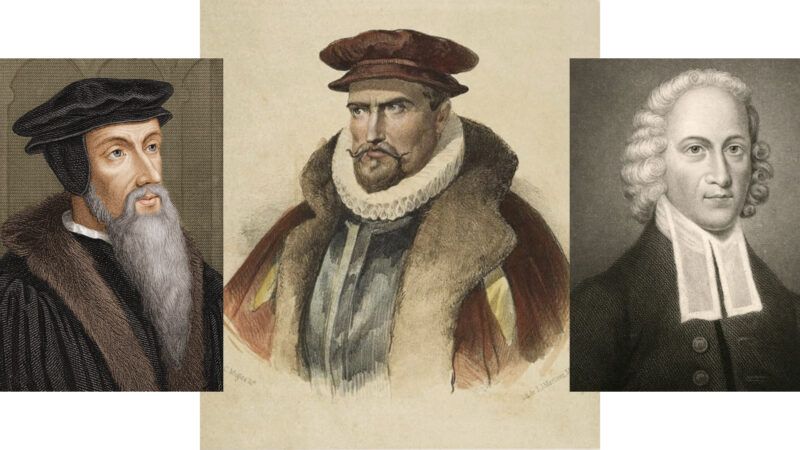
John Calvin, Pedro Fernandes de Queirós and Jonathan Edwards
2. The People God Used
Here, I want to briefly mention four men who had a huge influence on the founding of Australia. Every one of them had been touched by the revivals that were taking place in Europe.
First, there was William Wilberforce, who we know for his role in abolishing slavery. Wilberforce was a product of the First Great Awakening. In fact, John Wesley addressed his final deathbed letter to Wilberforce, urging him to finish the job of wiping slavery from the face of the earth.
Wilberforce was also the best friend of William Pitt, the British Prime Minister whose government commissioned the First Fleet. Thanks to Wilberforce, Christian chaplains joined that fleet to look after the spiritual welfare of the convicts and help them on the road to reform. This was part of Wilberforce’s bigger vision to see Australia become a gospel outpost to evangelise the South Seas — a dream that was ultimately fulfilled. (But you’ll have to read the book to find out the rest of that story).
Second, there was John Howard — but probably not the one you’re thinking of! This John Howard was a 19th century prison reformer, and another product of revival. John Wesley called him “one of the greatest men in Europe”.
Howard had seen the chains, neck irons and disease in British prisons and he was appalled. He spent years touring Europe’s prisons and then wrote a book that changed the world called ‘The State of the Prisons’. Almost single-handedly, John Howard turned the idea of prisons upside down, from a place of punishment to a place of rehabilitation.
Thanks to Howard, the Australian prison experiment was very humane by the standards of the day. In Sydney, convicts lived in their own homes, ate dinner at their own tables, put their skills to good use use, and with good behaviour could earn back their freedom.
Third, there was Charles Middleton, the Comptroller of the British Navy, whose job it was to find and fit out the ships for the First Fleet. Middleton’s wife had been converted under the preaching of George Whitefield, and he himself was a godly man and a staunch abolitionist. He was determined to make sure the First Fleet looked nothing like the slave trade.
The ships Middleton found were almost brand new — only one was more than six years old. He packed them with generous supplies and a big team of surgeons. The First Fleet was the biggest overseas migration the world had ever seen, a journey of over 24,000 kilometres, travelled at approximately walking speed. Of the more than 1,400 people who made the 8-month journey, only 48 died in transit, which was a maritime miracle for that era.
Fourth, there was Richard Johnson, Australia’s first chaplain. Johnson was handpicked by Wilberforce. He prayed for prisoners the entire journey, and held Australia’s first church service a week after the First Fleet arrived. Johnson was tireless — he built the colony’s first church and school, taught 200 school children each day, visited the convicts in their homes, cared for the sick, adopted a little Aboriginal girl along with his wife Mary, and put up with lots of abuse for all his troubles.
In his final letter to the colony’s inhabitants, Johnson prayed for their salvation and an “out-pouring of his Holy Spirit, not only here, but in every part of the habitable globe”.
3. The Purposes God Has
Australia could not have been founded at a more strategic time in world history. The First Fleet set sail from a Britain that was profoundly reformed by the Great Awakening.
God’s extraordinary intentions for the Great Southland, which he slowly revealed over time, were fanned into flame by Spirit-filled believers who used the First Fleet to smuggle the seeds of revival to Australia.
Within a generation, what should have been a dreadful prison colony at the shadowy edges of the world was a blossoming society planted in the rich soil of the Great Awakening.
In the words of our friend, the historian Stuart Piggin, “Christianity is probably the most formative influence on Australian history.”
Don’t believe the popular myths. Australia wasn’t just some ragtag, criminal outpost of the British Empire.
Australia is a product of revival. And God is going to finish what he started.
___
Image courtesy of Unsplash.
6 Comments
Leave A Comment
Recent Articles:

24 October 2026
3.3 MINS
When we ask God, "What is in my hand?", and see our possessions, money and time as seed that God asks us to sow, life becomes simpler.

23 October 2026
6.8 MINS
Hillsong UNITED’s Joel Houston reflects on fame, faith and the burden of ministry, questioning performative Christianity as he seeks a more authentic walk with God.

23 October 2026
13.1 MINS
Tasmania’s proposed conversion practices legislation raises serious questions about religious freedom, pastoral care and whether Christians can freely pray with those seeking to live according to their faith.

23 October 2026
7.7 MINS
Melbourne Catholic Archbishop Peter Comensoli has spoken out clearly against the deadly promises by both major parties in Victoria ahead of the election, drawing a comparison between abortion and capital punishment.

23 October 2026
3.1 MINS
As Western societies grow more hostile, could abandoning Christianity’s moral foundations be contributing to the rise of ideological extremism, political intolerance and violence?
23 October 2026
3.1 MINS
The one who is worthy of it all is awakening his Church to be captivated by him, so that we will honour one another and share his gospel with humility and courage.
22 October 2026
2.9 MINS
Victoria Labor’s promise to fund free abortions has drawn a forceful response from Presbyterian leaders, raising profound questions about unborn life, government priorities and Australia’s moral direction.



Amen to this writing ..Thanks again Kurt ..LET IT BE SO
🙏🏼🙏🏼🙏🏼
BRAVO!!!! A KILLER SPEECH TURND INTO A KILLER ARTICLE!!!!
Only God can save Australia!
The coming of Christianity through the first chaplain to Australia was an act ordained by God. In addition, the founding of modern Australia which would see the land turned into productive farming, mining, and later manufacturing was also ordained by God. I am not sure whether the landing of the first fleet in Sydney Cove should be regarded as Australia Day or the first Sunday after the landing. It was this latter event which first saw the Word of God officially proclaimed in this land which, in my mind, is far more significant than the landing itself. However, custom has it that Australia Day is 26th January (the founding date of modern Australia) so I suppose I will settle for that.
Well done ! I want to order it.We need the holy Spirit’s Blessing on Australia. I pray each night for protection for Australia.