


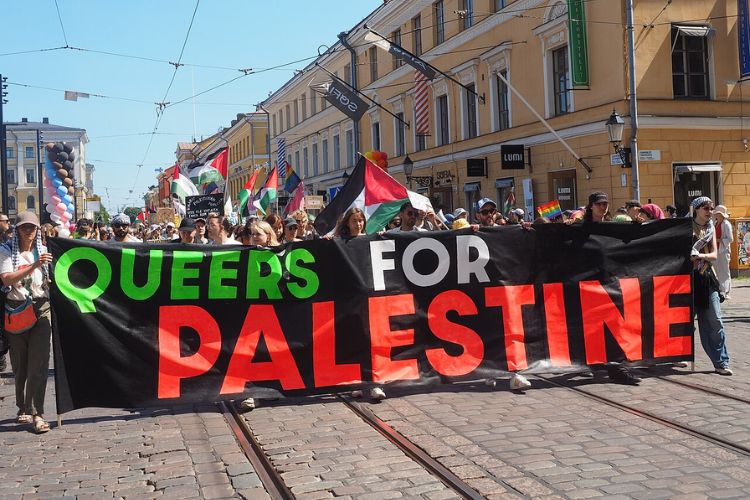
Suicidal Empathy: Why the Socialist Left Is Empowering Islamism
To most people’s surprise, some of the most influential political alliances are not formed between ideological allies, but between ideological opponents.
One of the best examples of this is what scholars call the Red-Green Alliance, which is an alliance between secular progressives (‘Red’) and Islamists (‘Green’).
The progressive movement promotes secularism, feminism, LGBTQ rights, and individual autonomy, while Islamists want to order public life according to the Qur’an and the Sharia.
Despite these profound ideological differences, the two find common ground in their hatred towards the West, nationalism, and of course, Israel.
There is an important aspect that is often not asked. Given their ideological differences, it is inevitable that one side will exercise greater influence over the coalition than the other. It’s true that political alliances begin with shared grievances, but over time the movement with the more comprehensive moral framework is more likely to shape the coalition’s direction.
Progressivism and Suicidal Empathy
I will begin by looking at the progressive side of the coalition by looking to Gad Saad who offers an important insight into one dimension of this phenomenon through his concept of “suicidal empathy.”
His theory helps explain why some progressives are reluctant to subject what are labelled marginalised groups or ideologies to the same level of moral scrutiny that they apply to others. Groups viewed as historically marginalised therefore acquire a degree of moral immunity from criticism because disagreement itself is interpreted as hostility towards victims. In many Western institutions, identity and historical oppression go hand in hand.
These frameworks define the boundaries of working relationships, which helps to explain why progressive activists excuse illiberal positions with Islamists, but are unwilling to do it with Christian conservatives.
Within their moral framework, the decisive issue is not the content of a group’s beliefs, but where the group is located within perceived structures of power and oppression.
Islamists are granted the baffling courtesy of being part of marginalised groups, despite the overwhelming evidence to the contrary. At the same time, conservative Christians are viewed as part of the privileged of society.
As a result, any criticism of Islam is often treated as reinforcing oppression, whereas criticism of the latter is regarded as an act of justice.
This results in an asymmetrical moral landscape in which two groups with comparable views on issues such as sexuality or gender are judged according to different standards because of the identities they represent — rather than the ideas they advocate.
Two Competing Moral Structures
The asymmetry within the coalition reflects a deeper difference than political strategy. It arises from the moral architecture of the two movements themselves.
To be sure, empathy is very important as a moral virtue, but it cannot serve as an organising principle of civilisation. Every society must answer questions that extend beyond compassion if it hopes to make consistent moral judgments.
Among the questions every society must answer are these: What is a society’s source of authority? After all, every society needs a final standard that determines what is true, good, and morally binding.
For many progressives, moral authority is frequently located in lived experience, identity, and an evolving moral consensus, whereas Islamists locate ultimate authority in divine revelation as expressed through Sharia Law. Every moral framework must also explain how competing values should be prioritised.
Socialist Leftist Morality
Every political movement tells a story about the source of human suffering.
For the progressive left, oppression functions as the central explanatory framework. History is understood largely as a struggle between marginalised groups and systems of power based on race, gender, sexuality, colonialism, or economic inequality.
In this narrative, injustice persists because dominant institutions perpetuate unequal power relationships. The moral task, therefore, is to dismantle oppressive structures, amplify marginalised voices, and create more equitable social arrangements.
Islamist Morality
The Green Alliance operates from a fundamentally different theodicy.
Islamist movements generally locate the world’s disorder not primarily in social structures but in humanity’s rebellion against God’s revealed will.
This is a fundamental difference that sometimes Westerners are not aware of.
Over time, much progressive thought has shifted from grounding morality in universal reason to grounding it in lived experience, identity, and moral sentiment.
Islamists reject both approaches. For them, divine revelation — not autonomous reason or subjective feeling — remains the ultimate source of authority. Revelation trumps both reason and feelings.
From their perspective, the solution is not merely political reform but submission to God through the implementation of Sharia Law and the restoration of a rightly ordered Islamic society.
In this framework, justice is achieved when human life conforms to divine revelation rather than autonomous human judgment.
This differs fundamentally from the progressive account of oppression, which seeks liberation through the transformation of social structures rather than submission to divine authority.
The More Robust Moral System: Islamism
This is where Islamism has a more robust source of continued influence.
It has a comprehensive understanding of authority, community, sacrifice, and moral obligation.
It provides the moral framework capable of sustaining long-term political and social movements rather than a postmodern understanding that merely reacts to changing cultural conditions.
It can form institutions that educate future generations and sustain long-term commitments because its members understand themselves as participating in something larger than the political moment.
They are working on behalf of God, which supplies them with a divine purpose.
By contrast, movements organised primarily around feelings and changing cultural priorities often revise their priorities as cultural circumstances evolve.
This explains why Islamists are good at influencing political organisations and universities. Their political vision is not limited to protest or social reform but is rooted in a comprehensive religious worldview that includes concepts such as jihad, understood by many Islamist thinkers as the obligation to struggle for the establishment and defence of God’s order in society.
Whether pursued through political, social, or, in some cases, violent means, jihad functions as part of an integrated moral and theological framework rather than as a temporary political slogan.
Red Suicidal Empathy and the Death of Critical Thinking
By contrast, what Gad Saad describes as “suicidal empathy” encourages an unwillingness to critically evaluate the goals and assumptions of groups perceived as marginalised or historically oppressed.
If criticism is treated as a form of victimisation, progressive activists may become reluctant to examine ideological commitments — including Islamist conceptions of jihad — that conflict with their own stated commitments to liberal democracy, individual rights, or gender equality.
In this sense, a coalition driven primarily by empathy may gradually yield intellectual leadership to a movement whose objectives are defined by a more comprehensive and internally coherent vision of political and religious life.
Contrasting Red and Green Worldviews
The contrast becomes even clearer when the two movements are viewed side by side.
Progressive movements often derive their moral language from concepts such as equality, liberation, and historical redress.
Islamist political movements derive their political vision from religious commitments that they understand to possess transcendent authority.
These traditions should not be collapsed into simplistic categories, nor should all Muslim individuals or organisations be treated as sharing identical political goals.
Nevertheless, where Islamist movements explicitly seek to organise political life according to religious principles, they operate from a framework that integrates theology, law, ethics, community, and political purpose into a unified vision. That comprehensive character gives such movements a different kind of organisational coherence than movements whose moral vocabulary is more fluid and responsive to changing cultural conditions.
The Red-Green Alliance therefore illustrates a broader principle about political coalitions that are at work. Alliances are not sustained merely by shared enemies, but by the moral frameworks that animate them.
Movements organised primarily around empathy often struggle to resist partners whose vision — such as Islamism’s — is destructive.
If my analysis is correct, the long-term question is not whether the alliance will survive but which moral framework will ultimately define it.
The answer to that question should be obvious.
Progressives that champion their cause for justice will have blood on their hands.
___
Bibliography
Qutb, Sayyid. Milestones. Revised edition. Translated by A. B. al-Mehri. Birmingham, UK: Maktabah Booksellers and Publishers, 2006.
Saad, Gad. Suicidal Empathy: Dying to Be Kind. New York: Broadside Books, 2026.
Small, Charles Asher, and David Harris, hosts. “Fighting Antisemitism: The ISGAP Hour – Asra Nomani.” Featuring Asra Nomani. JBS. YouTube video. July 23, 2025.
___
Image via Wikimedia Commons.
6 Comments
Leave A Comment
Recent Articles:
26 October 2026
4.5 MINS
OECD chief Mathias Cormann warns Australia is losing its competitive edge, as excessive regulation, housing pressures, immigration challenges and declining public trust threaten national prosperity.
26 October 2026
2.5 MINS
Nation First exposes the rush to weaponise the Haines attack against Pauline Hanson, conservative voices and men before investigators established a motive.
26 October 2026
5.1 MINS
Anthony Albanese calls for civility after the Helen Haines attack, but revelations of a political dirt file raise uncomfortable questions about his government’s own conduct.

26 October 2026
3 MINS
Australia’s national resilience inquiry overlooks a critical weakness: decades of deindustrialisation have left the nation dangerously dependent on imports, unprepared for compounding threats and strategic disruption.
26 October 2026
2.9 MINS
A powerful display of thousands of shoes highlights Australia’s escalating male suicide crisis, while Dads4Kids celebrates fatherhood, family connections and practical action to strengthen generations.
26 October 2026
3.2 MINS
Following Paul's example in Ephesians 1, let us pray for the Father to open the eyes of our hearts so that we may grasp the hope of his calling, the riches of his glorious inheritance in the saints, and the greatness of his power towards us who believe.

25 October 2026
4 MINS
Prayer is active partnership with God, and he is awakening his body to prayer, not by might or by power, but by his Spirit.



Quote ” When the revolution comes “(from Mahoud Fazal + Kate McGuinness ‘s threat to Gina Rineharts’ life ) we know that which side will win , and , it’s not the ” Queers for Palestine ” , etc. What a bunch of Fools !
Very good point. The same thing happened in 1979 during the Iranian Revolution. After Khomeini took power, the regime started killing the Marxists. When it comes to the Red/Green Alliance, the Green will always win.
Chants like “Free palestine”, “From the river to the sea”, and “Globalise the intifada” are calls for the destruction of Israel and harm to Jewish people. These chants stem from their ties to militant groups and violent uprisings
“From the river to the sea” demands the geographic elimination of Israel, which sits between the Jordan River and the Mediterranean Sea, leaving no room for the Jewish sovereign state of Israel.
Because militant organisations like Hamas, Hezbollah, PIJ, et.al. use the phrase alongside goals of Israel’s destruction, these calls are a denial of Jewish self-determination and an implicit call for the forced displacement or elimination of the millions of Jews living there.
The Hamas charter calls for the death of all Jews.
“Globalise the intifada” An “intifada” refers to the violent Arab uprisings against Israeli rule (marked by bombings, shootings, and attacks during the First and Second intifadas).
Calling to “globalise” this uprising translates to exporting that violence worldwide, effectively encouraging physical attacks, harassment, and vandalism targeting Jewish individuals, synagogues, and institutions globally.
This is manifest by the 700-1,000% increase in antisemitic attacks and events in the last few years.
“Free Palestine” on its own is a broad political demand for Palestinian independence, its meaning changes significantly when paired with the previous phrases. When contextualised by a demand for the entire territory (“river to the sea”) achieved through global militancy (“globalise the intifada”), “freeing” the land is viewed not as a peaceful call for coexistence, but as a euphemism for the total removal of the Jewish presence both in Israel and even globally. The “freedom” of one group is structurally dependent on the complete erasure of the other.
chants such as “From the river to the sea” and “Globalise the intifada” cannot be treated as neutral expressions of concern for Palestinian suffering. Zionism begins with the conviction that the Jewish people are a historic nation with the right to self-determination in their ancestral homeland. Any political slogan that imagines Palestinian freedom through the disappearance of Israel therefore strikes at the heart of Jewish national existence..
This matters because the slogan is not historically detached from the movements that have popularised it. Hamas, Palestinian Islamic Jihad, Hezbollah, and other militant organisations have used similar language while openly rejecting Israel’s legitimacy. In that ideological setting, the phrase does not mean two states living alongside one another. It means replacing Israel with another political order stretching across the entire land.
Gaza’s suffering is real. So is the industry built around packaging, directing and selling it to the world. The suffering is caused by radical Islam in the form of Hamas, PIJ, et. al.
For Hamas, the camera is a weapon. Ruined buildings, grieving parents and injured children are converted into political ammunition before anyone has established the facts. The more horrifying the image, the further it travels, and the less likely anyone is to ask who filmed it, what was left outside the frame or who benefits from its circulation.
A profitable influencer economy has grown around this machinery. The formula is simple: place a vulnerable child before a camera, add mournful music and a donation link, then let Western guilt do the accounting.
Gazan influencer Saleh Al Jafarawi helped promote a campaign that collected almost $10 million for the reconstruction of Al-Nasr Children’s Hospital. The Palestinian Health Ministry in Ramallah denied any involvement and warned against the use of its name and logo. Emotional appeals can raise millions long before donors have any realistic means of establishing who controls the money.
The manipulation of imagery can be even more effective. A photograph of the severely emaciated toddler Mohammed Zakaria al-Matouq appeared prominently on the front page of The New York Times as a symbol of starvation. The paper later acknowledged that he had pre-existing health problems affecting his brain and muscle development. His condition does not rule out malnutrition, but omitting it deprived readers of essential context.
The photographer, Saher Alghorra, later received the 2026 Pulitzer Prize for a Gaza series praised for depicting “devastation and starvation”.
German media reports also raised questions about photographs of children holding out empty pots after wider footage appeared to show that no food distribution was taking place. The photographer denied staging the scenes, but the episode showed how quickly a selectively framed image can become global “evidence” before proper verification has even begun.
Not every photograph from Gaza is false, nor is every appeal fraudulent. Genuine misery is precisely what gives manipulation its power.
It provides cover for selective framing, opaque fundraising and a propaganda system that understands Western psychology better than many Western journalists understand Gaza.
Children are not protected within this system. They are filmed, circulated and turned into symbols. Their fear becomes content, their wounds become currency, and their faces shield the adults who began the war, embed themselves among civilians and profit from its continuation.
The world calls it humanitarian storytelling. Hamas calls it strategy. For those exploiting it, suffering has become a business model. We call it #Pallywood.
The children are left with the trauma. Everyone else collects the dividends.
https://www.facebook.com/share/v/19DsmzwbLq/
Gaza’s suffering is real. So is the political and media machinery that packages, directs, and distributes that suffering to audiences around the world. A Christian response must be capable of holding both truths together. Palestinian civilians are experiencing genuine misery, but their suffering cannot be separated from Hamas and Palestinian Islamic Jihad—movements that initiated the present war, militarised civilian society, and have repeatedly treated the deaths of their own people as political assets