


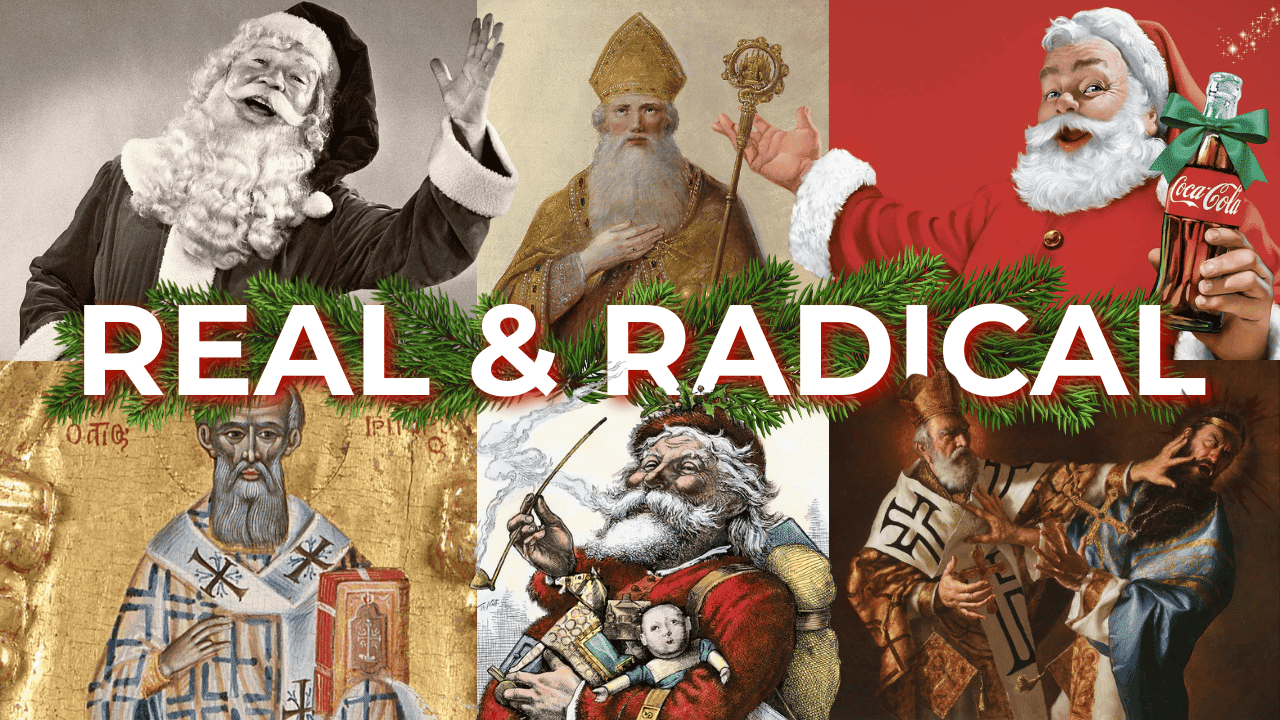
How a Persecuted, Pro-Life, Culture-Warring Bishop Became Santa Claus
Forget the jolly cartoon—Santa Claus was a real Christian hero. Historian William Federer reveals St. Nicholas’s courageous faith, radical generosity, and the true, deeply Christian roots of Christmas traditions.
A historian says, “There really is a Santa Claus.”
Most of us grew up with a cartoon version of Christmas: a jolly man in a red suit at the North Pole, flying reindeer, elves, and a vaguely “pagan” Christmas tree that serious Christians are allegedly supposed to frown at. William J. Federer, however, is not content with cartoons. He’s a respected Christian historian, best-selling author, and the man behind There Really Is a Santa Claus: The History of St. Nicholas and Christmas Holiday Traditions, as well as the popular AmericanMinute.com daily history emails.
In a three-part video interview with me, Federer walks us through the gritty, deeply Christian roots of Christmas traditions that have been trivialised, commercialised, or misrepresented as pagan. Far from being a sugary distraction, the true story of Santa Claus and Christmas is about persecution, courage, pro-life conviction, and the triumph of the gospel over paganism.
Was Santa Claus Real?
Under the Roman Empire, the church was born into a one-world, anti-Christian state. For three centuries, Christians were thrown to lions, burned as human torches, and hunted from province to province. It was in this world that Nicholas was born in what is now Turkey, then part of the Roman Empire.
Nicholas became the most beloved saint of the Greek church – to them what St Peter is to Roman Catholics or St Patrick to the Irish. He was a genuine, flesh-and-blood Christian bishop of Myra, not a North Pole mascot.
Early in life, Nicholas embraced a wave of “pietism” that urged believers to give away their possessions and live wholly devoted to God. He took that call seriously. Wanting no credit, he began sneaking through his town at night, throwing money through the windows of the poor.
The most famous story tells of a bankrupt father whose three daughters were at risk of being taken into sex slavery by creditors. Nicholas secretly provided three bags of gold on three separate nights, giving each girl a dowry so she could marry instead of being trafficked. The gold was said to have landed in shoes or stockings drying by the fire, planting the seed for our traditions of stockings and secret gift-giving.
Art across the Middle Ages depicts Nicholas as a bishop with three golden balls, symbolising the bags of gold he used to rescue those girls. Those same three balls later became the sign of pawnbrokers, a commercial echo of a Christian act of radical generosity.
Was St Nicholas a Soft, Jolly Figure – or a Christian Activist?
Far from a sentimental grandfather figure, Nicholas lived through savage persecution. Under the emperor Diocletian, he was imprisoned and nearly martyred. When Constantine legalised Christianity in AD 313, Nicholas emerged from prison and immediately began preaching publicly against the state’s pagan practices: human sacrifice, temple prostitution and the exposure of unwanted infants.
In the Roman world, a father could simply refuse a newborn; the child would be abandoned to die or be taken and raised for prostitution or slavery. Nicholas vigorously opposed this, just as Christians today oppose abortion. He also confronted the occult practices of divination and the lurid immorality surrounding temples like that of Diana at Ephesus. If he lived today, Federer argues, Nicholas would be known as a pro-life, pro-marriage, anti-LGBT sexual revolution activist, not a neutral holiday mascot.
He also defended the faith doctrinally. When the first major heresy, Arianism, claimed Jesus was a created being “less than God”, Constantine summoned bishops from across the Christian world to the Council of Nicaea in AD 325. There, Nicholas famously slapped the heretic Arius in his zeal for the deity of Christ – the very doctrine at the heart of Christmas. The “jolly old St Nick” of legend once risked censure and punishment for defending the truth that the baby in the manger is fully God, fully man.
Nicholas’s courage extended to politics. One ancient account tells of a corrupt governor arranging the execution of innocent men to cover his own crimes. Nicholas reportedly rushed to the scene, seized the executioner’s sword, threw it down and exposed the governor’s secrets in public. Under conviction, the governor begged Nicholas to pray for mercy. If Nicholas were alive now, Federer suggests, we’d see him confronting corrupt officials on the steps of Parliament, not just posing for shopping-centre photos.
Isn’t Christmas Pagan? The Real Story of 25 December and the 12 Days
One of the most popular modern claims is that Christmas is “just a baptised pagan festival” tied to the winter solstice. Federer patiently dismantles that myth by pointing to the church’s concern with dates long before the debate over the solstice.
Luke’s Gospel tells us that John the Baptist’s father, Zechariah, served in the temple “of the course of Abijah”. Ancient Jewish records, confirmed by the Dead Sea Scrolls, connect that priestly rota to late September, around the Day of Atonement. From there, the early church calculated John’s conception, then counted forward six months to Mary’s conception of Jesus (traditionally 25 March), and nine more months to His birth – 25 December. In other words, the Christian reasoning runs from Scripture and Jewish calendars, not from copying pagans.
Eastern Christians historically focused more on 6 January, the Epiphany, marking the visit of the Magi and Christ’s manifestation to the nations. Unable to decide which date was “holier”, church leaders in AD 567 declared that the entire period from 25 December to 6 January would be a season of “holy days” – the original twelve days of Christmas. Over time, “holy day” simply slurred into “holiday”, but the season itself is emphatically Christian from start to finish.
Yes, pagans had solstice festivals. But the church’s instinct was not to join them; it was to proclaim Christ’s lordship right on top of them – replacing pagan feasts with celebrations of the true Light of the world.
Are Christmas Trees Pagan?
Another modern worry is that Christmas trees are secretly pagan. The history, again, runs the other way.
In 8th-century Germany, pagan tribes worshipped Thor and Woden, performing sacrifices before a sacred oak at Geismar. On Christmas Eve, the missionary Boniface (also known as Winfred) walked into the village, raised an axe, and chopped Thor’s oak down, dramatically challenging the false god to defend his own tree if he could. With the idol shattered and no lightning bolt forthcoming, Boniface pointed to a nearby evergreen and declared, “Let this be the tree of the Christ child. Let there be no more shedding of blood tonight.”
The evergreen’s unchanging colour in winter became a natural symbol of eternal life. Its triangular shape was soon used to teach the Trinity – Father, Son and Holy Spirit, three in one. Centuries later, Martin Luther is said to have brought an evergreen into his home on Christmas Eve, setting candles on its branches to show his children a picture of the starry sky over Bethlehem the night Christ was born. The idea of lights on the tree also sits comfortably alongside the Jewish Feast of Dedication, Hanukkah, which Jesus Himself observed and which already featured candlelight in mid-winter.
Far from being a pagan holdover, the Christmas tree is a symbol of Christian defiance over paganism and a visual sermon about the eternal, triune God and the birth of His Son.
How Did St Nicholas Become “Santa Claus”?
As centuries passed, Nicholas’s story travelled. His relics were moved from what is now Turkey to Bari in Italy when Muslim armies threatened to desecrate Christian graves. The Italians eagerly adopted his gift-giving traditions, which sometimes slid into distraction. To refocus attention on Christ, St Francis of Assisi introduced live nativity scenes in 1223, deliberately drawing eyes back to Jesus in the manger.
The Reformation added another layer. Martin Luther, wary of an overload of saints’ days and statues, ended the liturgical focus on saints while keeping the German love of gift-giving. He shifted presents from Nicholas’s feast on 6 December to Christmas Day and insisted that “all gifts come from the Christ-child” – the Christkindl. Over time, Christkindl morphed in popular speech into “Kris Kringle”, which originally meant Christ, not Santa.
The Dutch, who loved St Nicholas, carried his traditions to New Amsterdam (later New York), naming their first church there after him and sailing with his figure on their ships’ prows. In Dutch, Sint Niklaus slurred into “Santa Claus”. American writers like Washington Irving and Clement Clarke Moore (“’Twas the night before Christmas…”) reshaped him into a smaller, pipe-smoking, sleigh-riding gift-giver. Civil War cartoonist Thomas Nast fixed him in the North and added the North Pole motif. Coca-Cola’s 20th-century advertising then globalised Nast’s red-suited, full-sized, jolly Santa image.
Under all those cultural layers, Federer insists, is still the real Nicholas: a Greek Christian bishop, imprisoned for Christ, who gave generously to the poor, defended sound doctrine, opposed sexual immorality and paganism, and stood up for the vulnerable. Santa Claus is simply the heavily mythologised version of a very real, very courageous Christian.
Just Scratching the Surface
This article can only skim the surface of the rich, surprising, and deeply Christian history behind Santa Claus, Christmas trees, dates, and traditions that moderns either take for granted or dismiss as “pagan”. My full three-part interview video series with William Federer goes into far greater depth, tracing the story from the Roman persecutions to the Reformation and right through to Coke-red Santa. What you’ve just read is only a brief summary of that much more comprehensive and detailed exploration – so enjoy the videos!
___
Republished with thanks to Church and State.
2 Comments
Leave A Comment
Recent Articles:

13 October 2026
2.6 MINS
Allegra Spender’s proposed bill reignites debate over discrimination protections, religious freedom and the right of faith-based schools to uphold their beliefs and values.

13 October 2026
3.9 MINS
Tasmania’s proposed conversion practices law raises serious concerns for churches, parents and faith-based schools, with broad definitions, severe penalties and uncertain protections for religious freedom.

13 October 2026
5.5 MINS
Stephen Baldwin’s journey from drug addiction to sobriety, Christian faith and family life reveals how surrender, daily discipline and renewed hope transformed his life.
13 October 2026
2.8 MINS
The church in Ephesus had so much going for it. Yet despite their hard work, perseverance, endurance, and discernment, there was something deeply wrong: they had left their first love.

12 October 2026
4.6 MINS
Learn how journalists use loaded language, selective quotes and misleading headlines to shape public opinion, using a controversial report about James and Joanna Howe as a case study.
12 October 2026
12.9 MINS
God’s judgement can seem difficult to reconcile with His goodness. But Scripture presents God’s perfect justice as something we can celebrate — and His present offer of mercy through Jesus as the good news.
12 October 2026
3.7 MINS
An EU court case over baptismal records could pit data protection laws against religious freedom, raising serious questions about whether governments can compel churches to erase sacramental history.



Phew ! with a sigh of relief, modern Christmas traditions can be enjoyed with a clear conscience again 😃…
But knowledge of the truth is first required, isn’t it ! Thanks for sharing this, Dave.
Here’s the issue I find : people often don’t WANT to hear or discuss objective “truth”.
We sinners want “our truth” to be the only truth we need; anyone who tries to dislodge our truth is being academic, highfaluting, even downright annoying.
May every one exposed to the truth of the biblical meaning of “Christmas” this year,
receive the light of God’s truth into their watching eyes and listening hearts, to draw them towards the One who is the Light of the world, Christ Jesus our Lord and Savour.
That person may have existed but to say the celebration of Xmas is purely Christian in roots and has no paganism in it is utterly false. It wasn’t celebrated by the Christians from the time of Christ until 300 yrs later. Look at the history of it in the USA in the early days it there was considered non Christian and so did once England. The shepherds were not in the hills with sheep in their winter which it was when Christ was born. The wise men there is zero mention of how many there was, 8 people, any number could have brought the gifts in number. They were not at the birth of Jesus they visited “the child in His home” the bible clearly teaches this, read it. They didn’t visit the baby. By the time they found Him he was understood to be near 2 yrs old, a child in His home. The Santa you look at now is a Coca Cola santa and we have a celebration that lies to children telling them about someone with abilities or attributes that God alone has, “all seeing, all knowing”. Christ Mass, its an early mish mash from Roman Catholicism, Christ-Mass. Don’t be fooled theres nothing holy about it. People listening to songs by singers that live anything but a Christian life. I get Roman Catholics doing Christ Mass but others why? Here’s todays Santa. The past guy has nothing to do with Christ Mass people celebrate.
https://youtu.be/5qOQhQmyX5E?si=2Rk8OdxZVjukIV8u