


Are Pagan Festivals the Reason We Celebrate Christmas on 25 December?
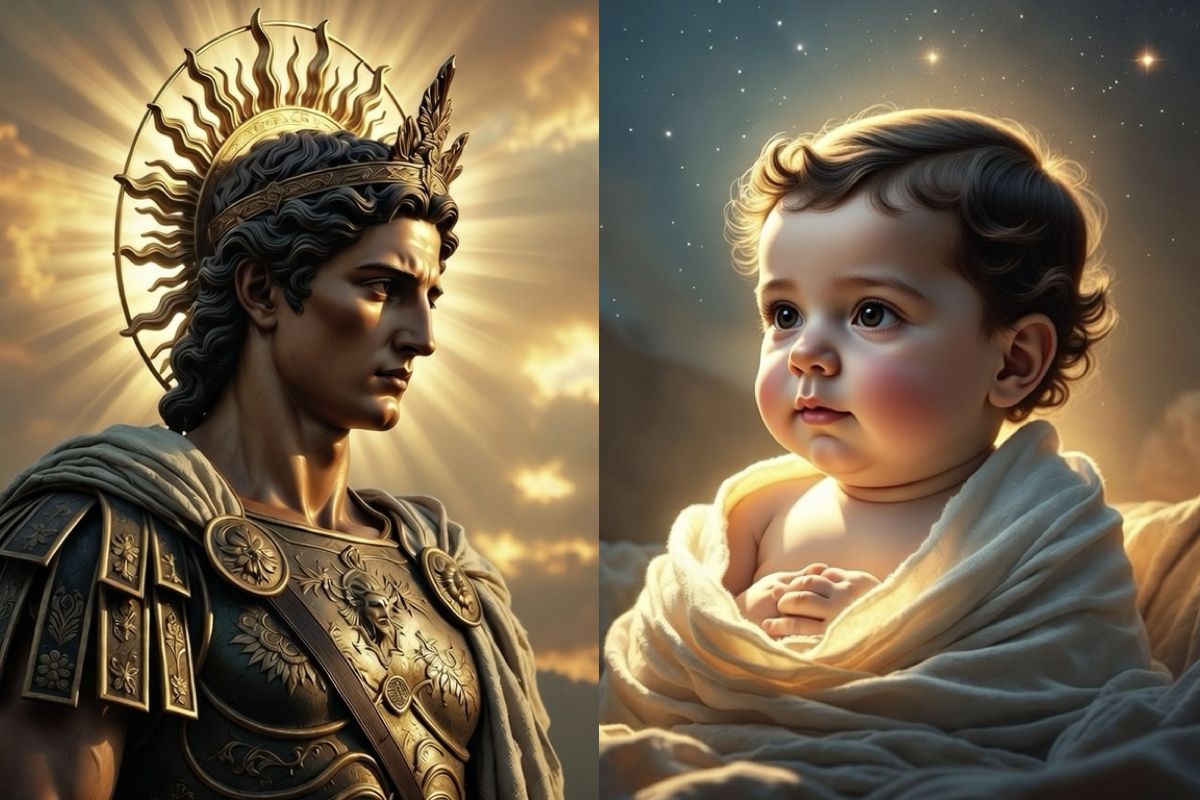
It’s widely claimed that Christians adapted ancient Roman holidays — and borrowed 25 December — in an effort to make Christmas more palatable to pagans. But what if the the evidence points in the opposite direction: that pagans adjusted their feasts to rival the popularity of Christmas?
Every December, a familiar claim resurfaces: that Christmas was originally a pagan holiday — and Christians later claimed 25 December for themselves to help pagan converts feel more comfortable celebrating a Christian feast.
But what if the opposite is true? What if Christmas was already well established — and pagan festivals were strategically moved to the 25 December in an attempt to piggyback on its popularity?
I’ve previously discussed the alleged pagan origins of Christmas, but not examined in depth the claim about rebadged pagan holidays — the two major contenders of which are Sol Invictus and Saturnalia.
So, let’s take a closer look at the evidence.
Sol Invictus: Pagan Sun Under Christian Shadow
Sol Invictus — the “Unconquered Sun” — was the official sun god of the late Roman Empire.
Sol had been worshipped in Rome for centuries, but his cult remained minor, with observances scattered across the year — most notably with an annual sacrifice on August 9. It was only in the late third century, under Emperor Aurelian, that Sol was elevated to a supreme deity and came to be associated with 25 December. Even then, celebrations on that date were largely confined to the city of Rome.
By the time 25 December became more widely recognised as Sol Invictus’ feast day, there is strong evidence that Christians had already been celebrating Christmas on that date for decades. In a sermon preached in 386 AD, for example, St John Chrysostom described celebrating Christmas on December 25 as a “long-standing tradition.” Most Christian calendars of that period corroborate his statement.
We also know that as Christianity spread, Roman authorities increasingly viewed it as a threat to social cohesion and established patterns of worship. As such, the evidence suggests that pagan rulers ultimately cemented 25 December as the feast day of Sol Invictus in response to the growing popularity of Christmas, not the other way around.
Saturnalia: Chaos, Not Christmas
Saturnalia — the ancient Roman holiday for the god Saturn — is the other festival often cited as a pagan precursor to Christmas, since it took place in December and involved feasting and gift-giving. However, the resemblances are superficial at best.
Saturnalia was originally held on 17 December. In time, it was extended until 19 December, and then until 23 December — but never 25 December, the date on which Christians celebrated Christmas. The simple fact is that there were so many Roman festivals throughout the year that any new Christian holiday was bound to fall near a pagan celebration. In other words, Saturnalia’s proximity to Christmas was incidental.
More importantly, the customs associated with Saturnalia were anything but Christian. Lucian of Samosata, writing in the second century, famously personified Saturn to describe the festival’s diabolical antics:
During my week, the serious is barred. No business allowed. Drinking and being drunk, noise and games and dice, appointing of kings and feasting of slaves, singing naked, clapping of tremulous hands, and occasional ducking of corked faces in icy water, such are the functions over which I preside.
Think what you will of Christmas, but Saturnalia bears little resemblance to it. The chaotic celebrations of this Roman feast — crowning a “king of the slaves,” turning social hierarchies upside down, getting drunk and gambling, singing in the nude, dunking people in freezing water — are as far from the meaning of Christmas as one can possibly imagine.
The only similarities of note are the sharing of food and the exchanging of gifts — points that popular sites like Wikipedia and Britannica like to emphasise while downplaying the incongruence of Christmas with Saturnalia’s more bizarre customs.
The Date Christians Claimed First
So where did 25 December as the date for Christmas originate? As I explained in my previous article on the alleged pagan origins of Christmas:
December 25th is exactly nine months after March 25th — the date that Tertullian calculated for Christ’s crucifixion. Since the fourth or fifth century, March 25th is also when the Feast of the Annunciation is celebrated — marking when Jesus was conceived in Mary by the Holy Spirit. In other words, the early church believed that Jesus was conceived and crucified on the same day, making December 25th his birthday.
And the rest is history. By AD 336, the Chronograph of 354 records Christmas being observed on 25 December, confirming the date in early Christian practice.
However, there is another point to consider.
The claim that Christians rebadged festivals like Sol Invictus or Saturnalia to make Christmas more palatable to pagans collapses under an even simpler test: no early Christian source ever says this.
Surely, if Christians had sanitised pagan holidays to make Christmas more appealing to the masses, they would have said so. Yet the Church Fathers never make this claim. In their sermons, calendars and correspondence, they consistently make theological arguments for 25 December as the date of Christ’s birth, and don’t even mention an incidental link to Saturnalia or Sol Invictus.
At best, it appears that the connection between Christmas and those early pagan feasts is indeed only incidental.
Moreover, if one did borrow from the other, the direction is unmistakable: Christmas was already firmly established on 25 December long before Sol Invictus was celebrated on that date throughout the Roman Empire, while Saturnalia never coincided with it at all.
Far from co-opting pagan holidays, Christmas was so influential that Roman authorities apparently made their own attempts to displace the popular Christian celebration.
They failed, while Christmas endured — and 20 centuries later, we are still celebrating the birth of the Christ child whose influence transformed the Empire and civilised our world.
9 Comments
Leave A Comment
Recent Articles:

24 October 2026
3.3 MINS
When we ask God, "What is in my hand?", and see our possessions, money and time as seed that God asks us to sow, life becomes simpler.

23 October 2026
6.8 MINS
Hillsong UNITED’s Joel Houston reflects on fame, faith and the burden of ministry, questioning performative Christianity as he seeks a more authentic walk with God.

23 October 2026
13.1 MINS
Tasmania’s proposed conversion practices legislation raises serious questions about religious freedom, pastoral care and whether Christians can freely pray with those seeking to live according to their faith.

23 October 2026
3.1 MINS
As Western societies grow more hostile, could abandoning Christianity’s moral foundations be contributing to the rise of ideological extremism, political intolerance and violence?

23 October 2026
5.1 MINS
France’s escalating riots expose the dangers of political extremism, antisemitism and radical alliances, offering America a stark warning about the future of Western democracy.
23 October 2026
3.1 MINS
The one who is worthy of it all is awakening his Church to be captivated by him, so that we will honour one another and share his gospel with humility and courage.
22 October 2026
2.9 MINS
Victoria Labor’s promise to fund free abortions has drawn a forceful response from Presbyterian leaders, raising profound questions about unborn life, government priorities and Australia’s moral direction.



WOW!!! An amazing article. Thank you Kurt. I have been suffering under the illusion that Christmas was originally a pagan festival for 60 years. NO one has explained any different. This makes wonderful sense and lines up with all of human history over the last 2,000 years everything that is good comes from Christ. The proof is irrefutable!!!! Soli Deo Gloria!!!!
Kurt, just reading Simon Montefiore’s book “The World” shows what a vile place ( cannibalism, depravity, etc ) the whole world was without Christianity. I am sad “Santa” has replaced the real meaning of Christmas, the birth of our Saviour, Jesus Christ, which in Australia is no longer mentioned by the Media.
One can come up with compelling arguments that the Earth is flat too, that doesn’t change the fact that its not.
What is present at Chist Mass?
Images of Christ, God. What does the Bible teach on this subject?
Exodus 20 v 4
“Thou shalt not make unto thee any graven image, or any likeness of any thing that is in heaven above, or that is in the earth beneath, or that is in the water under the earth.”
Nativity scenes depict an image of Christ as a Baby. You have presented a picture of a supposed Christ in this article!
We see lots of support for the Jewish communities here. The Oracles of God were first given to them in the Old Testament. Do the Jews use images of God? No, they even take care when writing His name like this G-D.
“The Jewish concept of G-d is an intangible Being with no physical form. Therefore there is no way to draw or sculpt an image of Him. Physical images and idols are very strongly prohibited in Judaism” If you can’t draw or create any image of God then why do it of Christ? Christ is God.
Isaiah 40 v 18
“To whom then will ye liken God? or what likeness will ye compare unto him?”
The Bible doesn’t describe Christ but man using his vain imagination creates his own images.
John 4 v 24
“God is a Spirit: and they that worship him must worship him in spirit and in truth.”
Not images.
The Wise men. Nativity scenes depict three wise men at his immediate birth. That didn’t happen, read the Bible when they visited Him. The child in his home. The Bible doesn’t say how many there were either. 3? where does it say three? Three types of gifts means that however many there were these were the gifts given traditionally. 5 people could have presented three types of gifts!
If Christ Mass, yes its a Roman Catholic Word, two words turned into 1, was to be celebrated then why for the first 300 yrs after Christ didn’t it exist?
Rather than use excuses and and the words of men ask yourself “what does the Bible teach, not men, but what does Gods Word teach?”
Gods Word teaches not to make images in any form, to not make up for ourselves men made holy days and to worship Him in the way He prescribes, not men.
One can over and over find ways to excuse anything they want, that what man’s fallen mind and corrupted hearts want, justification in everything they want to do. Ask yourself what does God want me to do? What does the Bible teach in how we worship God? Did God go through all that He did giving us recorded history from the Old Testament through to the New Testament up until the End Times to then leave us to worship Him according to our own devices?
It is blasphemy to even suggest He would. We see all through the Bible how corrupted man becomes when left to his own devices, the golden calf, adopting the religious practices of those around them, the expecting new Christians to follow the old laws such as circumcision and don’t eat this, eat that (does that sound familiar at Easter?)
The followers of Christ never celebrated Jesus birthday, followers for near 300 years didn’t either.
Worship God according to his Word, not mens vain imaginations and made up false holy days.
Read the Word.
You have given Zero Bible proofs that we can practice Christ Mass, all you have done is present your, man’s reasons why we should. I have given Biblical proofs of the error of practicing Christ Mass.
Your teaching error based upon the imaginations of men with no Bible proofs.
There is no good scholarship which supports modern superstitions about pagan links to Christian holy days.
There’s just none. No quality exegesis or hermeneutics. No primary source documentation. No support in Church history.
The Reformation & Puritans rejected all saints days, but for different reasons, throwing the baby out with the bathwater.
“Everything is pure to those whose hearts are pure. But nothing is pure to those who are corrupt and unbelieving, because their minds and consciences are corrupted.” – Titus 1:15
Why is there no date in the Bible when Jesus was born? If Jesus wanted us to celebrate His birthday, wouldn’t the Bible tell us the exact day? No! Jesus left explicit instructions on how His followers were to commemorate His DEATH, not His birth! (1 Cor.11:23-26). To partake of Communion on a regular basis. The early church never celebrated it; and there is no record of the Disciples cutting down a tree to decorate it. December 25 is traced back to Baal worship, the sun god of ancient Babylon. If people did the real biblical and historical research (not through Wikipedia and such) they would find truth. Even that Christmas Card slogan “Jesus is the Reason for the Season” is a lie, for Jesus is NOT the Reason for the Season!
There are many inconsistencies surrounding Christmas. Why go into debt for thousands of dollars to celebrate the “birthday of Jesus” when no where in the Bible does it tell us to do so?
A lot of Pastors acknowledge that Christmas has pagan roots, yet they wrap it up in Christianity to make it acceptable to God. God is Holy and does not accept compromise. He does not share with Satan and idols. A pagan holiday remains a pagan holiday and everything associated with it. Even Santa gets a mention! If Christmas was a Christian holiday centred on Jesus, why does Santa take centre stage?
God told us never to blend in with the world, but to separate. Rev.18:4, “…Come out of her, my people, lest you share in her sins, and let you receive her plagues”. The Apostle Paul in 2 Cor.6:14-17 reminds us “For what communion has with darkness? What agreement has the temple of God with idols?” God says His days are holy and sacred.
Deut.22:11 says not to wear a garment of different sorts, such as wool and linen mixed together. Linen represents God’s Spirit of Righteousness in our lives. Wool on the other hand represents a soulish spirit. This verse refers to a spiritual issue: meaning that these two spirits can be active in our life, but they can also leave us open to deception,
It comes down to whether we are willing to obey God (Acts 5:29), or follow man in these false pagan traditions of December 25, for the date has no bearing on the birth of Jesus Christ. It represents a man-made celebration, a tradition of lies, idol worship and deception.
Jesus is coming soon for His Church; a church without spot or wrinkle. (Eph.5:27).
This is a really good article. Thank you for writing it. It presents a very solid and strong argument for Christmas being an organic tradition rising out of Christianity, rather than piggy-backing onto a pagan festival.
Just a few little things.
You state: It was only in the late third century, under Emperor Aurelian, that Sol was elevated to a supreme deity and came to be associated with 25 December. and this is possibly a bit misleading.
Pagans by their very nature are polytheistic, so we can’t see the worship of Sol purely through our own monotheistic lens.
This is the Sun god we are talking about – Sol. And the Roman worship of the Sun (as with many other cultures, including the Egyptians et al) is quite foundational. Sol was already an important diety right from the start of the Roman Republic. The worship of the Sun was foundational to the Roman Republic, who had a temple to Sol Indiges established by Tatius, king of the Sabines in the eighth century BC (Quintillian, Institutio Oratoria, I.7.12; Varro, De Lingua Latina, V.10).
This was 1000 years before Aurelian.
There was also temple to the Sun god in the Circus Maximus (Tacitus, Annals, XV.74; Tertullian, De Spectaculis, VIII.1).
When Julius Caesar instituted his new calendar in 45 BC, December 25 marked the winter solstice. The shortest day of the year. This was to celebrate Sol’s birthday. As from the sun grew from that day.
December 25 became the time when Romans celebrated Sol’s birthday.
You state:
By the time 25 December became more widely recognised as Sol Invictus’ feast day, there is strong evidence that Christians had already been celebrating Christmas on that date for decades. . Once again this seems to be misguided.
The Romans had already been celebrating the birth of the Sun at the winter solstice for centuries. With the Julian calendar, this became the norm from 45 BC.
And here’s another thing. Why do we worship on Sunday?
Well aside from Constantine (after he became a Christian, but still arguably worshipping Sol as well) making Sundays a holiday in 321 AD, is this also an example of us Christians co-opting a day for worship of the Sun god so we could differentiate ourselves from the Jews who worshipped on the Sabbath.
Early Christians knew Jesus as the ‘Sun of righteousness’ and I think the adoption of the Sun’s birthday December 25 as celebrated by the Romans, was quite deliberate. As was the choice of Sunday as the day of worship. They didn’t want to worship on the sabbath because they wanted to worship Jesus – because Jesus didn’t observe the sabbath the way the Jews did. He worked on the sabbath and healed on the sabbath.
But Jesus was (and is) the Sun of righteousness hence why we worship him on days when the Romans worshipped the Sun. December 25 – the Sun’s birthday and Sunday, the day of Sun worship.
Can I suggest the Servant of righteousness per Hebrew language.
With healing in his corners.
Ref: https://www.ancient-hebrew.org/studies-verses/malachi-4-2-the-tsiytsiyt-and-the-sun-of-righteousness.htm (5 minute video)
And yet, as you would well know, the early church were using the Septuagint.
Hence, ἥλιος δικαιοσύνης (hēlios dikaiosynēs): sun of righteousness.
It would be hard to argue against the fact that the early church used the LXX, and therefore saw Jesus as the Sun of righteousness – the light of the world.
But if they were, for whatever reason, referring to the Hebrew, then ‘servant of righteousness’ is a possible interpretation, but a highly unlikely one. I liked how Jeff A. Benner showed some pictures of the Persian and Egyptian sun gods – complete with their wings. Funnily enough, this supports the ‘sun of righteousness’ interpretation. Benner seems to suggest that the LXX got it wrong (and yet these guys were the best of the best, having an excellent command of both the Hebrew and Greek). Given that Malachi was one of the ‘recent’ books (having been written a mere two centuries prior) they would have been reflecting the interpretation of the time. It is highly unlikely they got it wrong. And for an early Christian to be reading Malachi in Hebrew and interpreting it differently to the LXX – the same LXX that Jesus quoted from, then well… let’s just say that would be highly improbable.
Benner also mentions the Masoretic text and shows the vowel points – once again reflecting the interpretation of ‘sun of righteousness’. Now he’s also saying the Masoretes got it wrong! The Hebrew word שמש appears in the Tanakh approximately 134 times, of which almost every use exclusively means sun.
And it’s not as if they were perpetuating the same ‘mistake’ the LXX did. The Masoretes were the experts in ancient Hebrew – moreso than Brenner I suspect.
Moreover, scholars today are reasonably certain that when the Masoretes started their work, they were dealing with a consonantal text that was already well established, that changes had not been made— at least significant changes—for centuries. And so we can, for the most part, rest relatively assured that the Hebrew text we read now (if we read Hebrew!) is the same text that was in place 2000 years ago.
And that’s the one that says ‘Sun of righteousness’.
So let’s bring this back to Christmas. Hark the Herald Angels Sing:
Hail the Sun of Righteousness!
Light and life to all He brings
Risen with healing in His wings
Hail the true Sol. Born on the day of the Solstice – December 25. Jesus the Sun of righteousness – the light of the world.
Constantine converted to Christianity and legalised it in AD 312.
Despite this, Constantine’s coins still prominently featured Sol Invictus (the Unconquered Sun), symbolising his divine right to rule and acting as a bridge between pagan solar worship and emerging Christianity, with common legends like “SOLI INVICTO COMITI” (To the Unconquered Sun, Companion) and depictions of Sol holding a globe or raising a hand, linking the Emperor with the powerful sun god, a practice that also helped ease the empire’s transition to Christianity by aligning with the popular solar cult and its December 25th festival (Dies Natalis Solis Invicti).
So getting back to Kurt’s article, he states: by AD 336, the Chronograph of 354 records Christmas being observed on 25 December, confirming the date in early Christian practice.
But this was obviously because Jesus was seen as the Sun (Sol) of righteousness. Hence his birthday was December 25 – the Solstice (not because of some complicated calculation involving feasts and count backs and numerology – that all seems highly convoluted and unlikely).