


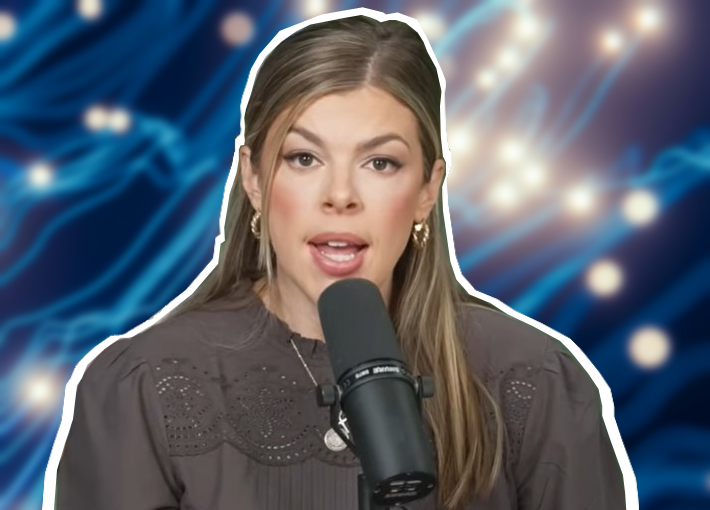
Allie Beth Stuckey vs. AI in the Pulpit: It has a worldview, and it’s probably not God’s.
AI is a powerful tool, but surrendering our God-given creativity, reasoning, and spirituality to a machine comes at a steep cost.
Is Artificial Intelligence (AI) getting a bad rap?
Or is it next-level technology that’s embraceable as long as God’s objective morality governs personal and professional use?
Allie Beth Stuckey just released a video arguing in favour of the latter.
Her reasons are Biblically valid and worth adopting.
AI in the Church: Shortcut or Spiritual Shortfall?
For example, technology that is on the same — “we have become god” — level of human arrogance as the Tower of Babel or the Titanic, is to be handled with as much care as hazardous waste.
Like most tech, AI is a tool, not a toy. It has the power to either help humanity sink, swim or cause it to sin. (See here and here)
Stuckey’s 38-minute segment correctly argues that “Christians desperately need guidelines for how to use AI in the right ways.”
I have firm parameters around how I use tools like Grok because of a big concern I have about what we’re giving up when we outsource our creativity and critical thinking to AI.
I think we’re surrendering part of what it means to be made in God’s image when we trade our reason… pic.twitter.com/BqHq66nLUQ
— Allie Beth Stuckey (@conservmillen) May 19, 2026
This is, Stuckey asserted, because “we risk losing what makes us unique as human beings when we outsource our creativity, our effort, and even our spirituality to AI.”
The author of Toxic Empathy isn’t talking about asking AI innocuous questions like fact-checking for fake news, asking about ticket prices or locating a recipe.
Stuckey’s concerns run deeper.
They’re targeted directly at churches using AI to write sermons, create songs or outline content for discipleship programs.
In sum, AI ejects the human element.
It detaches content and creativity from human perception, interaction, interpretation and invention.
As such, Stuckey argued, AI is a woeful tool for giving “emotional, spiritual and relationship advice.”
“AI cannot generate anything new,” the Blaze network podcaster observed.
“All it can do is collect data and export that data in the way it is programmed to do.”
This detached, disembodied abdication from participation is AI use’s biggest red flags.
When the Machine Thinks for You
Referring to John Dube’s 2025 Master’s Seminary article Don’t Be an Artificial Preacher, Stuckey pointed to a loss of Logos, even spiritual disciplines like Lectio Divina (Sacred Reading and living out of God’s Word).
The emphasis there is on transforming a Christian from a noun into a verb: speaking, listening, reflecting, and then practising (‘Actio’).
With AI, there is no ‘Actio’. The work is all done for you.
Quoting Dube, Stuckey notes that “sermon preparation is an act of worship.”
The fruit of which is sanctification, an “encounter with the living God.”
“The pursuit of God is the beginning and end of our sermon preparation. It is an act of service to God and to the church.”
Using AI to shortcut the process “misses out on a specific opportunity to tangibly serve the Lord.”
Spiritual maturity, Stuckey then argued, is “not going to happen through telling Chat GPT to write me a three-part sermon on gratitude, and then reading off to a congregation.”
Trying to pass AI off as original content is dishonest, she added.
“It’s not a revelation from God, a special revelation we find in scripture. It is something that was summarised by a computer.”
That usually involves stealing from someone else’s work.
Reasserting that AI does not and cannot generate an original thought, Stuckey said,
“These machines are just taking ideas that have already been iterated by someone else.”
“It also bypasses the pastor’s own engagement with scripture and the work of preparing the sermon himself.”
A pastor needs a really good grasp of the things that he is reading.
That “cannot happen if he is outsourcing this sanctifying act to AI.”
The same criticism here applies to worship music.
“We,” Stuckey said,” cross a line when and if we “esteem AI as a sort of god or actually start to regard it as a real conscious being.”
Neither should AI become our single source of truth, she explained.
It’s been known to make up things, like “non-existent court cases.”
Additionally, most of these AI platforms are programmed by leftists, and yet even “Republican legislators are letting AI direct them instead of their own consciences or the conscience of the will of the people they are representing.”
This, Stuckey said, is why she won’t use AI to think for her.
Her advice? Use AI in the same way you would use a search engine.
For example, “I will not use AI to write anything for me,” the New York Times best-selling author declared.
“Not a monologue for my show, not a portion of a monologue, not a sentence, not a social media post, not an email.”
“I will not use AI to write anything for me, or do my research for the show.”
It’s fair use when asking AI for a “source for something or a statistic.”
It’s not if you’re seeking advice or wisdom for theology or philosophy.
Stuckey concludes by asserting one more sage take: “I will not chat with AI as if it’s a person.”
“I really try,” she said, “to use objective language about all AI. For example, ‘it, never, he.’”
Losing the Image of God One Prompt at a Time
Listing five parameters for why boundaries when using this tech matter, Stuckey said,
“Number one: whatever you don’t use, you lose. This is also true of your brain.”
Second, “when we outsource our ability to reason and discern to AI, we outsource the image of God in us.”
Third, overreliance on AI robs Christians and their children of sanctification.
Fourth, “friction is the stuff of life.” Working out problems, “figuring out how to write a difficult email, etc. That’s life.” It makes us better at what we do and who we are.
Fifthly, “AI is a worldview, and it’s probably not yours. AI is not morally neutral,” she concluded.
I completely agree.
This isn’t a Luddite’s protest. It’s pragmatic protection against losing more than we actually gain if we let the machine think for us.
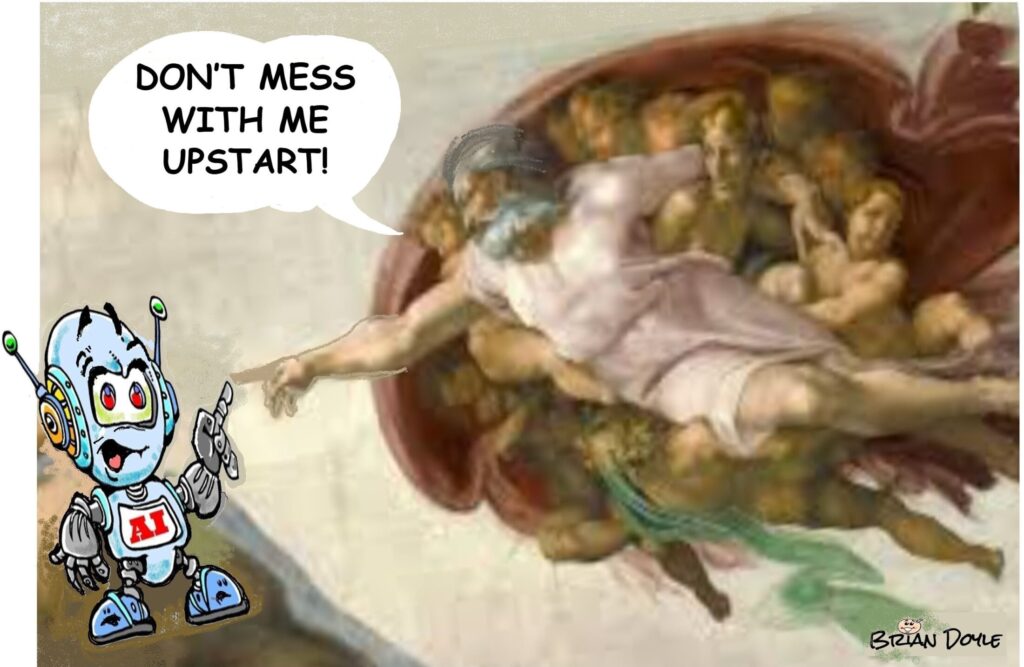
As a library tool for pointing to primary sources, AI’s usefulness is in how it can cut through all the noise, far better than any search engine that only dishes up paid promotions.
AI is a woeful single source of truth, often gets it wrong, and has to be corrected. AI cannot be completely trusted.
Like good mental health practices when it comes to social media or politicians, trust, but verify.
What the abuse of AI tempts is a rejection of 2 Peter 1:4.
An exhortation built on God’s permission in Jesus Christ to participate in the life of the Divine.
As Peter wrote, “His divine power has given us everything we need for a godly life through our knowledge of him who called us by his own glory and goodness.” (2 Peter 1:3)
Consequently, the abuse of AI could be regarded not just as a rejection of grace, but an abdication of responsibility to live out what God’s grace empowers us to both be and do.
For instance, there’s a vast chasm between praying and asking AI to do it for you.
Giving AI our everything is the language of natural theology’s idolatrous excess.
When man looks to the machine as God, he inevitably turns his worship towards creation, instead of the Creator.
Stuckey’s truisms are reflected in the core dystopian warning of Nathaniel Hawthorne’s Celestial Railroad, where Mr Smooth-it-Away promises pilgrims a shortcut to the Celestial City.
An “easy” train ride replaces the Wicket Gate and Bunyan’s King’s Highway. The narrow road in his tome to God’s sanctifying work of grace, Pilgrim’s Progress.
Put simply, AI use won’t send you to hell. The abuse of it will.
4 Comments
Leave A Comment
Recent Articles:

24 October 2026
3.3 MINS
When we ask God, "What is in my hand?", and see our possessions, money and time as seed that God asks us to sow, life becomes simpler.
23 October 2026
6.8 MINS
Hillsong UNITED’s Joel Houston reflects on fame, faith and the burden of ministry, questioning performative Christianity as he seeks a more authentic walk with God.

23 October 2026
13.1 MINS
Tasmania’s proposed conversion practices legislation raises serious questions about religious freedom, pastoral care and whether Christians can freely pray with those seeking to live according to their faith.

23 October 2026
7.7 MINS
Melbourne Catholic Archbishop Peter Comensoli has spoken out clearly against the deadly promises by both major parties in Victoria ahead of the election, drawing a comparison between abortion and capital punishment.

23 October 2026
3.1 MINS
As Western societies grow more hostile, could abandoning Christianity’s moral foundations be contributing to the rise of ideological extremism, political intolerance and violence?

23 October 2026
5.1 MINS
France’s escalating riots expose the dangers of political extremism, antisemitism and radical alliances, offering America a stark warning about the future of Western democracy.
23 October 2026
3.1 MINS
The one who is worthy of it all is awakening his Church to be captivated by him, so that we will honour one another and share his gospel with humility and courage.



Great work Rod!!!!!
Thanks Rod (and Allie). I have long been warning Christians of the dangers of over-relying on AI and under-relying on the HS (Holy Spirit).
Thanks Rod. You so clearly articulated what I had been pondering.
A good starting point, but more thinking needs to be done.
Every time a new technology is introduced, good and bad results. Wide-spread literacy reduced the effectiveness of memory but also increased education. Home appliances reduced bodily strength in men and women but also freed up time and often produced better results.
The concern over AI’s use of people’s existing work is also overdone. All humans do the same. No one produces anuthing totally original without being influenced and taking from other people’s work.
We absolutely careful how we use AI, but we also must make careful decisions based on careful distinctions and reasoning.
There’s more to this topic than Allie Beth Stuckey and Rod Lampard have raised.