


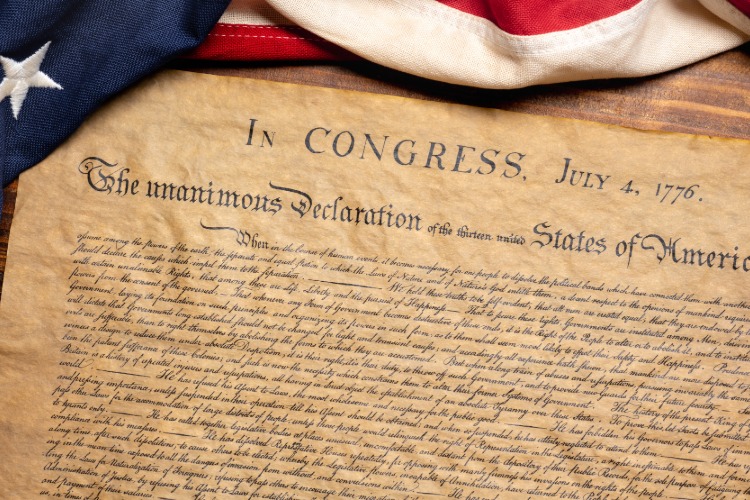
Happy Birthday America
Sadly, throughout the West history is either no longer being taught much at all, or it is being replaced with historical revisionism. Thus most students today know little about Western history, or they have been taught that the West is evil and should be hated and rejected.
Given that 4 July marks the 250th anniversary of America’s independence, it is worth speaking about the Declaration of Independence, since so few know anything about it. Indeed, simply watch this cringe-worthy 4-minute video where young Americans mostly display their abysmal ignorance of all things pertaining to July 4.
American History in Short
By way of background (since so many have forgotten all this), here is a very brief timeline of events:
- 1492 — Christopher Columbus arrives in the Americas.
- 1607 — Jamestown, Virginia, is established as the first permanent English settlement.
- 1620 — Plymouth Colony is founded by the Pilgrim Fathers.
- 1763 — Britain gains control of much territory following victory over France in the Seven Years’ War.
- 1774 — Colonists form the First Continental Congress as Britain closes down Boston harbour and deploys troops.
- 1775 — The American Revolution: George Washington leads the Continental Army to fight against British rule.
- 1776 — The Declaration of Independence is endorsed by Congress as the colonies declare their independence.
- 1781 — Rebel states form a loose confederation after defeating the British at the Battle of Yorktown.
- 1783 — Britain accepts American independence via the Treaty of Paris.
- 1787 — The Founding Fathers draw up a new constitution, coming into effect in 1788.
- 1789 — George Washington is elected the first president of the United States of America.
- 1791 — The Bill of Rights is drafted, which guarantees individual freedom.
The Declaration of Independence
Although not officially signed until August 2, 1776, this famous document is now largely forgotten. Let me share some of it here. It begins:
“When in the Course of human events, it becomes necessary for one people to dissolve the political bands which have connected them with another, and to assume among the powers of the earth, the separate and equal station to which the Laws of Nature and of Nature’s God entitle them, a decent respect to the opinions of mankind requires that they should declare the causes which impel them to the separation.
“We hold these truths to be self-evident, that all men are created equal, that they are endowed by their Creator with certain unalienable Rights, that among these are Life, Liberty and the pursuit of Happiness.–That to secure these rights, Governments are instituted among Men, deriving their just powers from the consent of the governed, –That whenever any Form of Government becomes destructive of these ends, it is the Right of the People to alter or to abolish it, and to institute new Government, laying its foundation on such principles and organizing its powers in such form, as to them shall seem most likely to effect their Safety and Happiness. Prudence, indeed, will dictate that Governments long established should not be changed for light and transient causes; and accordingly all experience hath shewn, that mankind are more disposed to suffer, while evils are sufferable, than to right themselves by abolishing the forms to which they are accustomed. But when a long train of abuses and usurpations, pursuing invariably the same Object evinces a design to reduce them under absolute Despotism, it is their right, it is their duty, to throw off such Government, and to provide new Guards for their future security.–Such has been the patient sufferance of these Colonies; and such is now the necessity which constrains them to alter their former Systems of Government. The history of the present King of Great Britain is a history of repeated injuries and usurpations, all having in direct object the establishment of an absolute Tyranny over these States. To prove this, let Facts be submitted to a candid world.”
It goes on to list 27 actions of the British king which those seeking independence were rebelling against, and then spells out what this independence entails. You can find the entire document here.
The Declaration of Independence: A Remarkable Document
This truly was an incredible – a revolutionary – document. The very notion of rulers getting “their just powers from the consent of the governed” was almost unheard of. So too was the idea of that “all men are created equal, that they are endowed by their Creator with certain unalienable Rights.” This was radical stuff indeed. Sure, it took some time for the words to apply equally to all Americans, but it certainly laid the foundation for that.
There would be many thousands of books and many millions of words about this document and the American experiment in independence and liberty. Let me briefly draw from two quite recent sources. As to the slavery issue, Eric Metaxas, in his new book Revolution (Odysseus Books, 2026), says this in part.
“But before we ourselves indulge in what has been called the “soft bigotry of low expectations” by assuming these issues were impossibly foreign to them, we must remind ourselves that the devout Christians of Puritan Boston took another view and were not always shy in expressing it. John and Abigail Adams were adamantly against slavery, as was Samuel Adams. But James Otis Jr.—whom Adams credited with starring in the “opening scene of the Revolution” in 1761—had been the most boldly anti-slavery of them all, and in 1763 in a widely read pamphlet on the rights of colonists dared to say that British “colonists are by the law of nature freeborn, as indeed all men are, white or black.”…
“So it seems that everyone in Independence Hall in 1776 who had been willing to follow the lead of the Boston Puritans to this point—essentially accepting their biblical views about “natural rights” inherent to every person because God had created them with those rights—knew that if they followed these views further down the line of logic there would be trouble. So they seem to have made a tacit bargain that they would not challenge these incendiary words, but would simply assent to them. It was a dirty bargain, and they knew it. But since the present goal was independence, they would do what was necessary to achieve that goal and defer further clarification of the principles that had led them to that goal. Of course that clarification would come in the next century, at the cost of 700,000 American lives.” (pp. 337–338)
And a brand-new article in the Australian Spectator by Dimitri Burshtein and Peter Swan discusses “Words that changed the world: The Declaration overturned centuries of assumptions about hereditary power and authority”. They say, in part:
“What made the Declaration extraordinary was not the revolution it triggered but the argument it made. Thomas Jefferson, drawing, with some irony on a tradition of political philosophy that ran largely through Britain, produced a document that smuggled universal principles inside a list of colonial complaints.
“There were twenty-seven grievances in all including the obstruction of justice, the dissolution of elected assemblies, the strangling of trade, taxation without consent, and the waging of war against the very people the Crown was meant to govern.
“The list was meticulous and lawyerly for good reason. The revolutionaries were building a case, showing a watching world that their rebellion was justified, proportionate and measured rather than a fit of colonial temper.
“It is the document’s second paragraph, though, that has echoed down the centuries: ‘We hold these truths to be self-evident, that all men are created equal, that they are endowed by their Creator with certain unalienable rights, that among these are life, liberty and the pursuit of happiness.’
“None of this was self-evident in 1776. It was revolutionary. Almost every human being who had ever lived had done so under arrangements that assumed the precise opposite. That birth determined destiny, that station was fixed by God, and that government existed to serve those at the top rather than to protect the dignity of those at the bottom. Jefferson did not merely reject that order but pronounced it self-evidently wrong.
The authors look at how this revolution, and this document, impacted so much of the world, including Australia:
“America’s Constitution, in force since 1789, is the oldest written national charter still governing a country anywhere on earth. That is no small achievement for an experiment so many expected to fail. But the Declaration’s deepest legacy was never just American. The ideas escaped.
“The French borrowed its language in 1789. Britain itself edged, haltingly but irreversibly, towards full parliamentary democracy. The great independence movements of the twentieth century framed their demands in terms Jefferson had pioneered, copying not only its spirit but often its very form. The proposition that governments derive their just powers from the consent of the governed is now so widely assumed that even dictators feel obliged to stage elections, however fraudulent, because the idea has travelled too far to ignore. Australia is no exception….
They conclude:
“What crossed the Pacific was the architecture of self-government. None of this was inevitable. It required men willing to pledge, in the American Declaration’s own closing words, their lives, their fortunes and their sacred honour to a proposition that looked, by any sober assessment in 1776, unlikely to prevail. Plenty of clever men in London expected the whole enterprise to collapse. It required an argument precise enough to justify a revolution and universal enough to outlive one.
“Two and a half centuries on, the Declaration of Independence stands as something rarer than a founding document. It stands as proof that ideas matter, and that a well-made argument can change the world. The men who signed it did not know they were rewriting human history. They thought they were saving their colonies. They managed, as it turned out, to do rather more than that.
“Happy birthday, Uncle Sam. The world is better for your arrival.”
Happy birthday indeed, America.
___
Republished with thanks to CultureWatch. Image via Adobe.
6 Comments
Leave A Comment
Recent Articles:
10 October 2026
4.1 MINS
When Jesus rebuked the Laodicean church, this was not a sign of his lack of love, but proof of it and how greatly he longs to reward and bless us. He is knocking — will we answer?

9 October 2026
5 MINS
During a recent dialogue between high profile legal experts, a top Australian constitutional law expert was asked if Australia should have a Bill of Rights. His answer may surprise you.
9 October 2026
1.3 MINS
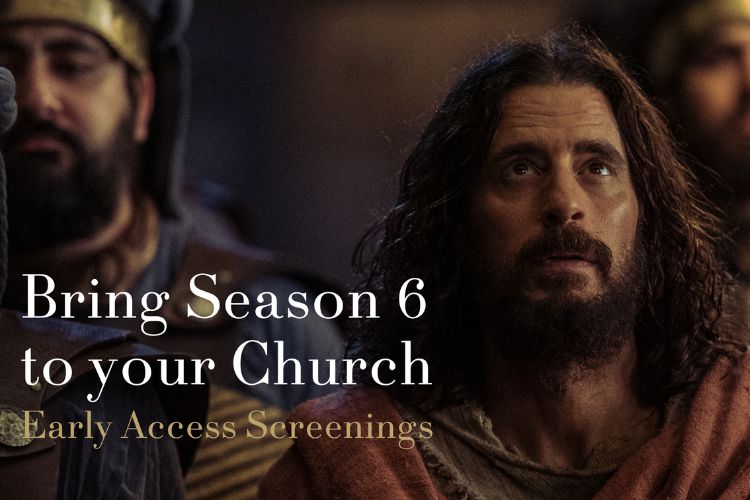
Season 6 of The Chosen is releasing next month, and until 15 November, your church has the opportunity to host a free pre-release screening of Episode 1. Here's how.
9 October 2026
2.9 MINS
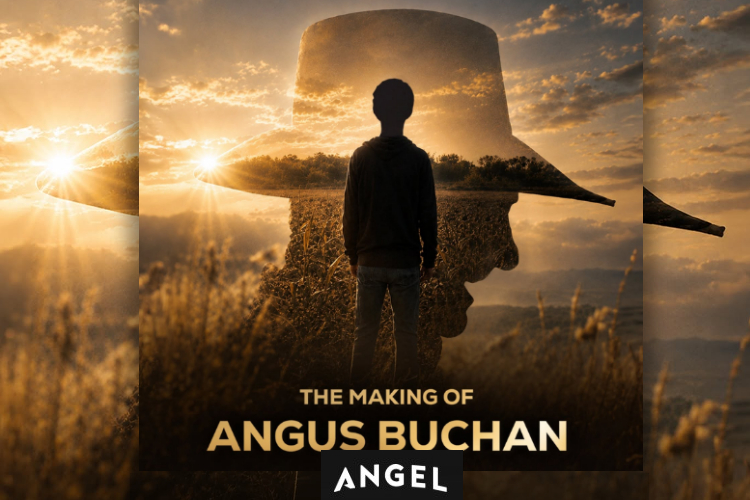
Angus Buchan’s remarkable journey from farmer to evangelist is brought to life in a new documentary now streaming, revealing the faith, family and challenges behind his public ministry.

9 October 2026
1.8 MINS
Pen Power Australia has been busy confronting antisemitism and double standards, lodging letters, pursuing accountability and celebrating several important wins along the way.

9 October 2026
3.3 MINS
New South Wales healthcare workers who object to abortion and voluntary assisted dying face growing pressure, raising serious questions about conscience rights, employment and moral injury.

9 October 2026
2.9 MINS
God is intensely relational, and he puts us into a community of believers so we can use our gifts in service of Christ's body.



I remember my excitement at age 23 viewing the Liberty Bell in Philadelphia and reading the original document of American Independence, and standing in Jefferson’s Rotunda , Washington, reading his immortal words , that ” all me are created equal “, that we are ” Endowed by our “Creator ” with certain inalienable Rights…Life , Liberty and the pursuit of Happiness”. None of which is enshrined in the Australian Constitution ! I loved New York’s “Boston Tavern ” , the haunt of Revolutionaries, apparently since burnt to the ground.Probably because it covered valuable real estate space? It contained many relics , including La Fayette’s blood-stained sash. The USA no longer teaches Pride in its history, the sacrifices made to achieve Freedom , including by that great man and general , Washington, and the other Revolutionaries who sacrificed their lives for Freedom. The Document established the principle that govt could only be by the ” Consent ” of the People .
In the north of Tasmania lives an Earl whose ancestor was the last British Governor of the State of New York .He fled the Revolutionaries.
What we have in Australia is Phoney ” Liberty ” , and, an Electoral System of Preferences which , most Australians (especially new Migrants ) don’t understand, giving us Govt. elected by approx. 1/3 of voters. A vast number of migrants rely on translation ( paid by the taxpayer ) , never making any effort in all their lives to learn English. So, how do they ever understand the complexities of any proposed legislation? They are open to voting manipulation, ie deliberate misinformation .
Thank you for the explaining the history of the USA so thoroughly Bill. It demonstrates a unique battle for liberty from oppression or injustice and equality for each citizen as well as religious freedom. No wonder so many have attacked these democratic rights and tried to revise and misrepresent the noble of history won by the forefathers. It remains incredible to look back and see how many sacrificed their lives to fight for what was right and to see that nowadays the whole history is mispresented and called either colonialist or oppressive by those who have Marxist sympathies….The younger generation have little chance to grasp the truth unless they read and study the true history.
I was reading recently a book about the USA by Pastor Michael Youssef ‘Hope for the present Crisis’ that demonstrated anti-American radicalism and wokeness was introduced by Howard Zinn, a socialist who taught political science at Spelman College and Boston Uni. He wrote over 40 books ‘A people’s history of the United state’ selling 2.6 million copies which was used in universities to teach a new version of USA history portraying main events as oppression in order to show a Marxist oppression against minorities. Micheel says p119 referring to Zinn: ‘He intended to completely redefine America as evil in the minds of his readers’…
Michael comments that Zinn ‘wanted to topple all great heroes in American history and portray them as villains as Geroge Washington and all the Founding Fathers and even Abraham Lincoln.’
This ‘revisionist ‘movement led to students believing that the USA sought to oppress may groups and so he wrote false narratives about those whom American sought to look after, or give aide to or bring the gospel to (eg American Indians and minority groups who migrated to the USA) but the good side of history such as freeing salves and acknowledging freedom of religion was ignored, and American’s role in helping other nations in hard time and in the war times…Zinn’s writings caused many to disrespect Columbus falsely calling him ‘a genocidal murderer’ who had Christian values and denigrating Abraham Lincoln who helped fight for freedom of individuals and the founding Christian and democratic values.
Many thanks Countess and Gail.
WOW wow wow, how comprehensively accurate precise exactly as history and documents were heart given with their lives. thank you Bill.
citizen of Australia and USA.
Thanks you Mary.