


WHO Pandemic Agreement Formally Adopted by Member States
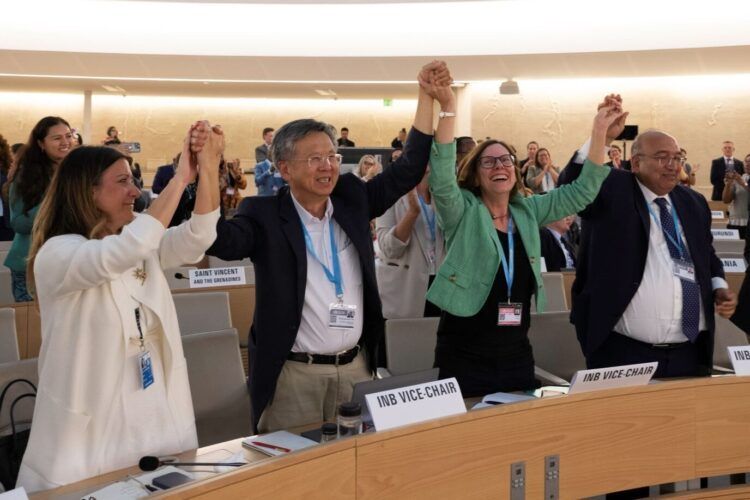
After three years of negotiations, the World Health Organisation’s (WHO) Pandemic Agreement to strengthen global pandemic preparedness and response was finally adopted by member states on Tuesday, 20 May 2025, at the 78th World Health Assembly (WHA) in Geneva.
The adoption by consensus followed Monday’s approval of the international Treaty by vote (124 in favour, 0 objections, 11 abstentions).
The United States (US), having announced its intended withdrawal from the WHO, was absent from the proceedings.
WHO Director-General Dr Tedros Adhanom Ghebreyesus said that “the world is safer today” due to the adoption of the Agreement, which he characterised as “a victory for public health, science and multilateral action.”
“It will ensure we, collectively, can better protect the world from future pandemic threats.
“It is also a recognition by the international community that our citizens, societies and economies must not be left vulnerable to again suffer losses like those endured during COVID-19.”
It’s official: the #PandemicAccord is officially adopted by the World Health Assembly!
My warmest congratulations to @WHO Member States for their commitment to keeping their people and the world safer.
What a moment in global health history. Together! pic.twitter.com/DfEHDBrhUB
— Tedros Adhanom Ghebreyesus (@DrTedros) May 20, 2025
While the adoption of the Pandemic Agreement moves things forward, implementation will not be realised for at least a year or more, as member states are yet to finalise a Pathogen Access and Benefit Sharing (PABS) annex, which can be adopted at the next WHA in May 2026 at the earliest.
Once the PABS has been adopted, the binding Agreement must be ratified by 60 member states to come into full effect.
Gain of Function Research Conspicuously Absent
The controversial Agreement is one of two interoperable WHO pandemic reforms that promise to boost global collaboration. However, these reforms have been criticised for posing a threat to national sovereignty and directing vast resources away from more pressing global health needs.
Ironically, though Covid was the nominal impetus for driving this Agreement forward, no part of the text mentions or safeguards against government-funded gain-of-function research, which is widely recognised – including by intelligence agencies in the UK, Germany and the US – to be the most likely cause of the pandemic the world just lived through.
An earlier draft clause addressing gain-of-function research, “including accidental laboratory leakages of disease-causing agents”, did not make it into the final version of the Agreement.

Proposal for negotiating text of the WHO Pandemic Agreement, Chapter III, 14 February 2024.
Systems, Surveillance, and Astronomical Costs
Instead, the Agreement (interchangeably called the Pandemic Treaty) focuses heavily on building systems to constantly surveil for and detect emerging pathogens to enable swift global coordination, including the development and distribution of medical countermeasures to ensure equity (i.e.: access to pharmaceutical products).
“If we’d been faster last time with the vaccines, we would have saved over eight million lives. That’s a huge, huge benefit,” said chair of the Coalition of Epidemic Preparedness Innovations (CEPI) Jane Halton on ABC today, weighing in on the “breakthrough” Treaty.
Yet, “We have not had a major outbreak in over 100 years that is in the category of natural outbreaks that the pandemic agenda is designed for,” public health physician and former WHO medical officer Dr David Bell told me earlier this year, referring to the pre-antibiotic era Spanish flu.
Through his work with the multidisciplinary REPPARE group convened by the University of Leeds, Dr Bell’s recent work highlights the exaggerated presentation of pandemic risk by the WHO, which is not supported by the available evidence.
This has not perturbed member states from pledging their commitment to the Treaty and its complementary International Health Regulations (IHRs) amendments (2024), the latter of which will come into effect if member states do not formally reject them by July of this year.
This commitment includes an increase of 20% in member state contributions towards the WHO’s 2026-2027 budget of US $4.2 billion ($2.1 billion per year).
The development of the Pandemic Agreement alone has already cost an estimated US $201 million, with annual costs post-implementation estimated to run at approximately $32 billion. This is just shy of the estimated $37 billion per year that it would cost to eliminate world hunger by 2030.
WHO’s Authority Over Nations: International Health Regulations (IHRs)
While most world governments are ramping up their rhetorical and financial support for the pandemic preparedness industry led by the WHO, there are pockets of resistance.
Argentina has joined the US in announcing its intention to withdraw from the WHO, and 11 countries, including Slovakia, Italy, and Poland, abstained from the vote to approve the Pandemic Agreement.
Australian officials have thrown their full weight behind the adoption of the Treaty.
@SenatorWong just addressed the Seventy-eighth @WHO Assembly in Geneva.
“Australia is proud to have served as the vice chair of the international negotiating body for the pandemic agreement.”
“We agree to the concrete action collectively to strengthen pandemic prevention,… pic.twitter.com/Htu8pd5rBT
— Michael Arbon (@arbsmichael) May 20, 2025
But a growing movement of nearly two million concerned citizens is coalescing in opposition under the banner of the Aligned Council of Australia.
Last year, a group of Australian politicians pressed the Prime Minister to reject the reforms on the basis that they posed “a significant threat to Australia’s autonomy and independence on the global stage,” a threat that the WHO flatly denies, although this denial is a matter of semantics.
The Treaty itself does not afford the WHO or the Director-General the authority to “direct, order, alter or otherwise prescribe the national and/or domestic law,” or to compel countries to implement measures such as travel bans or vaccine mandates, however the complementary IHRs do.
This is why it’s important to understand that the pandemic reforms are intended to operate in conjunction with each other.
As stated in Article 24.2 of the newly adopted Pandemic Agreement,
“The Parties recognize that the WHO Pandemic Agreement and International Health Regulations (2005) [soon to be updated to IHR amendments 2024] and other relevant international agreements should be interpreted so as to be compatible.”
Kennedy Explains Why the US Left the WHO
Meanwhile, US Health and Human Services Secretary Robert F. Kennedy Jnr. took the opportunity this week to affirm the US’s decision to leave the WHO.
Like many legacy institutions, the WHO has become mired in bureaucratic bloat, entrenched paradigms, conflicts of interest, and international power politics. While the United States has provided the lion’s share of the organization’s funding historically, other countries such as… pic.twitter.com/VvWbVBkb6M
— Secretary Kennedy (@SecKennedy) May 20, 2025
Kennedy wrote on X,
“Like many legacy institutions, the WHO has become mired in bureaucratic bloat, entrenched paradigms, conflicts of interest, and international power politics.”
“Global cooperation on health is still critically important to [President Trump] and myself, but it isn’t working very well under the WHO as the failures of the COVID era demonstrate.
“I urge the world’s health ministers and the WHO to take our withdrawal from the organization as a wake-up call.”
___
Originally published at Dystopian Down Under. Image via WHO/Chris Black.
3 Comments
Leave A Comment
Recent Articles:

3 October 2026
3.7 MINS
The Church is called to be counter-cultural not to be merely contrarian, but because we love God and people. In this world, that will mean going against culture that is contrary to God.

2 October 2026
2.6 MINS
NSW Libertarian Gemma Noiosi is challenging taxpayer-funded activist events, arguing government grants should not bankroll controversial projects or private cultural ventures.

2 October 2026
11.6 MINS
New evidence challenges prevailing assumptions about adolescent sexuality and gender medicine, urging parents, clinicians and Christian leaders to prioritise honest inquiry, careful care and scientific integrity.
2 October 2026
4.3 MINS
John Cleese’s views on multiculturalism, Christianity and criticism are resurfacing, offering a provocative challenge to assumptions about immigration, cultural identity and the West’s Christian foundations.

2 October 2026
6.6 MINS
A foiled airline attack highlights the courage of passengers and crew who confronted danger, while raising urgent questions about jihadist terrorism and the ideology behind it.

2 October 2026
3.4 MINS
New research highlights the strong links between active Christian faith, marital happiness, sexual satisfaction, family stability and the formation of future generations.

2 October 2026
5.2 MINS
Rising male unemployment, loneliness, pornography use and fatherlessness are compounding one another, raising serious questions about men’s wellbeing, family stability and the future of Western society.



Penny Wong is culpable in further entangling Australia in the spider’s web that is the WHO.
Another nail in the coffin of the loss of our autonomy as a Nation!
Thanks again Rebekah for great reporting on Health matters that affect us immensely …