


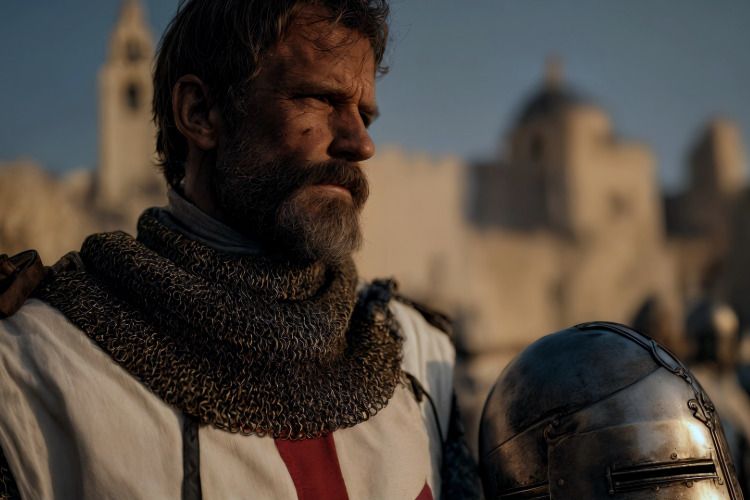
The Crusades Reconsidered: Unpacking the Myths with Raymond Ibrahim
What if the narrative we’ve been told about the Crusades isn’t just wrong, but intentionally fabricated to fit a modern-day narrative? Author and historian Raymond Ibrahim offers a compelling re-examination of one of history’s most misunderstood eras.
Raymond Ibrahim isn’t your average commentator on the Crusades.
An American-born scholar with Egyptian roots, he bridges two worlds—Western and Middle Eastern—with equal fluency in English and Arabic. This rare combination has equipped him to interpret centuries-old Christian–Islamic conflict through a lens many Western historians lack.
His interest in Islamic civilisation was first piqued when he began visiting the Middle East as a child in the 1970s. Interacting and conversing with the locals throughout the decades has provided him with an intimate, personal appreciation of that part of the world, complementing his academic training.
His academic resume is formidable. As the Senior Shillman Fellow at the Gatestone Institute and the Judith Friedman Rosen Fellow at the Middle East Forum, Ibrahim is a widely published expert on the Middle East and Islam.
His books include:
- Defenders of the West: The Christian Heroes Who Stood against Islam (Bombardier, 2022)
- Crucified Again: Exposing Islam’s New War on Christians (Regnery, 2013)
- The Al Qaeda Reader (Doubleday, 2007)
- The Battle of Yarmuk: An Assessment of the Immediate Factors behind the Islamic Conquests (MA thesis, 2002).
He spent years as a regional specialist at the Library of Congress, providing insight to counterterrorism, intelligence and defence agencies.
Ibrahim’s writings, translations, and observations have appeared in a variety of publications, including the New York Times Syndicate, CNN, LA Times, Fox News, Financial Times, Jerusalem Post, USA Today, Washington Post and Washington Times – to name but a few.
But it’s his passion for truth and the protection of persecuted Christians that truly drives his work. Since 2011, Ibrahim has produced a monthly report titled “Muslim Persecution of Christians”, documenting global abuses with detail and consistency. These reports serve as a living continuation of his 2013 book, Crucified Again: Exposing Islam’s New War on Christians.
Rewriting the Crusades
Ibrahim’s most striking work, however, may be in how he tackles the Crusades themselves.
As most of us have been taught, the Crusades were a time of unbridled terror, bloodshed, and rampant hatred by Christians who attacked Islam and all who followed it. It was supposedly a time when those who called themselves Christian crusaders slaughtered innocent Muslims who had done them no wrong. In fact, these Muslims were living side by side with Christians in peace and harmony.
But Ibrahim suggests we’ve been sold a fiction—crafted more to appease modern political sensibilities than to honour historical truth.
Like many others, I stumbled across Ibrahim’s work by accident. It was on YouTube, in a long-form conversation with Winston Marshall.
But it quickly became clear that this was more than just another opinion piece—it was a clear-eyed appeal to re-examine history with courage, humility, and a biblical sense of justice.
For those of us who grew up being told that Crusaders were the aggressors—murdering innocent Muslims without provocation—his message was, frankly, gobsmacking.
A Defensive War, Not an Aggressive One
At the heart of Ibrahim’s thesis is a simple but explosive idea: the Crusades were not acts of aggression but of defence.
For centuries leading up to the First Crusade in 1095, Islamic armies had rapidly expanded, overtaking vast swathes of formerly Christian lands—from the Middle East and North Africa to Spain and even parts of France. Ibrahim points out that Christian communities were decimated, churches destroyed, and pilgrims brutally attacked.
The Crusades, then, were a response—a desperate effort to push back, to defend fellow Christians under siege. The goal wasn’t to conquer for conquest’s sake but to reclaim what had been lost and to secure safe passage for pilgrims.
This changes the entire tone of the conversation. Suddenly, the Crusaders are not villains; they’re flawed but courageous men acting out of duty to protect their faith, their families, and their brothers and sisters in Christ.
A More Balanced Perspective
Of course, like any war, the Crusades were not without their horrors. Ibrahim doesn’t deny that. Atrocities occurred, as they have in every human conflict. But he insists these need to be understood in their historical context—not held up as proof of Christianity’s inherent violence while ignoring the often greater and more systematic brutality of opposing forces.
More importantly, Ibrahim highlights how the Crusader ethos was rooted in biblical values. Many Crusaders saw their campaigns as acts of service, not ambition—laying down their lives to protect the innocent and uphold Christian worship (John 15:13).
His book Defenders of the West introduces us to Christian heroes like Godfrey of Bouillon, Louis IX, and John Hunyadi—men who fought not for glory, but for God. It’s a striking counter-narrative to the one our culture has embraced.
Confronting Modern Narratives
So why does this matter today? Why revisit a conflict from nearly a thousand years ago?
Because the myths we believe about the past shape how we think about faith, freedom, and responsibility in the present. When Christians are portrayed as historic aggressors, it becomes easier to silence their voice in the public square. When Islam is portrayed only as a victim of Western violence, it becomes harder to address ongoing persecution and radicalisation with honesty.
Raymond Ibrahim challenges us to resist the temptation of easy narratives and to seek the truth—even when it’s uncomfortable. As Christians, we’re called to be people of truth (John 8:32), to test everything (1 Thessalonians 5:21), and to remember that history is ultimately God’s story—not ours to rewrite.
Listening to Ibrahim, I can’t help but wonder: how much else have I misunderstood? Am I willing to confront uncomfortable truths that turn over my conventional understanding?
Key takeaways from the interview with Winston Marshall include:
- Within the space of 100 years, after the death of Mohammed, by 732, Muslims were overtaking Europe by violent conquest. There was no tolerance, harmony between Judaism, Christians and Muslims. Christianity was denigrated, and it was convert, pay Jizya, or die. Jizya is money paid by non- Muslims so that they can keep practising their religion. (Under Islamic law, if the money is not paid, the people are to be enslaved or killed.)
- Three-quarters of the Christian world was conquered and has not been recovered.
- Once a Territory is taken by Islam, even though they are defeated and expelled from that region, Islam believes it always belongs to them and must be retaken.
- The Eastern world included Egypt, Syria, Lebanon, Turkey, and Morocco. They were more Christian in numbers and belief than Europe at that time. (In fact, the Coptic Christians from Egypt were instrumental in spreading the Gospel in Europe.) Each country was violently conquered. As was Israel.
- The Slavic nations got their name from the fact that Islam conquered the area and enslaved the populace. Slavery was their bread and butter.
- The Vikings supplied white slaves to the Muslims.
- The exploration of the New World by Christopher Columbus came about because of the constant threat of Muslim invasion of Spain. The quest was a fallback plan if all else failed.
- The very first war fought by the new United States of America was against the barbarism of the Barbary Pirates. A series of two wars were fought from 1801-1805. The North African slave traders ramped up their aggressive posture by shifting their focus to KIDNAPPING and holding for ransom. The pirates, based in modern-day Tunisia, Libya, and Morocco, demanded tribute for ‘safe passage’ through the Mediterranean. The newly minted American nation refused to negotiate with terrorists and defeated them.
- The times may change. The playbook remains the same.
In light of the ongoing religious persecution that Christians across the world are subjected to, perhaps Raymond Ibrahim’s work needs to be looked at more closely.
And indeed, the question must be asked why so few dare to speak about it today.
In a world that often suppresses truth in the name of political correctness, Christian clarity is more vital than ever.
___
Image courtesy of Adobe.
15 Comments
Leave A Comment
Recent Articles:

6 October 2026
10 MINS
This powerful testimony recounts a lifetime of hardship, danger, illness and near-death experiences — and the unwavering faith that carried one woman through it all.
6 October 2026
3.4 MINS
Christians cannot afford to let headlines and social media shape their view of Israel. Scripture provides a foundation for understanding Israel, God’s promises and our response.

6 October 2026
6.7 MINS
Fresh revelations about the foiled FlyDubai terror plot expose the attacker’s alleged extremist history, while a courageous pilot’s actions prevented an unthinkable catastrophe.
6 October 2026
6.2 MINS
Britain’s grooming gang scandal exposes a devastating failure to protect vulnerable children, raising urgent questions about political correctness, accountability, immigration and the loss of moral courage.

6 October 2026
3.8 MINS
A grandmother’s disputed death has put Canada’s euthanasia regime under fresh scrutiny, as the Medical Assistance in Dying (MAiD) program passes 100,000 deaths with a further expansion slated for 2027.
6 October 2026
3.3 MINS
We often talk about church renewal as though we need more people, more programmes, more energy and more resources. But Jesus seems to start somewhere much smaller. With two or three.
5 October 2026
4.9 MINS
Free Speech Union co-founder Reuben Kirkham warns Australia’s proposed Digital Duty of Care could expand censorship powers, undermine free expression and bypass recent legal protections.



I have read literature about the crusades. The Crusaders were certainly “busy ” in Sicily setting up a kingdom, but what I have read, treat the crusades almost like a fight similar to the battle of Bannockburn. They came, they fought (and most) left rather quickly.
If you can take the time to listen to the interview on YouTube, you will find that much of what was written is dubious. We certainly didn’t expect to hear what would be termed a completely different version of what we are presented with here in the West. Thanks Christine 💖
Thanks for this information Leonie.
Thanks Leonie for sharing your discovery.
I’m old enough to have been taught the truth (or at least some) about the crusades and how they came about.
Just goes to show that even now, any work started in truth and righteousness is so easily corrupted by sin, pride seems to often be the gateway.
Onward Christian Soldiers! Let’s not faint in spite of all challenges!
Repent and return to the beautiful paths God has prepared for us, maybe our family and friends will follow.
Amen brother 🙏
Daniel 11 and 12 detail the rise and fall of the Kingdoms represented in Nebuchadnezzar’s statue dream in Daniel 2. The Roman Kingdom spans 2000 years and the world is now experiencing the attack of the king of the south (radical Islam and allies) on the king of the north (the papacy and those traditional Christian churches who adopted the Constantine corruption of Yah’s words). You can also see the Crusade attacks and the fight against the Ottoman Empire and the Reformation.
The point I would make is that Rome especially under Constantine corrupted Yah’s words – by changing the calendar, the 7th day Sabbath which is holy and sanctified by Yah. Constantine also persecuted that Jews who embraced Yeshua and His Torah, His commandments. He denied the Lord’s feasts of Pesach, Shavuot, Trumpets, Yom Kippur and Sukkot in Leviticus 23. He adopted pagan Easter and pagan Christmas. The behaviour of the papacy was indefensible in light of Yah’s words – using false doctrine to control truthseekers, by forbidding access to Yah’s word and martyred those who translated the Bible into English. The papacy could never be accused of letting mercy triumph over judgment or overcoming evil by doing good
No it focused on control of people using power, fear, threat of death.
But it’s most evil action was to change Yahweh’s forever words. This continues today not only in the catholic Church but also in many protestant churches.
iniquity is blurring, twisting and distorting Yah’s words. Transgression is rebellion against Yah’s commandments. Also adding to His words and/or taking away from His words will result in Yah’s judgment including removal from your name from His Book of Life!.
To illustrate how grievous these sins are Yeshua told us If you love me keep my commandments. 1 John 5 says and this is the love of God that you keep His commandments and they are not grievous.
So the world sees that many Christians do not keep Yah’s commandments. They read about the bloody history of the church and genuinely question whether a God of love could condone the ugly violence exhibited by His followers.
Daniel 11 and 12 show the ki g of the South attacking the king of the north. In 2014 the Pope asked for assistance from Obama against Muslim aggression. Within days Obama obliged and the Islamists called Obama “the dog of Rome”. But a time is coming when the king of the north will attack the king of the south like a whirlwind. This attack will be by allies to Rome because the Vatican does not have an army.
The important thing is both kings and their followers will be destroyed by the uncut stone of Yeshua who will establish Yahweh’s kingdom on the earth in Jerusalem.
If you follow Daniel you will see those who refuse Yah’s true words are slated for destruction. It is no small thing to change Yah’s words. Yet many people ignore this truth. Now more than ever we must examine ourselves to see if we are truly in Yeshua. Be led by His indwelling and His word – not an organisation who tolerates the corruption of Yah’s words.
Great article Leonie!!!!
Thanks mate. 💖
This is excellent. Thanks for the links and especially the interview. He’s a great scholar and all his books are worth reading
Thanks Mark. The interview was really informative and certainly has piqued my interest in the subject!
This is just mind-blowing, Leonie. Thank you for bringing this important information to our attention.
Thanks sis. God bless you xx
Thanks Leoni ….great post
emperor Charlemagne ,the franks , destroyed Christianity by allowing usury .That’s the corrupting influence that enables the love of money .Money fuelled the crusades and made the Templars ,aka today the City of London from the Inns ,the only privately owned land in the City , wherein is the Temple Bar ,that runs the rule of law globally ,and the Temple Church which uses specifically an old version of the Bible from around 1650s ,roughly ,from memory .The crusades set the Templars up as the biggest bankers on earth and from there they created Switzerland. actually SS , and banking as we know it They were Catholics like Charlagne .They are the red and white flag eg the red cross ,the red shield etc .Rothschild’s are employed by the Vatican as their bankers .They work for them .The Vatican and Switzerland are intertwined totally .That’s why Swiss guards work in the Vatican.
also many historians agree that the Vatican created Islam Mohammed’s wealthy widow ,older than he , wife was previously a Catholic nun . Divide from within to conquer from without .Etc .It’s not surprising how similar the Koran is to the old testament .