


At Least 25 Christians Murdered in Syrian ISIS Attack
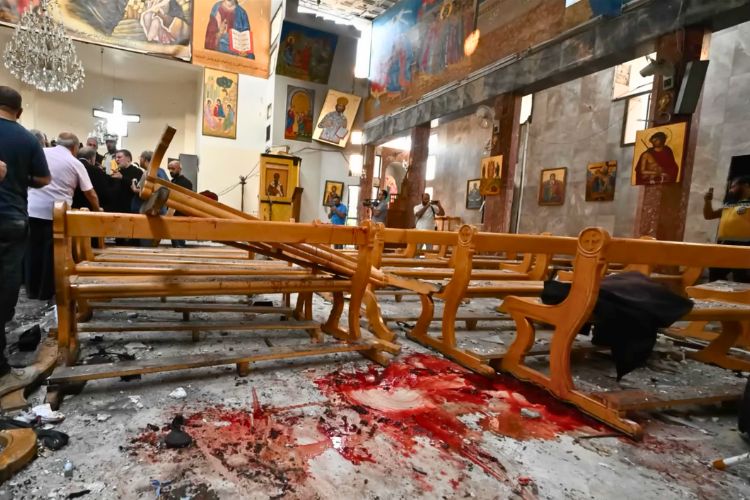
An ISIS suicide bomber in Syria shot his way inside the Greek Orthodox Mar Elias Church, before detonating himself, killing at least 25 and injuring an estimated 63 others. In another attack in Michigan, an attempted mass shooting was thwarted.
Christians were attacked in their places of worship on Sunday in two assaults thousands of miles apart in Michigan and in Damascus, Syria.
Experts say the attacks are reminders that Christian churches continue to be prime targets for terrorism both domestically and across the globe, and that churches should take appropriate security measures to protect themselves.
Michigan Mass-Shooting Attempt
On Sunday morning in Wayne, Michigan, a 31-year-old white male dressed in tactical gear and carrying a “long gun and handgun” attempted to enter CrossPointe Community Church during services, but was thwarted by parishioners, one of whom struck the gunman with his vehicle amid gunfire. Eventually, two church staff members fatally shot the individual. One staff member was shot in the leg during the incident.
So far, local police have not been able to determine a motive for the attack. “His motivations are unknown, but at this point it appears he was suffering from a mental health crisis,” Wayne Police Chief Ryan Strong stated.
USA: A man attempted to carry out a mass shooting at Crosspoint Community Church in Wayne, Michigan.
The attacker reportedly rammed his truck into the church during the worship service, stepped out with a rifle and opened fire on the congregation.
Fortunately, this church was… pic.twitter.com/Xi8Pt0oH8M
— Christian Emergency Alliance (@ChristianEmerg1) June 22, 2025
Syrian Suicide Bombing Attack on Damascus Greek Orthodox Church
At the same time, almost 6,000 miles away, a far more serious attack on Christians occurred on the outskirts of Damascus, Syria.
As worshippers prayed inside a Greek Orthodox church, a suicide bomber shot his way inside before detonating himself, killing at least 25 and injuring an estimated 63 others. Although no group has claimed responsibility for the attack, Syrian authorities say the terrorist was affiliated with the Islamic State group (also known as ISIS).
Syrian President Ahmed al-Sharaa, himself a former member of radical Islamist groups, called the attack “heinous” and vowed to bring justice to the perpetrators. The interior ministry reportedly arrested “a number of criminals involved in the attack” and seized explosive devices, saying that the operation was carried out against cells affiliated with ISIS.
Al-Sharaa has vowed to bring stability to Syria after his rebel group ousted the regime of former President Bashar al-Assad last year.
President Trump and Republican members of Congress have met with al-Sharaa, and Trump has expressed interest in normalising relations with the new government.
“We Are the Soldiers of Christ”
After the bombing of a Christian church in Syria with over 20 killed and dozens were wounded
Believers took to the streets in prayer, unity, and honor for the martyrs among them. 🕯️🙏pic.twitter.com/mFnl4QBAzO
— CitizenGO (@CitizenGO) June 24, 2025
Rising Violence Against Christians
The two attacks are the latest in a rising pattern of violence occurring against Christian churches both domestically and internationally.
A 2024 report from Family Research Council found that 915 acts of hostility occurred against churches in the U.S. over the past six years, including “vandalism, arson, gun-related incidents, bomb threats, and more.” The report further found that the 436 incidents that occurred in 2023 represented an eight-fold increase when compared to the number of incidents that occurred in 2018.
Globally, Open Doors reported earlier this year that numerous countries have seen “an increase in anti-Christian violence.” According to the organisation, approximately 365 million Christians are currently subject to “high levels of persecution and discrimination,” compared to 340 million in 2021.
“It’s jarring to see violence against churches full of believers mirrored in the United States and Syria on the same weekend,” Arielle Del Turco, director of FRC’s Center for Religious Liberty, told The Washington Stand.
“These acts are intended not only to end the lives of the Christians who gathered in those churches, but to terrorise and intimidate Christians far beyond the walls of those churches in Michigan or Damascus.
“We can pray for peace and safety for Christians around the world going to worship the Lord in community.”
She continued, “At a political level, the Trump administration should speak up on behalf of persecuted Christians at home and abroad, and work to ensure the nominee for the U.S. Ambassador at Large for International Religious Freedom is confirmed by the Senate quickly and can bolster the administration’s work to promote religious freedom around the globe.”
‘Churches Should Protect Themselves’: Former FBI Director
As to what churches in America can do to better protect themselves against violent attacks, security experts like former FBI senior director Wiley Thompson say that every church should find “a good leader with a good heart for service, who can recruit, organise, train, and deploy volunteers” in order to protect congregations from physical harm.
“When designing a security ministry, the altar, platform, or stage in the sanctuary represents the center point for imaginary strategic circles (or ‘layered security’),” he told TWS.
Thompson, a 25-year FBI veteran, further explained,
“The first layer is the outermost ring surrounding the church property which can generally be staffed with parking lot greeters who observe and report anyone or anything that looks suspicious. The idea is to identify and engage a potential threat before it reaches the doors to the church building.”
He continued,
The second layer of security is the greeters and members of the welcome team who are trained to conduct behavioural profiling and communicate to the security team anyone or anything out of the ordinary. The third layer is the ushers, deacons, pastoral staff, etc., inside the sanctuary, who have the same responsibilities as those in the second layer.”
“The final layer is the posting of two security team members on the stage facing the congregation and one on the front row, with direct line of sight and path to the pastor or priest at the pulpit,” Thompson detailed.
“The two are responsible for detecting and deterring any threat moving toward the pulpit during the service, while the gatekeeper in the front row has the primary duty of protecting the speaker by moving forward and leading the principal off the stage to a safe room, if necessary.”
___
Originally published at The Washington Stand as “Christians Attacked during Sunday Worship in Michigan and Syria”. Image via YouTube/Sky News Australia.
Recent Articles:

26 October 2026
2.5 MINS
Nation First exposes the rush to weaponise the Haines attack against Pauline Hanson, conservative voices and men before investigators established a motive.
26 October 2026
5.1 MINS
Anthony Albanese calls for civility after the Helen Haines attack, but revelations of a political dirt file raise uncomfortable questions about his government’s own conduct.
26 October 2026
3.2 MINS
Following Paul's example in Ephesians 1, let us pray for the Father to open the eyes of our hearts so that we may grasp the hope of his calling, the riches of his glorious inheritance in the saints, and the greatness of his power towards us who believe.

25 October 2026
4 MINS
Prayer is active partnership with God, and he is awakening his body to prayer, not by might or by power, but by his Spirit.

24 October 2026
3.3 MINS
When we ask God, "What is in my hand?", and see our possessions, money and time as seed that God asks us to sow, life becomes simpler.
23 October 2026
6.8 MINS
Hillsong UNITED’s Joel Houston reflects on fame, faith and the burden of ministry, questioning performative Christianity as he seeks a more authentic walk with God.
23 October 2026
13.1 MINS
Tasmania’s proposed conversion practices legislation raises serious questions about religious freedom, pastoral care and whether Christians can freely pray with those seeking to live according to their faith.


