


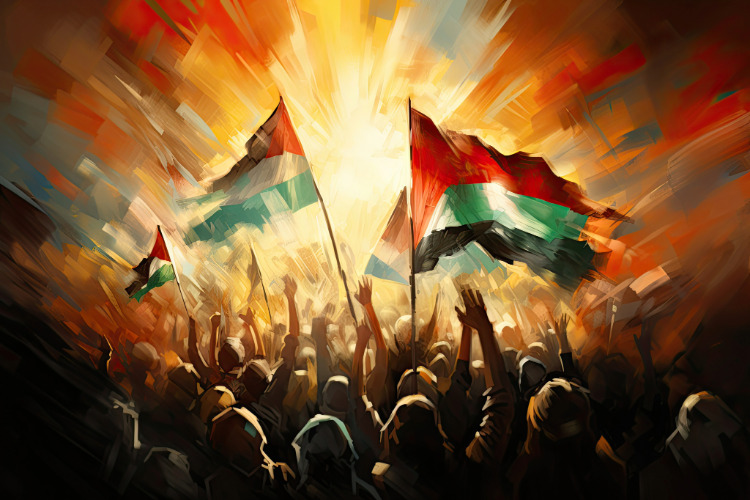
How Postmodern Politics Hijacked the Gospel in the Name of Palestine: An Intellectual Conquest of the Church
Conquest of the Mind
Conquest is not always military. More often, it begins with ideas. The United States has already lived through this with woke culture. Concepts that started in elite universities soon shaped media, politics, and even churches. French thinkers like Michel Foucault, Jacques Derrida, and Jean-François Lyotard taught people to distrust truth, to see knowledge as power, and to treat reason with suspicion (Foucault, 1980; Derrida, 1976; Lyotard, 1984). Once those ideas spread, no institution was untouched.
Australia is already there—at least in its mainline churches. The battlefield is increasingly theological, and at the centre is the question of Israel and Palestine. The weapon being used is Palestinian Liberation Theology (PLT)—a movement that cloaks itself in Christian language while replacing the Gospel with ideology.
What is Palestinian Liberation Theology?
PLT emerged in the late twentieth century as Palestinian Christians tried to explain their faith in light of their political struggle. Naim Ateek, an Anglican priest, gave shape to the movement through the Sabeel Center in Jerusalem. His book Justice and Only Justice (1989) argued that the Palestinian experience of oppression was the proper lens for reading the Bible.
From there, the biblical story was reimagined. The Exodus became a nationalist allegory: Palestinians were Israel, and modern Israel was Pharaoh. Jesus was redefined as the suffering Palestinian, crucified again in every injustice. Salvation was reduced to political liberation, and justice was framed as resistance. In short, Scripture became a manifesto for nationalism rather than God’s revelation of redemption (Raheb, 2014).
Why PLT Appeals to the West
Why does PLT resonate so strongly in the West? Because it aligns with postmodern assumptions already dominant in universities. Truth is relative. History is written by oppressors. Justice means siding with the marginalised. PLT simply baptises those ideas in theological language.
It also resonates emotionally. Palestinians are portrayed as David facing Israel’s Goliath. It plugs neatly into Western narratives of decolonisation, anti-racism, and social justice. And it offers mainline denominations an easy way to sound prophetic while fitting cultural trends. It looks righteous. It sounds compassionate. But it bypasses the cross.
The Theological Cost of PLT
The theological price is staggering. Christ Himself is reduced to the suffering Palestinian. Yet Scripture proclaims Him as the Lamb of God who takes away the sin of the world (John 1:29). His cross is not a metaphor of resistance, but the once-for-all sacrifice reconciling sinners to God (Heb. 10:10).
The Exodus is twisted into an indictment of Israel, though Paul insists it was written to point forward to Christ (1 Cor. 10:1–4). Salvation becomes political liberation, when the New Testament defines salvation as deliverance from sin and death (Rom. 6:23). Justice is reduced to solidarity with the oppressed, while biblically it flows from God’s own character (Deut. 32:4).
Israel is portrayed as Pharaoh, though Paul insists Israel remains beloved for the sake of the patriarchs (Rom. 11:28–29). And the church’s mission is rewritten as siding with the oppressed, while the New Testament declares its mission is to proclaim Christ crucified and risen, reconciling Jew and Gentile in one body (Eph. 2:14–16).
Strip these truths away, and Christianity becomes little more than political rhetoric.
The Political Shortcomings of PLT
Even politically, PLT collapses under scrutiny. It ignores centuries of Jewish persecution culminating in the Holocaust. It brushes aside Israel’s real security concerns, as though the nation were not surrounded by hostile regimes and terror groups.
Instead, PLT lends legitimacy to campaigns like Boycott, Divestment, and Sanctions (BDS), which isolate Israel rather than promote peace (Kairos Palestine, 2009). It remains largely silent about corruption in the Palestinian Authority and the violence of Hamas. At its core, PLT baptises Arab nationalism—using the language of Exodus and crucifixion not to exalt Christ, but to sanctify a nationalist struggle.
Christ at the Checkpoint: A Platform for PLT
Nowhere is this clearer than at the Christ at the Checkpoint (CATC) conference in Bethlehem. Marketed as an evangelical space for dialogue, CATC amplifies PLT’s message: that Western Christians must abandon support for Israel and adopt the Palestinian narrative as the hermeneutical key to the Bible (Isaac, 2014).
Though CATC promotes itself as a forum for peacemaking, its emphasis consistently shifts Christ from Saviour to symbol. The Bible is combed for metaphors of occupation, while its redemptive centre is pushed aside. The lingering message is that faithfulness to Christ requires endorsing a political cause. This is how movements like PLT sneak into churches under the banner of “justice”. What should be a conference exalting the cross has instead become a platform where ideology is wrapped in Christian language.
The Australian Connection
Australians should not imagine this is a distant debate. PLT has already gained traction in the nation’s church life. In August 2025, the Uniting Church Assembly Standing Committee endorsed the World Council of Churches’ A Call to End Apartheid, Occupation and Impunity in Palestine and Israel, effectively aligning itself with the theology of Kairos Palestine (Uniting Church in Australia, 2025). Just months earlier, UCA leaders hosted a “Uniting for Peace in Palestine” forum in Canberra, complete with prayers and liturgies that echoed PLT themes.
Progressive Anglican dioceses have moved in the same direction, with synod motions calling for solidarity with Palestinians and framing the conflict in terms of liberation and oppression.
Outside the denominations, advocacy groups are even more explicit. The Palestine Israel Ecumenical Network (PIEN), which claims members across 11 denominations, actively circulates Kairos Palestine resources and runs workshops in local congregations (PIEN, n.d.). Friends of Sabeel Australia openly partners with the Jerusalem-based Sabeel Center to bring figures like Naim Ateek and Mitri Raheb into Australian conversations. Palestinian Christians in Australia amplify the message further by distributing books and sermons from Ateek, Raheb, and Munther Isaac.
By contrast, evangelical churches have been far less receptive—but they have also been far too quiet. And in this case, silence is not neutrality. It is surrender.
The Spiritual Stakes
This is not just a battle of ideas. It is a battle for the soul of the church. PLT does not merely distort Israel’s story. It displaces Christ Himself. It trades the eternal for the political, the universal for the partisan, the kingdom of God for the agenda of man.
Churches in Australia that embrace PLT may think they are standing for justice. In reality, they are surrendering the gospel to ideology. The result is not liberation but bondage to a false gospel.
A Call to Discernment
PLT is not harmless. It is an intellectual conquest of the church. Just as woke culture reshaped Western institutions, PLT is reshaping the theology of Israel and Palestine. It hijacks biblical categories and rewrites them for political ends.
Now is the time for Australian Christians to wake up. You must pray for discernment. You must test every teaching against Scripture. And you must refuse to let ideology take the place of revelation. That means speaking up in your congregations, challenging false teaching, and proclaiming the true Gospel with clarity.
The hope for Palestinians and Israelis alike is not political liberation. It is Christ crucified and risen. He alone breaks down the wall of hostility (Eph. 2:14). He alone reconciles Jew and Gentile in one body. And He alone brings the justice, peace, and salvation the world longs for. Anything less is not the gospel. It is surrender to a false Christ wrapped in the language of justice.
___
References
Ateek, N. (1989). Justice and only justice: A Palestinian theology of liberation. Orbis Books.
Derrida, J. (1976). Of grammatology. Johns Hopkins University Press.
Foucault, M. (1980). Power/knowledge: Selected interviews and other writings, 1972–1977. Pantheon.
Isaac, M. (2014). The other side of the wall: A Palestinian Christian narrative of lament and hope. InterVarsity Press.
Kairos Palestine. (2009). A moment of truth: A word of faith, hope and love from the heart of Palestinian suffering. Kairos Palestine.
Lyotard, J. F. (1984). The postmodern condition: A report on knowledge. University of Minnesota Press.
Palestine Israel Ecumenical Network (PIEN). (n.d.). About us.
___
Image courtesy of Adobe.
10 Comments
Leave A Comment
Recent Articles:
8 October 2026
3.6 MINS
John Anderson warns that Australia’s decline is rooted in spiritual and cultural disintegration, calling for a recovery of Christian foundations, social cohesion and national purpose.

8 October 2026
1.6 MINS
A blackout at Australia’s $150 million Pre-COP climate summit in Fiji delivered an awkward lesson in energy reliability to delegates preaching the renewable transition.

8 October 2026
4.1 MINS
Aboriginal communities in Central Australia already know the gospel message. What they need now, Robyn Murray writes, is discipleship, encouragement and Christians willing to pray and participate.
8 October 2026
4.1 MINS
Italy honours St Francis of Assisi 800 years after his death, celebrating a saint whose devotion to Christ, radical simplicity and message of peace continue to shape generations.

8 October 2026
2.8 MINS
The MDBA’s case for further water buybacks rests on climate projections increasingly challenged by climate scientists, historical rainfall data and evidence of a greener Basin.

8 October 2026
4 MINS
Christ’s authority and concern is not limited to the four walls of the church. They extend to the life of the nation, and we are called to take up our part in seeking its righteousness.

7 October 2026
3.6 MINS
Victoria’s 18th March for the Babies will bring families together to peacefully affirm the value of every human life and call for a cultural change towards life.



Thank you so much Dr Orr. This is a most valuable article.
Thank you so much, Teri. I’m really encouraged that you found the article valuable. My hope in writing it was to help fellow believers see through some of the confusing narratives out there and stay anchored to the gospel. It means a lot to know it resonated with you
“The lingering message is that faithfulness to Christ requires endorsing a political cause. ”
Yes , as the opposite is ultimately faithfulness to Christ
There is a huge difference from a political cause, and being salt and light. E.g. standing for Pro-Life and stopping the murder of babies.
Dear Dr Orr,
Thank you for articulating the issues of the Palestinian Christ so well. I’m out with others street evangelising and find it disturbing when coming across distorted views of our Lord Jesus. It is bad enough that Muslims here are so deceived but when it is in the church it is grotesque. Jesus was, and is , Jewish, born of a Jewish mother, the Saviour of the whole world, the Light to the nations, who came “first to the household of Israel”, and is coming back to rule. His death, resurrection and ascension are attested facts history within the Jewish and the ruling Roman context. Much of the current suffering of the so called Palestinians is due to their own leadership and being brought up with “victim mentality”. It grates that so many other people who are genuine refugees receive so little help in comparison to the so called refugees of the Palestinian territories who’ve received billions, if not trillions, from UN contributors who maintain the lifestyles of corrupt “Palestinian” leadership.
I fully agree with Dr. Orr’s warning. What we are witnessing is nothing less than a hijacking of the Gospel by postmodern politics dressed up as theology. Palestinian Liberation Theology is not a harmless perspective—it is a false gospel that replaces the Cross of Christ with the slogans of ideology.
The Uniting Church Assembly, progressive Anglican synods, and even the Pacific Conference of Churches (PCC) have aligned themselves with PLT rhetoric in recent statements. They may think they are standing for justice, but in reality, they are surrendering the Church’s prophetic witness to the cultural trends of the day. This is not courage—it is compromise.
When Christ is reduced to a political symbol, salvation to “resistance,” and Israel to Pharaoh, the Church has lost its compass. Our task is not to baptise nationalism—whether Israeli or Palestinian—but to proclaim Christ crucified and risen, the only hope for Jew and Gentile alike.
Silence from evangelicals is no longer an option. Now is the time to speak clearly: the Gospel is not a partisan manifesto, it is the power of God unto salvation (Rom. 1:16). Anything less is betrayal.
This is terrifying, not least because theologians in mainline churches seem to be failing in their duty to critique new theologies. like this one. How has it become so strong, so accepted, without going through the usual stringent reviews to make sure that speculation still reflects the truths of the Gospel? Thank you, Dr Orr, for being a stand-out in this. We must not allow the preaching Gospel itself to be subverted by this version of Critical Theory.
Thank you, Dr Orr, for every point you have made and to warn us as Christians in Australia that Palestinian Liberation Theology (PLT) movement is a false theology. I would add it has a satanic source too, (as well as acknowledging the lack of discernment in churches) – Satan is the father of lies and slander and accusation.
Thank you for your central statement: ‘This is not just a battle of ideas. It is a battle for the soul of the church. PLT does not merely distort Israel’s story. It displaces Christ Himself. It trades the eternal for the political, the universal for the partisan, the kingdom of God for the agenda of man…Churches in Australia that embrace PLT may think they are standing for justice. In reality, they are surrendering the gospel to ideology. The result is not liberation but bondage to a false gospel.’
As I see it, the fight for truth within the church was already blurred due to Replacement theology creeping into churches by AD 300 and denying Israel’s right to own the land God gave and to still be blessed in days to come. Replacement theology took root so deeply, but now we have the whole ‘Gaza’ and so-called Palestinian state argument and conflict brought to our shores by ideology and media, by those who believe the false ideology; then adopted by politicians and some church leaders- all for ‘the good cause’ of defending an Arab and PLT sense of justice (as you pointed out).
The blindness that was multiplied in Hitler’s time and through much persecution of the Jews earlier, has all become a landslide of antisemitic thinking and most Christians have lost sight of the fact that God gave Abraham, Isaac and his seed the land of Israel as a covenant agreement, and the Torah. The church too inherited blessings when gentles became believers and recognised a Triune God who gave the Bible as a road map and so people could understand His Sovereign plan for Israel and mankind (grafting in the Gentiles)…Al this is God’s plan and has nothing to do with the Koran, or setting up a Palestinian state for Arabs or refugees and God clearly stated he sent His son to die on the cross in order that we might be saved, which contrasts with the Koran’s theology.
As you said we must speak up while we can ( I am aware the new proposed laws spoken of in Federal govt in the past few days, if implemented will likely see so speaking up means fines, jail times and much more persecution)
To Leigh
Thank you, Leigh. I appreciate how you’ve captured the heart of the tension here. It’s true—faithfulness to Christ can never be reduced to any human agenda, and yet our allegiance to Him shapes everything we stand for. When our faith guides our steps, it will naturally overflow into every sphere of life, including the way we approach culture and politics—but always with Christ as Lord, not as a banner for a cause.
To Kym Farnik
Kym, thank you for that thoughtful distinction. You’re right—there’s a world of difference between chasing political victories and living as salt and light. Standing for life, justice, and truth flows out of our identity in Christ rather than a partisan label. When we stay rooted in Him, our witness becomes less about winning arguments and more about embodying His heart in a dark and hurting world.
To Eunice Embury Johnson
Eunice, thank you for such a heartfelt and courageous reflection. It’s deeply encouraging to hear how you’re sharing the true Jesus in your street evangelism. You’re absolutely right—Christ’s Jewish identity and His historical life, death, and resurrection are not optional details; they are the core of the gospel. Your passion for truth and compassion for those who are misled shines through. May the Lord continue to give you boldness and tenderness as you proclaim Him.
To Sakeasi Tawakétini
Sakeasi, thank you for your powerful and heartfelt words. You’ve articulated with clarity what is at stake—when the cross is eclipsed by ideology, the gospel itself is emptied of its power. I appreciate how you call the church back to its prophetic task: to proclaim Christ crucified and risen, not baptize worldly agendas. Your voice is a needed encouragement to hold fast to the gospel with both courage and love.
To Joan Seymour
Thank you, Joan. Your concern is so valid—discernment is essential, especially among those entrusted to shepherd God’s people. It is sobering how quickly new ideologies can be embraced without theological testing. I’m encouraged by your resolve to hold the line on gospel truth. May God raise up many who, like the Bereans, will examine everything carefully and cling to what is good.
To Gail Petherick
Gail, thank you for your passionate and deeply thoughtful response. You’ve traced the bigger picture so clearly—how theological drift over centuries has opened the door for new ideologies to take root. Your love for God’s truth and His promises to Israel is evident, and your reminder that this is a spiritual battle is so important. Yes, we must speak up while we can, with both grace and conviction, trusting that God’s Word will not return void.
The problem with this article is that it implies that to accept the prophetic message of PLT requires abandoning its spiritual message. As a Palestinian Christian, I fully affirm the salvation message of Christ, his centrality , and the truth of scripture, while recognizing its prophetic power and its requirement of justice. justice does not replace salvation, but is one of the fruits of listening to Jesus’ message and his care for the poor and the oppressed. I reject the implied dichotomy that either you believe in salvation or justice: that you must support either spirituality, or care for God’s children. You need to do both.