


Thomas Crooks and Pot: A Forensic Detective Story for the President
Dr Phillip Drum, PharmD, is a clinical pharmacist and oncology specialist. Over his career, he has worked extensively with cancer and AIDS patients, gaining direct experience with the therapeutic use of dronabinol (synthetic THC).
Since the death of his sister in 2012 in a collision caused by a driver who was under the influence of marijuana, Dr Drum has dedicated himself to education on the risks of cannabis use.
When Dr Drum was in Melbourne in October to address the Drug Advisory Council of Australia (DACA), he outlined to News Weekly the investigation that he and his colleagues at the International Academy on the Science and Impact of Cannabis (IASIC) had undertaken into the autopsy performed on would-be assassin of Donald Trump, Thomas Crooks. Their analysis leaves little doubt that Crooks was a habitual user of cannabis. The uncovering of this detail, whether deliberately or accidentally obscured by the authorities, is an authentic real-life forensic detective story.
___
We had a presidential candidate in 2024, running for President of the United States. I think you’ve heard the name: Donald Trump. He was shot and injured in Allegheny County, Pennsylvania, by a man named Thomas Crooks. A Secret Service agent then shot and killed Crooks where he was lying on the roof of a nearby building.
All indications point to Thomas Crooks being a cannabis user. If you look back at his history, you’ll see that he was kicked out of his parents’ and grandparents’ house at ages 18 and 20 for “drug use” and “strange behaviours”. Though that’s all the mainstream media will tell you – they won’t tell you what drug. They don’t use the “M” word for marijuana anymore. Or they tell you that it’s mental-health issues.
They de-emphasise or obscure the fact that Crooks was a user of cannabis. And this is made all the easier as states loosen and repeal laws forbidding the production, possession and use of cannabis. So, no big deal – except for the mounting evidence of cannabis’ toxicity and dangers to mental and physical health and its well-documented dire social effects (see News Weekly, 15 and 29 November, “How Big Marijuana Has Manipulated the Public to Believe Cannabis Is Safe,” for details).
The International Academy on the Science and Impact of Cannabis (IASIC), to which I am an expert affiliate council member, acquired the toxicology report for Thomas Crooks from the Allegheny County Office of the Medical Examiner, Forensic Laboratory Division. This report states that they drew blood from various parts of Crooks’ body.
The top part tells you where the samples were taken from (heart blood, urine, eye fluid and bile). Further down are the results.
The result for his heart blood tells you that:
They looked for alcohol – none detected.
They looked for buprenorphine – none detected.
Benzodiazepines – none detected.
Cocaine metabolites – none detected.
Opiates, oxycodone, fentanyl, methamphetamine, barbiturates, methadone, amphetamine, carisoprodol – none detected.
Did you see the term THC (tetrahydrocannabinol, the active ingredient in marijuana) in there? No. Did they look for THC? It’s not on their list.
But that is not the end of the story. A little forensic detective work will reveal more.
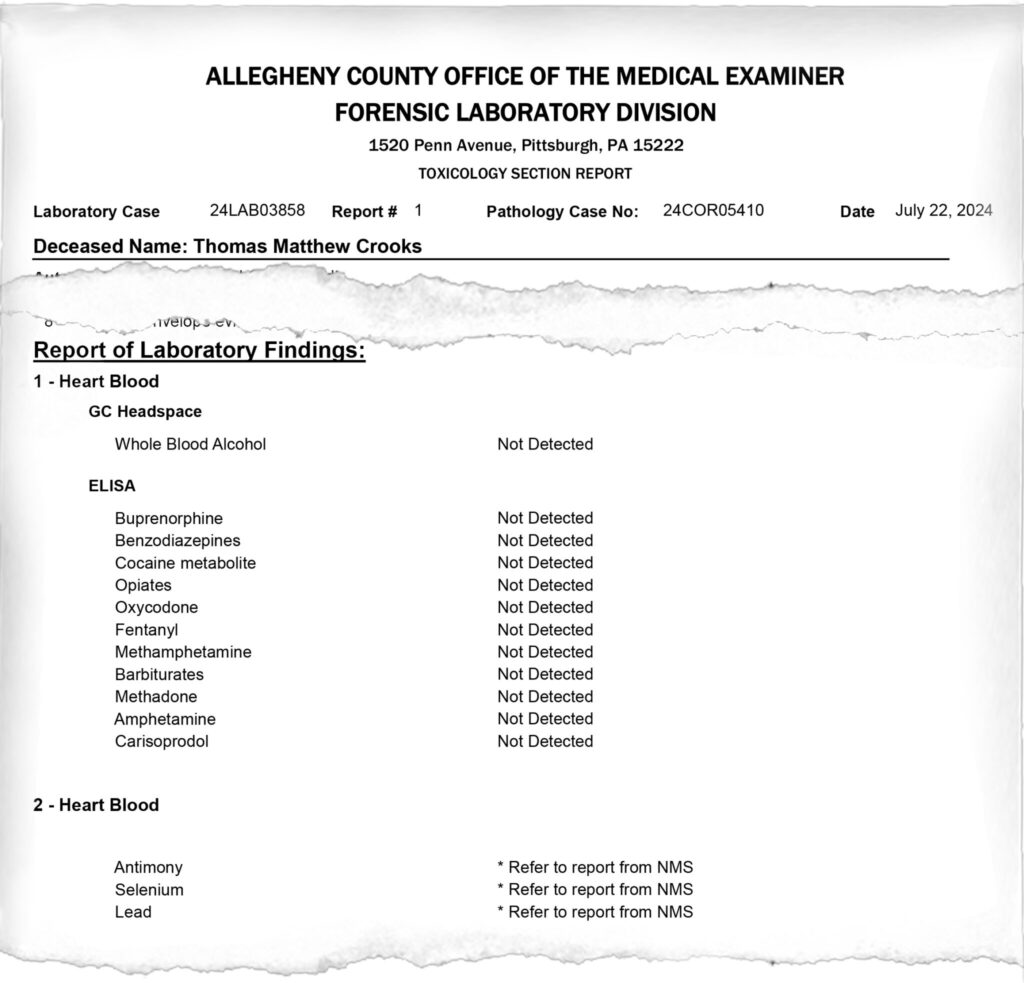
So, it is very pertinent that, right at the bottom of the toxicology report, it tells you that there was lead, antinomy, and selenium present in the samples. And they refer you to the “report from NMS” (NMS Labs is the name of the laboratory that performed the heavy metal tests).
And in the report from NMS, Screen for Heavy Metals – again, Thomas Crooks’ samples – it shows you the lead level (5.9 mcg/dL), the selenium level (1.7 mcg/L), and the antinomy level (160 mcg/L).
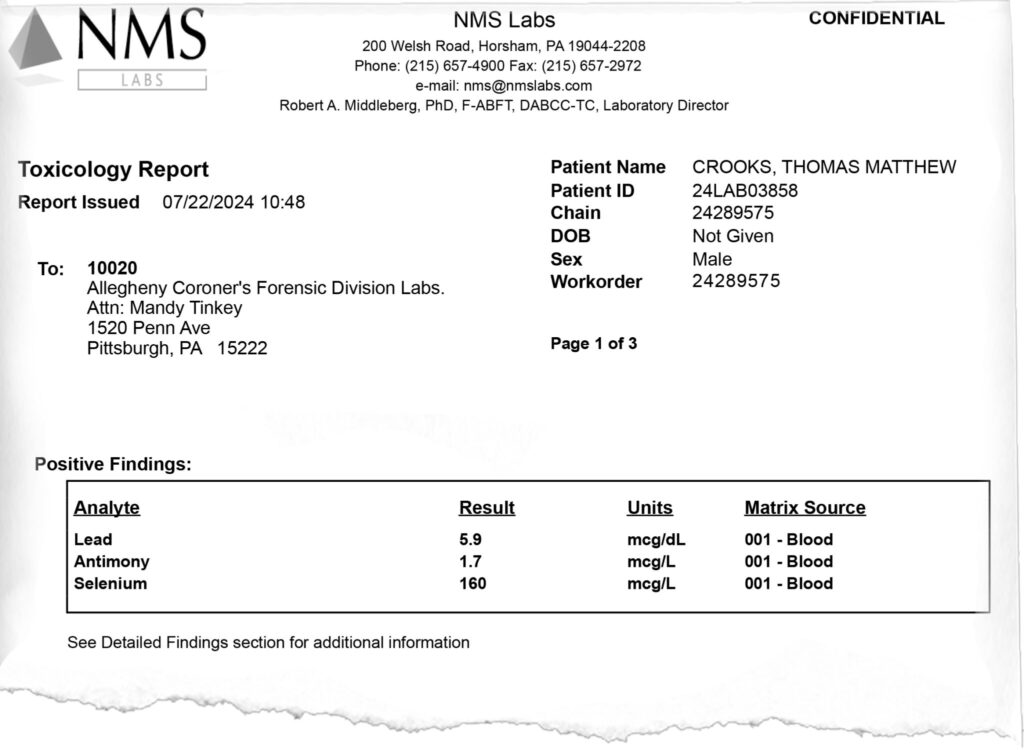
The level of lead found in Thomas Crooks’ blood according to the Screen for Heavy Metals report (5.9 micrograms per decilitre) is rated as “elevated”. Unexceptional levels are below 3.5 mcg/dL and the level in the general population is 0.855 mcg/dL. A blood level above 5 mcg/dL requires further investigation/ action, according to the Centers for Disease Control and Prevention (CDC) website. Yet, no action was taken to determine why Crooks’ level of lead was so elevated.
The obvious cause of the elevated level was completely ignored. It would have raised the issue of cannabis use – which apparently they did not test for. Why this is relevant will be explained immediately below.
Picking Up the Scent
Why didn’t they test for THC? Let me show you why this is very worrying.
In September 2023, Nate Seltenrich reported in the journal Environmental Health Perspectives on a study carried out at Columbia University in which they looked at blood and urinary metal levels among 7,254 exclusive marijuana users in the National Health and Nutrition Examination Survey (NHANES) between 2005 and 2018.
(NB: the journal Environmental Health Perspectives, in an irony of ironies, has disappeared from the internet after the Trump Administration cut funding to its parent organisation, the US National Institutes of Health (NIH). Editor)
Seltenrich’s report (copy in our possession), “Untested, Unsafe? Cannabis Users Show Higher Lead and Cadmium Levels”, mentions in its discussion that the results suggest that marijuana is a source of cadmium and lead exposure. What did Thomas Crooks have in his blood? Lead.
Lead.
I don’t know whether they even looked for cadmium.
Not enough? Let’s go on. In September 2020, in the journal, Frontiers in Pharmacology, the review article, “Cannabis Contaminants Limit Pharmacologic Use of Cannabidiol”, reports that cannabis is a phyto-mitigant. It says:
“Concerns have arisen about the possible contaminations of hemp with pesticides, heavy metals, microbial pathogens, and carcinogenic compounds during the cultivation, manufacturing, and packaging processes.”
It is crucial to understand that cannabis is what is known as a “phyto-mitigant”. The authors of the review article, “Potential of Industrial Hemp for Phytoremediation of Heavy Metals” (Plants, February 2022), write:
“Phytoremediation is the use of green plants to remove metal pollutants from soil or render them harmless. Many plants are known to accumulate metal pollutants …. Most metal-accumulating plants are small shrubs with shallow roots requiring specific growing conditions. To be effective at soil remediation, more than just the top layer of soil needs to be cleaned of pollutants. Hemp’s (cannabis sativa) ability to extract metals from soil with its deep roots, combined with its commercial prospects, make it an ideal candidate as a profit-yielding crop when used for phytoremediation purposes.”
Again, Nate Seltenrich in Environmental Health Perspectives (August 2019) writes:
“Metals are the final class of contaminants that cannabis regulators must contend with. The cannabis plant is known as a hyperaccumulator; as it grows, it can take up unusually high levels of metals from the soil or growing medium through its roots and potentially into its flowers.”
The review article, “Harnessing Cannabis Sativa L. for Integrated Environmental Remediation and Circular Biomass Use,” by A Jurga et al., in Science of the Total Environment journal in June 2025 says:
“Lead (Pb) content in particular hemp’s parts was like (concentration in the following descending order): flower > roots > stems > leaves > seeds > fibre.”
So, as you can see, lead is found in the flower in the highest concentration in a cannabis plant.
The US Government has known this for a long time, and it plants hemp on former military sites to extract heavy metals from the ground. And these plants are sucking up lead. Then they’re selling the marijuana (see the section at page bottom).
Carelessness?
So, back again to the toxicology report. As we saw, THC is not on the list of what they looked for. Why not?
I ask because, if you go to the Allegheny County Government website, and take a look at the Drug Chemistry page, this is what it says at the bottom of their “results”: “Each year, approximately 6,000 cases of suspected controlled substances are submitted to the drug chemistry forensic lab for analysis. The majority of these cases are concluded to be fentanyl, heroin, cocaine-based crack, and cannabis sativa.”
The County’s own website acknowledges that marijuana is number four in its list of controlled substances that they are identifying in the cases that come the way of its Medical Examiner. Why didn’t they look for it in Thomas Crooks? You’d think that they would want to know every detail they could gather about a man who had attempted to assassinate a public figure! Was it intentional, unfortunate or carelessness?
Dr Kenneth Finn is a cofounder and director of the International Academy on the Science and Impact of Cannabis (IASIC).
Dr Finn notified the Allegheny County Drug Chemistry Section of this anomaly of not testing for cannabis. The lab handed him off to the FBI. When he persisted in attempting to make the FBI realise the gravity of his inference that the elevated level of lead in Thomas Crooks’ blood “suggests” the use of cannabis, the FBI hung up on him.
Follow ‘the Lead’
Again, multiple studies out there show that marijuana or hemp is used to phytoremediate and remove metals from contaminated soil. Therefore, it’s in the plants. So, again, this goes strongly to support the contention that the lead that was in Thomas Crooks’ bloodstream came from his cannabis use. His family members‘ reports of “strange behaviour” and “drug use” also support this claim. And Allegheny County didn’t test for cannabis!?
There’s one other very important point. They took three different types of samples out of him. They took blood, they took urine, and they took hair. Urine, as we talked about earlier, tends to show marijuana use within the last week or more. THC levels in the blood come and go really fast – if you haven’t used in the morning, it may not be in the bloodstream. But that does not mean it is not in the brain. But the hair is the telling one; it gets into your hair follicles and stays up to 90 days from the time of the last use. Why did they not test the hair?
Trail’s End: Cremation
We were desperately contacting the US Government and congressmen and saying, “Get those samples, because by law, Allegheny County can destroy them after a year”. That year ended in July 2025 – the attempted assassination occurred in July 2024. But we couldn’t get anybody to go and get those three samples so that they wouldn’t destroy them.
And guess what else they did with Thomas Crooks? They cremated him very soon after the autopsy. So you cannot find his THC now!
What really scares me is that the Trump Administration is now considering moving marijuana from a CSI to a CSIII classification, and that will allow a lot more marijuana to be out on the streets.
I don’t think Donald Trump is aware that the guy who tried to take his life was a marijuana user. He had high lead levels. He was only 20 years old. What was he doing? Licking lead paint his entire life? No, he was a marijuana user who went psychotic.
Read Ross Grainger’s book, Attacker Smoked Cannabis: Suicide and Psychopathic Violence in the UK and Ireland, from 2019, and Alex Berenson’s book, Tell Your Children: The Truth about Marijuana, Mental Illness and Violence, from 2020.
I have collected over 600 pages of news reports of marijuana use leading to the deaths of thousands of people due to impaired driving, suicides, mass homicides, stabbings, beheadings, air crashes, and a long etcetera.
Somebody needs to get through to the Trump Administration that this is what happened. Mr President, do you realise that the guy who almost killed you was a pothead?
___
An Industry Under the Influence
Per US state laws, and they all differ, the marijuana industry has to check whether certain materials are present in their products. This includes bacteria, fungi, pesticides, and heavy metals.
The marijuana industry testing sites were creating fraudulent reports in California in the first year of sales (2018). See “Falsified California testing lab data may result in major marijuana product recall” by John Schroyer, published on December 3, 2018. in MJBizDaily:
“Sacramento-based Sequoia Analytical Labs surrendered its business licence after a state inspection discovered that the company’s lab director allegedly falsified cannabis product testing results for almost four months. Hundreds of marijuana products may now have to be recalled and retested.”
In a follow-up report, “California Issues Recalls for 29 Marijuana firms caught in Sequoia Labs Fallout”, on 20 December 2018, Schroyer wrote:
“The California Bureau of Cannabis Control (BCC) this week identified 29 separate companies that have been told to recall marijuana products after Sacramento-based Sequoia Analytical Labs’ said its former lab director falsified pesticide test results. The BCC also released a list of 848 product batches that were tested by Sequoia after June 30” … with so many product batches in question, the value of all of those goods could be in the ten-figure range.”
Another lab, Steep Hill Lab, was caught in the same year. In “California Marijuana Recall Threatens State Cannabis Industry”, on December 24, 2018, Clyde Hughes wrote in UPI:
“Before the Sequoia case, Berkeley’s Steep Hill Labs was suspended for 10 weeks earlier this year after it failed to meet state testing protocols for two pesticides. Some industry insiders have said that they don’t believe the laboratories are even capable of testing cannabis to the precision required by regulators.”
You know when those reports come out? Nine months later, they put it on the internet.
If I, as a pharmacist, have an FDA recall on a medication, I have to call the patient and say, “I need you to bring that medication back – the FDA has got a problem with it.” And that has to be done immediately on the various products that the FDA is recalling. I have to call the patient and tell them, “Bring that in so I can replace it with a good medication because something’s wrong with what we gave you”.
The marijuana industry does not do that. The cannabis control groups will notify them nine months later. Whom do you know who keeps marijuana around for nine months? It’s already been used.
___
Republished with thanks to News Weekly. Image courtesy of Adobe.
5 Comments
Leave A Comment
Recent Articles:

9 October 2026
5 MINS
During a recent dialogue between high profile legal experts, a top Australian constitutional law expert was asked if Australia should have a Bill of Rights. His answer may surprise you.
9 October 2026
3.3 MINS
New South Wales healthcare workers who object to abortion and voluntary assisted dying face growing pressure, raising serious questions about conscience rights, employment and moral injury.
8 October 2026
3.6 MINS
John Anderson warns that Australia’s decline is rooted in spiritual and cultural disintegration, calling for a recovery of Christian foundations, social cohesion and national purpose.

8 October 2026
1.6 MINS
A blackout at Australia’s $150 million Pre-COP climate summit in Fiji delivered an awkward lesson in energy reliability to delegates preaching the renewable transition.

8 October 2026
4.1 MINS
Italy honours St Francis of Assisi 800 years after his death, celebrating a saint whose devotion to Christ, radical simplicity and message of peace continue to shape generations.
8 October 2026
2.8 MINS
The MDBA’s case for further water buybacks rests on climate projections increasingly challenged by climate scientists, historical rainfall data and evidence of a greener Basin.

7 October 2026
3.6 MINS
Victoria’s 18th March for the Babies will bring families together to peacefully affirm the value of every human life and call for a cultural change towards life.



What on earth does this have to do with Australia!? This is ridiculous!
Give us Australian stories and articles which are relevant for us here.
Because what happens in America, Australia often follows on behind. The pressure for the legalization of marijuana has been increasing across Australia & has largely been legislated in the Australian Capital Territory. Gaining an understanding of the longer-term implications & consequences of what this can mean for the mental health of users in our nation, is I would argue very valid.
Sadly this is an Australians story. I have a number of friends who were Marijuana users and it ultimately destroyed them.
The marijuana that happy hippies smoked back in the Sixties was very mild. THC, the major active component, was about 3 percent back then; today it can be up to 20%.
Dope, grass, pot – these names have a nostalgic ring. But marijuana is a very different herb today.
https://gamutpackaging.com/blogs/resources/how-much-stronger-is-marijuana-today-compared-to-the-1960s
Shared this with “Drug Czar” Sara Carter at a conference about an hour ago and suggested an FBI investigation if all such “random” shootings.