


Avenue of Trees – Anzac Day Story from the Great War
A rural teaching post awakens one man to the weight of Australia’s war memorials — and leads him to reflect on a far greater sacrifice.
Following the completion of my teacher training, I was posted by Victoria’s Education Department to Nhill in the state’s west.
Having grown up in Melbourne’s suburbs, this was my first extended experience of living in a rural community, where I was exposed to aspects of Australian culture that seemed largely to have been obscured by city living.
Memorials in the Bush
One such feature was the memorials to those who had served our country in wars. Of course, I had attended ANZAC and Remembrance Day services, seen cannons in parks, and noticed honour boards in various locations.
But there in the bush, the memorials seemed more prominent, the sacrifices they recognised more local, and the need to remember more genuinely honoured.
Watch Steve Messer’s band Strange Country perform “Avenue of Trees” with the animated slideshow:
Nhill’s Memorial Hall had a substantial timber honour board, its meticulous golden lettering bearing enduring witness to the extent and human cost of the district’s commitment to our nation’s various calls to arms. The board featured many family names familiar to me from my class lists.
One Saturday afternoon, I took a few moments away from the afternoon tea provided in the country hall next to the cricket ground, where my team, Jeparit, was locked in a more peaceful contest. On a nearby wall hung a framed black-and-white photograph of a local boy who had made, as the inscription beneath said, the “Supreme Sacrifice”.
I was newly married and at the very beginning of my adult life, yet here I was, standing in front of a tribute to a younger man who would grow no older—his life taken from him far from the epic silence of his peace-time wheat fields.
Road travel to Nhill took me through the regional city of Ballarat where, in 1917, with the Great War far from over, the “Lucas Girls”—workers at a local textile company—raised funds and began planting one of Australia’s earliest memorial avenues.
Completed in 1919 and comprising nearly 4,000 trees, each in honour of a Ballarat man or woman who had enlisted in Australia’s Imperial Forces, the avenue is reckoned to be the longest in the nation.
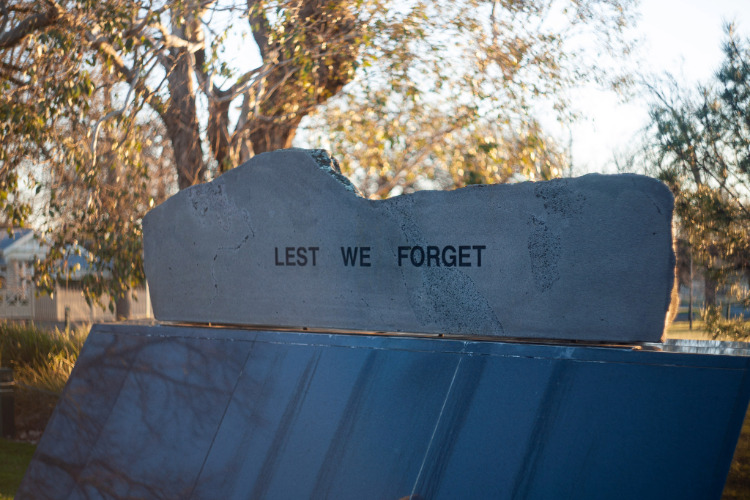
Memorial in Ballarat, Victoria.
The Avenue and the Arch
Standing astride the Western Highway, just before the first of the trees, is the imposing Arch of Victory—another Lucas Girls’ project—officially opened in 1920 by His Royal Highness Prince Edward, the Prince of Wales.
The significance of Australia’s contribution to the Great War, and what it represented for our newly federated nation, was keenly felt at the time. Banjo Paterson’s 1915 post-Gallipoli poem, We’re All Australians Now, addressed as an “open letter to the troops,” begins:
Australia takes her pen in hand
To write a line to you,
To let you fellows understand
How proud we are of you.
It was Paterson’s contention that Australia’s war effort marked our arrival as a nation on the world stage—a sentiment shared by Australia’s official war correspondent, C.E.W. Bean. He wrote a speech to be read when “Peace Souvenir Medallions” were presented to all schoolchildren in 1919.
Bean declared that “our own young country,” so recently barely known, was now counted among the “great and free nations… given a place in the conference of nations… with the right to mould her future as she pleases.”
The mark left on country communities by Australia’s involvement in war seemed very real, yet somehow the Great War stood apart in the urgency of the need that it never be forgotten. A later poet, Geoff Page, captured this in Small Town Memorials (1975):
The next bequeathed us
Parks and pools
But something in that first
Demanded stone.
A Song Born from Silence
Several years after we had left Nhill, my family and I returned to visit friends. Driving under the Arch and westward through the avenue, our children were making a back-seat racket because we hadn’t stopped for lunch at some golden arches—a symbol more familiar to them and, at that point, of more immediate concern. They were only young, but their complaining felt strangely out of place as we passed through a memorial to self-sacrifice.
That memory stayed with me and became the inspiration for a song in which I tried to express the effect these rural memorials and their cultural significance had on me. More than that, I wanted the undoubted sacrifice of Australia’s men and women to become a lens through which to view and understand the incomparably greater, once-for-all sacrifice of the Lord Jesus Christ.
Australia’s servicemen and women were persuaded of the importance of a cause worth suffering and dying for. Many of our memorials to their valour carry words from the fifteenth chapter of John’s Gospel: “Greater love has no one than this, that someone lay down his life for his friends.”
Those words have a certain aptness in relation to their sacrifice. Yet the evil that lies in the human heart means that “wars and rumours of wars” will always be with us. Until that evil is comprehensively dealt with, no war will end war.
Jesus came to earth as the Prince of Peace, uniquely qualified as both God and man to offer himself as a perfect substitute and sin-bearer—not just for the defence of a nation, but for the salvation of the whole world.
Faith in him—trust that his death paid the price that ends the deeper conflict beneath all war, humanity’s estrangement from its Creator—secures peace with God in the present and the promise of a future where “the nations shall beat their swords into ploughshares, and their spears into pruning hooks,” where “nation shall not lift up sword against nation, neither shall they learn war anymore” (Isaiah 2:4).
All because Jesus was hung in an avenue of trees.
Watch the live concert version set to start at “Avenue of Trees“:
AVENUE OF TREES
Words and music by Steve Messer
Heading out of Ballarat towards the western plains
The tall white arch behind me, ahead the dual lane
On both sides of the highway, stripped bare by winter’s breeze
Ten miles of sad reminders, the avenue of trees
I’d never thought about it, can’t say what changed my mind
I must have driven through there about a hundred times
But this day it all connected, I begged a moment’s silence please
Ten miles of fallen heroes, the avenue of trees
Greater love has no man than he lay his life down
In order that another could go free
Brave men marched to war from cities and from country towns
Some made it home, some died alone
Who knows their agony?
And so there stands the avenue of trees
There are statues in the main-streets boards up on the walls
Hand-carved with golden letters in every country hall
And if you see a cross there, it’s for brave men such as these
That just outside of Ballarat, there’s an avenue of trees
I spent an hour alone inside a memorial hall
I stopped before a photo of a boy who heard the call
The inscription underneath said he was born in ‘twenty-three
That’s way before my time; he’s still a younger man than me
The one who lives forever, the one who knows each name
Came and lived among us and died alone in shame
And cruel men stood and mocked him in the act that brought release
Did they know their scorn was poured on the one who made the trees?
Greater love has no man than he lay his life down
In order that the whole world could go free
Jesus left his throne, and tangled thorns became his crown
So far from home, he died alone
Who knows his agony?
When they hung him in the avenue of trees
Greater love has no man, when they hung him in the avenue of trees
Steve Messer’s Strange Country: Band Bio
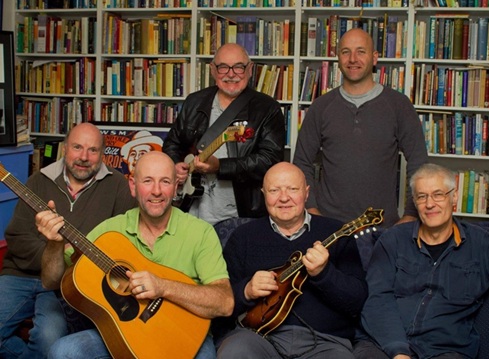
L-R: Rod Boreham, Steve Camp, Gary Adams, Steve Messer, Mike Stritch, Darryl Thompson
Steve Messer’s Strange Country cooks the musical flavours of country, blues and gospel into an original uptown-downhome, pre-post-modern, rhythm’n’bluegrass stew. For over thirty years, Strange Country has performed across Victoria and interstate, at concerts, festivals and live radio broadcasts, in venues big and small, delighting audiences with their lively musical and conversational interplay, and songs rich in stories about life’s joys and struggles, hard times, high hopes and the triumph of faith in Jesus Christ.
___
Image courtesy of Adobe.
3 Comments
Leave A Comment
Recent Articles:

15 October 2026
4.2 MINS
Many Australian Christians don’t know a single Aboriginal person. Robyn Murray argues that reconciliation begins with honest history, prayer and a shared life in Christ.

15 October 2026
6.1 MINS
Historian Frank Furedi warns that the West is waging a war against its own past, censoring books, rewriting history and severing future generations from their heritage.

15 October 2026
7.2 MINS
A man’s death in a tiger enclosure sparks chilling online reactions, exposing a growing willingness to judge human worth by usefulness, behaviour and ideology.
15 October 2026
2.6 MINS
Before anything else, we must make prayer central. I urge the Church in Australia to awaken to, first of all, prayer.

14 October 2026
6.7 MINS
A national poll challenges claims that pro-life Australians are extremists, revealing broad support for abortion restrictions, protections for unborn babies and safeguards for vulnerable women.

14 October 2026
2.8 MINS
Queensland recorded 1,082 assisted suicide and euthanasia deaths in 2025–26, as the review board called for consultation on potentially widening eligibility criteria.
14 October 2026
5.5 MINS
As Christianity fades from public life, Marxism or Communism offers a substitute faith built on oppression, liberation and political salvation — but at what cost?



It is hard to put into words the power of this song.
Thanks again Steve for helping us to ponder what is really important on Anzac Day
Great article Steve. Nice to see you popping up on these illustrious pages.