


Politics, Redrawn
Nation First looks into the collapse of traditional voting loyalties and the explosive rise of populist insurgencies across Australia and Britain.
The political map is being torn up in front of our eyes.
The old loyalties are dying. Fast.
- One Nation’s victory in the Farrer by-election has shattered assumptions about permanent Coalition dominance in regional Australia.
- Reform UK and Great Yarmouth First are proving the same populist revolt is spreading rapidly across Britain.
- Working-class, regional and middle-income voters increasingly believe the major parties no longer represent their interests.
- Younger and middle-aged voters are breaking away from inherited political loyalties far faster than older generations.
- Australia and Britain are entering a far more volatile political era where outsider parties can rise with extraordinary speed.
Farrer Was Never Supposed to Fall
Official Australian Electoral Commission figures now show One Nation’s David Farley on 57.33 per cent of the preferred vote in yesterday’s Farrer by-election, with postals still to be counted. But the result is over. One Nation has won. And not just by a little bit either.
That matters because Farrer was not supposed to fall.
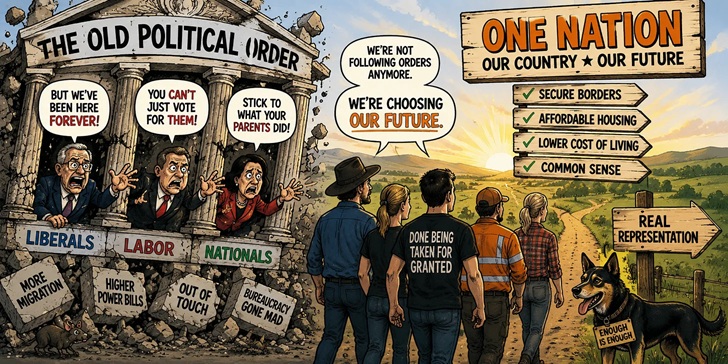
This was a seat the Liberals and Nationals had held forever. A vast regional electorate where the Coalition machine once operated almost automatically. The assumption inside Canberra was always that regional conservative voters might grumble, complain, threaten protest votes for a while, but eventually they would “come home” to the Liberals and Nationals when it mattered.
Farrer just shattered that assumption.
And what makes this more significant is that it is not happening in isolation. Across Britain this past week, Reform UK has ripped through old political strongholds with extraordinary force, smashing both Labour and Conservative voting blocs in local elections and proving that millions of voters no longer feel bound by old tribal loyalties. Even smaller insurgent movements are now breaking through. In Great Yarmouth, the Great Yarmouth First movement, linked to Rupert Lowe’s Restore UK, swept every single seat it contested across Norfolk County Council and Great Yarmouth Borough Council.
Different countries. Different electoral systems. Same political trend.
The establishment keeps trying to interpret these movements as temporary protest votes. But this is becoming something much deeper than protest. We are watching the collapse of political inheritance.
For decades, voting patterns were almost cultural rituals passed down through families. Your parents voted Labor so you voted Labor. Your grandparents backed the Coalition so you stayed loyal too. Large sections of the working class automatically voted Left. Regional voters defaulted to conservative establishment parties. Many middle-class voters stayed locked inside predictable political habits because that was simply “what people like us do”.
That old structure is breaking apart.
The End of Inherited Loyalty
The new political divide is no longer neatly economic. It is cultural, institutional and emotional. More and more voters believe the political class itself has become detached from the nation it governs. They look at rising crime, collapsing housing affordability, strained infrastructure, cultural fragmentation, censorship, declining living standards and political elites obsessed with global priorities while ordinary citizens struggle to stay afloat.
And they increasingly conclude that both major parties helped create the mess.
That is why parties like One Nation and Reform are growing. Not because every voter agrees with every policy detail. Not because every candidate is flawless. But because these parties increasingly represent resistance to a political class that many voters no longer trust.
In Australia, this trend may become especially powerful in regional and outer suburban electorates. They are sick of mass migration, the housing crisis, soaring power prices, bureaucratic arrogance and being lectured constantly by media commentators and inner-city activists who often seem openly contemptuous of their values and concerns.
And importantly, the demographic shifts are changing too.
The voter most likely to shift right-populist today is not just the old conservative voter. In fact, polls show that baby boomers (those roughly 60 and above) are the likeliest to keep voting along traditional two-party lines and mostly for the so-called conservative wing of the two-party system, that is the Liberals and Nationals in Australia, and the Tories in the UK.
The real movement is increasingly coming from younger working-age voters, regional Australians, tradies, self-employed operators, middle-income families and especially men under 50 who feel politically homeless inside the current system.
That creates enormous long-term instability for the establishment parties.
Because once voting habits stop being inherited, politics becomes far more volatile. Seats once considered permanently safe suddenly become competitive. Voters become willing to swing dramatically between elections. And outsider parties no longer need decades to build support. They can rise extremely quickly if public frustration reaches critical mass.
That is exactly what the old parties are now confronting.
Who Will Fight for Voters?
The Liberals and Nationals increasingly face a structural problem across regional Australia because many voters no longer see them as genuinely conservative. Labor in Australia and Labour in Britain both face a similar crisis because huge sections of their traditional working-class base no longer believe the parties represents workers at all. Across the Western world, parties built for the political battles of the 1980s and 1990s are now trying to govern electorates that have fundamentally changed.
And many voters have simply stopped believing the old slogans.
Voters are no longer thinking about who their mum and dad voted for. They’re no longer concerned with which party is supposed to represent them. They’re no longer believe hoary old lines like Labor is for the workers, the Liberals are for small business and the Nationals are for the farmers. All that is bygone political spin detached from lived reality.
Instead, voters just want to know who is prepared to fight for them.
That is the future now rushing toward Australian and British politics. Not stable two-party management. Not predictable electoral loyalty. But an increasingly fragmented, populist and anti-establishment political era where millions of voters are actively searching for alternatives outside the old system.
The Farrer by-election may end up being one of the moments when even the political establishment in Australia finally realised the realignment had already begun.
___
Republished with thanks to Nation First.
4 Comments
Leave A Comment
Recent Articles:

15 October 2026
3.6 MINS
An 80,000-strong gathering in Texas signals a hunger for revival, as Pastor Philip Anthony Mitchell warns that Christian indifference could leave future generations without the faith.

15 October 2026
4.2 MINS
Many Australian Christians don’t know a single Aboriginal person. Robyn Murray argues that reconciliation begins with honest history, prayer and a shared life in Christ.

15 October 2026
6.1 MINS
Historian Frank Furedi warns that the West is waging a war against its own past, censoring books, rewriting history and severing future generations from their heritage.

15 October 2026
7.2 MINS
A man’s death in a tiger enclosure sparks chilling online reactions, exposing a growing willingness to judge human worth by usefulness, behaviour and ideology.

15 October 2026
3.9 MINS
Canada plans to legalise euthanasia through advance requests, raising concerns about consent, dementia patients’ rights and whether earlier decisions should determine the circumstances of death.
15 October 2026
2.6 MINS
Before anything else, we must make prayer central. I urge the Church in Australia to awaken to, first of all, prayer.

14 October 2026
6.7 MINS
A national poll challenges claims that pro-life Australians are extremists, revealing broad support for abortion restrictions, protections for unborn babies and safeguards for vulnerable women.



It looks like, finally (!), the end of arrogant Uni-Party politics is coming to an end.
Thank you Geerge for every word spoken so clearly and powerfully, demonstrating such change in Australia and in UK where voters know know its time for radical changes and return to protecting each nations neeeds. It’s time to return to protecting borders, the economy, rural communities and farmers, the essential workers, the school children, hospital staff and families, the right to live for babies, and protection for those who speak truth. The destructive consequences of a leftist policy in many states and in Federal Govt are evident.
LABOR PANIC
Mail out today from Labor Victoria to all their members.
‘name’ –
We’re going to be 100% transparent with you.
The result in Farrer isn’t a passing phase, or a protest vote that will simply disappear at the next election.
Pauline Hanson is already doubling down. The Liberals know their path back to Government runs through One Nation.
That’s why our ask today is so important.
If you can, please make a contribution to Labor’s Election Fund today to help us build the campaign infrastructure needed to take on this new reality. (link redacted)
……
Labor have hit the panic button !
What is their secret polling saying?
Thanks Kym. Labor [especially in Victoria] should be afraid, very afraid.