



The Story of the Victorian-Era Anti-Mandate Movement
From Victorian England to the Covid era, resistance to vaccine mandates has never been about science denial — it has always been about coercion, liability, and market freedom.
The epithet “anti-vaxxer” is common in our time for anyone who resists mandates or resents the enormous legal privileges, protections, patents, and subsidies the industry receives today. It also pertains to those who attempt to bring attention to vaccine injury and death, a sensitive and even suppressed subject for an industry that relies on a utilitarian measure to demonstrate its social value.
The label does not always or often make sense. The dominant theme of the movement now – and this has always been true – is to reject intervention and instead regard this industry as any other in a free marketplace (hamburgers, bottled water, washing machines, etc.), neither subsidised, nor mandated, nor protected from liability for imposed harms. If that goal were achieved, the “anti-vaxx” movement would shrink dramatically.
A Movement Misunderstood
The trouble is that no matter how deep we look into the history of vaccination in Western countries, and the US in particular, we find that vaccination has never been treated as a normal market good to accept or reject based on consumer preference.
Indeed, if this pharmaceutical product were as obviously glorious as advertised, it should be able to elicit sufficient economic demand to sustain itself profitably and competitively like any other product. It’s simple: let this industry be subjected to the cold winds of a ruthless free market and see what happens.
From the outset, however, the vaccine industry has enjoyed some form of privilege under the law. I’ve detailed some of this history here.
This naturally gives rise to suspicions that something isn’t quite right. Perhaps these products are neither safe nor effective, else why would the population need such heavy-handed nudging? Injury from shots further fuels the fervour to at least make them voluntary and stop the subsidies and liability protections. What’s more, mandates have historically not led to higher vaccination rates but only more population resistance and lower rates.
The Leicester Rebellion
An excellent example is the Leicester Anti-Vaccination League of 1870s and 1880s England. This was one of the more effective anti-vaccine mandate movements in Western history. It rose up in response to the Vaccination Act of 1867, as passed by Parliament in compliance with intense industry lobbying and the familiar graft (nothing has changed).
This Act made vaccination mandatory for all children up to the age of 14. It paid vaccinators 1 and 3 shillings per successful vaccination (same as now). It required birth registrars to issue a notice of vaccination within seven days of a child’s birth registration (same). Non-compliance led to criminal conviction and a fine of up to 20 shillings (millions were professionally displaced only recently with the Covid shot).
The Act imposed repeated penalties until the child was vaccinated (same: doctors lost licenses). Failure to pay could result in imprisonment (some went to jail this time). It also banned variolation (the older method of exposure triggering an immune response) with imprisonment up to one month.
A question I keep asking myself about this period: if vaccination is so much and obviously superior to variolation, why was such hoopla and subsidies necessary for one to replace the other, all the way up to criminal penalties for using the older method? I do not have the answer, except to say this is another way in which this industry defies market dynamics in which innovations always organically replace inferior tech.
In short, the Vaccination Act of 1867 was an egregious law, passed in the face of growing population resistance that developed in the half-century since the famed Edward Jenner first brought the attention to the new method to replace variolation. While effectiveness of the cross-immunity from cowpox to smallpox was never in question, injury from vaccination (via cuts in the arm, sniffed through the nose, and only later injected) had been a theme from the 1790s.
Sanitation Over Syringes
The Leicester Anti-Vaccination League was founded in 1869 in response to the government’s crackdown. At its height, it had 100,000 members. Their theme was consistent: good hygiene and good sanitation are enough to satisfy the demands of public health. The League believed that vaccines were wildly overrated relative to traditional public health measures. This was considered to be a reactionary movement.
Prosecutions in Leicester for non-vaccination went from 2 in 1869 to 1,154 in 1881, and more than 3,000 by 1884. Hundreds faced fines or imprisonment; some parents chose jail as a deliberate protest. This Gandhi-like movement has never been celebrated as such but instead has been treated as an irrational anti-science populist revolt of know-nothings.
Even in those days, the movement had to resist media smears. Because of what might today be regarded as “misinformation,” vaccination uptake plummeted in light of the coercion, from 90 percent at its height in 1870 to a mere 1 percent by 1890. The graph below comes from the Journal of Medical History, “Leicester and Smallpox: The Leicester Method” by Stuart M.F. Fraser. It was neither the first nor the last time a mandate caused opposite results to those intended.
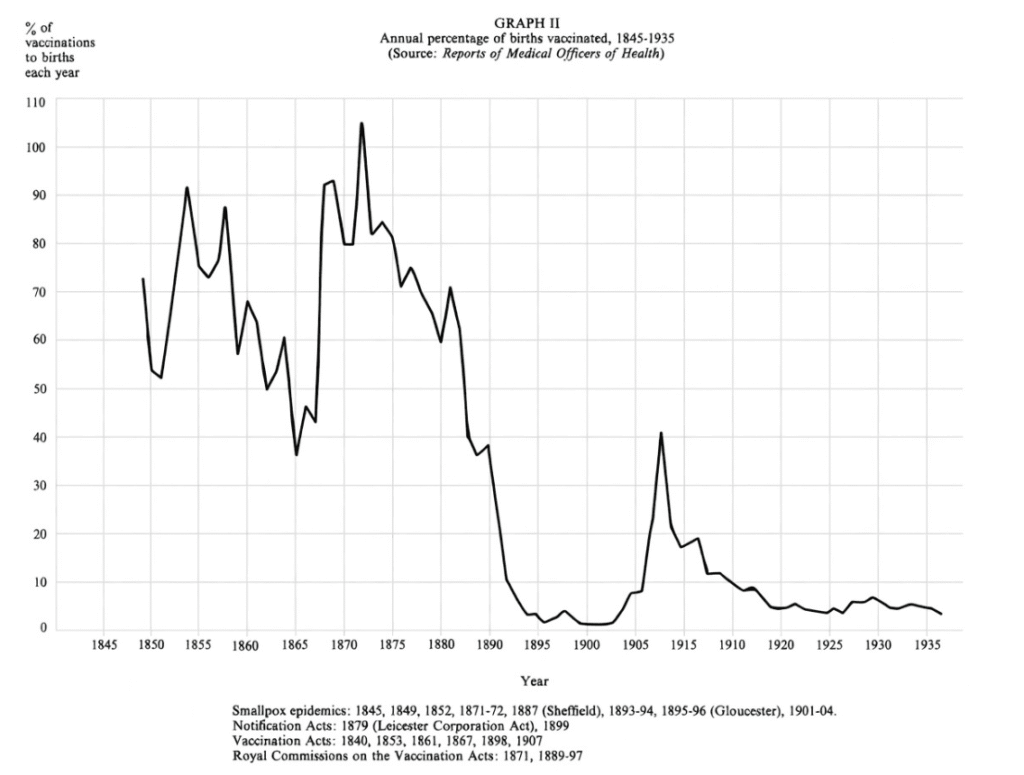
The movement grew despite extreme methods and oppression, due to the persistence of vaccine injury and a growing sense that shots were not as effective in cleaning up the commons as clean water, food, and hygiene. Because industry profits are more voluminous from vaccination than sanitation and handwashing, vaccination was treated by official sources as some kind of magic bullet. Therefore, low uptake was seen as foreshadowing a public health disaster.
To the amazement of many, smallpox cases actually declined during the period of high resistance to vaccination, much more so than in other cities. As Fraser writes, with some reluctance, “Leicester stands as an example, probably the first, where measures other than total reliance on vaccination were introduced successfully to eradicate the disease from a community.”
Sanitation engineer and town council member J.T. Biggs, in 1912, published a retrospective 800-page book (Leicester: Sanitation versus Vaccination) seeking to demonstrate a simple but indisputable point: “Leicester not only has less small-pox than any other town of a similar character, but also very little vaccination.”
Emboldened by the empirical results of the mandate refuseniks, the movement kept growing. The most famous event was the Leicester Demonstration March on 23 March 1885. Up to 80,000–100,000 participants, drawing delegates from over 50 other anti-vaccination groups, protested in the streets in response to mandates.
The procession featured banners with slogans emphasising liberty, men who had been imprisoned for refusing vaccination, families whose goods had been seized for unpaid fines, a child’s coffin symbolising vaccine deaths, which were undeniably real. This movement spread to every city.
So powerful was this movement that Parliament decided on its own to convene a Royal Commission to investigate vaccines in general, which met from 1889-1896. It affirmed vaccination’s value but recommended ending penalties for non-compliance and introducing a “conscientious objection” clause. These points were enacted in the Vaccination Act of 1898.
This Act did not satisfy any side in the debate. The industry demanded mandates, as it always has and does, while the anti-mandate side only grew. The Leicester League became the National Anti-Vaccination League, which continued its efforts, eventually resulting in a complete repeal of mandates in the United Kingdom in 1948.
The Fight Continues
The industry in Britain pushed to impose vaccine mandates in the case of Covid – particularly on health care workers – but those were struck down by courts. As a result, and mostly due to this long history, mandates were far less intense than in the US or most of Europe.
The shoddy performance of the Covid shot, however, has given rise to more population resistance to vaccination in general but it is nothing like what happened in the Victorian era, when a mass movement mobilised and successfully beat back a wicked and industry-backed coercive regime of mandatory inoculation.
All rhetoric, hyperbole, and seeming extremism aside, all these movements have ever really wanted – from the 1790s to today – is for this product to be subject to normal market discipline of supply and demand, without any interventions designed to back the industry. If vaccination provides both individual and community benefit, it can and should survive on its own.
This should not be too much to ask. Sadly for this industry and the public, it has long benefited from its close relationship to government while relying on utilitarian ethics to sweep risks and injuries under the rug. So long as that is true, population resistance will flare in every instance of vaccine mandates and obvious (if suppressed) evidence of mass vaccine injury.
___
Republished with thanks to The Brownstone Institute. Image courtesy of Adobe.
2 Comments
Leave A Comment
Recent Articles:

16 October 2026
4 MINS
A desperate Victorian Labor Party is peddling taxpayer-funded abortions as free “healthcare”. In a shameless attempt to stay in power, they're willing to do anything — including killing the unborn and forcing taxpayers to pay for it.

16 October 2026
4 MINS
Katie Zacharia’s first days as White House Press Secretary have sparked fierce media criticism, but her remarkable testimony of surviving an abortion attempt tells a deeper story.

16 October 2026
3.4 MINS
Australia’s proposed digital duty of care laws promise greater online safety and increased user control by switching off algorithms, but critics warn they could give ministers sweeping powers to restrict lawful content and threaten free speech.
A Million Women Movement Marks Second Anniversary: “Look What the Lord Has Done! Ishtar Has Fallen!”
16 October 2026
2.8 MINS
Two years after A Million Women gathered in Washington for ten hours of prayer and fasting, organisers point to victories they believe reflect God’s answers to intercession.

16 October 2026
2.6 MINS
Euthanasia accounted for 4% of all deaths in Belgium in 2025, with growing numbers involving people who were not terminally ill, dementia patients and psychiatric conditions.

16 October 2026
5.2 MINS
Christa Pike’s botched execution has sparked outrage across America, but critics argue that the same concern for human dignity is denied to abortion survivors.

15 October 2026
3.6 MINS
An 80,000-strong gathering in Texas signals a hunger for revival, as Pastor Philip Anthony Mitchell warns that Christian indifference could leave future generations without the faith.



Jeffrey, wonderful! You balanced description of this history is so powerful. I think your thesis, let market forces and free will dictate the product’s success or failure is spot on.
Thanks for this post ….helpful to understand