


New Book Slams the Murray-Darling Basin Plan
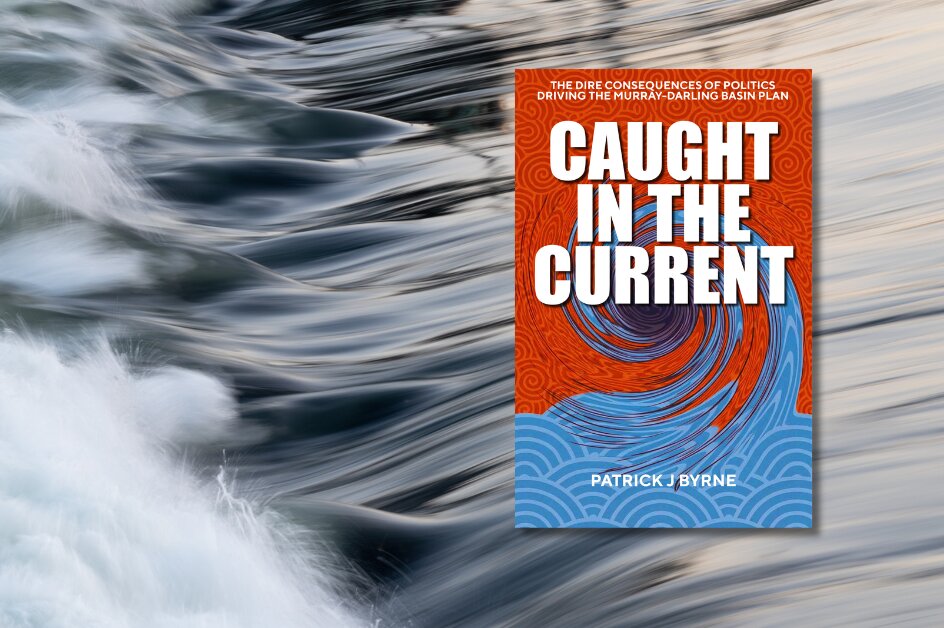
NCC Senior Advisory Council member, and former National President Patrick J. Byrne has published an important book that comprehensively analyses one of the biggest controversies in Australian agriculture.
The book’s publication is timely as the Murray-Darling Basin Authority (MDBA) is conducting a major review of the Basin Plan, under which there have been huge buybacks of irrigation water for the environment, as required by the Turnbull-Howard Water Act 2007. Under the Murray-Darling Basin Plan, an area almost twice the size of the Australian Capital Territory has gone out of irrigation farming.
Caught in the Current: The Dire Consequences of Politics Driving the Murray-Darling Basin Plan covers the complex policies impacting environmental, social and economic conditions in Australia’s major food bowl.
The book is written not just for farmers, but for university students studying agricultural and environmental science; politicians who have chronically misunderstood the Basin’s environment and water use; economists needing to incorporate important findings into modelling of the Australian economy; and all Australians who will be alarmed at the implications for the nation’s food supplies and food prices.
Caught in the Current documents the huge engineering Basin works that built the locks, weirs and dams (such as the Hume and Dartmouth dams) and the Snowy Mountains Scheme water resources since Federation. It covers the Basin’s management evolution that led to global accolades for the Murray-Darling Basin Commission (1988-2008), which set the standard for “world’s best practice” in large river-basin resources management.
The book is critical of the authoritarian-style Murray-Darling Basin Authority management system that replaced the Murray-Darling Basin Commission. The book documents the damage to irrigation agriculture under the Water Act and the Basin Plan, which have in any case delivered limited benefits to the environment of the Basin; and questions why successive governments have refused to consider alternative policies, such as building new dams and allowing the Lower Lakes to return to their natural estuarine state, instead of (mis)using $13 billion of taxpayer funds to take water out of productive use.
More than a critical analysis, Caught in the Current proposes policies to restore world’s best practice in Basin management and offers alternative solutions to water buybacks that would also provide a far better balance between environmental, social and economic outcomes.
News Weekly will have more on this important book in future editions.
Professor John Briscoe
One of the key chapters of Caught in the Current is devoted to a scathing critique of the Water Act by the late Professor John Briscoe, a South African-born environmental engineer.
Briscoe was Senior Water Adviser at the World Bank for many years. He became visiting Professor of the Practice of Environmental Health in the Department of Environmental Health at the Harvard University School of Public Health. He held senior environmental water appointments at Harvard.
Briscoe was considered the world’s leading expert on management of water in large river basins. Shortly before his death in 2014, he received the Stockholm Water Prize for unparalleled contributions to global and local management of water that have improved the lives and livelihoods of tens of millions of people worldwide. The award is regarded as the Nobel Prize for Water.
On his several visits to Australia from 1996, he followed closely water management in the Murray-Darling Basin. In 2010, he was invited by the Murray-Darling Basin Authority (MDBA) to join a High-Level External Review Panel to review the draft Guide to the Basin Plan.
The following year, he wrote a most important letter to the Senate Legal and Constitutional Affairs References Committee inquiry into the provisions of the Water Act 2007.
The inquiry heard from Briscoe, the MDBA, environmental organisations and legal authorities that the Water Act so prioritised the environment that it was an environmental watering Act, despite purporting to balance social, economic and environmental interests.
On the one hand, Briscoe’s submission gave Australia an extraordinary accolade for the ingenious use of water in the Basin and the cooperative management system the MDBC had created with the Basin communities. He praised how, during the decade-long Millennium Drought, “a 70 per cent reduction in water availability had very little aggregate economic impact”.
He regarded this as “the single most important water fact of the 21st century, because it shows that it is possible (with ingenuity and investment) to adapt to rapid climate change and associated water scarcity”. Australia’s response was “extraordinarily innovative … for ameliorating the environmental damage of the terrible drought”.
On the other hand, he was scathing of the federal government’s response to the one-in-a-hundred-years Millennium Drought, particularly that of then-Water Minister Malcolm Turnbull. Briscoe said that Turnbull’s diagnosis – that state water management had “been extraordinarily ill-informed” and focused on economics at the expense of the environment – was “(a) extraordinarily widespread and (b) extraordinarily erroneous”.
Briscoe was highly critical of the Commonwealth invoking its external affairs powers by using international conventions like the Ramsar Convention as a “fig-leaf” to avoid a constitutional crisis and allow a Commonwealth takeover of the Basin’s water. (The federal external affairs powers were recognised in 1983 by the High Court when the Hawke government successfully prevented the Tasmanian government from building the Gordon-below-Franklin Dam on the Gordon River.)
Briscoe concluded that using the Ramsar Convention made the Water Act “an environmental act … since it was in the name of the Commonwealth’s obligations to an obscure international environmental convention that it was taking powers from the states”.
“And so the fundamentals of the Act were born – an environmental act in which Canberra would tell states and communities and farmers what to do,” he wrote.
Briscoe pointed to the ignorant misuse of science in the Water Act. “The Act is based on an extraordinary logic: namely, that science will determine what the environment needs and that the task for government (including the MDBA) is then just to ‘do what science tells it to do’.
“Taken literally, this would mean that 100 per cent of the flows of the Basin would have to go to the environment, because the native environment had arisen before man started developing the basin.”
He observed that this was not only inconsistent with the basic tenets of good governance, it was not consistent with the letter of the Act, which said it would balance environmental needs with social and economic needs.
Chastising the government, he said it needed to make “necessary tradeoffs and value judgements, and needs to be explicit about these, assume responsibility and make the rationale behind these judgements transparent to the public”.
Abandoning World’s Best Practice
Most of all, Briscoe was critical of the government for abandoning the MDBC’s world’s best practice consultation that involved community, cooperative involvement in management of the Basin. Further, he was astounded at the secrecy involved in the drafting of the Basin Plan.
“In all of my years of public service … I had never been subject to such an elaborate ‘confidentiality’ process as that embodied in the preparation of the Guide to the Basin Plan. The logical interpretation was that the spirit of the Water Act of 2007 (environment first, science will tell, the Commonwealth government will decide, the people will obey) required such a process …
“Time and again I heard from professionals, community leaders, farmers and state politicians who had made Australia the widely acknowledged world leaders in arid-zone water management that they were excluded from the process,” he wrote.
Finally, contrary to current MDBA Plan reports saying that the buyback of water was the most efficient way to achieve environmental targets, Briscoe recounted how he continually “heard a chorus of opposition from economists about what they considered to be a program which paid a massive amount for every drop of water saved”.
Briscoe regarded the allocation of $10 billion (an amount later increased to $13 billion) on the massive buybacks of irrigation water as “a very expensive way to save water and that many of the investments will be made in areas that will, sooner or later, go out of production”.
Briscoe starkly concluded that the Water Act was the “original sin” founded on a “political deception” that was responsible for “the detour on which Australian water management now finds itself”.
He urged the federal government to engage all Basin stakeholders to produce a new Water Act to “serve Australia for generations to come … put Australia back in a world leadership position in modern water management”.
The 2011 Senate Inquiry’s recommendation was only marginally short of Briscoe’s recommendation. It called on the federal government “to give appropriate weight to economic, social and environmental considerations in order to balance these interests against each other”, by amending the Water Act “as a matter of urgency”.
The urgent calls of Briscoe and the Senate Inquiry have been ignored by all federal governments since.
___
Republished with thanks to News Weekly.
One Comment
Leave A Comment
Recent Articles:

1 October 2026
3.1 MINS
Christian schools in Western Australia can currently hire staff who share their faith. Under reforms flagged by the Cook Government, they may lose that protection wherever faith is not deemed an “inherent requirement” of the role.

1 October 2026
6.2 MINS
A foiled terror plot at RAF Fairford highlights the vigilance of local residents, heightened threats to Western military bases, and growing concerns over Iran’s role.

1 October 2026
6.2 MINS
Britain’s mounting security failures, immigration pressures and restrictions on public expression raise profound questions about political leadership, national sovereignty and the spiritual state of the West.

1 October 2026
3.2 MINS
A major Australian religious freedom conference has highlighted growing tensions over conscience, faith-based education, speech, public safety and social cohesion.

1 October 2026
3.7 MINS
A revived Church is the only hope for a dying world. As Billy Graham (1918–2018) said, “An awakened Church is the greatest evangelistic tool in the world.”

30 September 2026
2.8 MINS
Steve Grace’s Eternity Truck is bringing music and the Gospel beyond church walls, taking a mobile concert stage to remote communities and country towns.

30 September 2026
3.2 MINS
In an increasingly secular and pluralistic Australia, Christians must recover their confidence in proclaiming Jesus Christ as the unique, sufficient and only Saviour.



I strongly concur.
The federal government can make amends by engaging all Basin stakeholders to produce a new Water Act to “serve Australia for generations to come”.