



The Sheer Lunacy of the Modern West
It is time to call out the reigning lunacies.
Anyone who is rather observant about the state of the West today will know that it is suffering from various crises: a moral crisis, a spiritual crisis, a cultural crisis and so on. But it is also suffering from an intellectual crisis. That is why one brand-new volume has this as its subtitle: “How to Think Clearly When Everyone Around You Seems Crazy”.
I refer to J. Budziszewski’s latest offering, Pandemic of Lunacy (Creed & Culture, 2026). Those who are unaware of the American Christian moral and political philosopher can learn more about the man and his work here.
Here he urges us to think, and avoid the dumbing-down process we see all around us. Indeed, we are made to think. In the book’s Introduction, Budziszewski says this: “It takes a lot of work not to think, for the human mind tends to follow the golden path of logical consequences. Eventually, it gets to the end.” (xvii) He then offers four reasons why we so quickly take lunacies for granted. I offer the first three in bullet form:
- The mind which accepts one bad idea can become fertile ground for related bad ideas – even if they don’t follow from them logically.
- Bad ideas give rise to such unacceptable results, that certain other bad ideas become more attractive than they would have been otherwise.
- The revenge of conscience.
The last one I offer in full:
The fourth, which makes clear thinking cruelly hard, is that every mistaken idea – even the craziest – has some grain of truth, which makes it seem plausible. For example, unlimited wealth doesn’t make people happy, but many believe it does just because utter destitution and squalor obviously makes people unhappy. Actually, suicide rates are high among the poorest, drop in the middle, and rise again among the very rich. But the fact that lies and errors contain truths helps explain why ordinary people who are not at all deranged can come to hold some ideas which are. (xviii-xix)
I have already discussed one of the 30 lunacies he covers in this book: that which claims that “manhood and womanhood can take any shapes that we wish”. See my write-up about this one here.
Justifying Evil
Some of the other lunacies are worth highlighting. In Chapter 3, he speaks of the lunacy that “sometimes we just have to do the wrong thing”. He gives the example of ethicist John Harris, who famously said killing one innocent person to save two or more dying people is morally justified.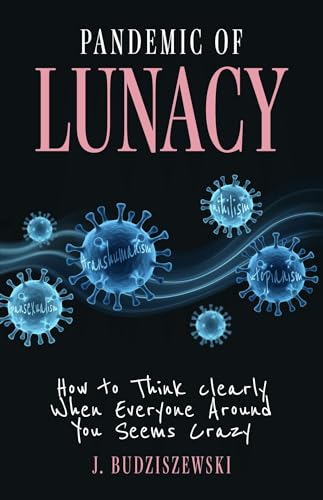
Budziszewski looks at two crucial distinctions that need to be kept in mind here. The first is the distinction between ordinary and intrinsic evil:
Consider disappointment, fever, and fatigue. These are merely ordinary evils, and if the reasons are good enough, then deliberately bringing them about is not necessarily wrong. For their own good, children who have misbehaved may have to suffer the disappointment of being grounded. It is sometimes better not to fight a fever too aggressively, because a high temperature is one of the body’s defenses against disease. Soldiers in basic training need to be exposed to fatigue in order to learn to keep functioning under adverse conditions. We see, then, that whether an ordinary evil is wrong to bring about depends on whether more good than harm is brought about under the given circumstances.
But the wrong of deliberately committing intrinsically evil deeds does not depend on weighing harms, and has nothing to do with the circumstances. The most conspicuous example of an intrinsic evil is murder. I must not deliberately take innocent human life for any reason whatsoever. Thus I may not hang an innocent man even to prevent a deadly riot, gun down children in the play yard even to shorten a war, or poison my patients even to end their suffering. (p. 16)
He continues:
Here is where the second crucial distinction comes in. For good enough reasons, we may sometimes tolerate the possibility, or even the certainty, of an intrinsic evil, but we may never intend an intrinsic evil. This distinction bears the cumbersome name “Double Effect,” because it treats the tolerated and the intended results of our actions differently. Thinkers of the “consequentialist” school of thought, like Harris, consider the distinction meaningless. If something bad happens, what difference does it make whether you intended it or merely tolerated it? Whether you bring about someone’s death or merely fail to kill someone else so that he can be cured, either way he’s not alive!
But it makes all the difference in the world whether I drive my automobile to work even though there is always some risk of unintentionally hitting someone, and whether I drive it in hopes of running someone down. In both cases the act of driving involves the possibility of death to innocents. But in the former case I am acting permissibly, while in the latter case I am a murderer.
And here is another point. Trying to run down those pedestrians will be just as wrong whether I intend it as an end in itself (for instance, because I hate people or killing amuses me), or as a means to some other end (for instance, because even though I don’t want them dead per se, decisively doing away with them clears the road so that I can get to work faster). For this reason, the complete expression of the principle I have just stated goes on to say that we may never intend an intrinsic evil either as a means to an end or as an end in itself.
So, we must distinguish intended from unintended evils. (p. 18)
Material World
One final lunacy: “all that exists is matter”. Materialism has long been argued for, and it has long been debunked. Just one extended quote from this chapter gives you a feel for the approach he takes here:
And what about our thoughts about matter? They don’t have mass or take up space either. “Yes, they do,” the materialist may say. “Thoughts are merely something your brain is doing.” This materialist opinion has gone through many versions. In the seventeenth century, Thomas Hobbes proposed that thoughts were the motions of tiny, interconnected springs in the brain. Corpuscles of light from a horse strike the eye, the eye recoils, the motion is transmitted to the brain, and there you have it: the thought of a horse. In the nineteenth century, Pierre Jean-Georges Cabanis viewed the process as chemical: “Impressions, upon reaching the brain, make it enter into activity, just as food, by falling into the stomach, excites it to a more abundant secretion of gastric juice, and to the motions which favor their dissolution.” Today, materialists view the process as electrical.
But this is hand-waving. Yes, the brain is indispensable to thought, just as vibrations in air are indispensable to speech. But to say that the mechanical, chemical, or electrical events in the brain just are thoughts is like saying that the vibrations which convey words just are what the words convey. Any electrician can make an instrument which plays a recorded voice saying, “Red!” whenever red light strikes a photoelectric cell, but it would be ridiculous to think that the device has the idea of red.
There are so many things materialism cannot explain, among them meaning, thought, belief, pain, pleasure, the look of a color, the sound of a note, the soul or self, and mental experience in general. Faced with this failure, some materialists desperately resort to what is called “eliminativism.” Their idea is that we don’t need to explain any of these things—because they don’t exist! We are not actually having mental experiences, but only think we are. We are like that photoelectric cell, except that we are suffering introspective illusions.
This position raises unavoidable questions: If there is an illusion, then what is having it? If I am having it, then how can my self be an illusion? If it results from introspection, then what am I looking at in there? Eliminative materialism is so extreme that a consistent eliminativist can’t even believe in eliminativism—for beliefs are one of the things he can’t believe in.
Chesterton must have anticipated eliminativism when he wrote: “As an explanation of the world, materialism has a sort of insane simplicity. It has just the quality of the madman’s argument; we have at once the sense of it covering everything and the sense of it leaving everything out. Contemplate some able and sincere materialist … and you will have exactly this unique sensation. He understands everything, and everything does not seem worth understanding.”
Just so. In every age there have been scoffers who say that although I may be moved to awe by my beloved’s face, the glory I see in it isn’t really there. Eliminative materialists outdo ordinary scoffers by a mile. Not only is the glory in my beloved’s face an illusion—my awe is an illusion too! (pp. 154-155)
I strongly urge you to get this book and explore all 30 lunacies that Budziszewski so capably and expertly deals with.
___
Republished with thanks to CultureWatch. Image courtesy of Unsplash.
One Comment
Leave A Comment
Recent Articles:

9 October 2026
3.3 MINS
New South Wales healthcare workers who object to abortion and voluntary assisted dying face growing pressure, raising serious questions about conscience rights, employment and moral injury.

8 October 2026
4.1 MINS
Italy honours St Francis of Assisi 800 years after his death, celebrating a saint whose devotion to Christ, radical simplicity and message of peace continue to shape generations.

7 October 2026
1.5 MINS
Across the Middle East, North Africa and Anatolia, Christianity once shaped entire civilisations. Could Britain’s Christian heritage likewise become a memory rather than a reality?

7 October 2026
6 MINS
What can Tucker Carlson’s interview with Jacob Rees-Mogg teach us about political disagreement? Their clash over war, Russia and national defence highlights the importance of listening carefully and understanding an opponent’s position before attempting to refute it.

7 October 2026
8.5 MINS
Gerald McDermott’s work challenges Christians to approach Israel through Scripture first, exploring God’s covenant faithfulness, Christian Zionism, Jewish identity and antisemitism.

6 October 2026
3.4 MINS
Christians cannot afford to let headlines and social media shape their view of Israel. Scripture provides a foundation for understanding Israel, God’s promises and our response.

6 October 2026
6.7 MINS
Fresh revelations about the foiled FlyDubai terror plot expose the attacker’s alleged extremist history, while a courageous pilot’s actions prevented an unthinkable catastrophe.



Thanks for this Bill, It is good to have some resources about trick ethical questions because Christians are often stumped when trying to deal with tricky propositions put forth by those who wish to discredit Christian beliefs. Atheist and agnostics spend a lot of time trying to defend their position and so are practised in very nuanced and perhaps esoterical arguments that we would not consider because the bible as well as being a book about relationship with god is also the ultimate guide to ethics and morality and my ethics are guided by its standards