


Two Legal Experts Tackle the Right to Civil Disobedience in Rigorous New Book
For millions of people, the Covid wars were a hellish time of statist tyranny, hardcore lockdowns, draconian infringements of basic civil liberties, and medical fascism. If you had the great misfortune of living in a place like Melbourne, Australia you endured two full years of this hell.
Because of all this, many people – including many Christians – have begun to wonder whether there is a time and a place for things like civil disobedience and resisting the unjust dictates of tyrannical governments. Their questions are not new: this has been pondered for millennia.
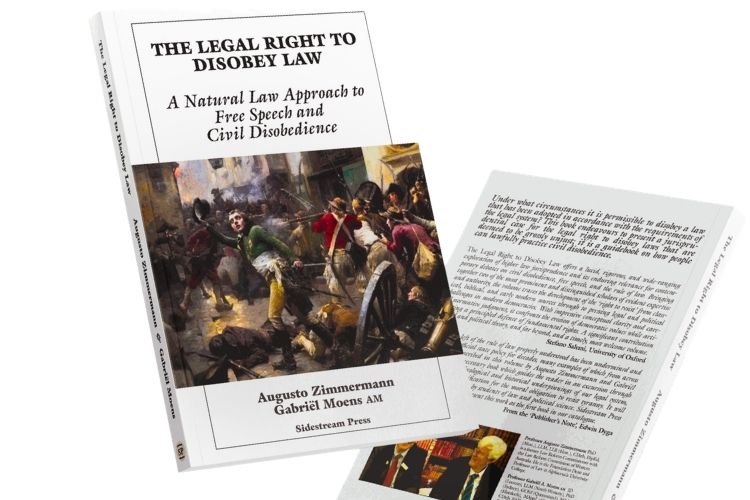
One important book on this must be mentioned. Australian law professors Augusto Zimmermann and Gabriël Moens have just released a new volume examining this entitled The Legal Right to Disobey Law: A Natural Law Approach to Free Speech and Civil Disobedience (Sidestream Press, 2026).
Legal Experts Augusto Zimmermann and Gabriël Moens
This pair of legal experts have previously teamed up to produce a number of crucial works, many of which I have reviewed (see here for but one example of this).
In their latest volume they spend some 200 pages looking at the history and development of the notions that disobedience to unjust laws is morally licit, and that resistance to tyranny has a long-standing and noble pedigree. The case for this is argued for in some detail and with careful documentation in 14 chapters featuring 443 footnotes.
Those following the authors know that they both have written extensively on such matters, and finding so much of their life work distilled in this excellent volume is certainly invaluable. One way to briefly summarise the volume’s contents is to put it like this:
Western civilisation is largely the product of the Judaeo-Christian worldview. Thus the West values law, the rule of law, and the truth that we are to be all equal before the law. But it also believes in something more: that there is a law above the law. Human law has its basis and validity because of a higher law.
The divine law giver is above all human law, and when human laws violate God’s law, there is a duty to disobey that law. That is how Western law works — or should work.
One major label for this is what is known as “resistance theory”. This happens to be the 138th article I have on this site discussing resistance theory and Christian civil disobedience.
Tracing the Right to Resist through History
In this book the authors carefully trace the development of this concept from the ancient Greeks and Romans, through many centuries of Christian thought and practice, right up to modern jurisprudence and contemporary political documents.
Those familiar with resistance theory will recognise many names and ideas presented here. Simply having so many important quotes from so many key thinkers all available in one volume is quite valuable. With so much crucial material presented here, the authors did well to keep it confined to a rather slim volume.
Consider but one example from the Greek philosophers. Aristotle had said this in his Politics: “To invest the law then with authority is, it seems, to invest God and reason only; to invest a man is to introduce a beast, as desire is something bestial, and even the best of men in authority are liable to be corrupted by passion.”
All this was developed so much further during the Christian period, especially at the time of the Reformation. Coming from its Hebrew roots, the Christians, starting with Christ, put real limits on the state. Recall the famous words of Jesus: “Render unto Caesar the things that are Caesar’s, and to God the things that are God’s” (Matthew 22:21).
We find this way of thinking early on in the development of Christian teaching. As the authors state:
“What has made the traditional Christian understanding of human rights so unique is its distinctive foundations in natural law. Already the early Christian fathers emphasised that God wrote his natural law in the hearts of all people and rewrote it in the pages of Scripture. This natural law, which finds its most significant summary in the Ten Commandments, prescribes a series of duties that each person owes to God and to others….”
As such, the church father Origen had put it this way: “Where the law of nature, that is, of God, enjoins precepts contradictory to the written laws, consider whether reason does not compel a man to dismiss the written code. And the intention of the Lawgivers, and to devote himself to the divine Lawgiver….”
In the medieval period we had great Christian thinkers and philosophers such as Aquinas also making these points: “[M]an is bound to obey secular princes in so far as this is required by the order of justice. If the prince’s authority is not just but usurped, or if he commands what is unjust, his subjects are not bound to obey him, except perhaps accidentally in order to avoid scandal or danger.”
Reformation thought especially emphasised these points. Not just Luther and Calvin, but a host of others. The Scottish Reformer John Knox is one obvious case in point. He said this about resisting tyrants: “The Lord hath commanded no obedience, but rather He hath approved, yea, and greatly rewarded, all those who have opposed themselves to their ungodly commandments and blind rage.”
The famous English philosopher John Locke who was born into a Puritan home wrote much on these matters. In his Second Treatise on Civil Government he spoke of the right of the people to revolt against tyrannical government: they are “absolved from any further obedience, and are left to the common refuge which God hath provided for all men against force and violence.”
Samuel Rutherford is another famous example of this. In Lex Rex he stated all this plainly: “Whenever God appointed a king he never appointed him absolute, and a sole independent angel, but joined always with him judges, who were no less to judge according to the law of God (2 Chron. xix 6) than the king, Deut. xvii. 15….”
Civil Disobedience, Modern Law and Modern Issues
And modern international law has drawn from all this, whether or not it acknowledges its roots. That would include documents such as the International Covenant on Civil and Political Rights. These human rights charters and documents all flow out of the past 2500 years of careful thinking about the higher law behind the law.
The writers look at modern issues in America and Europe, including cancel culture, attacks on free speech, mass migration, and the rise of Islam in the West. And being Australian-based, the authors focus on the Australian situation in some detail as well.
The draconian government overreach during the Covid era is of course discussed, along with various laws that are trampling on free speech and the like. Increasingly various anti-discrimination legislation and equal opportunity laws are taking us away from political freedom and down dark tyrannical paths.
All these recent legal and political developments are pushing us in the direction of the time-honoured right of civil disobedience. As the authors put it:
“They are motivated by Locke’s view, that governments have no other end but the preservation of our fundamental human rights, and that they ‘can never have a right to destroy, enslave, or designedly to impoverish the subjects’. Hence, Locke concluded, resistance to government becomes lawfully valid whenever these fundamental rights of the individual are violated. Locke put it rather succinctly: ‘Revolt is the right of the people’.”
But how does all this look in practice? They go on to say this:
“Naturally, we believe that civil disobedience preferably should be non-violent. However, it is equally important to consider that laws resulting in gross violations of basic human rights … are themselves a form of state-supported violence. Be that as it may, any recourse to civil disobedience should always be balanced against the principle of regular obedience to validly enacted laws. As a strong medicine to render the ruling classes more responsive to valid popular grievances, reliance on civil disobedience requires a clear violation of moral standards, and that should be followed by popular mobilisation based on the widespread community support.”
And again, by way of a summarising statement:
“Civil disobedience, therefore, does not mean a rejection of the rule of law, or the importance of the law in the governance of society. It is rather an appeal to a higher law and to a better and fairer society. The person who practices civil disobedience demonstrates respect for the rule of law by accepting the consequences that follow from a public and open violation of the law.
“Our survey of the views of those who have written about civil disobedience revealed that the right to disobey directives that violate these fundamental freedoms constitutes an old tradition in Western legal-political philosophy….
“It is possible, therefore, to conclude that citizens are morally justified to disobey legislative commands that are incompatible with well-known principles of the ‘rule of law’ which are also derived from our traditions of constitutional government. If the government fails to respect freedom of association, movement, religion, and speech, the people will find themselves in the uncomfortable situation of having to exercise their right to resist. In such cases, use of the right to resist would effectively function as a mega-right to ensure that laws (and orders given in reliance on these laws) which are inconsistent with the ordinary exercise of these freedoms, are not enforced.
“Civil disobedience may therefore manifest itself as a valid means to lawfully disobey arbitrary directives that constitute an intolerable violation of our fundamental rights….”
Well done gentlemen for another very important volume which has so much relevance to the times we are now living in. May this book have a very wide hearing and reading indeed.
The book can be ordered here.
___
Republished with thanks to CultureWatch.
Image via Oxford Printery.
2 Comments
Leave A Comment
Recent Articles:

3 September 2026
4.1 MINS
Charlie Kirk’s death became a catalyst for spiritual awakening, prompting Jenny McCarthy and Donnie Wahlberg to publicly embrace deeper faith in Jesus Christ.

3 September 2026
3.7 MINS
How would you feel if you were told that your child’s school, through the Education Department, was obliged to teach children that they could be born in the wrong body and that babies were ‘assigned’ their sex at birth?

3 September 2026
3.2 MINS
Another controversy has erupted in Victorian women’s football, as female players raise concerns about fairness, safety and biological differences in women’s sport.

3 September 2026
2.1 MINS
Alexis de Tocqueville’s warnings about Islam and democracy raise uncomfortable questions about religious authority, political power, Western freedoms, and the future of liberal societies.

3 September 2026
8.1 MINS
Another collection of G. K. Chesterton’s sharpest one-liners offers wit, wisdom and timeless Christian insight on faith, freedom, truth and society.
2 September 2026
3.8 MINS
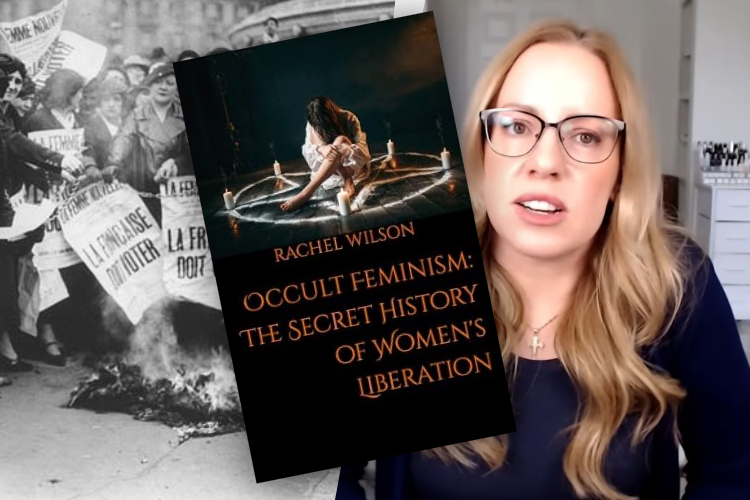
Rachel Wilson’s "Occult Feminism" has sparked fierce debate over feminism’s historical roots, Christianity’s role, and the ideological forces shaping modern womanhood.

2 September 2026
4.5 MINS
A new IFS report finds conservatives have and want more children than progressives, with the gap linked to greater fears about parenting, mental health, and genetics among liberals.



Great article about a book written by two great men!
The book mentioned by Bill is available from https://shop.oxfordprintery.com/. for $44.95 AUD.