


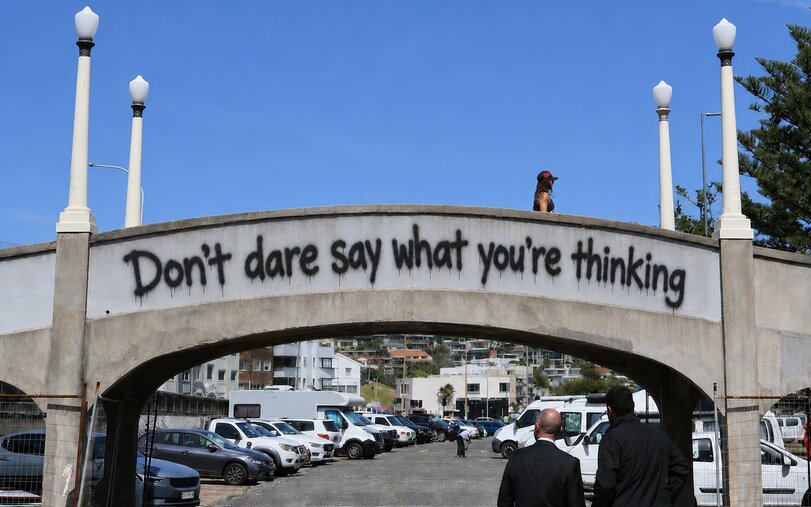
What You Can’t Say About Islam
Australia’s expanding hate speech laws threaten free expression; combating hatred through censorship risks weakening democracy and suppressing legitimate public debate.
Over recent years, Australian politicians have displayed a disturbing lack of regard for fundamental human rights, including one of the most basic rights of every truly democratic society: freedom of speech. And now, the Albanese government, supported by its Labor-lite Liberal counterparts, has been responsible for the enactment of draconian legislation that criminalises so-called “hate speech”. [1] The new legislative scheme delivers the toughest laws Australia has ever had against “hate crimes”.
The Criminal Code Amendment (Hate Crimes) Act 2025 creates new criminal offences and makes clear that advocating ‘hateful ideas’ is “unacceptable and will be subject to serious criminal penalties.” [2] The new legislation follows the introduction of other statutes that already criminalise the display of Nazi symbols and the Nazi salute, as part of an alleged crackdown on recent racial hatred and anti-Semitism. This is in addition to the ruthless attacks on free speech by the eSafety Commission, and the weaponising of the infamous section 18C of the Racial Discrimination Act 1975, among others. [3]
History’s Warning About Censorship
Clearly, our politicians do not seem to understand that hate speech laws, in eliminating or severely restricting free speech, strengthen the resolve of those whose speech is targeted by the legislation. History offers instructive examples of the validity of this point.
For example, the pre-Nazi German Weimar Republic of the 1920s and early 1930s passed and enforced several laws against “insulting religious communities”, and these laws were fully applied to prosecute hundreds of Nazi agitators, including Joseph Goebbels.
Ironically, the more charges the Nazi rabble faced for their anti-Semitic speech, the greater became the admiration of their supporters. Thus, far from arresting National Socialist ideology, the Weimar anti-speech laws helped the Nazis achieve broader public support and recognition that assisted the dissemination of racist ideas.
In this sense, the recent adoption of ever stronger hate speech laws which criminalise any speech deemed to criticise religion is a misconceived and dangerous experiment destructive of free speech. Nevertheless, the Albanese government has, inter alia, recently appointed an anti-Semitism envoy to draft a report on how to combat this undeniable social ill.
The recommendations emanating from the envoy’s report propose the further erosion of free speech by adopting even more stringent hate-speech laws. This is concerning, because the criticism of religion, any religion, should be tolerated, and even celebrated, as an expression of the implied freedom of political communication, recognised by the Australian High Court.
Unfortunately, however, the ruling Labor Party and its Coalition doppelgangers appear completely oblivious to the fact that their new hate speech legislation, because of its generality, can easily be used as a convenient tool to effectively remove free speech on religious grounds from the public forum.
The Danger of Criminalising Religious Criticism
Ominously, it might even be used by religious extremists to claim that the impugned speech recklessly or strongly criticises their religion and that the speaker should be eligible for a seven-year jail sentence. Hence, one of the great ironies of hate-crime laws is precisely that they might eventually be used as a weapon by a small group of religious extremists, although it is not entirely clear why such a people should merit any protection of the law from severe criticism.
Specifically, and subject to the validity of this point, our politicians are cowardly obscuring the fact anti-Semitism is primarily a problem associated with a specific group within our multicultural society – namely, the pro-Palestine lobby, which consists of the extreme Left and radical Muslim activists. The discovery on 12 February 2025 of a video of two New South Wales Health nurses speaking about their refusal to treat Israelis and suggesting they would kill them if they turned up to their hospital is a sobering reminder of the unsettled and dangerous world in which we live. [4]
Because of these newly enacted hate-speech laws, we may comfortably predict that many Australians will now be unprepared to make critical comments or give warnings about radical Islam, no matter how well-based those comments or warnings might be. In a world where Islamic hatred of Jews is an ugly and obvious reality, and where threats are made by radical Muslims against Western democracies, and where some Muslim leaders in Australia, preaching from their pulpits, openly express sympathy with terrorists, the ability of Australians to defend themselves and their interests is seriously diminished by the prohibition of strong criticism of religion. [5]
Defeating Hatred Through Open Debate, Not Silence
It goes without saying that racism, including Antisemitism, must be confronted, and defeated not by taking legal action against people, but by reasoned and open debate. We should have every right in a democratic society to robustly criticise anyone’s religious practices and beliefs, and even consider such practices and beliefs as dangerous, mendacious, retrograde, and mindless.
Otherwise, one might say, we are basically enacting the sort of hate-speech legislation demanded by the Organization of the Islamic Conference in 2006, when it introduced at the United Nations a motion that would prohibit defaming religion and imposing strict limits on freedom of expression in the domain of religion.
Ironically, some Jewish advocacy organisations have welcomed draconian federal laws that give powers to ban so-called “hate speech”. Broadly recognised as their peak representative body, the Executive Council of Australian Jewry (ECAJ), regularly advocates for laws that support multiculturalism and further suppression of freedom of speech. [6] In the 2010s, for example, ECAJ strongly opposed the Abbott Government’s attempt to remove the words “offend”, “insult” and “humiliate” from Section 18C of the Racial Discrimination Act.
The proposed change was a necessary step towards the restoration of freedom of speech, but ECAJ, along with several left-leaning advocacy organisations, opposed the changes. This resulted in the then Australian Prime Minister eventually abandoning the fundamental reform, despite public opinion polls constantly showing that there was substantial popular support for amending the relevant provision. [7]
More recently, ECAJ’s co-chief executive, Peter Wertheim, has publicly stated that he supports more laws that further undermine freedom of speech, deeming these proposed legislative changes a “measurable improvement” that, according to him, moves the needle ‘further towards having effective laws against hate speech in this country.’ [8] Of course, the term “hate speech” is itself an artifice because simply initiating alleged “contempt,” “repulsion,” or “severe ridicule” might constitute “hate speech”.
Hence, it becomes enough to merely express disgust at Islamic terrorists, for example, who, on the grounds of their “religious belief or activity,” murder many innocent civilians. Likewise, many statements by the more extreme Muslim spokesmen in Australia should be treated appropriately with contempt or revulsion. But to react in this way is potentially to act illegally.
One also wonders if any criticism of the Israeli government could now be construed as a form of anti-Semitism. Of course, criticism of any government does not amount to an attack on the group that inhabits the jurisdiction of that government. For example, the government of Israel was the world’s first country to make the notorious mRNA vaccines a mandatory requirement for its entire population.
Naturally, to strongly criticise the Israeli government for such disgraceful behaviour, and for instituting one of the most horrendous lockdowns on its victimised population during the pandemic, does not involve the attribution of any blame to its innocent citizens. Likewise, one can perfectly criticise the unpopular Australian government for a vast array of human rights violations, especially over the last few years, without having such criticism labelled as being “anti-Australian”, and quite to the contrary.
Protecting Democracy by Protecting Free Speech
One aggravating problem leading to anti-Semitism (and other sources of societal problems), of course, is the policy of mass immigration depositing on our shores some who are prone to religious extremism and scripturally endorsed anti-Semitism. Accordingly, Australia should engage in serious research into all would-be visitors and immigrants and abandon the pro-forma review that prevails these days.
This, of course, requires money and time; it also entails that each person entering the country be checked to ensure no radical anti-Semite is allowed in, even for brief visits, to secure our common security. To deal with immigration in a responsible manner, it is worth remembering the words of the late Sir Harry Gibbs, formerly Chief Justice of the High Court of Australia:
While it would be grossly offensive to modern standards for a state to discriminate against any of its own citizens on the grounds of race, a state is entitled to prevent the immigration of persons whose culture is such that they are unlikely readily to integrate into society, or at least to ensure that persons of that kind do not enter the country in such numbers that they will be likely to form a distinct and alien section of society, with the resulting problems that we have seen in the United Kingdom. [9]
For a long time now, it could be argued that Australian governments’ responses to Islam are influenced by a desire to protect Muslims from criticism. The problem is aggravated by the fact that some universities have centres to promote Islamic and Arab cultures.
Of course, most Muslims seem to be peaceful people who would never commit any act of violence. But to place any religion beyond robust criticism just because some adherents may feel offended is to ignore, as Salman Rushdie puts it, ‘the battle against fanatical Islam, which is highly organised, well-funded, and which seeks to terrify us all, Muslims as well as non-Muslims, into cowed silence’. [10]
In this sense, we are convinced that anti-Semitism should be confronted (and defeated) not by taking legal action against people who are deemed to practice “hate speech”, but by reasoned and open debate, a basic requirement of every authentic democracy. And yet, the Australian governments are planning to further undermine democratic debate by enacting more anti-free-speech laws to cover criticism of religion and mandate an artificial uniformity. As Nine journalist David Crowe correctly points out in The Sydney Morning Herald,
The obvious danger is a blasphemy law – if not in name, then in effect. At what point does speaking out against a religion turn into a form of discrimination that should be stopped? [11]
Above all, we must never allow our freedom of speech to be undermined by the inflated sensitivities of any religious group, whatever this religious group might be. In fact, much speech that is presently deemed “hate speech” is no more than a fair response to the vile, though often protected, speech of hate preachers and fanatics. Australians must, therefore, be entitled to publicly manifest their opinions about any religion whatsoever. This, after all, is an essential precondition of every truly free and democratic society.
___
Augusto Zimmermann is foundation dean and professor of law at Alphacrucis University College in Sydney. He served as associate dean at Murdoch University. He is also a former commissioner with the Law Reform Commission of Western Australia.
Gabriël A. Moens AM is an emeritus professor of law at the University of Queensland, where he served as Garrick Professor of Law. He also served as pro vice-chancellor and dean at Murdoch University.
Zimmermann & Moens are the co-authors of ‘The Legal Right to Disobey Law: A Natural Law Approach to Free Speech and Civil Disobedience’ (Sidestream Press, 2026)
___
[1] Flat White, ‘Coalition defend their support of hate speech laws’, The Spectator Australia, 10 February 2025.
[2] ‘Albanese Government Strengthens Hate Speech Laws’, Attorney-General’s Department, 6 February 2025.
[3] Regarding section 18C of the Racial Discrimination Act, see: Joshua Forrester, Lorraine Finlay and Augusto Zimmermann, No Offence Intended: Why 18C is Wrong (Connor Court Publishing, 2016).
[4] David Wu, ‘NSW Health nurses in viral video say they refuse to treat Israeli patients, suggested ‘killing them’ if they turned up to hospital’, Sky News, 12 February 2025.
[5]. Ian Spry QC, ‘The Totalitarian Effects of Anti-Free Speech Legislation’ (2008) National Observer 64, 65.
[6] See: Celina101, ‘The Multicultural Lobby’, Celina’s Substack, 25 June 2026. See also: David Evans, ‘Australian multiculturalism is the institutionalisation of minority ethnic and religious lobbying’, The Wentworth Report, 3 July 2026.
[7] Ibid.
[8] Maani Truu and Romy Stephens, ‘Jewish leaders call for vilification offence to be revisited as Coalition splits over watered down hate laws’, ABC News, 21 January 2026.
[9] Rt Hon Sir Harry Gibbs, GCMG, AC, KBE, ‘Australia Day Message, 26 January 2002’, Upholding the Australian Constitution Volume 17, Proceedings of the Seventeenth Conference of The Samuel Griffith Society, 8-10 April 2005 (The Samuel Griffith Society, 2005), 369.
[10] Henry McDonald, ‘University to go ahead with Charlie Hebdo conference after outcry’, The Guardian, 2 May 2015.
[11] David Crowe, ‘Religious Discrimination Laws Are a New Culture War in the Making’, The Sydney Morning Herald, 4 July 2019.
___
Republished with thanks to Quadrant. Image supplied.
5 Comments
Leave A Comment
Recent Articles:

11 September 2026
3.3 MINS
Moira Deeming has joined Family First as its lead Victorian candidate, pledging to contest the 28 November state election and continue her fight for child safeguards, faith, and sex-based rights.

11 September 2026
7.9 MINS
10 September marks the one-year anniversary of Charlie Kirk's assassination. Reflecting on his legacy, let's pray for his family and that we continue the mission God has called us to.

11 September 2026
3.7 MINS
Irish boxing icon Katie Taylor retired in style at Dublin's Croke Park, walking out before 80,000 fans singing "All Hail King Jesus" and wearing Psalm 18 in gold — a testament to the faith she calls the foundation of her life.

11 September 2026
2.9 MINS
Among the groups collecting the taxpayer funds were the Working with Women Alliance, which pushes free abortion via Medicare, Minus18 Foundation, which hosts “Queer Formals” for 12-year-olds, and Acon Health, which promotes “gender transition” treatments for children.
11 September 2026
3.2 MINS
A NSW Council dares to suggest public spaces should unite Australians rather than divide them by race. The outrage is revealing.
11 September 2026
2.9 MINS
Families whose loved ones were killed in the 9/11 Twin Towers terrorist attack have demanded New York major Zohran Mamdani — who has links to terrorist activity — avoid attending a private ceremony marking the 25th anniversary of the horrific event.

11 September 2026
2 MINS
Hundreds of parents are taking legal action against the Queensland Government over the ban on transgender drugs for children. While the drugs are still available through the private health system, they are seeking $50,000 each in compensation for 'discrimination'.



Brilliant analysis !!
I wonder if it possible to criticize Islam without breaking the law by saying that we are criticizing a religious ideology and not a race of people, therefore not racism, whereas antisemitism is criticizing a race of people. Would that work?
Australians must be entitled to publicly manifest their opinions about any religion whatsoever.
This, after all, is an essential precondition of every truly free and democratic society.
This makes sense to me.
We ought to be able to freely offer an intellectual critique of Islam or any other ideology without fear of reprisals. Those of us engaging the public in discourse out on the streets for the cause of Christ, frequently have to deal with Muslims who have been specifically taught in madrassas against the Christian message with all sorts of misrepresentations. Surely, we have a right to refute these in a gentle and loving manner, and point out where Islam or its followers fail scrutiny too- just as we have to own where Christians and the Church have failed. Actually, out in the public space I prefer to find common ground with people where possible in order to connect.
Easy. Bring back blasphemy laws against Christianity! Protect our core culture. (Sorry, my Jewish friends… but at least we worship the same God). But Australia is (or should be) a Christian society. Built on Judeo-Christian values (which does actually include Judaism :) ). Anything outside that is an anathema. This stupid “hate speech” thing is a woke idea dressing up “tolerance” above truth telling. It will backfire. As does all Satan’s schemes to confuse and divide.