


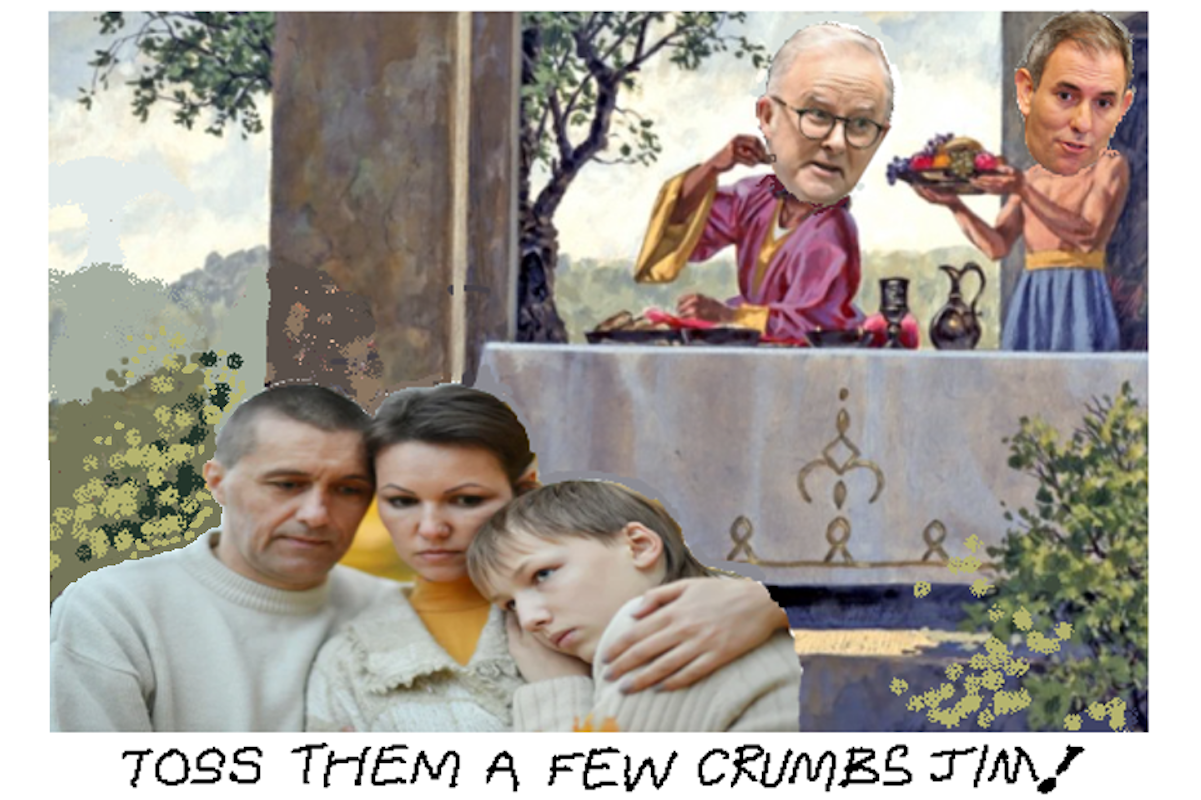
Why Australians Feel Poorer: 10 Data Points Albanese and Chalmers Will Never Mention
A new OECD report shows that Australians have suffered one of the developed world’s sharpest declines in living standards since Covid. The signs are everywhere: whether bracket creep or business confidence collapse, here are 10 hard data points that expose the gap between Labor’s spin and Australians’ everyday experience.
Earlier this week, I made the case that the United States’ economy is faring far better than Australia’s — to the point that most middle-class Americans are living like upper-middle-class Australians.
As though to prove me right, the OECD released its 2026 Employment Outlook report this week confirming that Australians have suffered one of the sharpest declines in living standards in the developed world since the Covid era.
Since March 2021, the average Australian worker’s real pay — what their wage actually buys after inflation — has fallen by 5.1%. Over the same period, the average worker across the rest of the developed world got 5% richer in real terms. That’s a 10-point gap between Australia and its peers.
What’s more, the OECD warns the pain isn’t over yet, and predicts a further 1% fall by September.
It seems that every time a dire report like this comes out, Anthony Albanese and Jim Chalmers respond first by ignoring it, then by taking to social media with cherry-picked statistics that have no bearing on day-to-day reality for Australians.
It’s a strategy that’s bound to fail, not just because most Aussies know better, but because the bad economic news under Labor has been truly relentless.
Below are 9 more data points that have emerged during Albanese and Chalmers’ tenure that can’t be ignored.
2. Rents just hit another record high across Australia’s capital cities
Domain just released its June 2026 Rental Report with the headline finding that rents have hit new record highs in every capital city this quarter, with prices ballooning again at their fastest pace in almost two years.
Sydney led the charge, rising 6.3% — the sharpest quarterly hike in four years — to $850 a week. Nationally, renters are now paying $12,500 more a year than they were just five years ago, while vacancy rates remain under 1% in most capital cities.
3. Australia suffered its worst per-capita recession in 40 years
Australia endured the longest per-capita recession in more than 40 years during the Albanese government’s first 11 quarters in office, according to the Institute of Public Affairs’ analysis of 2025 ABS data.
That streak was eventually broken by a handful of better quarters, but it has since resumed: GDP per capita fell again in the March 2026 quarter by 0.1%.
In short, for ten of the last 15 quarters under Albanese and Chalmers — or around two-thirds of their time in office — the average Australian has been getting poorer, not richer.
In the words of IPA’s Dr Kevin You, the government has relied on “the lazy approach of mass migration to keep the aggregate economy afloat” — causing the national pie to keep growing even as each Australian’s slice of it has continued to shrink.
4. Australia has the third-highest mortgage burden in the developed world
Owning a home in Australia comes with one of the heaviest repayment burdens in the OECD. Mortgage repayments eat up a bigger share of household income here than in almost any other developed country — third-highest of all, trailing only France and Luxembourg.
Everyday costs compound the pain: household goods and services in Australia cost more than in most of the developed world, with the country’s overall price level sitting in the most expensive quarter of all OECD countries.
5. Business confidence has suffered its sharpest collapse since Covid
Business confidence in Australia crashed 29 points in a single month in March this year, the second-largest monthly fall on record, with drops of that scale previously seen only during the Global Financial Crisis and the onset of Covid. Conflict in the Middle East has been cited as a trigger for the drop, but it landed on an economy already worn down by years of cost pressures.
Confidence has since crept back from that low — to -24 in April and -14 in May — but remains negative across every state and industry.
6. Bracket creep is costing Australian workers $2,000 a year
Thanks to the stealth tax known as bracket creep, inflation has pushed the average full-time worker’s tax bill up by about $2,000 a year since Labor took office, according to the Australian Financial Review.
And it’s set to get worse: Parliamentary Budget Office figures project the average tax rate Australians pay will climb from 24.5% today to 27.8% within a decade.
Personal income tax revenue has already jumped 31% to $338 billion since Albanese and Chalmers took office — and by Coalition calculations, a third of that rise comes from bracket creep alone, not from Australians actually earning more.
7. Australia’s public sector is the biggest in the developed world
Adjusted for population, Australia has the largest public-sector workforce of any major economy — roughly 29% of the entire workforce, according to ILO data cited by The Economist that covers all levels of government and state-owned enterprises. In raw numbers, that’s almost four million workers — or 143 workers per 1,000 people — more than the United States, Britain or France.
At the federal level alone, the Australian Public Service grew by nearly a quarter in just three years — from about 159,000 employees in June 2022 to about 199,000 by June 2025.
8. Productivity has gone backwards for two of the last three years
Australia’s productivity — how much the economy produces per hour worked, and the biggest long-run driver of real wage growth — is falling, not rising. Labour productivity has dropped in two of the last three financial years, including a 0.7% fall in 2024–25, according to ABS figures.
Albanese and Chalmers’ full three-year record includes a 3.7% collapse in 2022–23, a bare 0.1% uptick the year after, followed by this year’s drop.
Concerningly, without productivity growth, there’s no viable path back to the real wage growth of the pre-Covid decade.
9. Australia’s money supply has ballooned, and house prices have followed
Every new loan issued by a bank effectively creates new money — and Australia has been creating it at a staggering rate. The money supply hit a record $3.45 trillion in April 2026, up 8.2% in just the past year, according to Reserve Bank data.
During the last half-century of monetary expansion, Australian house prices have surged — the two tracking closely, especially since the Global Financial Crisis, according to one widely-shared chart — locking a generation out of home ownership.
10. Even Australia’s recent growth quarter came with a big asterisk
Albanese and Chalmers have eagerly highlighted December quarter growth of 0.8% — the fastest annual pace in nearly three years — as proof of a turnaround.
But by the March quarter of this year, growth had slowed again to just 0.3%, and bank economists warned that investments in data-centres drove essentially all of the most recent growth.
Those same economists now warn that Australia’s economy could shrink outright by mid-2026 — something that hasn’t happened since the 2008 GFC.
The Prime Minister and the Treasurer can explain the economic challenges before them in terms of global supply chain issues and conflicts in Europe and the Middle East. But governments are not ultimately judged by the hand they’re dealt, but by how they play it.
On all the counts that matter for everyday Australians, Albanese and Chalmers are making our country far less liveable.
Many levers are within their reach to fix the mess: indexing tax brackets to inflation, capping the public service headcount, easing zoning restrictions, slowing net migration, and cutting spending growth.
If they’re unwilling to make the necessary changes, it’s time they stopped tweeting, stepped aside, and handed the reins of government to leaders who will.
4 Comments
Leave A Comment
Recent Articles:

25 October 2026
4 MINS
Prayer is active partnership with God, and he is awakening his body to prayer, not by might or by power, but by his Spirit.

24 October 2026
3.3 MINS
When we ask God, "What is in my hand?", and see our possessions, money and time as seed that God asks us to sow, life becomes simpler.
23 October 2026
6.8 MINS
Hillsong UNITED’s Joel Houston reflects on fame, faith and the burden of ministry, questioning performative Christianity as he seeks a more authentic walk with God.

23 October 2026
13.1 MINS
Tasmania’s proposed conversion practices legislation raises serious questions about religious freedom, pastoral care and whether Christians can freely pray with those seeking to live according to their faith.

23 October 2026
7.7 MINS
Melbourne Catholic Archbishop Peter Comensoli has spoken out clearly against the deadly promises by both major parties in Victoria ahead of the election, drawing a comparison between abortion and capital punishment.
23 October 2026
3.1 MINS
As Western societies grow more hostile, could abandoning Christianity’s moral foundations be contributing to the rise of ideological extremism, political intolerance and violence?

23 October 2026
5.1 MINS
France’s escalating riots expose the dangers of political extremism, antisemitism and radical alliances, offering America a stark warning about the future of Western democracy.



The numbers tell a story!!!!!
Those of us who didn’t vote this government into power are having to pay the price for the deliberate damage that has been done to this country, socially and economically. Delusional and deceptive, our leadership can wade through a myriad lies, but those with eyes to see that weakening the country morally, socially, financially, productively, and many other ways opens us up and allows evildoers to grab power. We need to repent, seek, the God of Ages and return to His ways for the way out of the mess. It won’t happen overnight. It is more than getting rid of the government. The problem is in our own hearts, attitudes, and lives lived. Abortions, sexual perversion, dishonesty- especially in our media, the way Israel and Jewish people have been been treated, the way we treat each other, complacency and lack of integrity mark us all unless we separate ourselves from these and really look at what we’re doing and where we are heading.
Albo labor/teals/greens leading us headlong into and evil marxist agenda has totally betrayed Aussies !!
The saddest part is that so many are affected by what is happening and not in a good way.