


The Blue Planet: Designed by a Loving Creator
From its precise orbit to its life-giving atmosphere, Earth’s fine-tuning seems too perfect for chance. Explore ten remarkable features that make our planet uniquely suited for life.
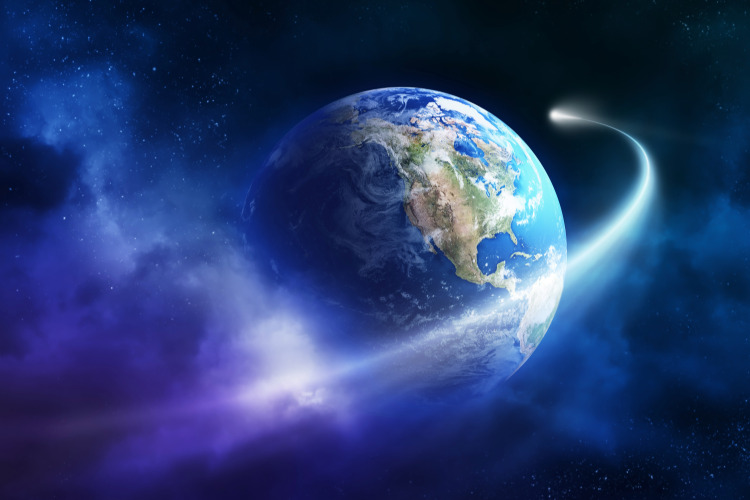
When astronauts went into space for the first time, one of the first things they noticed was that the Earth had a beautiful blue glow when viewed from space. This is why the Earth is called the ‘blue planet’.
Despite discovering many hundreds of planets in the Milky Way Galaxy, astronomers have not found a planet anything like the Earth.
Isaiah wrote that the Earth was deliberately designed to be inhabited (Isaiah 45:18), and the psalmist wrote that the earth is full of the goodness of the Lord (Psalm 33:5). Modern discoveries have shown these statements to be wonderfully true.
Finely Tuned for Life
Some of the most important ways that the Earth is well designed for life are:
(1) It is the right distance from the Sun for producing the right amount of heat and light. The Earth also has a remarkably circular orbit, which means that the distance from the sun varies by only a tiny amount as the Earth circles the Sun. In contrast, all other known planets have elliptical orbits.
(2) It has a diameter for producing the right amount of gravity. If the Earth were much larger, then gravity would be too large, and we would feel very heavy. However, if the Earth were much smaller, then gravity would be too small and, like the moon walkers, we would find it difficult to grip the ground. The level of gravity is also just right for biological processes.
(3) It has a rate of spin for producing the right amount of night for sleeping and right amount of daylight for activities in the day. The rate of spin also produces stable weather and temperatures. If the length of day were much shorter, then there would be severe weather patterns all over the world. However, if the length of day were much longer, then the nights would be too cold and the days too hot.
(4) It has the right tilt for creating seasons. The Earth’s axis is tilted by around 23.5 degrees with respect to its orbit around the Sun. This tilt is high enough to produce distinctive seasons, but not so high that excessive temperatures occur around the world as the seasons change.
(5) It has a remarkably smooth surface. Even the highest mountains and deepest oceans represent tiny variations in height compared to the diameter of the Earth. In most places on Earth, the variations in height are around 0.01 per cent of the Earth’s diameter, which is an incredibly small variation. The smoothness of the Earth is one key reason why the Earth has such stable and mild weather.
(6) Its moon is an ideal size for producing the right tides. If the moon were much larger, then there would be huge tidal waves every day. However, if the moon were much smaller, then tides would not be enough for preventing coastal waters from becoming stagnant.
(7) It has the right amount of water. The oceans make up about 70 per cent of the Earth’s surface, which is ideal for creating a weather system that brings abundant clean and fresh water to the land. The oceans also supply much seafood and help to create coastlines.
(8) The earth has abundant quantities of the right materials, such as metals, which are very useful for building and technology. Renewable materials like wood are also extremely important for human existence.
(9) It has the right atmosphere for supporting life. The 21 per cent oxygen is enough for breathing animals, but not so much that it causes poisoning or fires. The 78 per cent nitrogen is just right because, unlike other gases like carbon dioxide, it does not cause global warming.
(10) It has the right brightness of sky. The Earth’s atmosphere is such that light is scattered by air molecules, and this produces a beautiful blue colour right across the sky. In contrast, on places like the moon, the sky is black.
A Sky Made to Be Admired — and a Creator Who Cares
The Earth is so special that God even made billions of stars to shine light on the Earth during the night. This is why the Puritan writer Thomas Watson said that the Earth was bespangled with sun, moon and stars that the Earth’s beauty might be beheld and admired.
The vast universe does not mean the Earth is unimportant, but rather it shows the Earth to be supremely important.
When Isaac Newton studied the clockwork motion of the solar system, he concluded that it could not have been produced by chance. The Earth shows not only that there is a creator, but that the creator cares deeply for mankind.
He cares so much for the world that He allowed His Son to come into the world to seek and save lost sinners such as you and me.
___
Republished with thanks to Evangelical Times. Image courtesy of Adobe.
2 Comments
Leave A Comment
Recent Articles:

24 October 2026
3.3 MINS
When we ask God, "What is in my hand?", and see our possessions, money and time as seed that God asks us to sow, life becomes simpler.

23 October 2026
6.8 MINS
Hillsong UNITED’s Joel Houston reflects on fame, faith and the burden of ministry, questioning performative Christianity as he seeks a more authentic walk with God.

23 October 2026
13.1 MINS
Tasmania’s proposed conversion practices legislation raises serious questions about religious freedom, pastoral care and whether Christians can freely pray with those seeking to live according to their faith.

23 October 2026
5.1 MINS
France’s escalating riots expose the dangers of political extremism, antisemitism and radical alliances, offering America a stark warning about the future of Western democracy.

23 October 2026
3.1 MINS
The one who is worthy of it all is awakening his Church to be captivated by him, so that we will honour one another and share his gospel with humility and courage.

22 October 2026
2.9 MINS
Victoria Labor’s promise to fund free abortions has drawn a forceful response from Presbyterian leaders, raising profound questions about unborn life, government priorities and Australia’s moral direction.

22 October 2026
4.7 MINS
Western Australia’s proposed anti-discrimination overhaul has sparked warnings from Christian leaders that religious freedom, parental choice and faith-based schools’ ability to uphold their beliefs are at risk.



What a great article about the magnificence of Gods creation.
carbon dioxide, (0.04 % of the atmosphere) is heavier than oxygen (21% of the atmosphere) doesn’t cause the atmosphere to heat up. As Co2 rises it thins out in concentration. our vegetation requires Co2 to grow and gives off oxygen for Humans and animals ro breath. Global warming has no basis.