


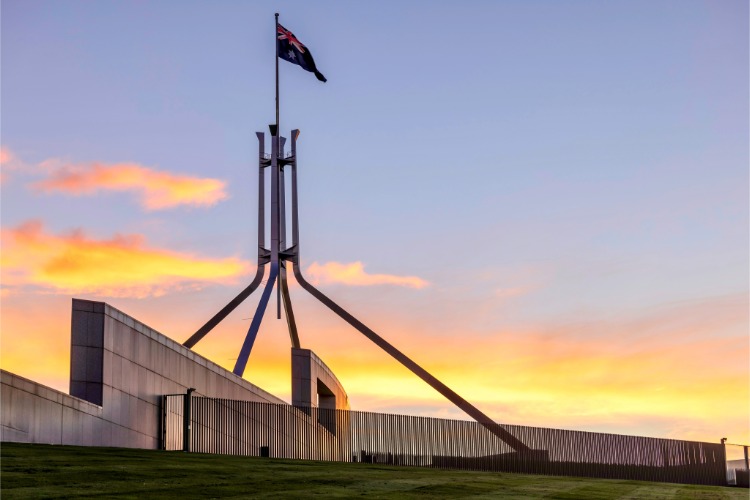
Read the Canberra Declaration’s Submission to the Online Safety Amendment (Digital Duty of Care) Bill 2026
The Canberra Declaration has submitted to the Federal Government’s Exposure Draft of the Online Safety Amendment (Digital Duty of Care) Bill 2026, warning that a Bill sold as child protection is, in its actual text, a mechanism for controlling lawful political and religious speech.
Every parent wants their children safe online. The Canberra Declaration, representing over 98,000 signatories committed to Christian values and freedoms, does not dispute that social media has real and documented harms for young Australians, or that government has a legitimate role in addressing them. But a bill’s stated purpose and its actual text are two different things. When we read the Digital Duty of Care Bill closely, what we found should concern every Australian who values free speech and religious freedom.
A Bill with an Open Definition of “Harm”
The entire structure of this Bill depends on one word: harm. And the Bill leaves its definition open.
Proposed section 25C(1)(m) gives the Minister for Communications power to declare “any other material or conduct” seriously harmful, by legislative instrument, whenever she is personally “satisfied” it may cause serious harm. There is no requirement that the material be unlawful. No requirement a court has ruled on it. No requirement Parliament debates the category before it takes effect. The Minister’s satisfaction is the entire legal test.
The rule of law is opposed to rule by decree — or “satisfaction.” A law built on the shifting judgment of whoever holds office, rather than on fixed, knowable standards, isn’t a safeguard. It’s a recipe for disaster.
A Clause That Targets a Viewpoint, Not a Crime
Proposed section 25D(1)(c) deems material harmful to children if it “encourages or promotes hostile attitudes towards women or gender equality.” This is not a description of a crime. It is a description of an opinion.
It is entirely lawful in Australia to teach that a husband and wife hold different, complementary responsibilities within marriage. It’s lawful to argue against gender quotas, or to argue that biological males should not compete in women’s sport. None of these is a crime. Yet under this Bill, whether any of them counts as a “hostile attitude” can be decided by one person’s satisfaction.
Even the Coalition’s own analysis of the exposure draft warns that “poorly defined tests risk catching legitimate political, religious, cultural and social debate.”
A Promise in a Policy Paper, Not in the Law
The government’s accompanying policy paper promises that any rule made under this framework “will be required to include a statement of the rule’s compatibility with Australia’s human rights obligations, including freedom of expression.”
We read the 75-page exposure draft in full. The words “freedom of expression,” “human rights,” “compatibility,” and “scrutiny” do not appear anywhere. Whatever safeguard the government intends exists only in a document that can be quietly revised or dropped, with no parliamentary process required. A safeguard that matters belongs in the Bill. This one isn’t.
Notably, the Digital Duty of Care Bill does carve out one specific protection: proposed section 26(7) exempts “lawful communications occurring in private solely between consenting adults” from the duty of care entirely. The government evidently knows how to write a clause that places a category of speech beyond the Minister’s reach. It simply hasn’t done so for lawful political communication or lawful religious teaching. Why not?
The Minister Has Already Told Us Who Decides
Asked directly who would decide what counts as a new serious harm, Minister Wells answered plainly: “the test for what would constitute a new serious harm would ultimately be made by me.” Pressed on the ABC’s Insiders about the missing definition, her response described only procedure — consultation with the eSafety Commissioner, and the theoretical right of a senator to move a disallowance motion. Neither answer defines the word “harm.” Both confirm that whoever holds the office will supply the definition, case by case.
This is not a new pattern. The eSafety Commissioner’s powers began in 2015 confined narrowly to cyberbullying material targeting children, then widened with the Online Safety Act 2021. This Bill widens them again — attaching that growth to open-ended ministerial discretion rather than a fixed, debated list.
A Regulator That Has Already Gotten It Wrong
This is not a hypothetical fear. In 2024, a delegate of the eSafety Commissioner issued a removal notice against Canadian activist Christopher Elston (“Billboard Chris”) for sharing and criticising a news article. It took a full year and an independent tribunal to correct. In July 2025, the Administrative Review Tribunal set the notice aside, finding an ordinary reasonable person “would not conclude that it is likely that the post was intended to have an effect of causing serious harm.” The eSafety Commissioner was convinced her decision to ban the post was fully justified. The Tribunal disagreed. Giving greater discretionary power to a regulator with an evident agenda on topics like sexuality and gender is a terrible idea.
This Bill does not restrain that discretion. It expands it, backed by a maximum corporate penalty of roughly $109.2 million and a compliance window cut from 48 hours to 24. A platform facing a fine that size, on a deadline that short, over a standard this vague, has every commercial incentive to delete first and never ask questions. That’s not a safety framework. That’s 109.2 million reasons to land on the side of censorship.
Parliamentarians Have Said It Themselves: It’s About Censorship
Greens Senator David Shoebridge, whose vote the government needs to pass this Bill through the Senate, has already said the quiet part out loud:
“… every time you get Pauline Hanson come out and say… she wants to promote hateful messages against First Nations peoples. Or you get the Coalition coming out and saying that they want to promote genocide denial… we need Digital Duty of Care so that those messages aren’t amplified.”
A sitting senator holding the balance of power has named a political party and a political leader, by name, as the reason this Digital Duty of Care Bill is needed.
Before the exposure draft was released, the Prime Minister warned of “the rise of populism,” with reporting linking his tech agenda directly to countering One Nation. But once the Digital Duty of Care Bill was actually on the table, the language softened to “this is not about giving government control… it’s not about censorship.” Are we to believe what was said before the Bill was drafted, or the talking points released once it was time to sell it to the public?
Censorship has already happened to real people holding views this Bill’s “hostile attitudes” clause targets. Queensland psychiatrist Dr Andrew Amos was banned by the Medical Board from posting about gender medicine. Dr Jillian Spencer spent three years suspended for publicly criticising a children’s gender service, before all proceedings against her were finally dropped. These aren’t slippery-slope predictions. They’re the present.
What We Told the Government about the Digital Duty of Care Bill
Our submission makes clear:
- Harm must be defined in the Digital Duty of Care Bill itself, not left to ministerial satisfaction, and should require a connection to conduct that is actually unlawful.
- Freedom of expression and religious freedom protections belong in the legislation, not in a policy paper that can be discarded without debate.
- Lawful political and religious speech deserves the same explicit protection the Bill already grants to private communication between consenting adults.
- Genuine child safety measures should be separated from open-ended discretionary power.
We oppose a Bill that uses the language of child safety to build a discretionary power that a senator has openly admitted is aimed at silencing political opponents, and that has already been used, in a narrower form, against people for lawful speech.
Read the Canberra Declaration’s submission on the Digital Duty of Care Bill here.
___
Image via Adobe.
Recent Articles:

24 September 2026
3 MINS
The US warns that Labor’s Digital Duty of Care bill could see platforms suppress independent journalists and commentary on “sensitive or controversial topics”, and would encourage platforms to engage in “pre-emptive censorship to avoid the risk of liability”.

24 September 2026
3.6 MINS
All Blacks and Springboks players united in prayer after their Baltimore clash, while Christian captain Siya Kolisi and Ardie Savea continue to testify openly about Jesus.
24 September 2026
6.3 MINS
True redemption is far more than a public comeback or second chance. Scripture points to Christ’s costly sacrifice, repentance, surrender and resurrection.
23 September 2026
4 MINS
A renewed petition targets pro-life law professor Dr Joanna Howe, as she and husband James fight back against claims they say have damaged their careers and reputation.
23 September 2026
6.6 MINS
Government-funded research on boys, masculinity and the manosphere deserves rigorous scrutiny, especially when contested theories begin shaping education, regulation and public policy.
23 September 2026
4.2 MINS
For too long, maintaining regional Victoria’s crumbling roads has been an issue of “out of sight, out of mind” for the state’s incumbent Labor government.
23 September 2026
4.7 MINS
John Anderson challenges Nyadol Nyuon’s rejection of Anglo-Celtic culture, arguing that immigration, social cohesion, shared values and economic pressures cannot be separated.


