


Paul Johnson and the Ten Pillars of Civilisation
What we need to withstand those who would destroy our culture in futile attempts to remake civilisation according to their impossible ideals.
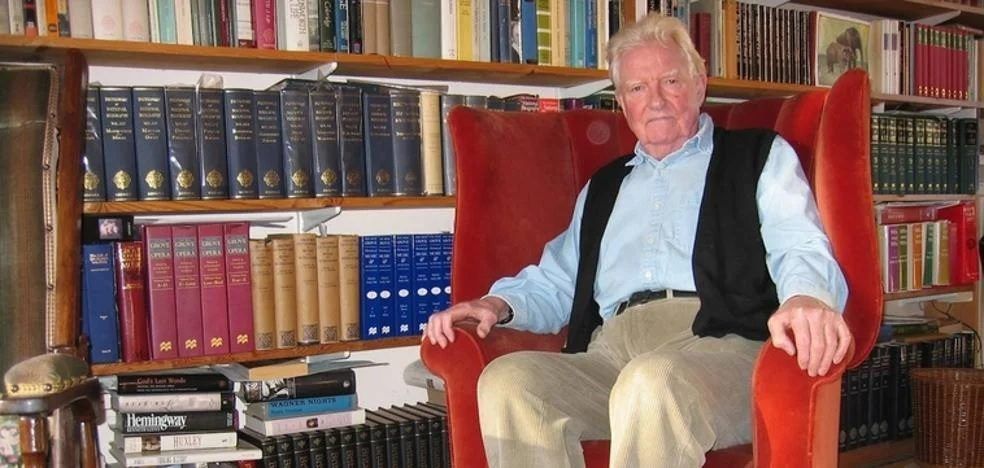
The influential English historian Paul Johnson died earlier this week. His passing did not seem to result in all that much media coverage, which was disappointing. The author of more than fifty books, Johnson wrote some of the most important works of history in the past half-century. See my write-up about the man and his contribution here.
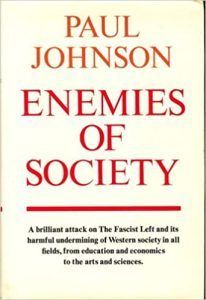 In writing that article, I was reminded again of what a key historian Johnson was, and why his books are so important. One of the ten books of his that I highlighted in my piece was his 1977 volume, Enemies of Society (Atheneum). I quoted from his last chapter, “A New Deuteronomy”. It is worth quoting even more from.
Unreachable Utopia
His book is about the enemies of the West, and how we can withstand them. He looks at the radicals and revolutionaries who have sought to remake society in their own image, especially in the last century. Yet these attempts at change have not made the world a better or more secure place. Says Johnson:
The events of this century should remind us that the hopes of mankind almost always prove illusory, and that we have only a limited ability to devise permanent and equitable solutions to problems which spring from human nature. Violence, shortage amid plenty, tyranny and the cruelty it breeds, the gross stupidities of the powerful, the indifference of the well-to-do, the divisions of the intelligent and well-meaning, the apathy of the wretched multitude — these things will be with us to the end of the race.
Hence civilisation will always be at risk, and every age is prudent to regard the threats to it with unique seriousness. All good societies breed enemies whose combined hostility can prove fatal. There is no easy defensive formula, and the most effective strategy is to identify the malign forces quickly, as and when they appear.
That has been the chief purpose of this book. At the same time, there are certain salient principles, valid always but of special relevance today, which we should take particular care to uphold. They are the Ten Pillars of our Civilisation; or, to put in another way, a new and secular Ten Commandments, designed not, indeed, to replace the old, but rather to update and reinforce their social message.
Points to Ponder
Let me offer in an abbreviated form these new Deuteronomic principles of Johnson.
The first, and perhaps the most important, is to reassert our belief in moral absolutes. It is not true that all codes of human conduct are relative, and reflect cultural assumptions and economic arrangements which do not necessarily possess any authority. It is not true that there is no such thing as absolute right, and absolute wrong…
It follows from this that certain acts are intrinsically, always and everywhere wrong. Murder is always wrong. Thus anyone who tries to justify political violence, the greatest single evil of our age, must automatically be suspect as an enemy of our society. In fact the theories which attempt to legitimize killing in the pursuit of political objectives are, without exception, founded on false premises, illogical or rest on deliberate linguistic conjuring…
The third moral axiom is that democracy is the least evil, and on the whole the most effective, form of government. Democracy is an important factor in the material success of a society, and especially in its living-standards. But of course the essence of democracy is not one-man-one-vote, which does not necessarily have anything to do with individual freedom, or democratic control.
The exaltation of ‘majority rule’ on the basis of universal suffrage is the most strident political fallacy of the twentieth century. True democracy means the ability to remove a government without violence, to punish political failure or misjudgment by votes alone. A democracy is a utilitarian instrument of social control; it is valuable in so far as it works…
Free institutions will only survive where there is the rule of law. This is an absolute on which there can be no compromise: the subjection of everyone and everything to the final arbitration of the law is more fundamental to human freedom and happiness than democracy itself…
The fifth salient rule is always, and in all situations, to stress the importance of the individual. Where individual and corporate rights conflict, the political balance should usually be weighted in favor of the individual; for civilisations are created, and maintained, not by corporations, however benign, but by multitudes and multitudes of individuals, operating independently…
The sixth of our rules is that there is nothing morally unhealthy about the existence of a middle class in society. No one need feel ashamed of being bourgeois, of pursuing a bourgeois way of life, or of adhering to bourgeois cultural and moral standards. That it should be necessary to assert such a proposition is a curious commentary on our age, and in particular its mania for the lowest common denominator of social uniformity. Throughout history all intelligent observers of society have welcomed the emergence of a flourishing middle-class, which they have rightly associated with economic prosperity, political stability, the growth of individual freedom and the raising of moral and cultural standards…
The seventh commandment is that, when the claims of freedom conflict with the pursuit of other desirable objects of public policy, freedom should normally prevail; a community should have a rational and an emotional disposition in its favour. In our times, liberty’s chief conflict has been with equality. But absolute equality is not a good at all; it is a chimera, and if it existed would prove as fearful and destructive a monster as that grotesque creature Bellerophon killed.
And the unregarding and indiscriminate pursuit of relative equality, itself desirable, has led to many unwarranted restrictions on human freedom without attaining its object. In short, the bias has been in the wrong direction, and it is now necessary to strike a new balance of moral good by redressing it. Where there is genuine doubt between the legitimate claims of liberty and equality, the decision taken should be the one most easily reversed if it proves mistaken.
When we are dealing with concepts like freedom and equality, it is essential to use words accurately and in good faith. So the eighth commandment is: beware of those who seek to win an argument at the expense of the language. For the fact that they do is proof positive that their argument is false, and proof presumptive that they know it is.
A man who deliberately inflicts violence on the language will almost certainly inflict violence on human beings if he acquires the power. Those who treasure the meaning of words will treasure truth, and those who bend words to their purposes are very likely in pursuit of anti-social ones. The correct and honourable use of words is the first and natural credential of civilized status.
Of course using words in their true sense is one element in precision of thought. And trained skill in thinking precisely to advance knowledge is what we mean by science. So the ninth commandment is: trust science. By this we mean a true science, based on objectively established criteria and agreed foundations, with a rational methodology and mature criteria of proof — not the multitude of pseudo-sciences which, as we have seen, have marked characteristics which can easily be detected and exposed. Science, properly defined, is an essential part of civilisation.
The last of our laws follows from the ninth, and in a sense embraces them all. It is this: no consideration should ever deflect us from the pursuit and recognition of truth, for that essentially is what constitutes civilisation itself. There are many around today who concede, in theory, that truth is indivisible; but then insist, in practice, that some truths are more divisible than others. If we want to identify a social enemy we need go no further than examine his attitude to truth: it will always give him away; for, as Pascal says, ‘The worst thing of all is when man begins to fear the truth, lest it denounce him.’…
As Johnson said, these are not a replacement for the divine original. But they offer some common sense for a world sadly lacking in common sense. Standing up for freedom, truth and morality is always worth doing, especially when so many around us deny all three.
___
Originally published at CultureWatch.
One Comment
Leave A Comment
Recent Articles:

9 October 2026
5 MINS
During a recent dialogue between high profile legal experts, a top Australian constitutional law expert was asked if Australia should have a Bill of Rights. His answer may surprise you.

9 October 2026
3.3 MINS
New South Wales healthcare workers who object to abortion and voluntary assisted dying face growing pressure, raising serious questions about conscience rights, employment and moral injury.

7 October 2026
8.5 MINS
Gerald McDermott’s work challenges Christians to approach Israel through Scripture first, exploring God’s covenant faithfulness, Christian Zionism, Jewish identity and antisemitism.

5 October 2026
4.9 MINS
Free Speech Union co-founder Reuben Kirkham warns Australia’s proposed Digital Duty of Care could expand censorship powers, undermine free expression and bypass recent legal protections.

2 October 2026
11.6 MINS
New evidence challenges prevailing assumptions about adolescent sexuality and gender medicine, urging parents, clinicians and Christian leaders to prioritise honest inquiry, careful care and scientific integrity.

1 October 2026
3.1 MINS
Christian schools in Western Australia can currently hire staff who share their faith. Under reforms flagged by the Cook Government, they may lose that protection wherever faith is not deemed an “inherent requirement” of the role.

1 October 2026
6.2 MINS
Britain’s mounting security failures, immigration pressures and restrictions on public expression raise profound questions about political leadership, national sovereignty and the spiritual state of the West.



In a world where gas lighting is an intrinsic aspect of our daily lives, this article if truly considered, shines like stars in a country night sky. A balm to my burned psyche.
Thank you Bill. More prayers for you n your family.