


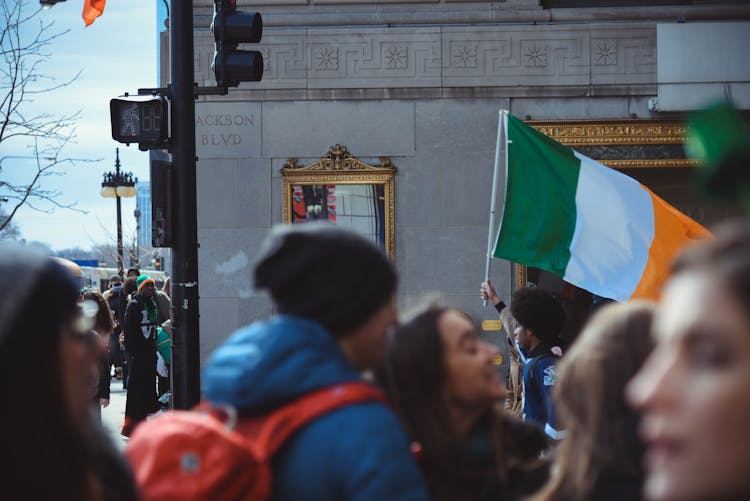
Historic Referendum Defeat in Ireland for Redefinition of Family, Marriage and Motherhood
Last Friday, 8th March 2024, Ireland voted on two referenda to erase the concepts of the family and mothers from the Irish constitution.
For the élites, these referenda were another blow to progress in the project to transform Ireland’s constitution to reflect, to quote The New York Times journalist Megan Specia, a more secular and liberal modern identity.
Currently, the Constitution says that:
‘The state recognizes the family as the natural primary and fundamental unit group of society, and as a moral institution possessing inalienable and imprescriptible rights, antecedent and superior to all positive law.’
and that:
‘The state pledges itself to guard with special care the institution of marriage, on which the family is founded, and to protect it against attack.’
The referendum proposed to add after the word ‘family’ the words ‘whether founded on marriage or on other durable relationships’. It proposed to remove the words ‘on which on which the ‘family’ is founded after the word ‘marriage’ in the second sentence.
Common Sense
NO Campaigner Maria Steen, in the video below, has hailed the win of the ‘No’ side in #Referendum2024 as a “victory for common sense.”
As a consequence of a previous amendment to the Constitution, the word ‘family’ means the unit based on a marriage between two people without distinction as to their sex. Consequently, one might wonder what constituted ‘other durable relationships’.
The Constitution also says that:
‘In particular, the State recognises that by her life within the home, woman gives to the State a support without which the common good cannot be achieved.
‘The State shall, therefore, endeavour to ensure that mothers shall not be obliged by economic necessity to engage in labour to the neglect of their duties in the home.’
The second referendum sought to delete these provisions and replace them with:
‘The State recognises that the provision of care, by members of a family to one another by reason of the bonds that exist among them, gives to Society a support without which the common good cannot be achieved, and shall strive to support such provision.’
Counting Chickens
The élites thought the outcome of the referenda was a foregone conclusion.
In their eyes, not only were the proposals demonstrably irrefutable, unless one was a bigot or a troglodyte, but all the people who mattered supported them ― the Coalition parties making up the government, Fianna Fáil, Fine Gael and the Greens, and Sinn Féin, Labour, Social Democrats and People Before Profit – Solidarity, supported the referenda. Only two small parties, Aontú and Independent Ireland, opposed.
Prominent organisations like the National Council of Women (which led the ‘Yes-Yes’ campaign), Family Carers Ireland and the National Information Service for Unmarried Parents supported the referenda, as did the mainstream media.
Here is Katie Hopkins from the UK giving a video explanation of this Referendum:
These referenda were in the home run of the modernisation project. Ireland already had passed referenda ending a ban on divorce (1995) and subsequently liberalising divorce laws (2019), legalising same-sex marriage (2015) and ending a ban on abortion (2019).
Despite the odds, the result was a disaster for the élites. 68 per cent of voters opposed the first question, and 74 per cent voted No to the second question.
It was the largest referendum defeat in Ireland’s history. Only one of 39 constituencies ― an affluent constituency near Dublin ― voted yes to the first question, and all 39 voted against the second question. These details seem to have escaped the attention of the mainstream media.
Excuses
Now the blame game is on.
People did not reject the ideas.
Orla O’Connor, head of the National Women’s Council of Ireland, cautioned against interpreting the result as Ireland voting to keep ‘life within the home’ language for women in the constitution: ‘It is more nuanced than that.’ (‘Why did Ireland’s referendums on family and women fail?’, Agence France-Presse, Peter Murphy, 10th March, 2024)
Watch the video from 4:09 to get comments on the Irish Referendum from the Outsiders team on Sky News.
According to Megan Specia,
‘After a series of referendums in recent years had reshaped Ireland’s Constitution in ways that reflect the country’s more secular and liberal modern identity, the result came as a surprise to some, including the government. But analysts said that rather than signalling a step back from those values, the results reflected a confusing, disjointed campaign that had left many voters reluctant to vote yes.’
(‘Ireland Rejects Constitution Changes, Keeping ‘Women in the Home’ Language’, New York Times, 24th March 2024)
She did not name the analysts.
The Irish Times (9th March 2024) summed the view of the élites:
‘Few people would disagree with the view that the gendered language in the Constitution referring to women’s role in the home should be changed, with recognition given to carers, and that the definition of the family should be broadened to include those not based on marriage.’
(The Paper did not indicate how people thought that the definition of family should be broadened.)
Whether few or many, among those who did disagree were the Roman Catholic bishops, who urged a No vote to both questions. Perhaps the decline in the proportion of the population describing themselves as Roman Catholics from 95 per cent in 1961 to 69 per cent in 2022 provided a rationale for pretending that the bishops are irrelevant, or maybe the modernisation project cannot countenance the idea that people take notice of what they say from time to time, regardless of whether they are in church or not.
The Paper’s political editor Pat Leahy assured reads that the result ‘does not mean that the general trend of society has lurched permanently to a conservative one.’
If the élites were not wrong, then responsibility must lie elsewhere. The Irish Times summed it all up:
‘The timing was rushed, the rationale unclear, the propositions confusing and the campaigning lacklustre. It was an accident waiting to happen.
It is hard to focus the blame anywhere but with the Government.’
Then there is the fact that only 44 per cent of the population voted. Presumably, that provides a basis for ignoring the result.
Waste of Time
The élites would be oblivious to the possibility and apoplectic if it occurred to them that issues apparently unrelated to the referenda could have influenced people’s attitudes. Before the vote, writer Paul Kingsnorth observed:
‘Over the past 50 years, amendments have removed the “special position” of the Catholic Church from the constitution, legalised divorce, abortion and gay marriage, prohibited the death penalty and allowed for various centralising EU treaties to be signed by the government, all of which reduced the Irish state’s political reach in Ireland while increasing that of the EU.
‘Traditional Catholics have been very unhappy about much of this — some of my older neighbours will bend my ear about it for hours — but there is no doubt that it is going with the grain of the culture, especially that of the younger population. Progressivism is the new faith of this republic, as it is across the West.
Official Ireland prides itself these days on Dublin’s rainbow zebra crossings, on the country’s increasing levels of immigration (which, however, are increasingly resisted and resented by the population as a whole), on its role as an EU hub for Silicon Valley and Big Pharma, on its pioneering stances on the banning of tobacco and the legalising of gender self-ID. All that is Catholic melts into air in what was, just a few decades back, the most Catholic country in the West.’
(‘Ireland’s referendum is an attack on women’, UnHerd. 4th March, 2024).
Check out Father Brendan Kilcoyne’s video advocacy for the No Vote 6 days before the Referendum. Thankfully, the people of Ireland took his advice.
Mr Kingsnorth’s sentiments give credence to the idea that a significant proportion of Ireland’s population may think that enough is enough and that they have more urgent things to worry about than an élite ideological agenda.
That possibility was reinforced by the comment of political scientist Eoin O’Malley of Dublin City University, who put a pin in the bubble of the élites when he described it as ‘a poorly executed referendum that nobody needed or wanted.’ (‘Why did Ireland’s referendums on family and women fail?’)
For those who have taken a passing interest in Australia’s referenda over the last 25 years, both the results of the latest Irish referenda and the attitudes and reactions of the Irish élites may well engender a sense of déjà vu.
___
Photo by gdtography.
2 Comments
Leave A Comment
Recent Articles:

24 October 2026
3.3 MINS
When we ask God, "What is in my hand?", and see our possessions, money and time as seed that God asks us to sow, life becomes simpler.

23 October 2026
6.8 MINS
Hillsong UNITED’s Joel Houston reflects on fame, faith and the burden of ministry, questioning performative Christianity as he seeks a more authentic walk with God.
23 October 2026
13.1 MINS
Tasmania’s proposed conversion practices legislation raises serious questions about religious freedom, pastoral care and whether Christians can freely pray with those seeking to live according to their faith.
23 October 2026
5.1 MINS
France’s escalating riots expose the dangers of political extremism, antisemitism and radical alliances, offering America a stark warning about the future of Western democracy.
23 October 2026
3.1 MINS
The one who is worthy of it all is awakening his Church to be captivated by him, so that we will honour one another and share his gospel with humility and courage.
22 October 2026
2.9 MINS
Victoria Labor’s promise to fund free abortions has drawn a forceful response from Presbyterian leaders, raising profound questions about unborn life, government priorities and Australia’s moral direction.

22 October 2026
4.7 MINS
Western Australia’s proposed anti-discrimination overhaul has sparked warnings from Christian leaders that religious freedom, parental choice and faith-based schools’ ability to uphold their beliefs are at risk.



Great news; Great article.
Thank you Rick.
Thanks for the article Rick. May many other countries be encouraged by Ireland’s vote and stand for family and the role of mothers.