


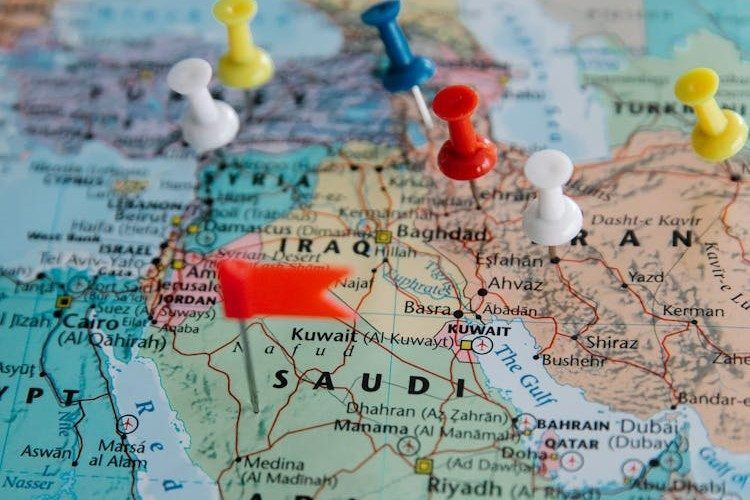
The State of Play One Year on from Hamas’ Attack on Israel
Hamas’ brutal mass murder of civilians and the taking of hostages on October 7, 2023, is burned into the psyche of Israelis just as the Imperial Japanese attack on Pearl Harbor and the 9/11 attack on New York’s World Trade Center are seared into the minds of Americans.
In proportion to the size of their populations, Israel’s losses were far greater than those of the United States in the 1941 and 2001 attacks. On neither of those earlier occasions were there calls for a U.S. “de-escalation” or a “ceasefire” to appease the aggressors.
The Middle East conflict has its own dynamics. Iran is the primary antagonist, determined to obliterate Israel and gain hegemony over the region. At the same time, the current conflict has much wider significance in the context of the growing military, economic and diplomatic cooperation between China, Iran, North Korea and Russia across the Eurasian continent in opposition to the Western global order.
Middle East Dynamics
The regional promoter of conflict is Shia Iran. It has an ideologically driven three-tier master strategy to destroy Israel, dominate the Middle East and confront the West.
First, Iran has stockpiled uranium that is close to being refined into weapons-grade material for nuclear bombs. With such weapons, Iran aims to neutralise Israel’s regional military and strategic supremacy and to give itself a nuclear insurance policy.
Second, it is producing advanced rockets, cruise missiles and drones to reduce the technological advantage of Israel, the U.S. and their allies.
Third, Iran has built lethal terrorist proxy forces – an “axis of resistance”, a “ring of fire” – to jointly destroy Israel.
These “non-state” terrorist forces are destabilising the whole Middle East, particularly in the countries whose territory they occupy. As Michael Shoebridge, director of Strategic Analysis Australia, recently observed, when Iran arms and trains these forces, “it accelerates institutional weaknesses and feeds chaos, dysfunction and economic stagnation”. For example, Hezbollah denies Lebanon the ability to run its own country; Hamas militarises Gaza at the expense of a proper civil authority for the Palestinian population; the Houthi prevent Yemen from being a functional state.
Today in Gaza, the military situation has stagnated. Most of the heavy fighting may have finished (although Hamas may recover its fighting ability in some areas), but there is no alternative force to keep peace in the territory. The situation is unlikely to change until the war with Hezbollah and conflict with Iran plays out.
Having endured a year of missile strikes from Lebanon, Israel is degrading the capabilities of Hezbollah. The Israeli Defence Force (IDF) has taken out Hezbollah’s top leaders, has intercepted most incoming missiles and is conducting air strikes and rapid ground incursions into strongholds in southern Lebanon, where Hezbollah is believed to be harbouring between 100,000 and 200,000 missiles pointed at Israel.
Israel has vowed serious retaliation on Iran for missile strikes launched against it. This is yet to happen.
As for Shia Iran, it is not ready for major war with Israel. As Arash Azizi recently observed in The Atlantic:
“Its economically battered society does not share its leaders’ animus towards Israel, and its military capabilities don’t even begin to match Israel’s sophisticated arsenal. Iran lacks significant air-defence capabilities on its own, and Russia has not leapt to complement them.”
Currently, Israel has put the axis of resistance on the back foot. Israel could “take a win” after degrading Hezbollah and forgo an attack on Iran. Or it could retaliate by attacking and weakening Iran. In response, Iran could decide to weaponise its nuclear materials, or possibly Israel could pre-empt and attack those nuclear facilities, as it has done before.
Iran’s Supreme Leader, Ayatollah Ali Khamenei, has long operated on what he calls a “no peace, no war” ideology – using Iran’s proxy forces to prosecute attacks on Israel, while avoiding any direct major engagement. This untenable strategy is now unravelling. With its proxy forces in tatters, Iran may face a devastating Israeli response.
Politically, Iran’s leadership has serious legitimacy problems. As Aziz also points out, there have been popular uprisings, as seen with the Women, Life, Freedom Movement following the death in custody of Mahsa Amini after she was held for improperly wearing a hijab.
Moreover, there is a lot of dissent against the regime’s entrenched hostility to Israel and the U.S., with its “commitment to perpetual conflict with both countries”. This has led to regime concerns “that direct confrontation with Israel and the U.S. would unleash these internal dissenting voices and seriously threaten the regime’s survival”, says Aziz.
Among Israel’s Sunni Muslim neighbours, it is striking that not one has reduced its relations with Israel during the war. Many have clamped down on Palestinian protests. Egypt has kept its borders shut to Gaza. Jordan showed goodwill in shooting down some missiles aimed at Israel. Saudi Arabia has signalled that normalisation of relations will proceed with Israel, probably after the conflict has subsided. All have quietly supported Israel.
Israeli Politics
In Israel, there have been demonstrations and protests against the Government of Benjamin Netanyahu. These have partly related to calls by some Israelis to find a way to bring home the hostages held by Hamas.
However, it is also the case that many Israelis blame Netanyahu for the October 7 massacre because of his failure to address Hamas’ strengthening military capabilities over the past decade. Many distrust Netanyahu after his 2023 attempts to undermine the independence of the country’s judiciary by limiting judicial review of government legislation.
Whatever the distrust of the Government, a recent poll, around the time of the Israeli strikes on Hezbollah’s leaders, showed that 90 per cent of Jewish Israelis supported an in-depth offensive against Hezbollah, while 70 per cent think both the IDF and Israel’s civilian population would be able to withstand an extended war on two or more fronts.
What of the future? Israel has offered a two-state solution to the Palestinians no less than four times, including the initial partition of the land in 1947. Indeed, when Israel and Egypt signed their 1979 peace agreement, Israel showed good will in handing back the entire Sinai Peninsula (an area three times the size of Israel captured in 1967) to Egypt. That should have been a sign that Israel’s offers to the Palestinians were genuine.
The recent Hamas, Hezbollah and Iranian attacks on Israel demonstrate that the conditions for normalisation of relations with the Palestinians requires Israel to continue making peace with its Arab neighbours; Iran to stop backing (or be stopped from backing) regional terrorism; and for Iran to abandon its aggressive pursuit of a one-Palestinian-state solution. Then a two-state solution could be considered.
For all that to happen, as Ari Shavit recently outlined in Foreign Affairs, the U.S. needs to be the centrepiece in “a Middle East defence organisation that would prevent Iranian nuclearisation, halt Iranian expansion, and demobilise Iran’s proxies.
“A consolidated U.S.-backed alliance would warn Iran’s supreme leader, Ayatollah Ali Khamenei, that an Iranian attempt at nuclear breakout would be blocked by any means necessary. The alliance could also impose a diplomatic and economic blockade on the theocratic regime, while giving moral, financial, and political aid to Iran’s liberty-seeking population.”
Such a strategy would depend very much on the disposition of the next U.S. President, be it Donald Trump or Kamala Harris.
Until such a solution is found, Iran’s proxies will continue to inflict huge suffering on Palestinian civilians, by making the territories where they live ungovernable and by using them as human shields. Even when Israel has sent millions of mobile-phone texts, made leaflet drops and given other warnings of impending battle areas, the behaviour of Hamas and Hezbollah has led to terrible civilian casualties.
Wider Geopolitical Significance
Second, recently writing on the wider significance of the Israel-Iran and Ukraine-Russia conflicts was Michael Pezzullo, a former Canberra deputy secretary of the Defence Department and a former secretary of the Home Affairs Department.
He placed these conflicts in the context of what the great Polish-American political scientist, Zbigniew Brzezinski, described as the world’s decisive geopolitical theatre – the “grand chessboard” of the supercontinent of Eurasia.
This supercontinent contains the bulk of the world’s population, natural resources and economic power. Says Pezzullo:
“Any Eurasian hegemon that managed to establish strategic control of the interior lines and networks of continental trade, investment, transport, energy, data and technology flows would become the dominant global power if it was also a significant sea power that was able to hold at bay U.S. sea power.”
Across Eurasia we are witnessing the broadening and deepening of alliances between China, Russia, and the smaller but significant regional powers of Iran and North Korea. Each has its own ideology for gaining hegemony over their part of this land mass, as others coveted it over the past two centuries.
What is more, as Pezzullo says, the members of this new hostile axis are “more integrated than ever was the first Axis of the 1930s and ’40s” that instigated World War II.
To contain this new axis, some have called for a Middle East form of NATO, others for an Indo-Pacific NATO.
Those who seek to weaken Western support for Ukraine and continue to urge Israel to back off (the Penny Wong proposal) are ignoring the high stakes involved and fail to understand the aims and threats of these ideologically driven states.
Such actions will encourage Putin’s Russian imperial ambitions, Iran to more wars, to seek regional domination and to inflict more suffering on the Palestinians, and China to war on Taiwan.
The consequences for the rest of Eurasia, Australia and the world are unimaginable.
___
Republished with thanks to News Weekly. Image courtesy of Pexels.
Recent Articles:

8 October 2026
4.1 MINS
Italy honours St Francis of Assisi 800 years after his death, celebrating a saint whose devotion to Christ, radical simplicity and message of peace continue to shape generations.
8 October 2026
2.8 MINS
The MDBA’s case for further water buybacks rests on climate projections increasingly challenged by climate scientists, historical rainfall data and evidence of a greener Basin.
7 October 2026
1.5 MINS
Across the Middle East, North Africa and Anatolia, Christianity once shaped entire civilisations. Could Britain’s Christian heritage likewise become a memory rather than a reality?

7 October 2026
6 MINS
What can Tucker Carlson’s interview with Jacob Rees-Mogg teach us about political disagreement? Their clash over war, Russia and national defence highlights the importance of listening carefully and understanding an opponent’s position before attempting to refute it.
7 October 2026
8.5 MINS
Gerald McDermott’s work challenges Christians to approach Israel through Scripture first, exploring God’s covenant faithfulness, Christian Zionism, Jewish identity and antisemitism.
6 October 2026
3.4 MINS
Christians cannot afford to let headlines and social media shape their view of Israel. Scripture provides a foundation for understanding Israel, God’s promises and our response.

6 October 2026
6.7 MINS
Fresh revelations about the foiled FlyDubai terror plot expose the attacker’s alleged extremist history, while a courageous pilot’s actions prevented an unthinkable catastrophe.


