



2025 Election Australian Christian Values Checklist Released
The Australian Christian Values Institute has been serving the Australian community since 1999. Each election, this institute releases the Australian Christian Values Checklist as a service to the Christian community.
The checklist focuses on issues of particular Christian concern – namely faith, Christian freedom, family, life and broader Christian interests.
This checklist has been compiled by an independent team of individuals who are not members of any political party. The team put the checklist together after an exhaustive search of party websites, voting history, and statements, including, in some cases, the voting record of their state counterparts.
Please remember that this checklist is not an endorsement of any political party. It is only an assessment of where each party stands with written or public policies on the relevant issues.
You are encouraged to make your own assessment of your political candidates and vote wisely.
2025 Australian Christian Values Checklist: Three Versions
The 2025 Federal Election Christian Values Checklist is now available! There are three different versions depending on your location. Click the buttons below to download a PDF version. We encourage you to print copies and share the checklist electronically with your family, friends and churches.
Please make sure you download the correct one for your state/territory.
The checklist ranks parties from most favourable to least favourable on Christian values. Below is the NSW, VIC, SA, TAS, ACT and NT checklist so we can explain how it works.
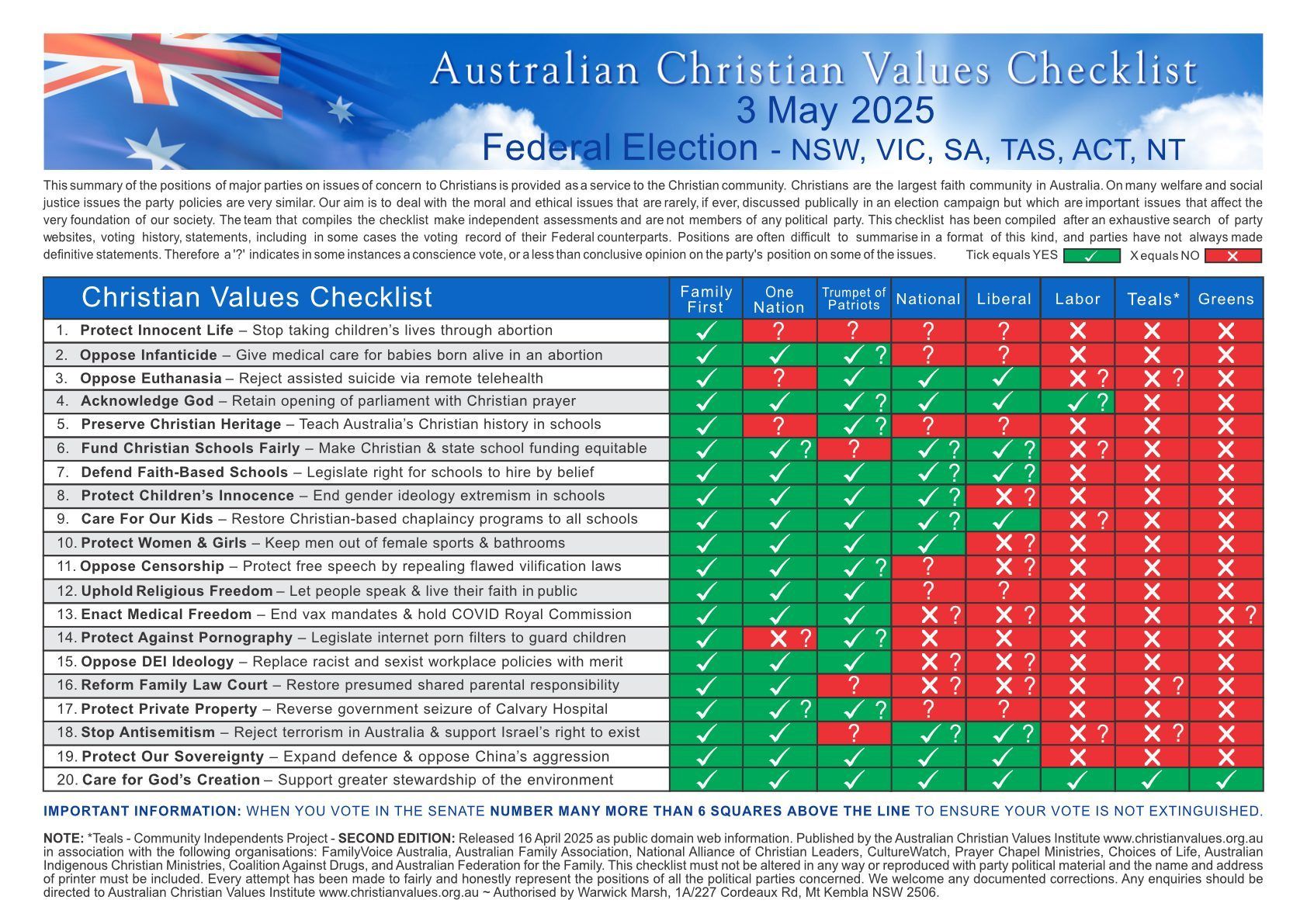
Parties are evaluated on whether their policy position aligns with Christian values on particular issues.
- A tick in a green box equals YES, and an X in a red box equals NO.
- A ‘?’ indicates, in some instances, that the party allows a conscience vote.
- A ‘?’ may also indicate a less than conclusive position or that the party’s members would vary on that issue.
It is often difficult to summarise these positions in this simplified format, as parties do not always make definitive statements. In addition, it is not possible to include every party (e.g. Libertarians) or independent candidates. That’s why it’s important to do your own research and come to your own conclusions.
The Australian Christian Lobby (ACL) has also provided an excellent and in-depth resource that evaluates both parties and individual candidates. We recommend comparing the checklist with the information provided on the ACL website Australia Votes.
We are also pleased to announce that Love Australia has released a guide, called “Vote Life”, to help people know how to vote for life at this election. Access the Love Australia Vote Life website here.
Another resource you can cross-reference as you evaluate your political candidates is Turning Point Australia.
Making Your Vote Count
Knowing how to make your vote count is critically important. The video below explains how the voting system works – and how to number the boxes on your ballot paper.
Watch this video to see how to make your vote count based on your own choices before you go to the ballot box!
The order in which you number your boxes is very important. Who do you prefer the most, and who do you prefer the least?
If you choose to put a minor party (e.g., Family First, Australian Christians, One Nation, etc.) as your number one choice, it is very important who you place next.
This is because a minor party has a lower chance of gaining a majority of votes to be successful. If your first choice is unsuccessful, your vote will go to your second preference. That’s why the order that you number the boxes is very, very important!
The following video by Topher Field explains one way of preferencing the minor parties before a major party (e.g. Labor, Liberal, National). Done this way, it maximises the chance of a minor party candidate being elected, while also ensuring your major party preference is counted.
House of Representatives (Lower House Voting)
When voting for the House of Representatives, you must number every box – in order – for your vote to count.
Senate (Upper House) Voting
When voting for your candidates in the Senate, you can either vote:
(1) Above the line. You must number at least six boxes (numbering all is preferable).
(2) below the line. You must number at least twelve boxes (numbering all is preferable).
The simplest way of Senate voting is above the line. This means that you are voting for parties – and the parties choose the order of their candidates.
The more in-depth way of Senate voting is below the line. While more difficult, this option has the advantage that you choose the order of your candidates.
Whether voting above or below the line for the Senate, we highly recommend that you number as many boxes as you can. Why? Because if your chosen candidate or party is unsuccessful, your vote will not count unless you have numbered all your preferences.
Turn the Tide: 21 Days of Prayer and Fasting
Australia is in incredible need of a turn to God this election. We invite you to join Christian leaders and churches of every denomination as we pray and fast for 21 days (Sunday, 13 April – Saturday, 3 May) for the federal election. Watch the promotional video below!
Please click the orange button below for more information about this vital prayer campaign and to sign up for daily devotionals!
Yours for wisdom in voting and revival for our nation this federal election,
Samuel Hartwich & Warwick Marsh
9 Comments
Leave A Comment
Recent Articles:

24 October 2026
3.3 MINS
When we ask God, "What is in my hand?", and see our possessions, money and time as seed that God asks us to sow, life becomes simpler.

23 October 2026
6.8 MINS
Hillsong UNITED’s Joel Houston reflects on fame, faith and the burden of ministry, questioning performative Christianity as he seeks a more authentic walk with God.
23 October 2026
13.1 MINS
Tasmania’s proposed conversion practices legislation raises serious questions about religious freedom, pastoral care and whether Christians can freely pray with those seeking to live according to their faith.

23 October 2026
7.7 MINS
Melbourne Catholic Archbishop Peter Comensoli has spoken out clearly against the deadly promises by both major parties in Victoria ahead of the election, drawing a comparison between abortion and capital punishment.
23 October 2026
3.1 MINS
As Western societies grow more hostile, could abandoning Christianity’s moral foundations be contributing to the rise of ideological extremism, political intolerance and violence?
23 October 2026
5.1 MINS
France’s escalating riots expose the dangers of political extremism, antisemitism and radical alliances, offering America a stark warning about the future of Western democracy.
23 October 2026
3.1 MINS
The one who is worthy of it all is awakening his Church to be captivated by him, so that we will honour one another and share his gospel with humility and courage.



I’d like to add a couple of prayers- that election weary Aussies would become engaged with the elections so that they know who they’re voting for and pray for these people. We are the employers of the Government, not the the other way around. 2. For those standing for election be honest and cease their slanging match with false accusations of other candidates. Yes, this is possible. I found myself handing out “my” parties how to vote cards . I was beside another party supporter, handing out “her’ parties cards. We got along so well! It was so funny! We had a medical emergency and 3 of us supporting 3 different parties raced off to assist the person. We were bound together by our Australian desire to help another Aussie! We’ve had voters coming along to vote with depressed expressions and seen what should be “oppositioners” having a great time. Their responses have been a delight. Their moods change. There is hope. Jesus is the victor- not a political party. He is in control. Handing out how to vote cards is a great way to silently
and quietly witness to Australians who is in control (JESUS) Well some times it does become hilarious…
I agree with your first 2 points Christine but I’ve never understood the need to hand out ‘How to Vote cards and pamphlets’ at the place of voting on the day of voting.
It seems an incredible waste of resources and frankly pointless.
Do you really think that people wont know who they are voting for by the time of the Election, particularly on Election day ?
At best it is an arduous task to vote, the lines are long, it’s often hot and all I want is to get there, get in, get it done and get home, like everyone else that I observe on Election day EXCEPT those souls handing out the political party propaganda sheets.
The only slight value I can see is if the pamphlets are all from minor parties that most people are unaware of but again, by Election day, everyone should already know who they will be voting for. It comes off to me as a cynical and opportunistic, last ditch effort to scoop up a smattering of uninformed voters who’s value is much less than the overall cost of the printed material.
I could be wrong of course and the return on investment is worth it considering the payment for every vote gained.
I wholeheartedly agree with you.
Additionally, I believe it’s a terrible waste of both financial and natural resources, and the amount of litter that it results in is quite obscene.
That’s why, in NSW, Australian Christians won’t be printing out any HTVs. We will be relying solely on QR codes and the websites of groups like this, ACL, Turning Point as well as our own to equip voters with the information they need. Corflutes are reusable and you only really need one or two for an entire day if you can get people to scan the code. The main issue for us is just getting one to each voting booth.
We may not be on the NSW checklist (because we only have two Senate candidates and there’s only so much space on the checklist,) but we are putting in the work.
Dear Helen + Everybody
Sadly most voters only give 30 seconds to a few minutes to the voting process. All this usually just before they vote. This is why the value of real people handing out how to vote cards at a voting station is incalcuable. For smaller parties How to Vote cards can increase votes anywhere from 20% – 80%. It is a highly worthwhile voting activity more so for smaller parties than large. When you add prayer and loving smile it takes the activity to a whole new level!
I’m a little confused regarding Trumpet of Patriots. The policies outlined on their website are conservative. Palmer says he wants to be a disruptor and break the duopoly of Liberal and Labour. In 80 of his candidate’s seats he is preferencing Teals and Labour. These parties are at odds with his policies. Conservative parties are more closely aligned to policies of Trumpet of Patriots yet he is not preferencing them.
Voter’s need to know a vote for Trumpet of Patriots in those 80 seats will flow through to Teals or Labour.
As Christians, we must put Scripture above all politics. To call something a “Christian Issue” means that it affects our ability to practice our faith or has direct impact into seeking justice and caring for our community. Some of the items listed are Political Issues. We need to act and think with love and empathy, at very least ask WWJD. We also need to be careful to not be reductive especially around sensitive issues. Unintended consequences must be considered with thought and if we want to speak truth, we must take an evidence-based approach.
1. I mourn any loss of human life as we all created in His image. However, blanket bans on abortion do not stop them from occurring, rather force women to more dangerous, nonprofessional methods. Additionally, it pushes vulnerable people away from engaging in healthcare or services that may assist in addressing the root causes of their situation. See: https://pmc.ncbi.nlm.nih.gov/articles/PMC9321431/
2. Agreed. Relevant link: https://www.aph.gov.au/Parliamentary_Business/Committees/Senate/Community_Affairs/ChildrenBornAlive2022/Report/Chapter_1_-_Introduction
3. Access to end-of-life planning is not against Scripture. Limiting remote access is just cruel to those that live in remote regions or have mobility issues. Australia has very strict criteria regarding eligibility for VAD: https://www.healthdirect.gov.au/voluntary-assisted-dying#eligibility
4. Agreed because I like the tradition. However, if it was removed, I would not see this as persecution, we can still pray freely and earnestly. This tradition neither enables nor impedes that. *Not a Christian Issue.
5. Children should be taught all of Australia’s history, good, bad or ugly. If that is done well, specific note of Christian history should not be necessary. *Not a Christian Issue.
6. Disagree. The statement as written says equitable funding between Christian and state schools. This is an entitled point of view and makes light of public school resourcing. Hard disagree. The correct statement should be written as equitable funding between private schools, whether Christian or otherwise. *Not a Christian Issue (well it becomes one in the negative by pushing for something unfair)
7. I agree with the concept of a Christian School. I disagree with the concept of Schools for Christians where all staff and students are Christian by mandate. That said, schools should have the right to set out reasonable codes of conduct in line with Christian values for staff while at work, but these should not extend into their personal convictions. *Not a Christian Issue
8. Agreed to an extent. It is healthy for kids to learn about gender ideology at age-appropriate ages. What age that is, is up for healthy discussion and I agree we need to pushback against pressure to make that too young. However, ending all gender/orientation discussions from school age young people is simply repression. This does not further the gospel, only stifles conversation, closes off heartfelt conversations and creates resentment against Scripture without the chance to be heard.
9. Agreed!! 100%!!
10. Complicated. Buildings have two sets of toilets. Society has more than two gender+orientation combinations. Blanket banning is a blunt instrument. See: https://pmc.ncbi.nlm.nih.gov/articles/PMC8022685/ and https://williamsinstitute.law.ucla.edu/publications/safety-in-restrooms-and-facilites/
Regarding sports, I agree with having just two divisions: Cis-Women and Open (Men + Other). However, in sport engagements that are not competitive, combat based, or heavy contact should allow people to play where they feel most comfortable.
11. While I agree with the overarching concept of free speech, I do not see how these laws prevent us from practicing and even sharing our beliefs. I am happy to be informed otherwise: https://dcj.nsw.gov.au/news-and-media/media-releases/2023/new-religious-vilification-laws-commence-today.html
12. Agreed. However, which law is stopping it? What policies pertain to which parties got green ticks or red crosses?
13. Not a Christian Issue. This is a Libertarian viewpoint, not a Christian one. I do not mind if you are Libertarian or not, but do not claim that ending vaccine mandates is a Christian issue. Doing so is disingenuous and not representative of Christians who support evidenced based approaches.
14. I agree in spirit but sadly in practice this is difficult to implement and impossible to enforce. For the record, this is anti-Libertarian. The best we can do is parent and educate well about the world, sex and health age-appropriately.
15. Agree with merit-based workplace policies rather than quotas. However, DEI is more than just that though. We need to be careful to not to negatively affect access and funding for supports that enable people with disabilities to join the workforce.
16. Agreed.
17. I do not know enough about this.
18. Agreed. Always reject terrorism and end antisemitism. The victims of war are always the civilians on all sides. It should be noted that both Palestinians and Israelites are Semites.
19. Not a Christian Issue.
20. Agreed. Every party got a green tick here. Are these backed by detailed policies or just general ideas?
I pray that we stick to Scripture, following Jesus and being disciple making disciples.
The Checklist can only evaluate the voting history and documented policy statements. It portrays how close parties align with key Christian values. That’s all the checklist can do. It cannot evaluate a party’s how-to-vote cards.
No party dictates your preferences. Your preferences are your own. A party’s how-to-vote card only reflects their preferences.
As for the dangers of only numbering six boxes on the Senate ballot, please see: https://dailydeclaration.org.au/2025/04/29/the-hidden-dangers-of-senate-voting-and-the-greens-advantage/
It’s crucial to number all boxes (or as many as you can). Further, not including a major party in your preferences runs a significant risk that your vote will be wasted. Please see the above link to explain why this is the case.
BIG CONGRATULATIONS to Canberra Declaration and all the team at the Australian Christian Values Institute for consistently producing such an invaluable resource! The Australian Christian Values Checklist is a fantastic, well-researched, easy to understand resource for every Christian in Australia. Yes, it’s not perfect (what resource is, apart from the original source, God’s inerrant Word, but anyone who cares about Christian Values should at least look at it before voting.
We were interested in the set of Christian values that you profess including faith, hope, love, humility, forgiveness, patience, kindness, faithfulness, gentleness, and self-control, and your concern that they should be exhibited by all peoples everywhere. However, we believe that you have been deluded by your attempt to inculcate these into the Australian population through political means.
Our God has given us freewill which means that we are responsible for first seeking the Kingdom of God individually and discerning His message and expectations for each one of us. We cannot force salvation on others, and we cannot and should not force the Christian values outlined above on people. However, our individual and our Christian community (Church) behaviour exhibiting these values should entice others to seek the salvation that is offered with the joy that we receive in the Holy Spirit.
In your mission statement you say, “bringing all legislation into conformity with the will of God as revealed in the Holy Bible”. As soon as we Christians attempt to pass laws and enforce them we deny Gods will and we become the oppressors. You yourselves argue against such oppression in your condemnation of enforced vaccinations.
May we draw you attention to 1 Corinthians 5:9-13 (New International Version)
9 I wrote to you in my letter not to associate with sexually immoral people— 10 not at all meaning the people of this world who are immoral, or the greedy and swindlers, or idolaters. In that case you would have to leave this world. 11 But now I am writing to you that you must not associate with anyone who claims to be a brother or sister but is sexually immoral or greedy, an idolater or slanderer, a drunkard or swindler. Do not even eat with such people.
12 What business is it of mine to judge those outside the church? Are you not to judge those inside? 13 God will judge those outside. “Expel the wicked person from among you.”
It is not our place to judge others outside the faith community (Church), but we have every right to rebuke those within our Church who do not live up to the values that we profess.
Matthew 18:15 – “If your brother or sister sins, go and point out their fault, just between the two of you. If they listen to you, you have won them over.”
Luke 17:3 – “If your brother sins, rebuke him; and if he repents, forgive him
Galatians 6:1 – “Brothers and sisters, if someone is caught in a sin, you who live by the Spirit should restore that person gently. But watch yourselves, or you also may be tempted.”
Proverbs 27:5 – “Better is open rebuke than hidden love.”
James 5:19-20 – “My brothers and sisters, if one of you should wander from the truth and someone should bring that person back, remember this: Whoever turns a sinner from the error of their way will save them from death and cover over a multitude of sins.”
Leviticus 19:17 – “Do not hate a fellow Israelite in your heart. Rebuke your neighbour frankly so you will not share in their guilt.”
Some of the recommendations that you suggest are not supported by scripture including re-introducing prayers into schools (Matt 6:5-6). Numerous attempts have been made in the past to control human behaviour and to enforce Christian principles on populations and these have only led to repression and revolution followed by violence. Prohibition of any kind never works long term. Look at history. We Christians must not attempt to control the behaviour of others.
With respect to the environment, certainly we all need to treat it with respect and be good stewards, but we have not. Australia has a horrific reputation in the environmental sphere. What is needed now is repair and we need to mitigate so much of the damage that has been done by human hubris and greed in mining, farming and housing. We cannot just put off what needs to be done (Net Zero) but take firm and precise action based on the best scientific advice and reject the climate chaos deniers. We have caused this problem; we need to pay for its correction!
It has been suggested that you are affiliated with the ACR which is a diverse movement of individuals, groups and churches that share traditional, fundamentalist approaches to the Bible and church teachings. We applaud your remarks against antisemitism, but we are concerned that you may have bought into the lie of saving Western Civilisation and its associated Islamophobia. There is no hate in Christ Jesus. In your manifesto you commit to ‘Defend freedom of religion, expression, worship, assembly and thought.’ We question whether this commitment is to all people and all religions including Islam, Buddhism, Hinduism as well as the “Dreaming” of the First Nations and other Australian religious practices (Full article: Decolonising Studies of Religion in So-Called Australia: Truth-Telling, Collective Reflections and Future Trajectories).
You suggest holding the government accountable for acting on recommendations to protect and support Aboriginal people, including children, adolescents and elders ensuring their safety, wellbeing, and opportunities are prioritised. Unfortunately, by campaigning for the No vote in the 2023 Australian Indigenous Voice referendum, you have created a barrier to communication with the people most likely to know what is best for Aboriginals.
The problem with the Christian right which has advanced socially conservative positions on issues such as creationism (biological evolution is a fact) in public education (based on only the Bible and dismissing other educational methodologies and faiths), school prayer (mentioned previously), temperance (unsupported by scripture John 2:1-11), nationalism (which in turn often leads to elitism and war), Sunday Sabbatarianism, opposition to LGBTQ rights (there is evidence to suggest through genetics these persons are wired differently), abortion (the Churches have an extremely poor record in assisting women who have been raped or the children who are the result), euthanasia and drug usage is that it attempts to force people to comply with their ideas. Christianity is not to be forced on individuals or groups, and when it is, it not only goes against Gods will that humans have freedom of choice but immediately creates resentment. Certainly, we can live an exemplary life by choice, and it is that which is salt and light to the nations (Matthew 5:13-16).
As Christians we have a responsibility to live lives that reflect the righteousness of God (Matthew 6:33) based on love (Matthew 22:37-40; 1 Corinthians 13:1-8,13) and treating others as we would have them treat us (Matthew 7:12). Forcing people to attain the Kingdom of God via laws and proscriptions is not what our King asks of us.
Certainly, as a lobby group we see no reason why you cannot emphasis the Christian values you profess: faith, hope, love, humility, forgiveness, patience, kindness, faithfulness, gentleness, self-control, the value of human life, the sanctity of marriage etc. remembering that the greatest of these is love. However, to try to impose any of these values or your manifesto on others, especially people of other faiths, will only backfire and cause disdain for your endeavours.
We commend to you the Serenity Prayer. God, give us grace to accept with serenity the things that we cannot change, courage to change the things which should be changed and the wisdom to distinguish the one from the other.
Living one day at a time, enjoying one moment at a time, accepting hardship as a pathway to inner peace, taking, as Jesus did, this world as it is, not as we would have it, trusting that You will make all things right, if we surrender to Your will, so that we may be reasonably happy in this life, and supremely happy with You forever in the next!
We write this in a spirit of correction, love and peace in our Lord.