


Australia’s Expanding Digital Surveillance State
The rise of the digital surveillance state is changing how Australians engage online. It’s important to call out the overreach… while we’re still allowed to.
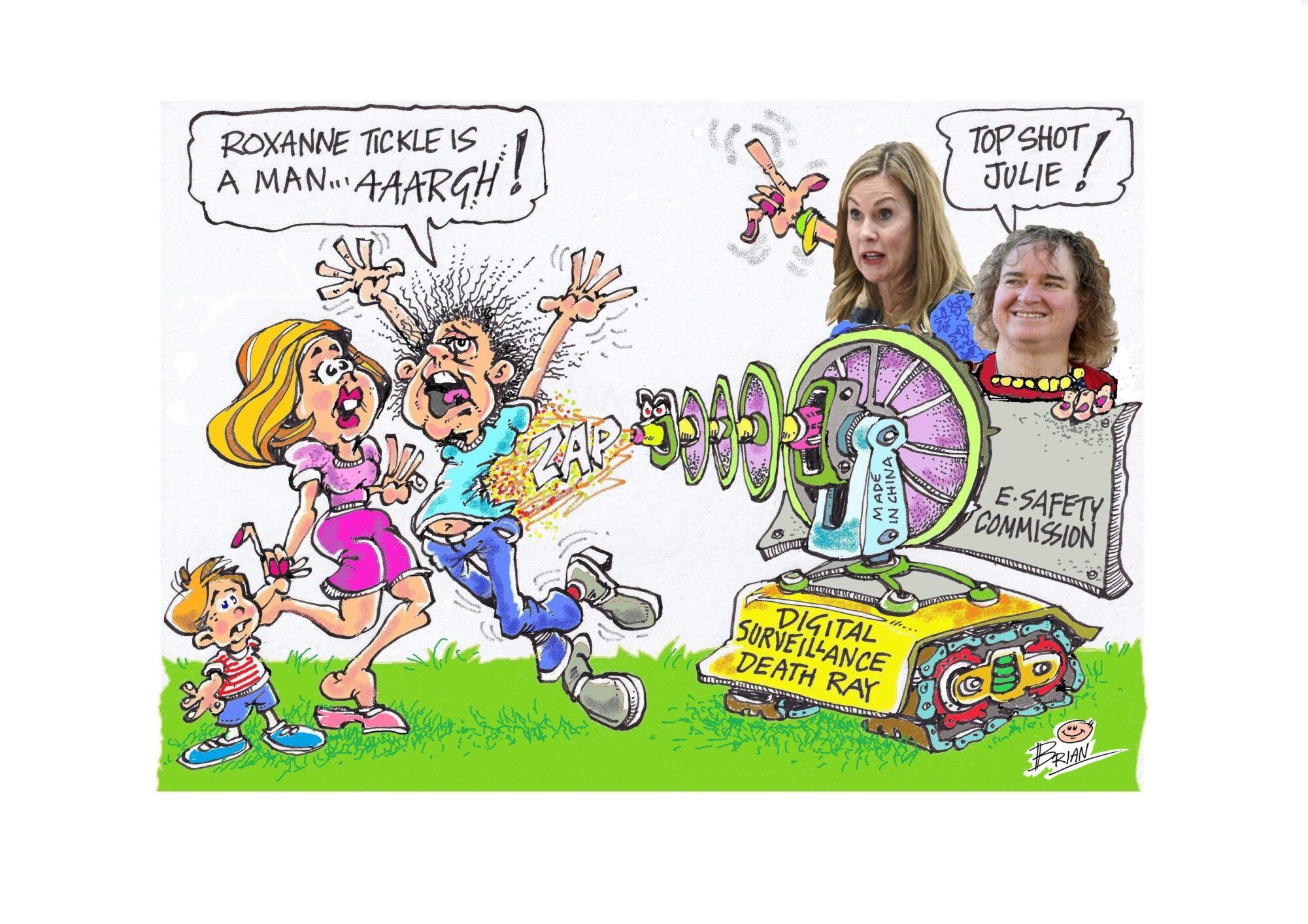
This week in Australia — in independent media circles, at least — all eyes have been trained on Giggle v Tickle.
Currently before a full bench of the Federal Court on appeal, this weeklong hearing will decide far more than its whimsical-sounding title might suggest.
At stake is whether women have the right to female-only spaces, whether Australians are free to distinguish between men and women in their speech and business ventures, and indeed, if Australian law even acknowledges the reality of biological sex.
Less than a decade ago, you would have been laughed out of town for suggesting that a man in makeup and a dress was a woman. Now you can be sued for denying it.
“Progressivism”, it would seem, means progressively banning basic beliefs we all once held in common.
Need further evidence? In June, as reported by The Telegraph, the UK government published training materials branding Brits opposed to mass migration “right-wing terrorists” who require deprogramming by the state.
Meanwhile, in New South Wales, Victoria, and several other states, parents and pastors now risk prison time for helping children overcome unwanted sexual attractions.
Judging by these trends, it’s not unreasonable to assume we’ll soon be punished for disagreeing with climate panic orthodoxy, rejecting Welcome to Country rituals, or affirming the exclusive claims of Jesus.
These radical causes seem unrelated at first glance — until you realise they’re all driven by a quasi-religious worldview that pits oppressed against oppressor, Western civilisation against itself, and governments against their own people.
And while these beliefs were once enforced with the silk glove of political correctness, they are increasingly imposed by the iron fist of digital surveillance.
In fact, digital surveillance is essential if the old beliefs are to be rooted out and replaced with the unbelievable — since the digital world is the only place the global resistance can meet and communicate en masse.
A Decade of Digital Surveillance Down Under
We are not living in Orwell’s world just yet. But the furniture is certainly being arranged for it.
Whether for good motive or ill, consider how far Australia has moved towards digital surveillance in just the last decade:
- 2015: The eSafety Commissioner’s office is established, initially created to protect children from cyberbullying and exploitation, but since expanded into a powerful regulator overseeing online speech, content and platform behaviour.
- 2021: The Online Safety Act is passed, expanding the eSafety Commissioner’s powers to remove illegal content like child abuse and terrorism, and restrict access to harmful material like violence and pornography.
- 2022: The Online Safety (Restricted Access Systems) Declaration is adopted, introducing mandatory age verification to access harmful online content, giving the government its first taste of control over digital gateways.
- 2024: The Digital ID Act is passed, laying the groundwork for a national digital ID system which allows government-accredited entities to verify users, with the provision that participation is voluntary — at least for now.
- 2024: The Online Safety Amendment (Social Media Minimum Age) Act is passed — a world-first law setting a legal minimum age of 16 for social media use, mandating platforms to implement invasive age assurance methods and face up to $50 million in fines for non-compliance.
Of course, protecting young people from online harm is an admirable aim. But Australia’s rush towards digital surveillance assumes that it’s the government — not parents — who are primarily responsible for keeping kids safe online.
Yes, the government has stronger powers than parents. So in theory, tasking Canberra with online safety means all kids are kept safe from online harm — not just those with vigilant caregivers.
But expanding the government’s control over digital gateways is a zero-sum trade — any gain in safety comes at the cost of freedom for all of us, adults included.
The High Cost of the Digital Surveillance State
The rapid expansion of this legal framework is our first tip-off that the Australian government is becoming very comfortable with its growing digital powers.
A second is how Parliament rushed and guillotined the minimum age bill in the final days of the 2024 session, bypassing thorough debate and public scrutiny.
A third piece of evidence that Canberra is consolidating its digital control is the growing power vested in the eSafety Commissioner, Julie Inman Grant, who has unashamedly used her powers to punish conservative viewpoints.
A fourth is the admission, made during a recent Senate estimates hearing, that verifying the age of under-16s by definition means verifying the age of all Australian internet users.
If this is how the Australian government is already behaving, what confidence do we have that the power grab ends there?
Digital ID might be voluntary for federal services now, but how long until it becomes compulsory? How long until it’s used to monitor our behaviour, viewpoints, or carbon footprint to decide which goods and services we’re allowed to purchase?
Who decides the definition of words like “harmful” — and whether the old views on marriage, sex and national sovereignty cause harm and therefore must be censored too?
What’s stopping Julie Inman Grant — and the eSafety Commissioners who succeed her — from enforcing their immense powers selectively, imposing steep sanctions on ideological foes like X owner Elon Musk, while showing leniency to those who share their progressive worldview?
How Digital Surveillance Is Already Hurting Us
Few Australians have stopped to think how these laws are shaping the behaviour of Australians — and the national psyche — simply by sitting on the statute books.
When platforms face $50 million fines for failing to censor certain content, they are incentivised to over-censor — gagging broader conservative views, and limiting Australians’ access to alternative opinions.
When young people can’t access dissenting viewpoints online, their exposure to the news is skewed towards mainstream, government-approved narratives — which in turn reduces their critical thinking, limits open debate in their peer groups, and creates a false consensus.
When Australians are required to show ID to use social media, they are more likely to self-censor — even to say something as conventional as “Roxanne Tickle is man” — for fear of being sued by activists or inviting further monitoring from the government.
If these digital developments were taking place in a different social context, or a different era of history, we’d have less reason to be alarmed.
But as it is, Australians are getting caught in the digital surveillance web at precisely the same time that national pride is being stigmatised, climate dissent demonised, biological reality penalised, and biblical sexual ethics criminalised.
And I’m the villain for pointing this out!
___
Image via Pexels.
7 Comments
Leave A Comment
Recent Articles:

24 October 2026
3.3 MINS
When we ask God, "What is in my hand?", and see our possessions, money and time as seed that God asks us to sow, life becomes simpler.
23 October 2026
6.8 MINS
Hillsong UNITED’s Joel Houston reflects on fame, faith and the burden of ministry, questioning performative Christianity as he seeks a more authentic walk with God.
23 October 2026
13.1 MINS
Tasmania’s proposed conversion practices legislation raises serious questions about religious freedom, pastoral care and whether Christians can freely pray with those seeking to live according to their faith.

23 October 2026
7.7 MINS
Melbourne Catholic Archbishop Peter Comensoli has spoken out clearly against the deadly promises by both major parties in Victoria ahead of the election, drawing a comparison between abortion and capital punishment.
23 October 2026
3.1 MINS
As Western societies grow more hostile, could abandoning Christianity’s moral foundations be contributing to the rise of ideological extremism, political intolerance and violence?
23 October 2026
5.1 MINS
France’s escalating riots expose the dangers of political extremism, antisemitism and radical alliances, offering America a stark warning about the future of Western democracy.
23 October 2026
3.1 MINS
The one who is worthy of it all is awakening his Church to be captivated by him, so that we will honour one another and share his gospel with humility and courage.



Exactly Kurt.
Oh Kurt how could you be so bold as to point out the obvious! However it is comforting to know that God is not surprised by this and He offers a way out. We just need to keep our eyes fixed on Jesus and assist as many as we can to change their gaze to fix on Him too, It is our only hope. Bless you!
Great summary Kurt. Topher Field had a very promising interview with senator Babets rep talking about the senate overwhelmingly disagreeing with Labour’s terrible push. Definitely a praise point because every other party including Greens joined together to oppose the push. here is the link https://youtu.be/Z1CTa4_20zg?si=P5e-B3zg9Yq-QEEV
Its interesting that the government doesn’t trust young people under the age of 16 to watch social media but does trust them under that age to be mature enough to decide that they can change their gender.
…or to vote…
Excellent insights Kurt. Thank you.
Kurt,
Aren’t you supportive of removing LGBTQ books from schools? I feel like that’s a surveillance level nanny state that you rail against in this article.