


Communities Flare at Solar and Wind Plans
In Victoria, the green revolution is running into resistance as the Victorian Government reveals plans to cover 8 per cent of the state – up from 7 per cent in the draft 2025 Victorian Transmission Plan released in May 2025 – with solar panels and wind farms.
The updated 2025 Victorian Transmission Plan proposes six priority renewable energy zones (REZ), a shoreline and offshore zone in Gippsland and a second offshore zone in Western Victoria, plus four new transmission lines to be built over the next 15 years.
Over that time, it is projected that 970 wind turbines and 5.2 million solar panels will be erected within these zones. Up to 500 offshore wind turbines are planned too.
At least, that was the state of play in this most moveable feast at the time of writing (August 22, 2025). The caveats on page four of the updated document give reason to think that the fiddling is far from done:
“The maps at Figures 1, 2, 4, 9, 10, 12, 13, 14, 15, 16, 17, and 19 show locations of proposed renewable energy zones (REZs). Data used to develop these maps was sourced on or before the date of publication and is subject to change.
“The maps at Figures 1, 3, 9, 12, 13, 14, 15, 17 and 20 show proposed alignments for the Western Renewables Link (WRL), Victoria to New South Wales Interconnector West (VNI West), Marinus Link and offshore wind transmission as at the time of publication. These alignments are subject to assessment through relevant planning and environmental approvals processes and, together with the identified locations of in service and committed generation projects, are indicative only.”
These warnings indicate to this writer that the document is largely a publicity exercise for media consumption – few average punters are going to work their way through 134 pages of government verbiage on their own.
The resistance, however, comes as landowners in the path of renewable energy projects are concerned about losing their land, and some are saying that they will lock their gates to builders and contractors.
Ross Johns is president of the Wimmera Mallee Environmental and Agricultural Protection Association. His farm sits within one of the proposed renewable energy zones in the Wimmera, north of Horsham. When the draft Plan was released in May, he said that many farmers were opposed to renewables projects being built on farmland.
“There will be a lot of people locking the gate and excluding construction across their properties,” Mr Johns said. He said that many farmers felt that the Allan Government had disregarded farmers’ rights and the importance of agriculture to the Victorian economy.
This last point is especially important as much of the land within the six development zones is well-cultivated farmland and grazing land, as well as there being extensive tracts of irrigated land. This land will no longer be available or useful for agricultural production. What this will mean for food production scarcely needs to be emphasised.
Ordinary Folk Rising
A rapid evaluation of the land that will be sidelined from productive capacity, presumably forever, reveals that the losses are not trivial. The land in the southwest is very good dairying and sheep grazing land. The Central Highlands hosts mixed farming and wool production. The central north region is largely cropping land, and the Mallee is good for grain and sheep grazing.
The northwest region includes extensive irrigation areas, which are highly productive of horticulture, grapes, cereals, rice and cotton. And South Gippsland, including around Traralgon and Sale and further east, is very productive dairy and grazing land, due in part to its high rainfall.
Smack-bang in the middle of the Grampians Wimmera REZ, north of Stawell, sits the farming community of Marnoo (see map below). The Monday after the finalised Plan was released, farmers and community leaders expressed their opposition to the Plan.
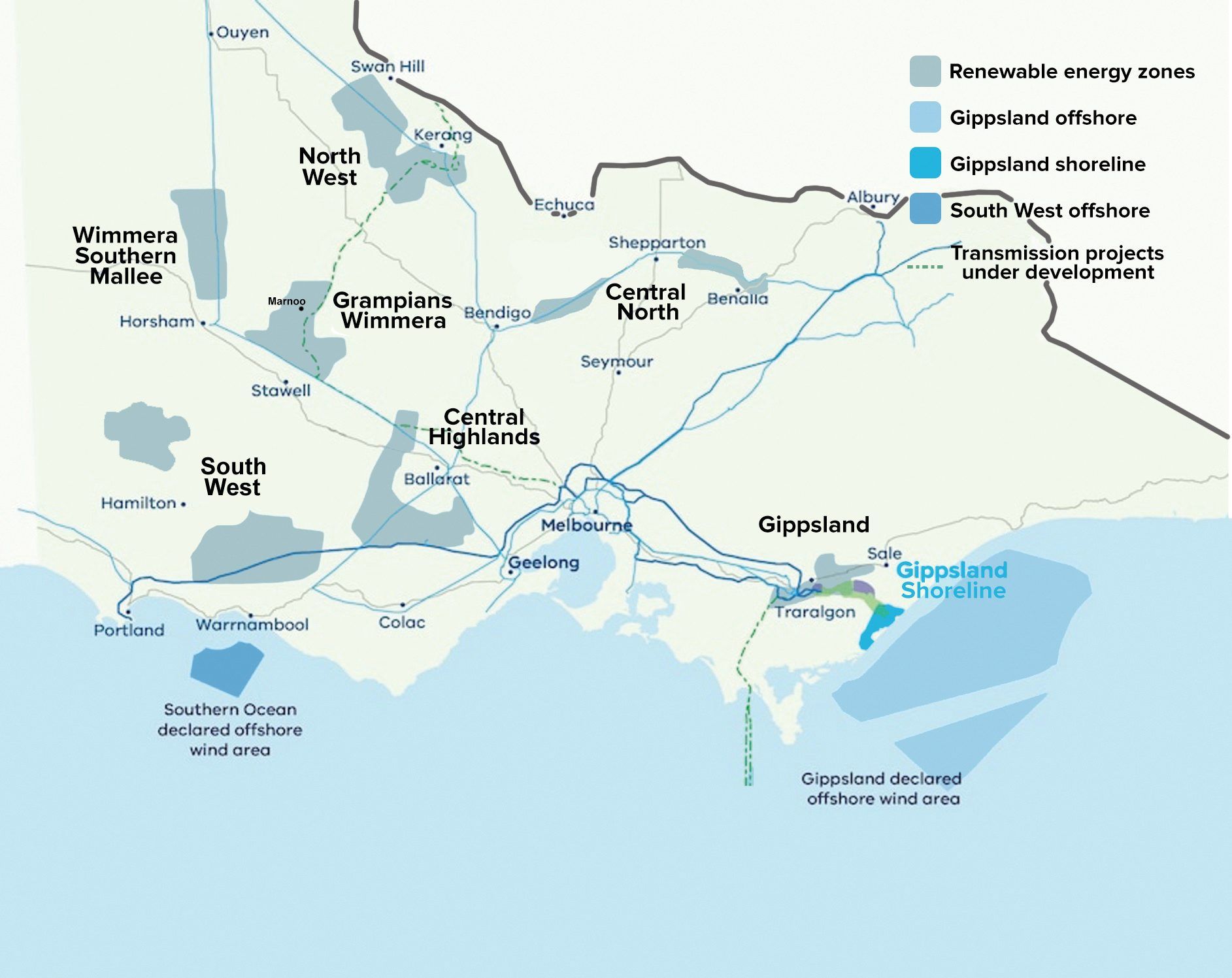
The six priority areas in the Victorian Transmission Plan. (Credit: VicGrid)
The meeting had been intended to be a conversation with Member for Mallee Anne Webster and Nationals Senator Bridget McKenzie. Northern Grampians Cr Murray Emerson was also at the meeting – last month the Council formally opposed the REZ being placed in the shire.
Kanya farmer Marcia McIntyre said it was typical of the Government to say “how much they had listened and how transparent” their process was – but communities knew the truth.
“Our community was determined not to be a REZ from the very beginning – we went to every meeting. We did hundreds of submissions,” she said.
Ms McIntyre said property owners in REZ areas faced land devaluation, disruption to community cohesion, a loss of community members, and increased fire risk and difficulty fighting fires.
Four Scenarios
In 2023, the IPA produced a report entitled “Analysis of Land Use by Variable Renewable Energy Production by 2050“. It evaluated the amount of land that would be required in four scenarios. The estimates are for all of Australia, not just Victoria, though the relative sizes and population densities of the different states mean that, if anything, Victoria will be more greatly covered – literally – by renewable energy than any other state.
Scenario 1: All renewable energy produced in Australia derived from solar power: The land required could amount to 57 million hectares. This is equivalent to over 7 per cent of Australia’s landmass, over 15 per cent of Australia’s agricultural land, or an area equal to eight Tasmanias.
Scenario 2: All renewable energy produced in Australia derived from wind power. The land required could amount to 181 million hectares. This is equivalent to 23 per cent of Australia’s landmass, half of all Australia’s agricultural land, or an area the size of the entire state of Queensland.
Scenario 3: All renewable energy produced in Australia derived from solar and wind power with a greater reliance on solar (at a ratio of 9:1), as considered by Net Zero Australia. The land required could amount to 68 million hectares. This is equivalent to 9 per cent of Australia’s landmass, over 18 per cent of Australia’s agricultural land, or an area equivalent to ten Tasmanias.
Scenario 4: All renewable energy produced in Australia wind and solar in equal proportion: That is, 50 per cent solar and 50 per cent wind power. The land required could amount to 119 million hectares. This is equivalent to 15 per cent of Australia’s landmass, one-third of all Australia’s agricultural land, or an area larger than the size of South Australia.
So, when the Victorian Plan describes the proposed renewable energy zones as “relatively small areas”, it is being a touch disingenuous.
The August iteration of the Plan says:
“The six proposed REZs cover approximately 1.8 million hectares, which equates to 7.9 per cent of Victoria’s total land area of 22.8 million hectares. …
“Under scenario 1, about 9.1 per cent of the combined area of the six proposed REZs would host wind and solar generation in 2040. Those land parcels will not be fully occupied. In fact, approximately 0.04 per cent of Victoria’s total land area is required for the physical infrastructure such as wind turbines, solar panels, access roads and others. …
“VicGrid acknowledges that these estimates are evolving as technology and construction techniques change over time. The estimated area of the land parcels in which onshore renewables will be hosted by 2040 (both inside and outside a REZ) is approximately 230,000 hectares, or about 1 per cent of Victoria’s total land area.” (page 65)
The May draft Plan had said:
“Together, they cover 7 per cent of land area. However, only about 11 per cent of the total combined area of the zones will be needed to host wind and solar projects, equating to less than 1 per cent of the total land area of Victoria. When you consider the project sites will not be fully occupied, just 0.06 per cent of Victoria’s land area will be needed for physical infrastructure such as wind turbines, solar panels and access tracks.”
VicGrid is the entity created by the Victorian Government to carry forward the energy transformation plan. VicGrid chief executive Alistair Parker has repeated the “percentage of a percentage” talking point. He renewed the claim – presumably based on the updated rubbery figures – on August 7:
“I know people can see the map and think there’s going to be renewable energy infrastructure across everything on the map, but that’s absolutely not the case.
“As we go to the next stage, we’ll rule out a lot of areas that looked like they were suitable when we did our initial analysis, but when we talked to local people it didn’t work out as well as we’d hoped.”
His statement, however, clears up nothing. It leaves all Victorians rather in even greater uncertainty, especially those people and communities whose land sits under the 8 per cent blobs hovering like great hoovers over their properties. It also leaves everyone in the dark as to why the 8 per cent has been proposed if only a fraction of a fraction of that is to be employed.
___
Republished with thanks to News Weekly. Image courtesy of Adobe.
4 Comments
Leave A Comment
Recent Articles:
23 October 2026
6.8 MINS
Hillsong UNITED’s Joel Houston reflects on fame, faith and the burden of ministry, questioning performative Christianity as he seeks a more authentic walk with God.

23 October 2026
13.1 MINS
Tasmania’s proposed conversion practices legislation raises serious questions about religious freedom, pastoral care and whether Christians can freely pray with those seeking to live according to their faith.
23 October 2026
7.7 MINS
Melbourne Catholic Archbishop Peter Comensoli has spoken out clearly against the deadly promises by both major parties in Victoria ahead of the election, drawing a comparison between abortion and capital punishment.
23 October 2026
3.1 MINS
As Western societies grow more hostile, could abandoning Christianity’s moral foundations be contributing to the rise of ideological extremism, political intolerance and violence?
23 October 2026
5.1 MINS
France’s escalating riots expose the dangers of political extremism, antisemitism and radical alliances, offering America a stark warning about the future of Western democracy.
23 October 2026
3.1 MINS
The one who is worthy of it all is awakening his Church to be captivated by him, so that we will honour one another and share his gospel with humility and courage.
22 October 2026
2.9 MINS
Victoria Labor’s promise to fund free abortions has drawn a forceful response from Presbyterian leaders, raising profound questions about unborn life, government priorities and Australia’s moral direction.



By the time these “renewables ” get up and running, most Victorians will have run out of Victoria .
What I think is a good idea is to place a solar panel and wind farm every property owned by the every politician, lobbyist and bureaucrat who is pushing this “energy zone” agenda.
Love this idea!
Top suggestion !!