


Why Christians Should Celebrate the Biblical Feasts
What relevance could a Jewish Feast have for Christians today?
This is a good question. If we delve a bit further, we find the so-called Jewish Feasts, as recorded in our Bible, are actually called Feasts of the Lord. Leviticus 23:1-2 says:
The Lord said to Moses, “Speak to the Israelites and say to them: ‘These are my appointed festivals, the appointed festivals of the Lord, which you are to proclaim as sacred assemblies.’”
Jesus celebrated these feasts, and so we will be drawn closer to Him if we search the scriptures to find out why Jesus felt they were so important.
Salvation History
There are seven ‘appointed times’ and each of them points to the fulfilment of the rescue plan God ordained from the beginning of time. He knew, right from the Garden of Eden, that given free will, we humans would choose to disobey Him and go our own way.
The whole of scripture describes the cycle of falling away and returning, with the only way to break the cycle being the ultimate sacrifice of God Himself coming to rescue us, as in human form, He sacrifices Himself on the cross, to take the punishment for our sins.
The seven appointed times are:
- The Sabbath – a time of rest. A time to remember the deeds of the Lord, to worship and meet together. Jesus came to be our rest. He invites us to accept the peace, shalom, he offers. As we are exhorted in Hebrews 4:7, “Today if you hear His voice, do not harden your hearts.” He calls us to rest in Him.
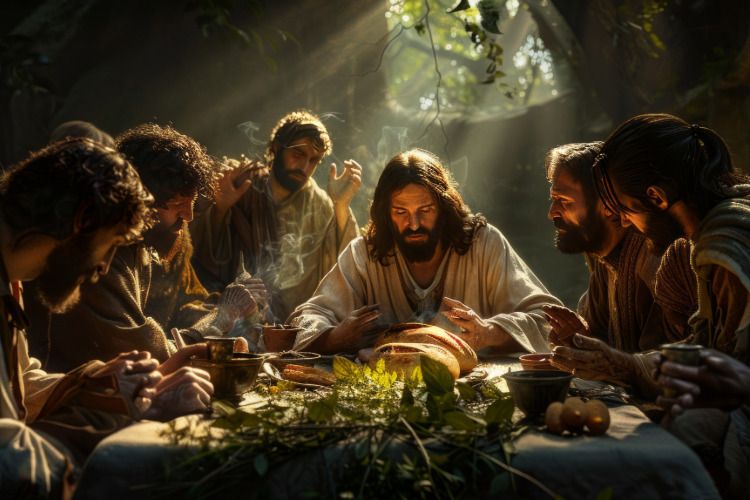
- The Passover. This Festival celebrates how the Lord rescued the Israelites from slavery in Egypt, formed them into a nation, and covenanted to be their God. In the Passover ceremony, the plagues of Egypt are re-enacted, and the deliverance from slavery is celebrated in a family meal. At the meal, three matzahs [unleavened bread] are placed on a plate. The father takes the middle matzah and wraps it in a napkin. It is then hidden somewhere in the house. The children are invited to find it. This ensures the children are an active part of the ceremony. When the matzah is found, and the child who found it is duly rewarded, the matzah is broken, and a piece is given to each participant. This simple activity neatly describes Jesus – [Father, Son and Holy Spirit – the middle Matzah being the Son] – who is buried [hidden] – then rises [found] – and gives his broken body.
- Feast of Unleavened Bread. This is celebrated following Passover. When the Israelites were rescued from Egypt, they had to leave in a hurry. There was no time for the bread needed for the journey to rise. In scripture, leaven [yeast] is often pictured as sin. In this festival, for a whole seven days, no yeast must be consumed. It is a stark reminder of the sin that so easily entangles us (Hebrews 12:1). We must be intentional to throw it out.
- Firstfruits. This was to give thanks for the harvest, and a command to bring the first of the harvest as an offering to the Lord. Jesus was named by St Paul as the ‘firstfruits of those who have fallen asleep’. [1 Cor 15:20]. Jesus’ resurrection happened on this Festival, and just as the firstfruits of the harvest anticipated the full harvest, so Jesus’ resurrection anticipates the coming resurrection for all who believe in Jesus.
- The Festival of Weeks or Pentecost. This occurs fifty days after Passover. It celebrates the giving of the Torah [law] to Moses on Mt Sinai and the giving of the Holy Spirit, which enabled Christians to live by a new ‘law’. On this day, the Christian church was born and entered a New Covenant, empowered by the Holy Spirit, which replaced the Old Covenant given at Mt Sinai.
- The Feast of Trumpets. This marks the start of the ten days of consecration and repentance leading to the most sacred day of the year, the Day of Atonement, which reminds us of Jesus’ atoning sacrifice. The blowing of the trumpets signals Jesus’ return. It is a time to clean the house, take stock of where we are in our Christian walk, and humbly prepare our hearts to receive His forgiveness and draw closer to Jesus. He is coming back!
- The Feast of Tabernacles. In this Festival, the people remember how the Lord rescued them from slavery in Egypt, and they dwelt in temporary shelters in the desert. The Lord ‘tabernacled’ with them, in the Tent of Meeting and later in the Temple. Then Jesus came to rescue us all from the slavery of sin and set us free to live in harmony with Him. The book of Zechariah prophesies a time when all nations will go up to Jerusalem to worship the Lord at the time of the Feast of Tabernacles, and even Gentiles are invited. [Zechariah 14]
Throughout scripture, God’s rescue plan speaks about the Righteous One who will come. Most explicitly in Isaiah 53, where it details how this Righteous One will suffer, giving up His life as a sacrifice for our sin, that we might be reconciled to our Heavenly Father.
Christ-Centred
Interestingly, if you attend the Feast of Tabernacles in Jerusalem, even today, you will see all over the city the temporary shelters or sukkahs that the Jews have erected. They are made on balconies, street corners, and long shady avenues.
As the Jews celebrate their rescue from slavery, the Lord invites us to also celebrate our rescue through Jesus. He gives us His Holy Spirit, which comes to ‘dwell’ in this ‘earthly tent’, as St Paul calls it.
By no coincidence, St Paul, who gave us most of the books of the New Testament, was a tentmaker by trade. In 2 Corinthians 5, he speaks of his body being an ‘earthly tent’. If our ‘tent’ is destroyed, we will be given a heavenly body. In the meantime, this tent is the dwelling place of the Holy Spirit.
This year, the Feast of Tabernacles is from 6-13 October. It is extraordinary that after two years of war, a peace treaty was signed in the middle of this Feast. Nothing happens by chance. Perhaps you can see a deeper significance in the timing of this peace agreement between the enemies of God and His chosen people.
While celebrating the Feasts of the Lord should not become a ritual, each of the Feasts points to Jesus, and celebrating them opens an opportunity to draw closer to Him, the Righteous One, our Rescuer, Saviour and Lord.
___
Image courtesy of Adobe.
12 Comments
Leave A Comment
Recent Articles:

27 October 2026
1.5 MINS
Labor’s Digital Duty of Care Bill threatens free speech, empowers covert online surveillance, and imposes potentially burdensome regulations on Australian businesses.
27 October 2026
10.3 MINS
As Tasmania and Western Australia consider conversion therapy bans, a former LGBT+ ministry leader warns of threats to religious freedom, personal choice and Christian discipleship.

27 October 2026
4.9 MINS
Nine Christians have been killed in a terrorist attack on a Jordanian church, prompting fierce condemnation, demands for justice and renewed concerns about religious persecution.
27 October 2026
3.6 MINS
For 25 years, the Mount Moriah Trust has supported struggling Christians across the Holy Land, bringing practical assistance, encouragement and hope to believers facing hardship and persecution.
27 October 2026
3.1 MINS
As the disciples discovered through a huge haul of fish, we can trust Jesus for a net-breaking, boat-sinking catch of people.
26 October 2026
3.2 MINS
Following Paul's example in Ephesians 1, let us pray for the Father to open the eyes of our hearts so that we may grasp the hope of his calling, the riches of his glorious inheritance in the saints, and the greatness of his power towards us who believe.

25 October 2026
4 MINS
Prayer is active partnership with God, and he is awakening his body to prayer, not by might or by power, but by his Spirit.



Does this mean we should also remember/keep the Sabbath on a Saturday, which Jesus observed?
I assume that most Christians would say they do keep the 4th Commandment by observing on a Sunday.
The Fourth Commandment is “Remember the Sabbath day, to keep it holy”.
I totally agree. We have departed biblical Christianity and chosen tradition and substitute days, rather than those commanded in the Scripture. We must seek to restore the Saturday Sabbath and biblical festivals and be pronomian in our our hermeneutic. I explore this approach on my Substack, ‘The 2nd Reformation with Dr. Szumskyj’. Christ observed the festivals and they were centred on Him; they were neither abolished or replaced. God does not change, nor does His holiness, or His standard for what is holy.
I don’t believe it is about obedience. We’re not under any law. But as far as bringing Christianity back to its Jewish roots, and having a richer connection to the Word which we are constantly reading and engaging with, it makes so much sense for Christians to celebrate the feasts, but put a distinct Christian twist to them: to bring out the point that these are “shadows” of which Christ is the full reality.
I believe our children would respond more positively to OT reading and study if more of it intersected with their lives throughout the year AND pointed them to Christ, the promised Messiah.
Totally agree Teri. Helps us appreciate and love Jesus all the more by digging up more treasure about him.
This is false. During the establishment of the early church, the Judaizers constantly sought to draw Christians back to the Old Testament “ceremonial law”. Much of the New Testament was written to establish the church and exhort Jewish believers to be firmly ground in the FINISHED work of Christ on the cross & to establish Gentile believers in their freedom in Christ, exhorting them NOT to be draw back towards the ceremonial aspects of the Old Testament law. Yes Jesus did celebrate these festivals, with the most obvious reason being, they were still in effect until his death burial and resurrection. At no point did Jesus either celebrate or command his disciples to do so after the resurrection. At the first major church council in Acts 15 we also see NO such command when that is precisely the issue in question. Yes Paul did at times take part in these celebrations — because as in his words, he sought to be a “Jew to the Jews & a Roman to the Romans — in order to win some”… even Paul’s own acts of “joining in” do not in any way point to any benefit to the believer in terms of their sanctification. Far from it – much of the Pauline corpus in the New Testament points to him warning the believers not to be drawn by the Judaizers. To encourage Christians into some form of “following the celebrations or taking part in them – especially the claim that this would have some benefit to them or their sanctification, is actually “contra” the very heart of the Christian gospel – especially the Protestant “Justification is by faith alone in Christ alone”. It draws peoples hearts back to the “shadows” of the Old Testament and thereby denies the gospel itself. I am not suggesting the people who do this are not sincere or do not love Christ, but doctrine matters. Read the entire letter to the Hebrews in a single sitting & ask yourself, to whom was this firstly written, for what purpose was the letter written, what is the central message and what should we as believers of Christ 2 millenia take away from it today. I think the central message of the letter is the finished work of Christ on the cross and it’s encouraging the Jewish persecuted believers to stand firm on that and not be drawn back into the types and shadows of the Old Testament. Stand firm on the word and do not be moved from that is my encouragement to you. This does not mean we should not honour and love our fellow Jews and not be earnestly praying for the peace of Jerusalem and the conversion of the Jews. That however is only going to happen by the means God has chosen – by his Son Jesus and his finished work on the cross for all of humanity.
Just an additional comment to clarify some context by the last commenter. Christians are not grafted into Leviticus 23. According to Romans 11 we are grafted into the vine. The question therefore arises, who is the true vine. According to John 15, Jesus is the true vine “I am the true vine, and my Father is the vinedresser.”. We are Christians are not grafted into “OT Judaism” – we are grafted into the true Israel. Jesus succeeded where all of Israel of old had failed. (as per Mt 2:13-15) {for more: https://learn.ligonier.org/devotionals/jesus-true-israel) Jesus was during his life sent only to the lost sheep of the house of Israel, but to over emphasis this is to distort that Jesus is the Son of God and the savior of the whole world, Jew and Gentile alike. Take Colossians 2:16-23 for one of many examples of Paul (himself a Jew) who exhorts the church NOT to do what this post is — perhaps innocently so — exhorting Christians to do. The jews need the gospel just like gentiles do. In order to win Jews, some believers who have close connection to them can “for the sake of winning Jews” take part in their ceremonies, but that is not the same thing as advocating Christians to do so for some kind of worship experience or their sanctification or something that Christians “should do” — even if it is claimed we should not do so under compulsion. The New Testament knows no such command or practice and in fact advocates for the very opposite. This last post attempted to “ground” the requirement of these celebrations in the idea that we are grafted into Leviticus. As I said, the New Testament no where makes this claim. We are not grafted into Old Testament Judaism/ceremonial laws. The ceremonial laws are a shadow & type of the work of Christ, they are done away with given that Christ was the perfect and FINAL sacrifice. To claim we are meant to celebrate the old — is tantamount to claiming Jesus did not actually do what he did, as firm as that may sound, it is just that.
The comments by Stephen Forkin is very sad. The idea that there are ceremonial laws is one of the many traditions of men.
Teri, sorry I am late coming to the party, but here is my two pennyworth! Your teaching on the background of the Jewish feasts is most encouraging and uplifting. I don’t feel ‘dragged’ towards the Jews by Judaizers, but rather I sense a growing fraternal bond between believing Jews and Christians. I sense a huge debt of gratitude to the Jews of old who carried the faith down the centuries. If the Jews had lost their faith and if the Jew Jesus had not come…..
Thank you so much for all your comments. I am excited that my article evoked such a strong response, as this is something many have obviously wrestled with. I am not saying we should become Jews or even adopt Jewish customs and traditions, rather my experience in celebrating the Feasts as a believer in Jesus, our Messiah, who came from the Jewish tradition, is that it has enriched my faith. The way the Bible is written presupposes many Jewish traditions and cultural norms. I believe we are enriched by being exposed to these and allowing the Holy Spirit to interpret the truth of the gospel in a deeper way.
Did you miss out the Day of Atonement by purpose?
I agree with you, Terri. Learning the richness of the Feasts (appointed times) has strengthened my faith and really “wowed” me. Yes, they are foreshadows (thus, my astonishment), but Jesus has not fulfilled them all—yet! The last three (fall) feasts are foreshadows of His return. We deprive ourselves when we refuse to learn these things and then teach others. It also enhances my ability to witness to those of the Jewish faith.
By the way, I have been deeply studying the feasts for about 5 years, and I have yet to find the bottom of learning and cross-referencing with the New Testament. The more I dig, the more I find. God is amazing!