


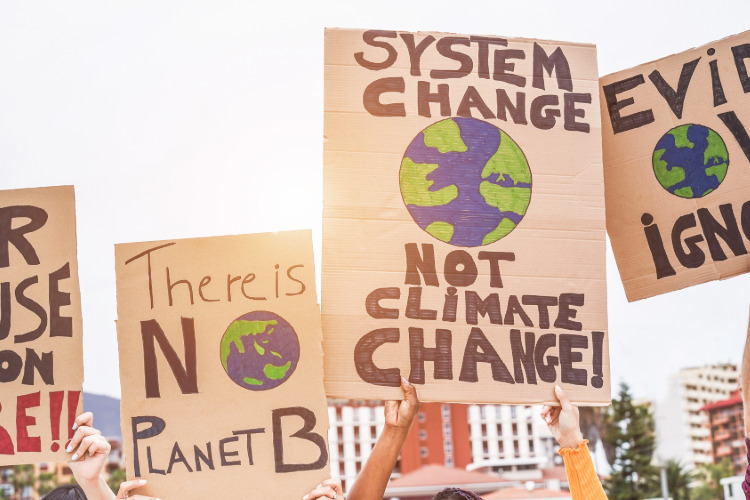
Bill Gates is No Longer a Climate Catastrophist – And Here’s Why
Bill Gates now warns that climate catastrophism clouds judgment. While climate change is real, focusing solely on emissions risks harming the vulnerable. A reasoned, holistic approach, including economic growth and adaptation, saves lives.
Bill Gates, the author of the book How to Avoid a Climate Disaster, is no longer a climate catastrophist.
In a recent blog post written for delegates ahead of the COP30 Summit (happening this week), he writes:
There’s a doomsday view of climate change that goes like this:
In a few decades, cataclysmic climate change will decimate civilisation. The evidence is all around us—just look at all the heat waves and storms caused by rising global temperatures. Nothing matters more than limiting the rise in temperature.
He continues:
Fortunately for all of us, this view is wrong. Although climate change will have serious consequences—particularly for people in the poorest countries—it will not lead to humanity’s demise. People will be able to live and thrive in most places on Earth for the foreseeable future. Emissions projections have gone down, and with the right policies and investments, innovation will allow us to drive emissions down much further.
(And it’s true: while the latest IPCC report says that climate change will have an impact, it stops well short of saying it’s an existential threat to humanity).
Now, climate change is one of those issues that arouses strong emotions, including among Christians. Some argue that unless we head to net-zero emissions, we’re being irresponsible and immoral. Others agree that climate change is an issue, but argue for a more moderate approach, while yet others question IPCC reports altogether.
But regardless of where you sit on this issue, we Christians, who are commanded to care for the planet, the poor and the vulnerable, should take note of Gates’ argument.
Here’s why:
1) Climate change is an issue, but it won’t be dealt with effectively by catastrophising its effects. We need a better, more reasoned conversation that considers all relevant factors – not just emissions.
According to Gates, the climate change conversation has been overtaken by those who see it as an existential threat to humanity. And it’s hard to disagree with him.
From the United Nations platforming Swedish teenager Greta Thunberg and her catastrophist ‘How Dare You’ speech, where she said we were ‘in the beginning of a mass extinction’. To schools across the West, drinking Thunberg’s Kool-Aid, encouraging their students to take part in ‘School Strike 4 Climate’.
I saw this alarmism first-hand at the 2022 Byron Bay Writers Festival, where several young climate activists told the audience that unless Australia takes urgent action to cut emissions, we’re doomed (considering Australia only makes up 1% of global emissions, I was left wondering how cutting our emissions would make any difference to the climate).
But this catastrophising affects real people. For example, a 2020 survey revealed that one in five UK kids were having nightmares about climate change. And there are growing numbers of men sterilising themselves to not bring children into a world affected by ‘the climate crisis’.
Climate catastrophism is also affecting our democratic process, which relies on discussion and reasoned debate. If you’ve ever tried questioning whether renewable energy is reliable enough to provide for a nation’s needs, chances are you would have been called various pejorative names (‘climate denier’), rather than have people engage in reasonable discussion.
But reasonable discussion is precisely what we need. Because, as Gates points out, policies have consequences – especially for the poor.
2) Bad climate policies that are focused on reducing emissions above all else will increase poverty across the world, making it harder for people – especially vulnerable people – to adapt to climate change
The climate-catastrophist view of climate change often leads to a loss of perspective.
And because of this loss of perspective, Gates argues, sometimes human welfare takes a backseat to lowering emissions, with dire consequences. He cites an example from a few years ago, where the government of one low-income country set out to cut emissions by banning synthetic fertilisers. Farmers’ yields plummeted, there was much less food available, and prices skyrocketed.
The country was hit by a crisis because the government valued reducing emissions above other essential things.
So, what’s a better way forward than focusing solely on reducing emissions?
3) The best defence against the impact of climate change is climate adaptation. And the best way to help countries adapt is to lift them out of poverty. But you can’t lift countries out of poverty with expensive and unreliable renewable energy.
According to Gates, a few years ago, researchers at the University of Chicago’s Climate Impact Lab ran a thought experiment: What happens to the number of projected deaths from climate change when you account for the expected economic growth of low-income countries over the rest of this century? The answer: It falls by more than 50 per cent.
Since the economic growth projected for poor countries will reduce climate-related deaths by half, it follows, argues Gates, that faster, more expansive growth will reduce deaths by even more. And economic development is closely tied to public health. So the faster people become prosperous and healthy, the more lives we can save.
Again, this economic factor seems to be missing from the climate conversation – at least in the media and popular culture.
And we see this in the actions of Western governments in Australia and Europe, which seem bent on taking steps that might reduce emissions, but weaken economies – and thus reduce our ability to adapt to climate change.
Here in Australia, our Federal Government is determined to drag the entire Australian population through an experiment that has never been tried anywhere in the world: getting us to generate 80% of our electricity from unreliable and expensive renewable sources, namely wind and solar.
And why?
Because their focus is on reducing emissions above other considerations, such as energy security and economic viability.
But in countries ahead of us in the renewable journey, this is already having consequences for real people, especially the vulnerable. Journalist Chris Uhlman recently summarised some of these consequences:
-
Across Europe – that has gone down a renewables path – electricity utilities and manufacturers are warning that the continent’s rapid shutdown of coal and nuclear power plants has left its grids fragile and its industries crippled by record power prices.
-
Germany has the highest household electricity costs in the world.
-
Factories from Italy to Ireland are scaling back production because they cannot afford the cost of (renewable) energy.
Western Europe – and soon to be Australia is in the process of ‘replacing predictable generation with a punt on the weather and calling it progress,’ says Uhlmann.
We manage what we focus on: if we focus on human wellbeing, we’ll do a much better job of caring for the vulnerable than if we focus solely on reducing carbon emissions.
Will climate change have an impact on our world?
According to many scientists, yes.
But as Christians, we’re tasked with looking after this creation and our neighbour: we need to have a holistic view of all the relevant factors, not just carbon emissions.
Which means we should have conversations about climate change, energy, and the impacts it has on the vulnerable without the name-calling or catastrophising. Even as we might disagree and land on different ways of addressing climate change.
And we can thank people like Bill Gates, who help bring much-needed perspective to the climate discussion.
___
Republished with thanks to AkosBalogh.com. Image courtesy of Adobe.
7 Comments
Leave A Comment
Recent Articles:
23 October 2026
6.8 MINS
Hillsong UNITED’s Joel Houston reflects on fame, faith and the burden of ministry, questioning performative Christianity as he seeks a more authentic walk with God.
23 October 2026
13.1 MINS
Tasmania’s proposed conversion practices legislation raises serious questions about religious freedom, pastoral care and whether Christians can freely pray with those seeking to live according to their faith.
23 October 2026
7.7 MINS
Melbourne Catholic Archbishop Peter Comensoli has spoken out clearly against the deadly promises by both major parties in Victoria ahead of the election, drawing a comparison between abortion and capital punishment.
23 October 2026
3.1 MINS
As Western societies grow more hostile, could abandoning Christianity’s moral foundations be contributing to the rise of ideological extremism, political intolerance and violence?

23 October 2026
5.1 MINS
France’s escalating riots expose the dangers of political extremism, antisemitism and radical alliances, offering America a stark warning about the future of Western democracy.
23 October 2026
3.1 MINS
The one who is worthy of it all is awakening his Church to be captivated by him, so that we will honour one another and share his gospel with humility and courage.
22 October 2026
2.9 MINS
Victoria Labor’s promise to fund free abortions has drawn a forceful response from Presbyterian leaders, raising profound questions about unborn life, government priorities and Australia’s moral direction.



In the 1700s before The Industrial Revolution, the River Thames, London froze over on about 3 occasions. The ice was so thick people rode back and forth to the other shore, erected booths on it , and cooked food and partied on it in their hundreds. There are paintings of these activities. Shown on SBS.
Bill Gates does not care about you, the climate, the environment or anyone or anything other than himself.
He is a psychopathic man hell bent on obtaining for himself as much wealth and power as possible. I’m sorry to disagree, but everything he has ever said or done, either directly or indirectly attests to that.
The only reason he is speaking now about the climate as he is, is because it suits his agenda, not because of any seeming altruistic motives.
He still continues to invest in and promote every anti-human, anti-life and ungodly agendas he can.
He is the living embodiment of one who gains the whole world but forfeits his own soul.
I believe you are correct Paul
Yes, focus on the wellbeing of people (including the poor and vulnerable) but also on caring for creation.
I cannot understand how the raping of our land to enable renewables can in any way be justified. And it is completely against our remit as God’s people.
Have you seen the permaculture projects restoring vast swathes of land in the Southern Sahara, in river deltas and bringing rivers back to life again— not by investing vast sums of money and technology but by people working with the land. (And God)
Have you seen the gifting of land by the Chad government to Sudanese refugees and their work making arid useless land able to sustain life and community? (https://youtu.be/jfiH9T-iR3E?si=VDtCn7_P61tn7wy9)
While the people who have massive power and money and have been shaped by the business world determine what is good for us we will be going in the wrong direction.
God shows us a picture of His plan for human life on earth when He took His people into the promised land and in the redistribution of wealth every fifty years so that everyone would have enough.
I think there are so many ways of defeating climate issues that affirm life ,community and quality of life and restore creation if we would only look and see.
To Paul: Jesus said, Do not judge.
Thank Bill Gates? Seriously!? Gates who under the guise and deception of “vaccinations” sterilised who knows how many thousahds of girls and women in Africa! Amongst other deception.
You tell me to thank this godless anti-christian! You are delusional.
I agree with Merril Lee. look after the needs of people in sustainable ways. Wind farms will not help us – Australiia does have wind blowing all the time> Th e opposition at election time squibbed on a much better way re energy _ use our resources – Nuclear, coal and gas ( the cleanest in the world) instead of sending it to china ( whose govt doesn’t give a damn re climate) who want to dominate us. Look after the People and those doing a good job at keeping us alive and well – farmers, fishers, medicos teachers families. Make it possible for families to look after their own little ones, instead of them being farmed out to child-care centres ( separating children from parent’s supervision and good nurturing) … etc etc… we are separating families, reducing our donki di Ozzie population etc to our great detriment!!!!