


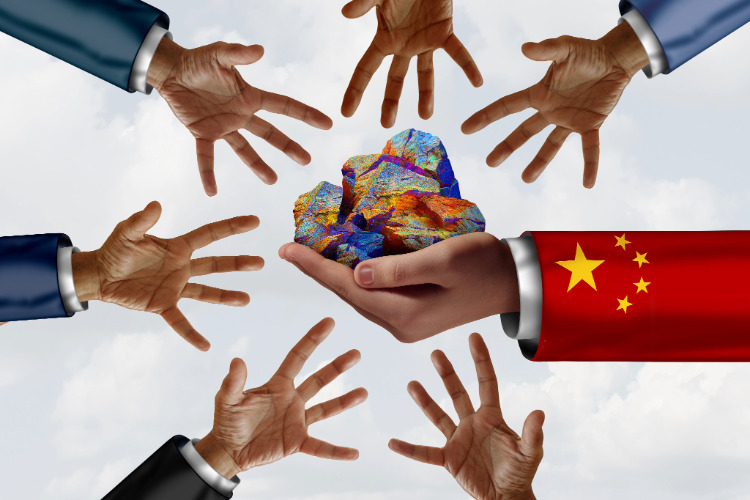
China’s Control of Rare Earths Will Last Years
Despite bold political claims, experts warn China’s dominance over rare-earth metals will endure for decades, leaving Western economies dependent on Beijing for critical defence, energy and electric vehicle supply chains.
Despite a flurry of announcements by political leaders, including U.S. President Donald Trump and Australian Prime Minister Anthony Albanese, that China’s control of strategic rare-earth metals can be ended quickly and easily, experts in the field have made gloomy predictions that China’s effective monopoly in these metals, as well as others like lithium and nickel, will last many years.
These predictions come in the context of the fact that, for decades, Western economies have moved from manufacturing into service industries like finance, retail, health, transport and welfare, and have shifted their manufacturing to developing countries and China. Now China has the second-largest economy in the world, and has turned itself into the world’s largest producer of rare earths.
Critical Components
Rare-earth metals are a vital component of defence systems, including military aircraft, drones and naval ships. The extent of defence use of these metals is often a closely guarded secret. However, they are also critically important for the motor industry, particularly electric vehicles and hybrids, where the impact can be documented.
Neodymium magnets, the most common type of rare-earth magnets, were first developed in the 1980s in the United States and Japan, to replace the high-cost samarium-cobalt permanent magnets that had been developed earlier.
They are currently the strongest type of permanent magnet commonly available, more than 10 times more powerful than conventional magnets, and are widely used in electric motors and generators, wind turbines, smartphones, cordless tools, hard disk drives and magnetic fasteners.
With the addition of other rare-earth metals, they are used in space technologies because they retain their magnetic strength even in the extreme temperatures of outer space.
Rare-earth elements lie behind many features of today’s motor vehicles, with rare-earth magnets inside the small electric motors that power mirrors, seats, pumps, and sensors. A typical petrol or hybrid car contains about 100 grams of rare-earth magnets, scattered across dozens of small systems.
But in electric vehicles, magnet demand skyrockets. Each EV typically contains three to five kilograms of neodymium magnets, largely in the electric motor that converts electricity into motion. As of 2025, an estimated 94 per cent of EVs use permanent-magnet architectures, due to their efficiency and power density.
Process Domination
Over the past three decades, China has expanded not only the mining of rare earths, but also its processing, right down to the production of electromagnets.
At first, rare earths were mined in hundreds of small-scale mines in China. Then, in 2011, the Chinese Government forcibly amalgamated them into six government-owned operations, dubbed the Big Six.
These corporations span the mining and processing of ore bodies, mineral extraction, purification and production of metal oxides, and then the production of rare-earth magnets.
Rare Earth Exchanges (REEx), an independent media and intelligence platform that covers the rare-earth and critical mineral industries, said that, in 2025, 70 per cent of global rare-earth mining occurred in China, which also had 85 per cent of global refining capacity, and about 90 per cent of world production of rare-earth alloys and magnets.
There is a two-tier centrally controlled pricing structure: a low-cost one for Chinese manufacturers; and higher-cost sales to overseas buyers.
The issue came to a head in 2025 when President Trump imposed high tariffs on Chinese manufacturing exports, in response to what he said were Beijing’s unfair trading policies.
Unlike Trump’s megaphone diplomacy, China’s response was measured and swift. It imposed restrictions on exports of seven rare-earth elements, later increased to 13. The restrictions immediately impacted American, Japanese and Korean car manufacturers, with reports of disruptions to production at Ford, Hyundai and Toyota plants.
Responding to international pressure, Beijing announced a 12-month deferral to planned restrictive exports, but export controls remain in place, and could be reinstated at any time.
One immediate consequence has been the announcement by many countries that they will encourage the development of rare-earth mines and processing plants. The U.S. and Australia jointly established a multibillion-dollar package of critical mineral financing and commitments. Europe’s Critical Raw Materials Act is pushing for domestic magnet production. Renault has begun recycling from France’s end-of-life vehicles, though recovered volumes remain small.
Because of long lead times, however, none of these measures will significantly reduce China’s control over the supply of rare earths for a decade or more.
In the meantime, China is expected to keep export prices just below the level at which it becomes economic to manufacture rare-earth elements overseas, maintaining Chinese control over the industry for as long as possible – certainly for the next 10 years or more.
___
Republished with thanks to News Weekly. Image courtesy of Adobe.
2 Comments
Leave A Comment
Recent Articles:

23 October 2026
13.1 MINS
Tasmania’s proposed conversion practices legislation raises serious questions about religious freedom, pastoral care and whether Christians can freely pray with those seeking to live according to their faith.
23 October 2026
7.7 MINS
Melbourne Catholic Archbishop Peter Comensoli has spoken out clearly against the deadly promises by both major parties in Victoria ahead of the election, drawing a comparison between abortion and capital punishment.

23 October 2026
3.1 MINS
As Western societies grow more hostile, could abandoning Christianity’s moral foundations be contributing to the rise of ideological extremism, political intolerance and violence?

23 October 2026
5.1 MINS
France’s escalating riots expose the dangers of political extremism, antisemitism and radical alliances, offering America a stark warning about the future of Western democracy.
22 October 2026
2.9 MINS
Victoria Labor’s promise to fund free abortions has drawn a forceful response from Presbyterian leaders, raising profound questions about unborn life, government priorities and Australia’s moral direction.

22 October 2026
4.7 MINS
Western Australia’s proposed anti-discrimination overhaul has sparked warnings from Christian leaders that religious freedom, parental choice and faith-based schools’ ability to uphold their beliefs are at risk.
22 October 2026
5 MINS
Queensland’s newly released abortion statistics reveal the scale of the state’s abortion toll, prompting renewed calls for political accountability, protection of unborn life and an end to parliamentary silence.



China has acted Smart, while ,as usual ,the bickering , infiltrated and corrupt West has been asleep at the wheel .Australia , which has huge reserves, should be manufacturing but lacks the brains or govt. will to do anything but dig holes in the ground. We could have been rich, respected, instead our govts .for years have spent all their time indulging in nonsense, wasting money and sending millions of dollars to Overseas Causes. In the 1960s Australia was a dynamic country with scientific inventions , exporting from Adelaide a scientist I knew to work for NASA, and, a special plane to take another (Goddard, also from Adelaide ) to NASA whenever they had a problem. It was our Golden Age. What went wrong ? Self-serving politicians were elected. Today our Education System is a joke.
Some predictions of men come to pass, some predictions of men never eventuate.
This is a prediction of man. No man sees the future. Only God and He can turn things on their head in the blink of an eye.
This from scripture concerning thinking on future events.
Mathew 6 25-34
“Therefore I say unto you, Take no thought for your life, what ye shall eat, or what ye shall drink; nor yet for your body, what ye shall put on. Is not the life more than meat, and the body than raiment?
Behold the fowls of the air: for they sow not, neither do they reap, nor gather into barns; yet your heavenly Father feedeth them. Are ye not much better than they?
Which of you by taking thought can add one cubit unto his stature?
And why take ye thought for raiment? Consider the lilies of the field, how they grow; they toil not, neither do they spin:
And yet I say unto you, That even Solomon in all his glory was not arrayed like one of these.
Wherefore, if God so clothe the grass of the field, which to day is, and to morrow is cast into the oven, shall he not much more clothe you, O ye of little faith?
Therefore take no thought, saying, What shall we eat? or, What shall we drink? or, Wherewithal shall we be clothed?
(For after all these things do the Gentiles seek:) for your heavenly Father knoweth that ye have need of all these things.
But seek ye first the kingdom of God, and his righteousness; and all these things shall be added unto you.
Take therefore no thought for the morrow: for the morrow shall take thought for the things of itself. Sufficient unto the day is the evil thereof.”
James 4 13-15
“Go to now, ye that say, To day or to morrow we will go into such a city, and continue there a year, and buy and sell, and get gain:
Whereas ye know not what shall be on the morrow. For what is your life? It is even a vapour, that appeareth for a little time, and then vanisheth away.
For that ye ought to say, If the Lord will, we shall live, and do this, or that.”
God tells us above that predicting just days ahead is not wise let alone decades.