



Australia: Support Manufacturing Businesses of National Importance
by Craig Milne
A manufacturing firm is of national importance if its products supply an industry of strategic economic significance. The firm may possess special knowledge, capabilities of considerable technical difficulty, accumulated over a lengthy period, difficult to replace, and useful in terms of external industrial linkages.
The firm may be at the centre of an industry where its continued existence is needed to support the activities of a large number of other firms, such that its loss would reduce or even condemn the prospects of all of its attendants.
The industry in which the firm operates may have such high entry and establishment costs that its loss, and the dissipation of its skills and capabilities, could be permanent. The firm, and its industry, may have indirect technical linkages with other parts of the economy such that its loss may be harmful to more tenuously connected firms, just as its continued existence may facilitate and enable novel activities in unrelated industries.
A factor that increases the national importance of a firm in Australia is that, due to the relatively small available market, there are many instances where that firm either constitutes the entire industry or is essential to its viability. The loss of that firm will thus entail the disappearance of the local industry altogether, along with its jobs, supplier network, accumulated technical expertise and useful capabilities.
A relevant issue in considering manufacturing firms of national importance is the extent of foreign ownership, or foreign interference through imports, in the industry. Australian policy has generally taken a sanguine view of foreign participation and ownership. The nation’s political and economic elites consider foreign investment to be benign, necessary to acquire technical skills beyond Australian capabilities, and a useful supplement to domestic savings.
This attitude has always been a major defect of Australian policy; allowing, even encouraging, the acquisition by foreign owners of a dominant position in industrial firms that are of national importance has been harmful to the nation’s prospects. Relying on foreign firms to manage the operations of an industry of national importance may be an easy path to follow, but it eventually leads to perdition.
Holden Motors
The loss of automotive manufacturing to Australia is a compelling illustration of policy failure relating to the preservation of firms of national importance. Although eviscerated over the period of economic reform, Australian automotive manufacturers had formerly produced or assembled more than 80 per cent of the national market.
Apart from its size, the automotive industry was an important contributor to Australian technical capabilities as it encompassed an encyclopaedic range of difficult, important and challenging manufacturing processes. It applied robotics and automation, materials handling and assembly at an intensive level, practising operational and quality-management techniques at the highest standard of performance.
The large number of local firms supporting the industry were required to function, as a condition of supply, at the leading edge of their respective technologies, to the most exacting standards of quality and productivity.
In terms of the depth and range of its activities, the standard of its design and engineering capabilities, its level of organisational competence and the size of its economic contribution, automotive manufacturing was one of the most important parts of Australian industry.
At the time of the industry’s termination, two foreign firms, General Motors and Toyota, constituted the core of the industry. The decision by General Motors, a declining, heavily indebted American firm, well past its prime, to cease manufacturing operations in Australia, forced the reluctant departure of Toyota, an entirely superior firm, as well. Toyota left because, with the loss of Holden, the situation of the local suppliers, always precarious in terms of scale economies, became untenable with only one remaining firm.
The loss of Australian automotive manufacturing is a striking example of why allowing foreign firms to wholly own and dominate an important industry is inconsistent with the national interest. The Australian automotive industry was efficient, technically capable and possessed world-class design and engineering skills.
The principal national firm, General Motors-Holden, formerly an Australian business founded in the 1850s, had become, as Holden Motor Body Builders (HMBB), one of the world’s largest and most capable automotive body manufacturers by the late 1920s. HMBB was acquired in 1931 by General Motors when it was in financial difficulties, caused largely as a result of its supply relationship with the American company.
In every case of the successful establishment of an automotive industry in Europe and Asia, national policy sought specifically to exclude or marginalise the participation of large American firms seeking a dominant position. In Australia, that step was not taken, and the nation paid the price.
By allowing General Motors to initiate automotive mass production, Australia ceded the control of the industry to owners with no interest in developing the business beyond a local presence. The owners persistently resisted or sabotaged the efforts of local managers to move their division beyond its allotted space.
Under a focused national policy, with secure Australian ownership, Holden could have become a successful global brand, with tens of billions of dollars’ worth of annual sales, supporting a wide network of suppliers and providing hundreds of thousands of skilled Australian jobs.
The disappearance of Australian automotive manufacturing is a lamentable tale, and although it is arguably the most significant of our industrial failures, it is just one of many; the list of firms of national importance lost to Australia is long indeed.
Chamberlain Tractors
The loss of Australian tractor manufacturing is another example. As a large agricultural producer, Australia might have been expected to have established a national tractor brand.
Australian inventors made important contributions to the development of agricultural machinery, in ploughs, cultivators, stripper harvesters and tractors. In the early years of the 20th century, for example, the Caldwell brothers designed and entirely produced high-powered four-wheel-drive, four-wheel-steered tractors of an extraordinarily advanced design.
Many Australian entrepreneurs attempted tractor production in the early years and a significant local manufacturer did emerge, to be subsequently lost in the usual way.
Alan Hawker “Bob” Chamberlain designed a large and powerful tractor suited to Australia’s broadacre farming conditions in the late 1930s. After World War II, Chamberlain tractors were produced in a disused military plant at Welshpool in Western Australia, using war-surplus machinery, aided by state government financial assistance and the support of Commonwealth production bounties.
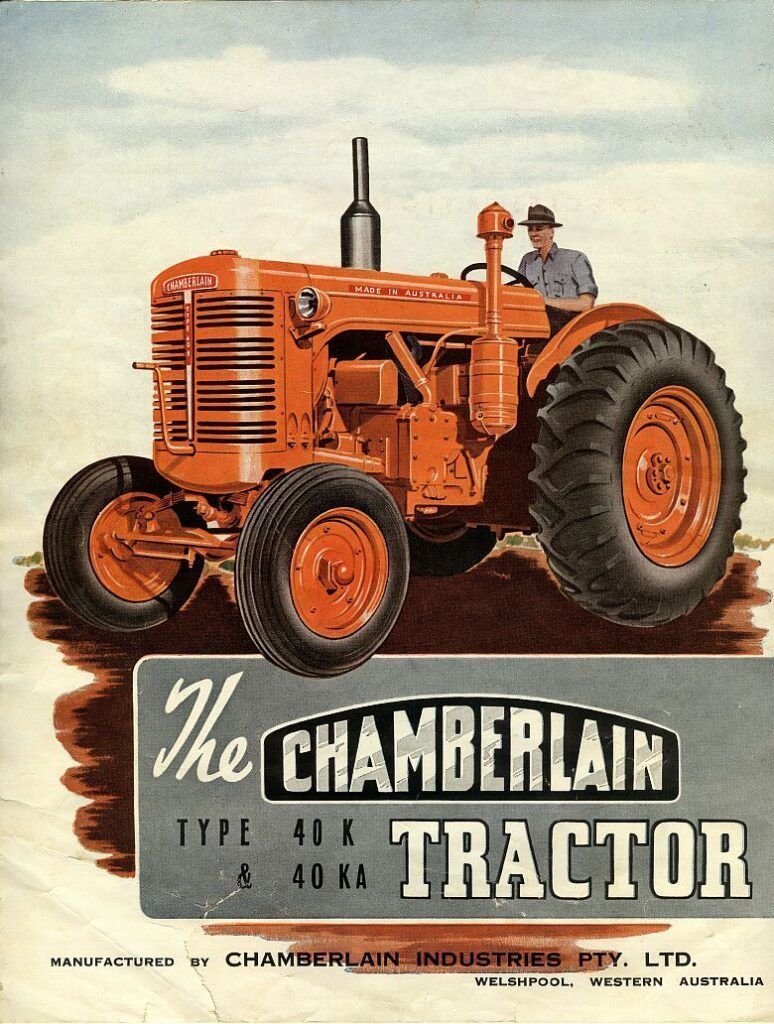
The tractors were well-engineered, performed exceptionally well under the Nebraska test conditions, and were entirely produced in-house by the company, including the robust transmission and kerosene-fuelled semi-diesel engine.
The fate of the Chamberlain business followed a trajectory common to similar Australian ventures. The West Australian government, the substantial financer of the project, wanted to create as many jobs as possible. The Commonwealth, however, was largely indifferent to the success of the venture, and some bureaucrats even intrigued against the company.
Foreign tractor importers, eager to make life difficult for the new entrant, discounted aggressively. Commonwealth counting errors over-estimated the size of the market, industrial disputation delayed production, and the management lacked experience.
Slower than expected initial sales, a government unwillingness to shed jobs, mounting interest debts and an accumulation of inventories placed the company under great pressure. The government investors started looking for a foreign buyer. John Deere, a large and predatory American company, eventually acquired the controlling interest in the business and terminated Chamberlain tractor production in 1986.
Chamberlain built excellent tractors. Had the business managed its difficulties better, if the value of Australian tractor manufacturing been more appreciated at the national level, and had policies been implemented to deal with its deficiencies and nurture its development, it could have become a business with national and export sales of a billion dollars a year and employing a skilled workforce of several thousand people.
The above are just two examples of manufacturing firms of national importance, well suited to Australian operations, which should have been able to prosper, but were allowed to fail, not only by errors of structure and judgement, but by inept and indifferent government policy.
A core problem is that, in many cases, the question of whether or not Australia is able to retain an industry can depend entirely on the fate of a single firm. When such a firm encounters difficulty, which is to be expected at some point in the life of any business, either through a temporary market downturn, poor management decisions or the actions of a foreign competitor, the survival of the whole industry is put at risk.
An inventory of the remaining manufacturing firms of national importance is needed. This list will be a great deal shorter than it would have been two or three decades ago and it will get even shorter in the future if nothing is done.
Any policy for retaining and developing such firms needs to address these three most important issues: the regulation of imports through trade policy; the provision of finance and technical assistance on reasonable terms; and firm state support, even nationalisation, if the survival of the firm is at risk because of factors beyond its control.
___
Craig Milne is a former executive director of the Australian Productivity Council, an industry assistance agency providing productivity improvement services to business organisations through engineering, human-resource and management systems work.
Republished with thanks to News Weekly. Image courtesy of Adobe.
3 Comments
Leave A Comment
Recent Articles:

9 October 2026
5 MINS
During a recent dialogue between high profile legal experts, a top Australian constitutional law expert was asked if Australia should have a Bill of Rights. His answer may surprise you.

9 October 2026
1.3 MINS
Season 6 of The Chosen is releasing next month, and until 15 November, your church has the opportunity to host a free pre-release screening of Episode 1. Here's how.

9 October 2026
1.8 MINS
Pen Power Australia has been busy confronting antisemitism and double standards, lodging letters, pursuing accountability and celebrating several important wins along the way.

9 October 2026
3.3 MINS
New South Wales healthcare workers who object to abortion and voluntary assisted dying face growing pressure, raising serious questions about conscience rights, employment and moral injury.

9 October 2026
2.9 MINS
God is intensely relational, and he puts us into a community of believers so we can use our gifts in service of Christ's body.

8 October 2026
3.6 MINS
John Anderson warns that Australia’s decline is rooted in spiritual and cultural disintegration, calling for a recovery of Christian foundations, social cohesion and national purpose.

8 October 2026
1.6 MINS
A blackout at Australia’s $150 million Pre-COP climate summit in Fiji delivered an awkward lesson in energy reliability to delegates preaching the renewable transition.



Instead, we will manufacture more solar panels when there is already a glut , and ,gift billions of taxpayers’money to an Australian billionaire, who in company with his partner– Communist China, claims he will produce ‘Green Hydrogen “.
Another issue for a national business to start up will also be security of electricity supply. As we transition to so called renewables, the supply of electricity will become more unstable without baseload capacity, which is needed for a large industry.
I hope Australia never needs to defend itself against armed attack. In the 1980’s at least we had a manufacturing base that could shift production to defence production. Should we come under attack I wonder whether we would turn to China to produce weapons for us. We are in a perilous predicament as I fear that this may one of the more likely countries to be one of the agressors, although this is really unlikely unless they feel that their economic takeover through price cutting and purchasing our real estate is moving at too slow a pace for their liking.
Well done Craig for an informative and timely article.