



Living Differently for the Sake of Our Grandchildren in Time and Eternity: Christian Family Dynasties Over the Generations
A compelling exploration of how Christian faith, passed through generations, has shaped virtuous family dynasties and left a lasting mark on Australian history and society.
Why the National Grandparent Movement is on to a winner
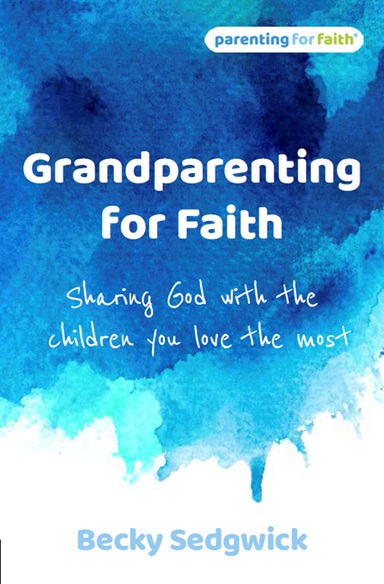
When you first heard about the National Grandparent Conference, did you react as I did? Did you think, “Here’s a winner if ever there was one – this cannot fail – everyone wants to talk about their grandchildren.”
On further reflection, there are many more reasons why it must be a runaway success. It has so much potential because there are so many sources of knowledge and wisdom on this very important subject.
There is not only your experience as a grandparent; there is also your experience of having grandparents.
Then there is the Bible. What divine guidance does it offer?
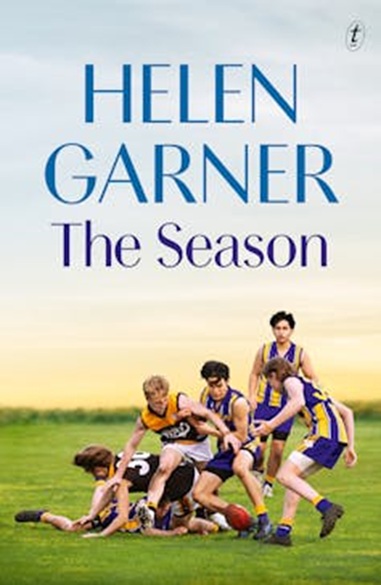 Then there is literature – novels and poems about grandparenting. There’s Helen Garner’s book about her grandson, Amby, and how she attends all his training sessions and matches of his U-16 AFL side.
 Then there are the “Ten Poems” series of books. They include “Ten Poems about Grandparents: Selected and Introduced by Liz Soar and the Pupils of Headington School, Oxford.” They are cheap enough to buy instead of a card, available at Dymocks.
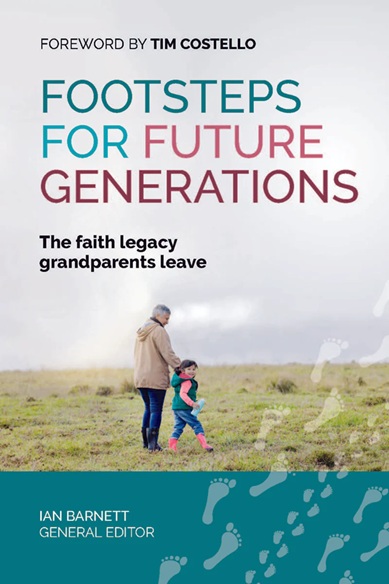
Then there is Christian literature on grandparenting.
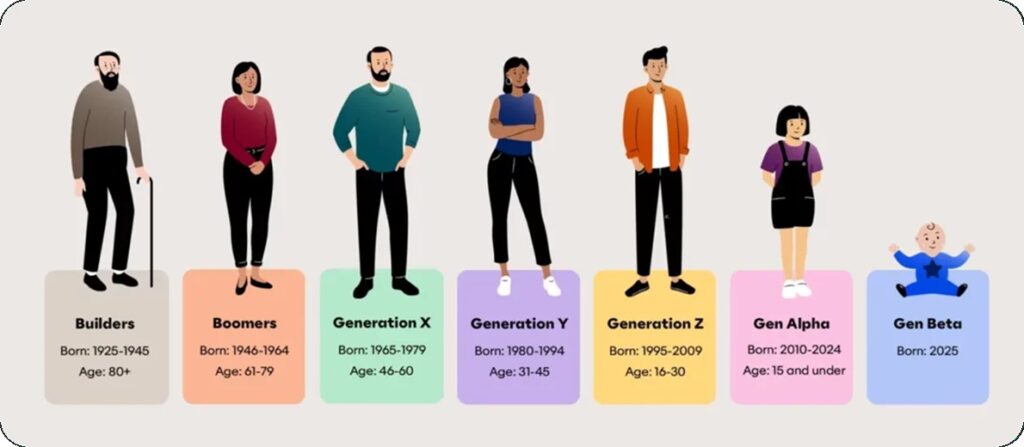
Then there are sociological surveys, such as McCrindle, produced for our edification about the characteristics of different generations:
Most of us are of generations labelled builders or boomers; most of our grandchildren are Generation Z, or Alpha, made up of those who “have never known a world without the Internet, cell phones and computers.” These surveys of the different generations help us to communicate across the divide.
Interestingly, there is some evidence that since Covid there has been something of a turn to Christianity in Gen Z in Australia, in Europe, the United Kingdom, Ireland, and the United States. [1]
Then there is history – the experience of grandparenting across the generations. Because I am a historian, I will focus chiefly on the startling contribution to family and national wellbeing of Christian family dynasties over the generations, with special reference to Australia.
1. Personal Experience
1.1 Of being a grandfather
But first, allow me a little space for indulgence to speak of my own experience of being a grandparent and of being a grandchild.
Two of my three grandchildren are Gen Z. The third is Gen Alpha. They do not read a lot. They have never read one of my books. But one of them suggested I should write a book about them. If I did, its title would be “Are you happy with your life?”
My youngest grandchild was trampolining one day – she was 7 at the time, so that’s six years ago, and I was standing there admiring her back somersaults with half-twist, when suddenly she stopped, and she said to me, “Are you happy with your life?”
“Yes. Are you happy with yours?”
“Yes. I am too. I think it is because I have excellent parents.”
She does have excellent parents, and she goes to an excellent church, which has given excellent children’s and youth work to all three of my grandchildren, and they all attended or attend an excellent Christian school, the principal of which was named the Australian School Principal of the Year in 2023 at the Australian Education Awards. Home, church and school. 3 out of 3. So that means my experience might not be the same as yours.
My experience is inexperience when it comes to matters which might be of heartfelt concern to you. Of course, any problems you may have experienced with any of those three only increases your own importance in the lives of your grandchildren, calling for your best wisdom and most faithful of prayers. Maybe what we learn about Australian Christian family dynasties from history will be of more encouragement to you than I can offer from my own inexperience.
1.2 Of being a grandson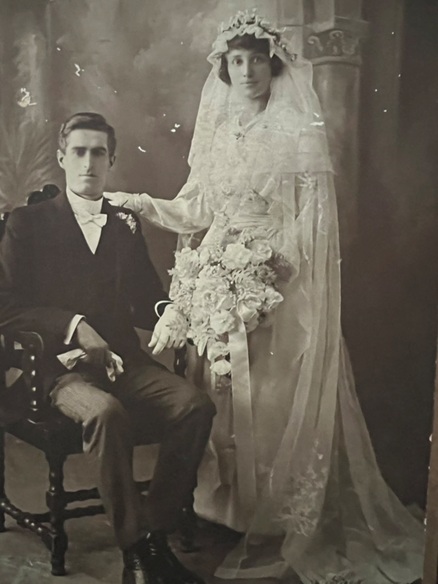
A word about Gran West, as she was known to all, including her own children. She was the matriarch of our family, not out of any larger-than-life dominance, but she was very wise and totally without ego. She played the organ in Balmain Presbyterian Church, the steeple of which I see every time I go into the city by ferry, along with the house in which she used to live and the factory in which her husband worked.
I lived with her for seven years – the last two years of my high schooling and five years at University. As a good Presbyterian, she was familiar with the Westminster Confession, which I argued over with her without any knowledge of what I was talking about. My sister reminded me of the note she wrote to her five children attached to her will. In it, she wrote this of her 13 grandchildren:
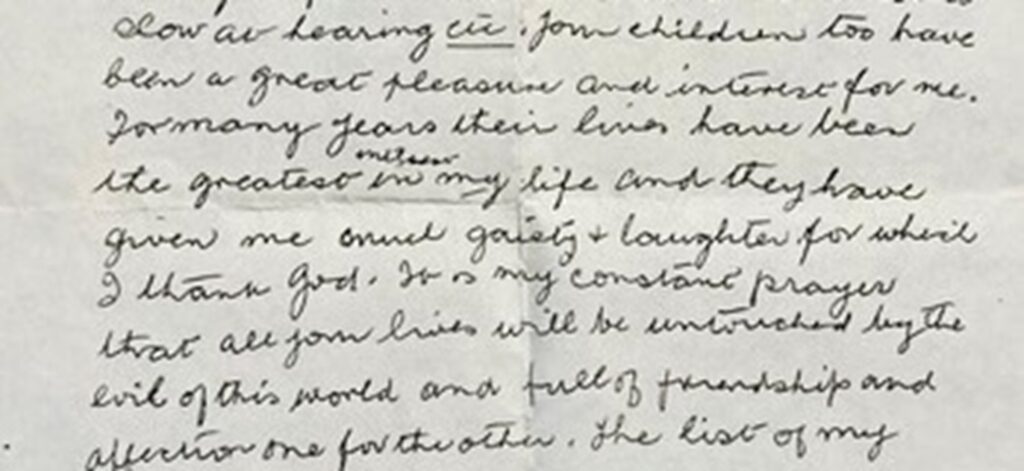
Your children, too, have been a great pleasure and interest for me. For many years, their lives have been the greatest interest in my life and they have given me much gaiety and laughter for which I thank God. It is my constant prayer that all your lives will be untouched by the evil of this world and full of friendship and affection one for another.
Is it highly significant that Gran West should write about gaiety and laughter at such a time? That is surely one of the main joys of the grandparent/grandchild relationship. It is just as serious as the parent/child relationship, but it’s more relaxing, more room for fun.
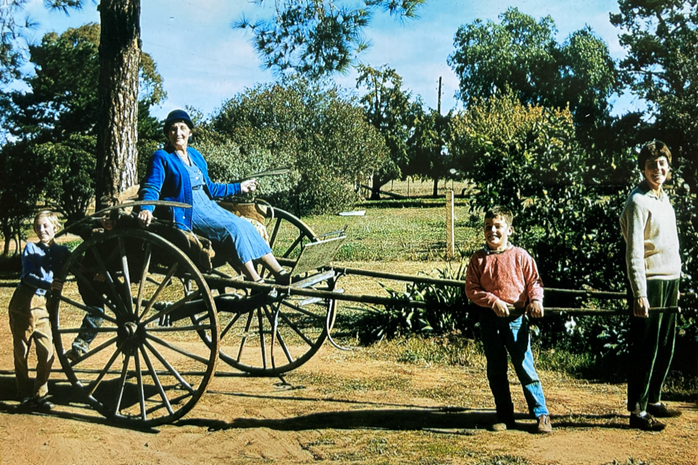
Gran West (1894-1980)
2. Sociology of Grandparenting
Now, a word on the value of sociology, especially the so-called sociology of religion. In 1986, two Melbourne sociologists, Gary Bouma and Beverly Dixon, published a book called The Religious Factor in Australian Life. [2]
They compared the attitudes of people who go to church with people who do not go to church. I know that going to church does not make you a Christian, but by 1986, when few went to church just for appearances’ sake, churchgoing was as good an indicator of Christian conviction as any. Bouma and Dixon strengthened their case by also analysing the views of those who said that they had ‘no religion’. [3] There is a strong correlation of churchgoing with the production of so-called “social capital”.
- People who say that they have no religion are the least supportive of the family, are less likely to have children and more likely to shun commitment and insist on their own rights.
- If you have no religion, you are less concerned about meeting people, you have less desire to be useful, you take less pride in your work, you want more holidays, and you feel more exploited.
- If you are a churchgoer, you are more likely to take the opinions of other people seriously, you are more determined to make a contribution to society, and you are more inclined to think that life is meaningful and purposeful.
- It is true that we have a pluralistic society and that it requires tolerance to make it work. It would seem that people who go to church weekly are the most tolerant and least racist group in Australia. People who not only not go to church, but also say that they have no religion, are also the most racist.
With that in mind, it may not be so surprising to learn, from a recent American study, that “religious grandparents are more involved in fulfilling their role than non-religious ones. [4]
Involvement with Grandchildren
| Religious grandparents | Non-religious grandparents | |
| Help with skills acquisition | 80% | 60% |
| Have discussions about problems faced | 37% | 21% |
| Care for sick grandchild | 50% | 35% |
With reference to the theme of our conference, “Living Differently”, you are already doing that because you are different.
But the difference is not as great as it might be, calling us to be more intentional about our role as grandparents, to “let our light shine” (Matthew 5:16) as Jesus commanded.
We are already different, so let us put the grace and the gift we have been given into practice. Might we move on from being a faithful grandparent to a grandparent full of faith. [5]
3. Christian Family Dynasties in History and in the Bible
Now, let us, with some relief, turn to history. So, my time begins now. I trust a few examples will suffice to make the point.
Virtuous and Vicious Family Dynasties: Jonathan Edwards and Max Jukes
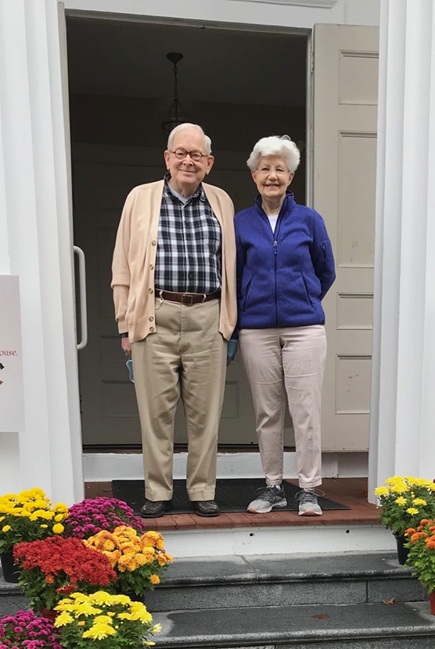
Wilson & Carole Kimnack
In 1985, I was on study leave at Yale University. I was studying the writings of America’s greatest philosopher-theologian, Jonathan Edwards, who is also the church’s greatest theologian of revival.
The leading authority on Edwards’s sermons, the late Wilson Kimnach, kindly guided me in my research, and we had lunch most days in the refectory attached to the Beinecke Library at Yale, where Edwards’s papers are held.
On one occasion, Wilson said to me, “You see that girl who is just coming through the main door – that is the great, great, great, great, great, great-granddaughter of Jonathan and Sarah Edwards, and she looks just like Sarah.”
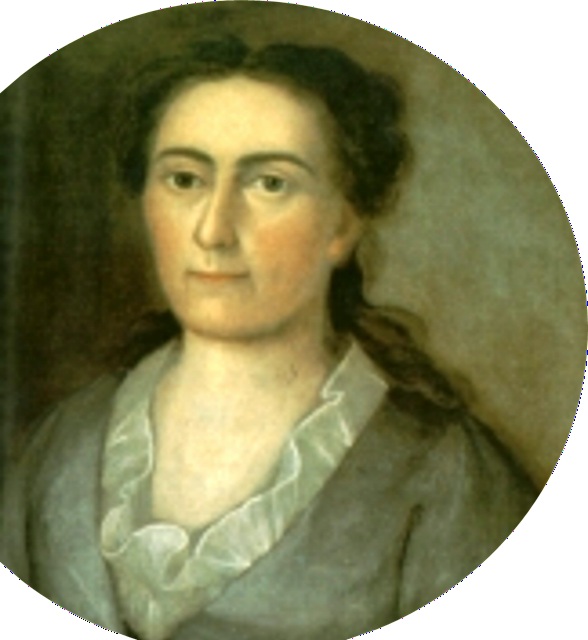
Sarah Edwards
25 volumes of Edwards’ writings have now been published, and there are a further 49 volumes online. Every one of those volumes, each of which costs a couple of hundred dollars, has been sent to me over the years by John Edwards, a great-great-great-great-great-great-grandson of Jonathan and Sarah.
John Edwards visited us in Australia and preached in Trinity Chapel at Robert Menzies College. He based his sermon on one preached by his famous ancestor, from the text Matthew 5:14, which Ian Barnett invited today’s speakers to reflect on with reference to the importance of being different for the sake of our grandchildren. “You are the light of the world. A city on a hill cannot be hidden.”
This verse has been taken by Trump-supporting evangelicals to refer to how special American Christians are – it is a verse put to the service of American nationalism or exceptionalism, as it is called. That was hardly the point of Edwards’s sermon.
Rather, Edwards begins this sermon with a proposition relevant to all Christians, namely that any society of professing Christians is a “city on a hill” and that means they are on view: they can be seen by all, and those who witness this profession will make up their minds about the truthfulness, the genuineness of this profession largely on what they witness of the holiness and godliness of that group of Christians. Much is at stake.
So the “doctrine” of that sermon is: “When any professing society is as a city set on a hill, ’tis a very great obligation upon them to honour religion in their practice.” [6]
The evangelist Rodney “Gipsy” Smith, hugely successful in Australia in the 1920s and ’30s, put it more simply:
“There are five gospels: Matthew, Mark, Luke, John and the Christian. Most people will never read the first four.”
So, it is critically important for you to be a fifth gospel.
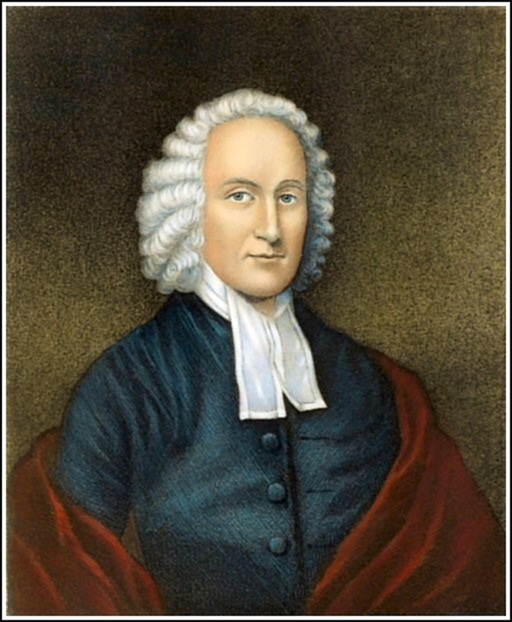
Jonathan Edwards
Well, with reference to Jonathan Edwards’s descendants, there is a study of them which is readily found on the net: 1394 descendants were traced.
Of these, 295 graduated from college, from whom 13 became college presidents, and 65 became professors.
3 were elected as United States senators, 3 as State governors, and others sent as ambassadors to foreign countries.
30 were judges.
100 were lawyers, one the dean of an outstanding law school.
56 practised as physicians, one was dean of a medical school.
75 became officers in the army and navy.
100 were well-known missionaries, preachers, and prominent authors.
Another was the comptroller of the US Treasury, another a vice-president of the United States. Not one of the descendants of the Edwards family was a liability to the government.”
So Jonathan and Sarah started what has been called a virtuous dynasty, a family which has been a blessing to the nation over many generations.
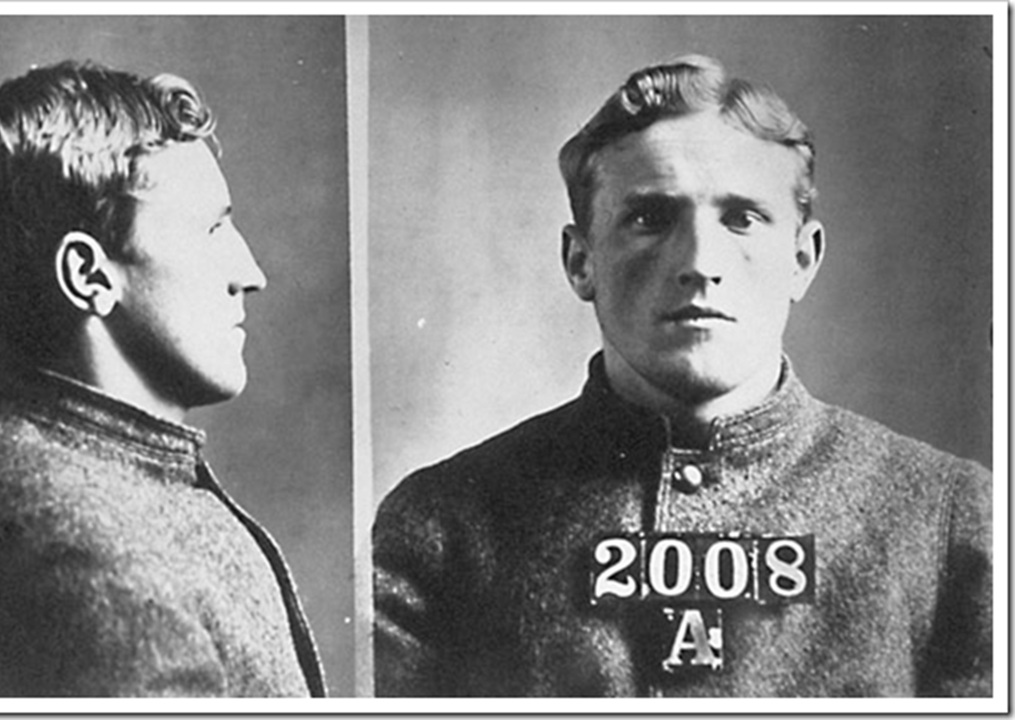
Max Jukes
This virtuous dynasty has been contrasted with that of one “Max Jukes, an atheist who married a godless woman. Some five hundred and sixty descendants were traced. Of these:
310 died as paupers.
150 became criminals, 7 of them murderers.
100 were known to be drunkards.
More than half the women were prostitutes.”
So, over the generations, you can get virtuous dynasties, as with Jonathan and Sarah Edwards or vicious dynasties, as with Max Jukes; dynastic delight or dynastic disaster.
Of course, like all things on the net, you can and you should be sceptical about the details – it is not a completely accurate picture.
The VP of the US, who was a descendant of Edwards, might have been pleasant enough, but he did shoot someone in a duel and does not appear to have been a person of faith. There are black sheep in every family dynasty, and all of us have been black sheep ourselves at times.
But if such tables are not entirely correct, they are so substantially correct that it is foolish to ignore their significance and the height of wisdom to desire for yourself and your offspring that you should be part of a virtuous dynasty.
Perhaps a little closer to home, historians, working on the convicts transported to Australia, have demonstrated not only were most of them completely unchurched, but their parents were too. People who say they have no religion will normally have children who have no religion.
3.2 The Bible itself has much on the role of ungodly and godly dynasties over generations. The damage done by human sinfulness is passed down through generations (Isaiah 14:20,21; Jeremiah 32:18; Lamentations 5:7). That is a reality also recognised in the New Testament (Matthew 27:25; Romans 5:12,13; Ephesians 2:1-3).
Conversely, hereditary blessings also stem from faithful parents who honour God. Phinehas the priest blessed his descendants by his righteousness (Numbers 25:10-13). Jonadab, son of Recab, followed the Lord with all his heart, and the Recabites were still being faithful to the Lord and blessed by him 250 years later (Jeremiah 35). Dynastic solidarity is a causative factor in human history, for good or for ill.
Cotton Mather, an American Puritan who lived in a generation before Edwards, was strong on the same theme:
I will show you the handwriting of God … There it is Isaiah 44:3 “I will pour My spirit upon thy seed, and My blessing upon thy offspring.” Here children can federate in their parents to inherit the glory of their ancestors.
You may be assured, that the virtue, the blessing, the efficacy of the covenant shall never be disanuled; He will be a God, not only to you only, but your seed also;
This your covenant shall draw in your children to partake of grace with you, never to be broken off. the oil that is poured upon the head will run down to the rest of the members. The covenant mercy of God, unto the children of godly ancestors, oftentimes the further it rolls, the bigger it grows. [7]
4. Christian Family Dynasties in Australian History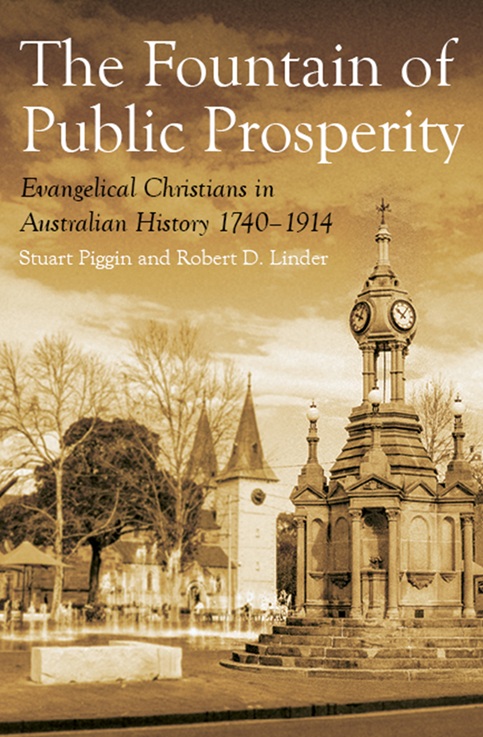
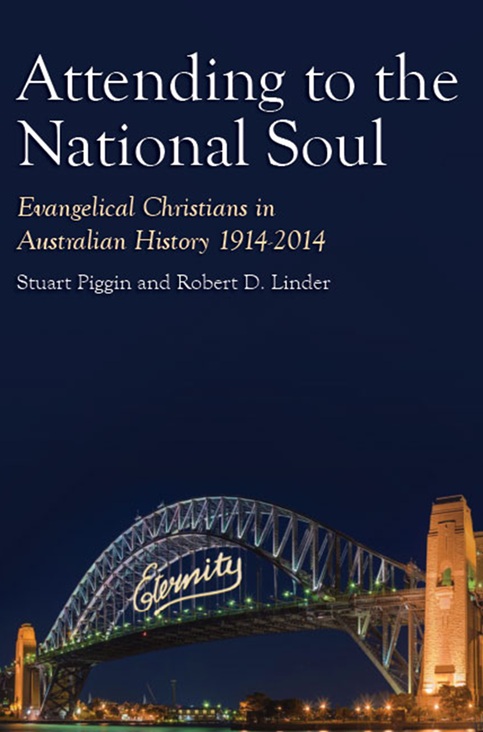
Our books, The Fountain of Public Prosperity and Attending to the Australian Soul, are studies of the impact of Christianity on Australian history, and they are full of stories of virtuous Christian dynasties.
Read it for yourselves.
One who did so was one Jenny Holmes, who wrote to me in 2018 to comment on a Bible study I had mentioned on p. 524 of the book, vol 1.
It was held every Monday night in Bendigo at the end of the nineteenth century.
 It was taken by Herbert Smirnoff Begbie, founder of one of the most prominent of Anglican dynasties, and present at this Bible Study was Sidney James Kirkby, who went on to found the Bush Church Aid Society.
Jenny is Kirkby’s granddaughter, and in her Bible Study at Lalor Park Anglican Church in Sydney is Katherine, Begbie’s granddaughter.
The tenacity of these godly dynasties from one generation to the next is remarkable.
The Playford Family Dynasty
At a conference of Baptist pastors some years ago, I met a very tall, impressive bloke who introduced himself as Tom Playford.
“Might you be related to the Tom Playford who was South Australia’s premier?” I asked him.
“I’m his son,” he said.
“Do you have any of his papers?” asked the historian in me.
“I have the diary of his great-grandfather, who was also a Baptist pastor in South Australia.”
“Could I see it?”
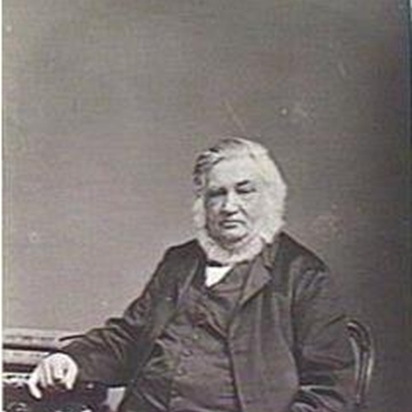
Pastor Tom
“I have made a copy of it. I’ll send it to you.”
It is an amazing story.
- In 1844, ‘Pastor’ Thomas Playford (1795–1873),[8] an ex-soldier and pastor, arrived in South Australia,[9] thus inaugurating one of Australia’s most enduring evangelical dynasties:
- His son, Thomas (1837-1915, ‘Honest Tom’, orchardist and politician);
- His son Thomas (1861-1945, orchardist);
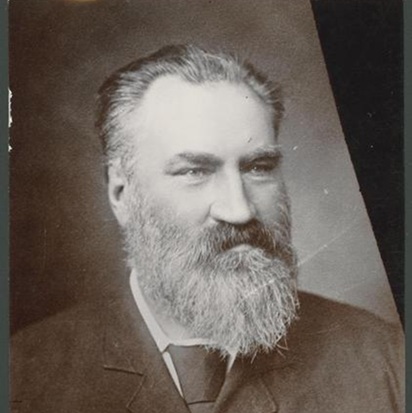
“Honest” Tom
- His son was Thomas (1896-1981, Sir Thomas, orchardist and Premier of South Australia from 1938 to 1965);
- His son Thomas (1945- , orchardist and pastor);
- His son, Thomas (1969- ), in 2013 was a project manager running Adelaide City Council’s $28 million Victoria Square upgrade;
- His son, Thomas, was 8 in 2013.
As can happen, one generation was more overt in the expression of faith than another. Pastor Tom’s son, ‘Honest Tom’, was not as devout as his dad, whereas his grandson, the orchardist, was more devout, and his great-grandson, the famous premier, was more interested in doing than preaching, and his great-great-grandson, a Baptist pastor, was not averse to preaching!
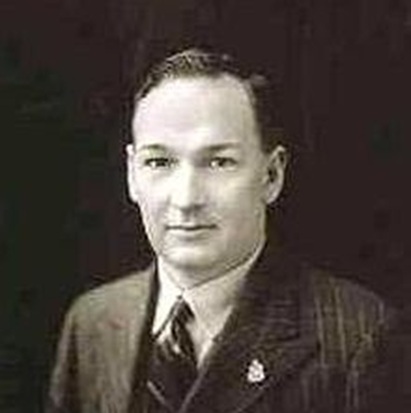
Sir Thomas, Premier
The Playfords have a lot in common over the generations – exceptional physical strength; honesty; independence of thought; aversion to honours or recognition; scrupulosity over the use of other people’s money; balanced budgets; no ostentation; capacity for hard work and concentration; geniality of temperament; public service as an ideal; a similar morality, including an aversion to gambling and drinking, accompanied by non-judgementalism of individuals who indulged in either. [10]
But while they have a lot in common over the generations, as we’ve observed, not all the Toms were equally devout. With this fact in mind, it may be legitimate to believe that family influence can skip a generation, so that the influence of a grandparent may be greater on a child than that of a parent. A child may react to a parent’s values and look, rather to the values of a grandparent in doing so.
An example more familiar to you might be the Murdoch family. See Wikipedia on five generations of the Murdochs. In the present generation, it may be that James has rejected some of the values of his father and adopted the values of his grandmother, Dame Elisabeth Murdoch, a woman of faith.
The Walker Family Dynasty
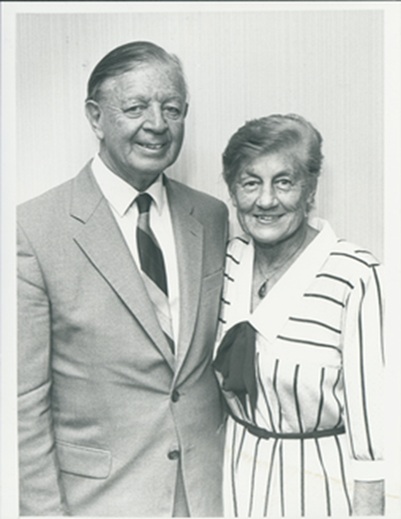
Alan and Winifred Walker
Sir Alan Walker, founder of Lifeline, was part of a remarkable Christian dynasty.
His great-great-grandparents were convicts.
They produced three children out of wedlock before they married when their eldest son¸ John Joseph¸ was 20.
With a reputation as an anti-religious hard drinker, John Joseph, on 3 February 1838, was brought to faith in Christ through the ministry of a Methodist circuit rider, the Rev. William Schofield, and a vicious dynasty was converted into a virtuous one.
Thus began a Christian dynasty which has produced to date sixteen ministers, of whom Alan was the 13th; his two sons, Bruce and Chris, are the 14th and 15th; and Chris’s son, Ben, is the 16th.
Malachi 2:6 might rightly be said of all faithful ministers of the Gospel: “True instruction was in his mouth and nothing false was found on his lips. He walked with me in peace and uprightness, and turned many from sin.” But what if by belonging to a Christian family dynasty, you can multiply that 16 times?
The Dynasty of Maria Yellowmundee and the Five Christian Family Dynasties who supported her (Shelleys; Kennedys; Marsdens; Hassalls; Cartwrights) and are still active today in Christian Service
Let me mention a cluster of dynasties our research has uncovered.
Every year at graduation ceremonies at Macquarie University, we are told by the young First Australian who welcomes us and leads us in the recognition of country that he is a proud descendant of Maria Yellowmundee. She was, historian Grace Karskens tells us, ‘the matriarch of a vast family, and her descendants now number in their thousands’.
Who and what were involved in making Maria Yellowmundee the person she was?
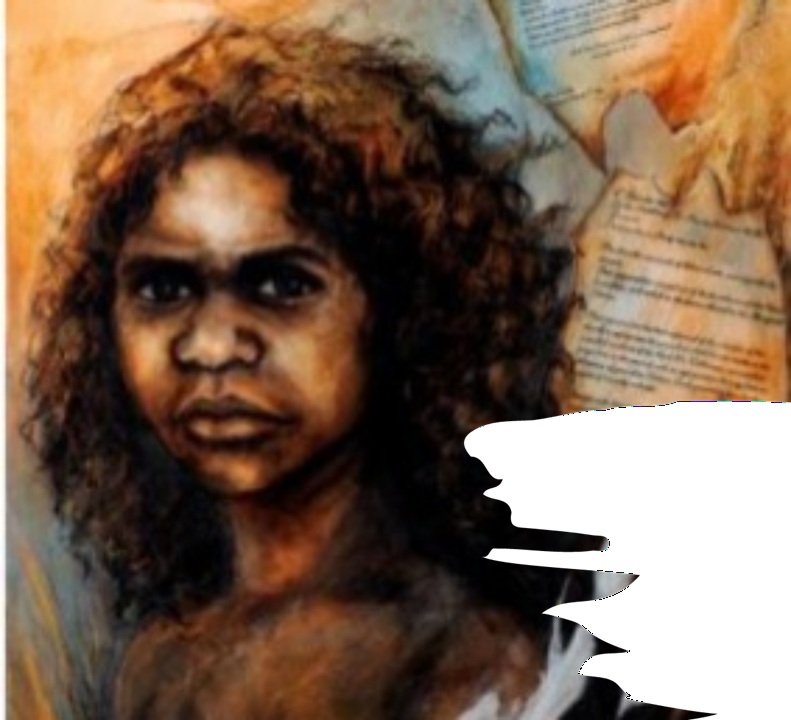
With the permission and support of her father, Yellomundee b. c1760, and her grandfather, Gombeeree, b. in the 1740s, Maria was the first Aboriginal child taken into the Native Institution at Parramatta, opened in 1814 by William and Elizabeth Shelley. Their descendants are still active in Christian service today, a Christian dynasty.
One of the best-known is Owen Shelley (1927-2014), on the staff of Scripture Union, and a missioner with the Children’s Special Service Mission (CSSM). William was one of the Congregationalist missionaries who settled in New South Wales c. 1798, having met with violent resistance in Tahiti.
They settled around Parramatta, where they were given land grants by Governor Hunter, himself an evangelical Christian and very glad to have people of such strong values.
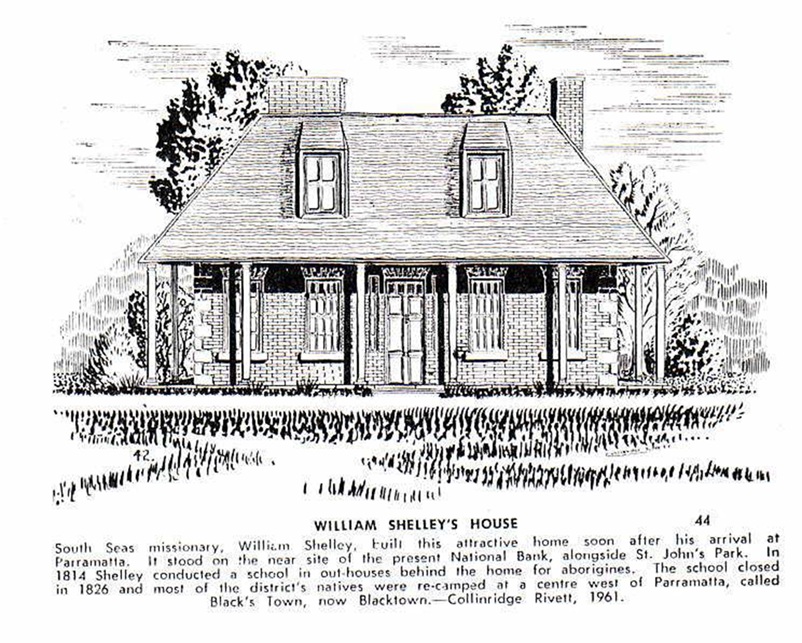
Governor Macquarie was in 1814 open to the Shelleys’ proposal to open the Native Institution because the relationship between Aboriginal people and white settlers was then particularly bad following the brutal murder of Aboriginal people near Appin, west of Sydney, and the payback from Aboriginal warriors which followed.

Hamilton Hume
The women and children of the Gandangara clan who were murdered here during the atrocity were buried on a farm owned by one John Kennedy. He arranged for them to be buried there even though they were not murdered on his farm. This was considered a humane act at the time. What motivated him?
Kennedy’s farm was called Teston farm, named after the town in Kent, which was a centre for the abolition of the slave trade. Next to it is Humewood Farm, named after Andrew Hume and his wife, Eliza, who was Kennedy’s aunt, and who had arrived in New South Wales in 1795 as a free settler and had been the first matron of the female orphanage started by Anne, wife of Governor King, in 1801. Eliza’s son, Hamilton Hume, was the famous explorer, revered like John Kennedy for his concern for First Australians. A descendant, Dr Robert Wiles of Cooma, is a keen apologist for the Gospel. So, another dynasty.
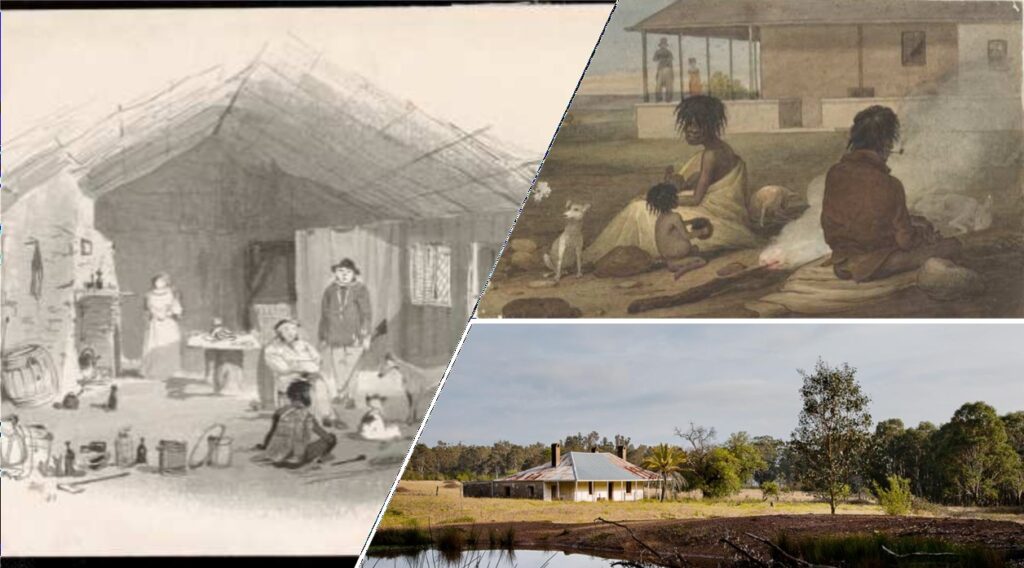
Humewood Farm, Appin
Now, Eliza was the daughter of the Rev. John Kennedy, from 1789 Vicar of Teston, in succession to the Rev. James Ramsay, the pioneer slave trade abolitionist. So, Maria Yellowmundee was a beneficiary, if you will of, the Testonites, the slave trade abolitionists, through their influence on Macquarie to accept William Shelley’s idea of the Native Institution.
In 1819, Maria stunned the colony by taking the first prize in the public examinations, defeating almost 100 white children in the process. The missionaries were thrilled. Maria’s achievement vindicated the evangelical Christian belief in the equality of all races and both sexes in intellect.
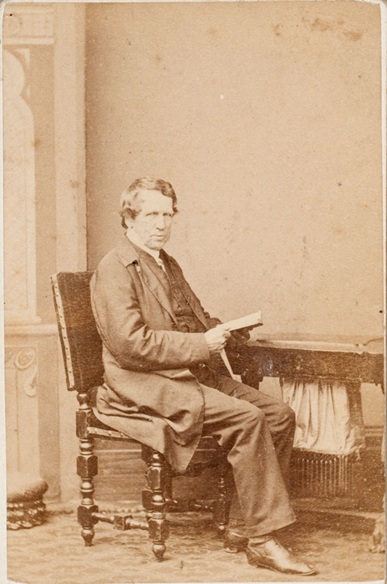
Rev. Thomas Hassall
Maria then lived for a time with Thomas and Anne Hassall. Thomas was the son of Rowland Hassall, another missionary who arrived in New South Wales in 1798. Anne was the daughter of the Rev. Samuel Marsden. Thomas started Sunday Schools in Australia; his wife taught in it, and Maria Yellowmundee attended it.
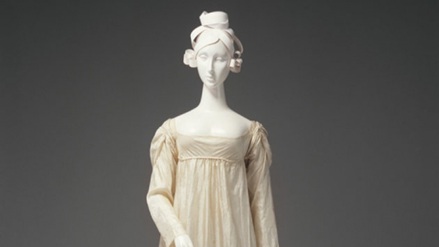
Anne Hassall’s wedding dress
The Hassalls maintained their committed evangelical faith over generations. In 2000, Thomas Hassall Anglican College was opened in Sydney’s south-west, and it now has 1700 pupils. So, another long-lasting Christian dynasty.

Thomas Hassall Anglican College
On the 36th anniversary of the settlement of the colony (26 January 1824), at Samuel Marsden’s church, St John’s, Parramatta, Maria married Robert Lock, a convict carpenter. Robert was the father of Maria’s 10 children, and her remarkable dynasty was underway. The newlyweds were both given employment by the Rev. Robert Cartwright.
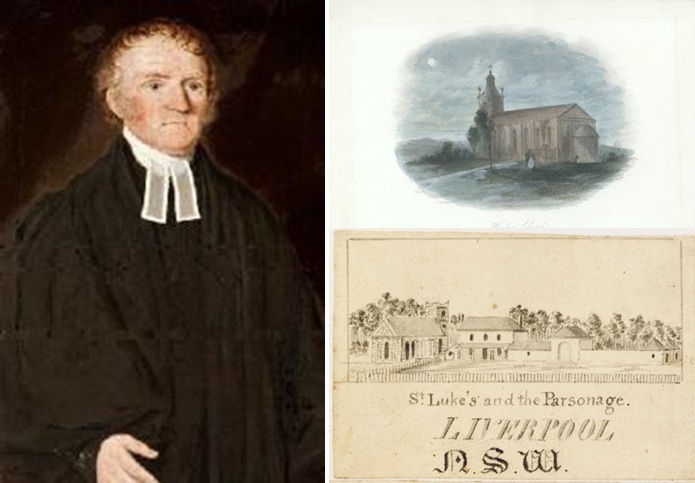
Rev. Robert Cartwright; St Matthew’s Windsor; St Luke’s Liverpool
Robert Cartwright had been curate for fourteen years at St Peter’s Church in Bradford, West Yorkshire, a strong evangelical parish, before being sent to Australia as a chaplain. When he was farewelled from Bradford church at a service held on 16 April 1809, a special hymn was written for the occasion and sung to the tune ‘Old 100th’:
With all thy power, O Lord, defend
Him whom we now to Thee commend;
Our faithful Minister secure,
And make him to the end endure.
Arriving in Sydney in 1810, Robert Cartwright was appointed to the Hawkesbury settlement at Windsor, from where he supported Maria and Robert Lock. He was later licensed to minister to a vast area in southern New South Wales, and evangelised the settlers from Canberra to Albury. It was a remarkable ministry to which the parishes of Queanbeyan, Yass, Canberra, Tumut, Young, Gundagai and Albury can all trace their origins.
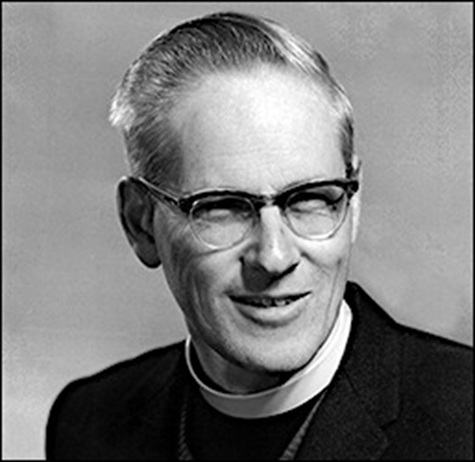
Tony Lamb
As for the hymn, framed, it now hangs in the entrance foyer of the home of Cartwright descendant, Jan Lamb, wife of Sydney Anglican minister and evangelical stalwart, the late Tony Lamb. So, we have here a fifth solid Christian dynasty associated with Maria’s early development.
As for Maria, because Robert, her husband, had not finished his sentence, he was assigned to her, and she was granted land. Extraordinary! Today, we would protest that she was already custodian of the land – she did not need to be granted it. But any indignation at the ‘appalling insensitivity’ of our founders should not obscure the remarkable departures from social conventions which our story represents.
- A black married to a white
- A man assigned to a woman
- A white man assigned to an indigenous woman
- A woman was allowed to acquire property in her own name
- An indigenous woman was allowed to acquire property in her own name.
Such was the length early New South Wales society was prepared to go, in this case, in support of marriage and stable family life.
Many Christian family dynasties, then, were involved in helping to make Maria Yellowmundee the person she was and in making her own family the dynasty it has become. Psalm 145:4 — “One generation shall commend Your works to another, and shall declare Your mighty acts.”
Class, gender, and race.
Christian family dynasties have probably been a major factor in the shaping of Australian history.
Conclusion (Take-home point/Action Steps)
Christian family dynasties:
- are very tenacious over generations
- have shaped Australian communities and influenced Australian history
- help their members to make the best of both worlds – this and the next
- commend the work of the Lord
The challenge to every Christian is to reinforce the solidarity of the Christian family dynasties to which they belong, or to be a pioneer or initiator of new Christian family dynasties.
Prayer:
- Psalm 78:4 — We will not hide them from their children, telling to the generation to come the praises of the Lord, and His strength and His wonderful works that He has done.
- Joel 1:3 — Tell your children about it, and let your children tell their children, and their children the next generation.
- Ephesians 3:21 — … to Him be glory in the church by Christ Jesus to all generations, forever and ever. Amen.
- In Psalm 90, a prayer attributed to Moses, the psalmist meditates on the fragility of human life before the everlasting God. But he concludes with humble hope, asking that God will establish His people’s work to endure: May the favour of the Lord our God rest on us; establish the work of our hands for us—yes, establish the work of our hands.
- May we also seek to live and work in ways that will outlive us, building a legacy of good for those who come behind.
The understanding of the covenant is strong in Presbyterianism, as is the reason why infants are baptised into the covenant enjoyed by all Christian families.
Because of God’s covenant promise, the children and grandchildren of Christian believers, baptised into that covenant, are raised in faith and not in fear, faith that they are already part of the Christian family, rather than in fear that they will never be converted or that they will fall away. It is a very healthy belief psychologically, as well as true theologically.
___
[1] Don Smith, “Gen Z sparks Christianity’s surprising revival“, Catholic Voice, 4 July 2025.
[2] Gary D. Bouma and Beverly R. Dixon, The Religious Factor in Australian Life (Melbourne: MARC Australia, 1986), 34–37.
[3] AI: In the 2021 Australian Census, 38.9% of the population, or almost 10 million people, reported having no religion, according to the Australian Bureau of Statistics (ABS). This makes “no religion” the second most common response after Christianity (43.9%).
[4] Valarie King and Glen H. Elder, “Are Religious Grandparents More Involved Grandparents?“, The Journals of Gerontology Series B: Psychological Sciences and Social Sciences, 1999.
[5] One social researcher concludes: “the decisive factor in the passing down of religion from one generation to another remains the quality of the relationship in the triad of children-parents-grandparents. ‘Warmth matters‘—parents and grandparents who offer unconditional support, freedom of choice, and a consistent model of living the faith have the best chance of passing on this imperishable legacy to future generations.”
[6] WJE 19: 540.
[7] Sacvan Bercovitch, The Puritan Origins of the American Self. New Haven and London: Yale University Press, 1975, 94,95. We Anglicans might not be strong in our understanding of the covenant. We need to reflect more on verses like Genesis 17.7: “And I will establish My covenant between Me and you and your descendants after you in their generations, for an everlasting covenant, to be God to you and your descendants after you.”
[8] Son of Thomas (died 1839, farmer).
[9] H. Estcourt Hughes, Our First Hundred Years: The Baptist Church of South Australia (Adelaide: SA Baptist Union, 1937); Manley, From Woolloomooloo to ‘Eternity’, p. 51.
[10] There is much more about the Playfords in our two-volume history of Australian evangelicalism. Suffice it to say that the Playford dynasty gave a sense of security and continuity to the people of SA. Sir Thomas was the longest-serving political leader in the British Commonwealth. Psalm 90:1 — “Lord, Thou hast been our dwelling place in all generations.”
___
Image courtesy of Adobe.
One Comment
Leave A Comment
Recent Articles:

24 October 2026
3.3 MINS
When we ask God, "What is in my hand?", and see our possessions, money and time as seed that God asks us to sow, life becomes simpler.

23 October 2026
6.8 MINS
Hillsong UNITED’s Joel Houston reflects on fame, faith and the burden of ministry, questioning performative Christianity as he seeks a more authentic walk with God.

23 October 2026
13.1 MINS
Tasmania’s proposed conversion practices legislation raises serious questions about religious freedom, pastoral care and whether Christians can freely pray with those seeking to live according to their faith.

23 October 2026
7.7 MINS
Melbourne Catholic Archbishop Peter Comensoli has spoken out clearly against the deadly promises by both major parties in Victoria ahead of the election, drawing a comparison between abortion and capital punishment.
23 October 2026
3.1 MINS
The one who is worthy of it all is awakening his Church to be captivated by him, so that we will honour one another and share his gospel with humility and courage.
22 October 2026
2.9 MINS
Victoria Labor’s promise to fund free abortions has drawn a forceful response from Presbyterian leaders, raising profound questions about unborn life, government priorities and Australia’s moral direction.

22 October 2026
4.7 MINS
Western Australia’s proposed anti-discrimination overhaul has sparked warnings from Christian leaders that religious freedom, parental choice and faith-based schools’ ability to uphold their beliefs are at risk.



Congratulations Stuart Piggin’s on this astounding brilliant article to encourage Christian families!!!!!