



The Secular Thinkers Who Believe Democracy Needs Christianity
The recognition that, despite our innate differences, all human beings are equal in dignity, is an idea peculiar to Christianity, which laid the groundwork for modern democracy.
Australia elected a new Prime Minister on Saturday night, namely Labor’s Anthony Albanese.
While the election went smoothly, and the transfer of power happened without controversy, not all Western democracies are as stable. (Although the large number of elected independents may also be a sign of a fragile and splintering society.)
Many Western democracies seem increasingly fragile.
The USA has record levels of polarisation, where large numbers of people no longer trust that elections are fair (and who can forget Trump’s refusal to concede defeat?). Serious commentators are even wondering if the USA will soon break apart.
Whether in America, Western Europe, and Australia, there’s a lot of cynicism around politics, and even democracy. This is picked up by secular commentator Ezra Klein in his New York Times article, “The Enemies of Liberalism Are Showing Us What It Really Means“.
Reviewing a book on this subject, Klein writes:
“After three decades of dominance, liberalism is losing its hold on Western minds,” Matthew Rose writes in his powerful new book, “A World After Liberalism.”
Rose does not mean liberalism in the way we typically use the word. This is not about supporting universal health care or disagreeing with Justice Samuel Alito. Rose means liberalism as in the shared assumptions of the West: a belief in human dignity, universal rights, individual flourishing and the consent of the governed.
And his assessment of modern democracies is likewise concerning:
That liberalism has been battered by financial crises, the climate crisis, checkered pandemic responses, right-wing populists and a rising China. It seems exhausted, ground down, defined by the contradictions and broken promises that follow victory rather than the creativity and aspiration that attend struggle.
Many informed commentators would agree.
As I’ve read and written about this issue over the years, it’s become apparent that there’s no natural law that says democracies will remain stable and exist forever. Indeed, democracies are fragile because they need some crucial pre-conditions — pre-existing beliefs among the populace — if they’re to survive. And many secular commentators have noticed this:
1) Christianity was a necessary precursor to modern Democracy
Another secular writer, French Atheist Luc Ferry, points out in his book A Brief History of Thought that Christianity is the necessary precursor to democracy:
In direct contradiction [to the Greco-Roman view of humanity], Christianity was to introduce the notion that humanity was fundamentally identical, that men were equal in dignity — an unprecedented idea at the time, and one to which our world owes its entire democratic inheritance.
Australian political commentator and Atheist Chris Berg makes a similar point:
Yet virtually all the secular ideas that non-believers value have Christian origins… It was theologians and religiously minded philosophers who developed the concepts of individual and human rights. Same with progress, reason, and equality before the law: it is fantasy to suggest these values emerged out of thin air once people started questioning God.
 Non-Christian historian Tom Holland makes a similar point in his book Dominion: The making of the Western Mind.
They make a good point, and one which can be tested:
How many non-Christian societies have successful, stable democracies?
If you look at the Islamic world, you’ll notice that liberal democracies have had difficulty taking root. The idea of universal human rights is not one that comes naturally to Islamic, Hindu or other non-Christian societies. What we take for granted in the secular West is utterly foreign to most of humanity.
Thomas Jefferson got it wrong: it’s not ‘self-evident’ that all men are ‘created equal’. What’s ‘self-evident’, rather, is how different we are. Only with the moral structure of Christianity coursing through a culture’s veins could anyone believe in human equality.
2) As Christianity leaves the West, other beliefs are taking hold
So how are we doing here in the West?
While secular commentators like Ferry and Berg point to liberalism as the inheritance of Christianity, another secular commentator, Douglas Murray, argues that we’re living through a period of ‘narrative collapse’, including the Christian narrative:
This is the simple fact we have been living through a period of more than a quarter of a century in which all our grand narratives have collapsed…
As all schoolchildren learn, nature abhors a vacuum, and into the postmodern vacuum new ideas began to creep, with the intention of providing explanations and meanings of their own. It was inevitable that some pitch would be made for the deserted ground…
The interpretation of the world through the lens of “social justice”, “identity group politics” and “intersectionalism” is probably the most audacious and comprehensive effort since the end of the Cold War at creating a new ideology.
This new ideology of identity politics is corrosive to so many things that the West has taken for granted: universal human rights irrespective of skin colour, justice through due process and the law, and the fallen ‘crooked timber’ of all humanity (not just those of the ‘oppressor class’). Identity politics doesn’t make for stable, united societies. Rather, it makes us more tribal.
Which isn’t good for democracy.
3) If Christianity leaves the Western building, then what?
Chris Berg gives his answer:
But while our age may be secular, it is, at the same time, still a deeply Christian one. If atheists feel they must rip up everything that came before them, they will destroy the very foundations of that secularism.
Indeed.
Right now, those foundations are on shaky ground. The Western world now stands as a cut-flower civilisation, and its once vital moral framework will have a seriously shortened life. After all, history and as the ‘woke’ revolution is showing us, there are many different ways to do morality and order society.
But those other ways have not led to democracy as we understand it.
4) We need the ‘strange beauty’ of Christianity to re-animate democracy
While the above secular commentators agree that democracy is increasingly fragile because Christianity is leaving the building, the New York Times’ Klein sees a resurgence of the ‘strange beauty’ of Christianity as part of the answer to democracy’s woes:
The answer to that — if there is an answer to that — may lie in the Christianity the anti-liberals feared, which too few in politics practice. What I, as an outsider to Christianity, have always found most beautiful about it is how strange it is. Here is a worldview built on a foundation of universal sin and insufficiency, an equality that bleeds out of the recognition that we are all broken, rather than that we must all be great. I’ve always envied the practice of confession, not least for its recognition that there will always be more to confess and so there must always be more opportunities to be forgiven.
A recognition that we are all sinful and need forgiveness if we’re to get along has helped the West avoid tribalism and cool the political temperature. If we see the line between good and evil running through each one of us, rather than dividing competing identity groups, then we are much less to be enraged and at enmity with others who are different to us.
5) While democracy needs a Christian view of humanity, Christianity does not need democracy
While secular writers may understand that modern democracies need a Christian view of humanity, Christianity does not need democracy to flourish. We can be thankful that God’s Kingdom can advance regardless of what system of government we live under. The Gospel grew in the early centuries during a time of emperors and autocrats when liberal values and universal human rights were non-existent. And the Gospel is growing today in places like China, despite the Orwellian control of the State.
And yet, it is worth remembering that Christianity has made a history-changing impact on the world for the better, not least a widely held recognition that all people are created equal. Which has allowed democracy to flourish.
Even secular writers are happy to acknowledge that.
___
Originally published at AkosBalogh.com. Photo by Fred Moon on Unsplash
Recent Articles:

6 October 2026
10 MINS
This powerful testimony recounts a lifetime of hardship, danger, illness and near-death experiences — and the unwavering faith that carried one woman through it all.
6 October 2026
3.4 MINS
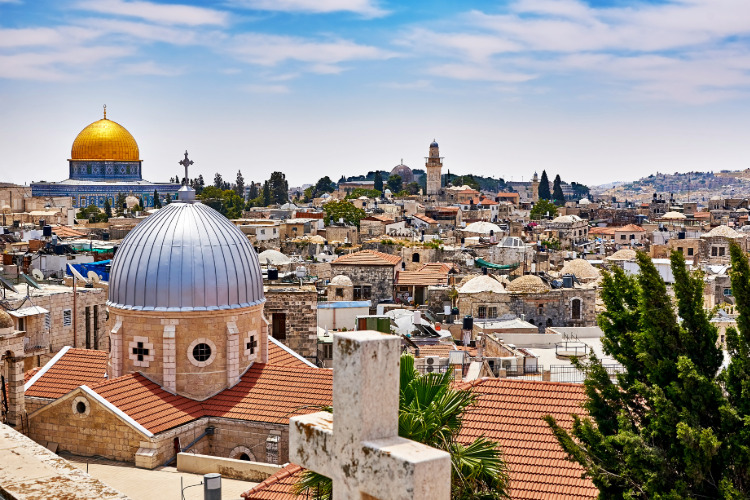
Christians cannot afford to let headlines and social media shape their view of Israel. Scripture provides a foundation for understanding Israel, God’s promises and our response.
6 October 2026
6.2 MINS
Britain’s grooming gang scandal exposes a devastating failure to protect vulnerable children, raising urgent questions about political correctness, accountability, immigration and the loss of moral courage.

6 October 2026
3.8 MINS
A grandmother’s disputed death has put Canada’s euthanasia regime under fresh scrutiny, as the Medical Assistance in Dying (MAiD) program passes 100,000 deaths with a further expansion slated for 2027.
6 October 2026
3.3 MINS
We often talk about church renewal as though we need more people, more programmes, more energy and more resources. But Jesus seems to start somewhere much smaller. With two or three.

5 October 2026
4.9 MINS
Free Speech Union co-founder Reuben Kirkham warns Australia’s proposed Digital Duty of Care could expand censorship powers, undermine free expression and bypass recent legal protections.
5 October 2026
7.3 MINS
DJ, composer and trance music icon, Tyson Illingworth aka tyDi shares his testimony in coming (back) to Christ in this exclusive interview with Aaron Duff from Australian Christian Records.


