


Will Islam Overtake Christianity as the World’s Largest Religion?
I’ve been mulling over a claim I’ve heard countless times, namely that Islam is on track to become the largest religion in the world. The numbers often cited sound convincing enough, but I’ve grown sceptical of the idea that this outcome is inevitable. I wouldn’t call myself an expert in religious demographics, but I’ve spent time digging into the data over the years, and the deeper I’ve gone, the more I’ve come to suspect that the story isn’t as straightforward as it seems. Beneath the headline figures, there are cracks that could dramatically change the trajectory.
For centuries, Christianity has stood as the world’s largest religion, shaping cultures, governments, and ideas across the globe. But that dominance may not last forever. Islam is growing rapidly, not just in population but also in confidence, influence, and, in some corners, militant ambition.
A recent sermon in Sydney, Australia, captured this mood vividly: an imam praised those “fighting with their blood and their children” on the front lines of jihad and promised that “Islam will dominate” as it has before (Leach, 2025). The fact that such rhetoric is being preached openly in a Western democracy shows how radical Islamist narratives are no longer confined to distant conflicts but are being voiced, and in some cases embraced, within the societies they aim to transform. And according to the Pew Research Center, if current trends continue, Islam could overtake Christianity as the world’s largest religion by the end of the century.
Yet behind the bold claims, the picture is far more complicated. Critics like Christian apologist/polemicist David Wood argue that Islam’s growth is fueled more by high birth rates and immigration than by large numbers of new converts, and those factors don’t always translate into deep or lasting faith (Licona, 2020).
Beneath the surface, millions of Muslims, particularly younger people with greater access to information, are starting to question their beliefs, and many are leaving the religion altogether. In places like Iran, surveys even suggest that a majority no longer identify as Muslim despite what official statistics report, hinting at a hidden wave of disaffiliation that challenges the narrative of unstoppable Islamic expansion.
Wood also highlights cracks in Islam’s theological foundations. Public acknowledgments of “holes in the narrative” around Qur’an preservation, textual variants, and competing manuscript traditions undermine long-held claims of perfect divine protection. These issues fuel what he calls the “Islamic dilemma”, since the Qur’an both affirms and contradicts the Bible, which means Islam is false whether the Bible is preserved or corrupted. Christianity, by contrast, rests not on flawless scripture but on the historical reality of Jesus’ resurrection, a truth, Wood argues, that stands independent of textual debates.
And Wood is not alone in his scepticism. Many demographers and sociologists warn that projecting the world’s religious landscape decades into the future is anything but certain. Rising secularisation, shifting cultural identities, and declining religious commitment could slow or even reverse Islam’s growth. Meanwhile, Christianity continues to expand across sub-Saharan Africa and parts of Asia, where explosive population growth and conversion movements could offset Islam’s demographic advantage.
The question, then, is far from settled. Is Islam truly poised to surpass Christianity and redefine global culture and politics, or are we mistaking temporary momentum for lasting dominance? The answer could shape the future of both faiths — and influence the course of civilisation — in the decades to come.
120 Years of Religious Growth: Christianity’s Global Shift and Islam’s Demographic Momentum
Over the last 120 years, both Christianity and Islam have grown enormously. In 1900, there were about 560 million Christians (roughly 26–27% of the world’s population) and around 240 million Muslims (about 12%). Today, Christianity has grown to about 2.5 billion (31–32%), while Islam has surged to nearly 2 billion (24–25%) (Pew Research Center, 2015/2017).
Christianity’s expansion over this period has been shaped by both geographic spread and the long-term effects of conversion, with new Christian populations growing rapidly through natural increase in the generations that followed. Its centre of gravity has shifted from Europe and North America to the Global South, especially sub-Saharan Africa, which exploded from about 9 million Christians in 1900 to over 680 million today (Pew Research Center, 2015/2017). Much of this growth was driven by conversion in the colonial and post-colonial periods, followed by high fertility rates among those newly converted communities. Meanwhile, the West has experienced a steep decline, with secularisation eroding Christianity’s institutional strength but not its global vitality.
Islam, by contrast, has expanded primarily through demographic momentum. Higher fertility rates, youthful age structures, strong religious retention, and post-colonial Islamic revival (tajdīd) movements that reinforced communal identity have driven its rapid expansion. Migration has also played a significant role, planting Muslim communities across Europe, the Americas, and Australia (Pew Research Center, 2015/2017). While conversion has contributed little to Islam’s global growth—Pew notes that about as many people leave Islam as join it—the sheer demographic weight of high fertility has propelled its rise.
Because Muslim populations are on average much younger than Christian ones, demographers often project that Muslims could approach numerical parity with Christians by around 2060 and possibly surpass them by 2075 if these trends hold (Pew Research Center, 2015/2017). Yet this forecast depends heavily on current fertility and retention patterns remaining stable. If either begins to erode—as has happened in other religious traditions—Islam’s long-term growth trajectory could change far more quickly than these surface projections suggest.
However, those projections assume that what has been true will stay true — an increasingly uncertain assumption, given evidence of rising religious disaffiliation among younger Muslims (Pew Research Center, 2015/2017). We’re already seeing religious disaffiliation rising sharply among younger Muslims, which undercuts the very engine of Islam’s growth: retention.
To visualise this, with much help from AI, I built three simple scenario models starting from today’s populations (about 2.5 billion Christians and 2.0 billion Muslims) using an AI language model (ChatGPT; OpenAI, personal communication, September 17, 2025).
- Status Quo: assumes current Pew-style growth (Christians +0.8%/yr, Muslims +1.2%/yr)
- Moderate Disaffiliation: assumes retention among Muslim youth softens (Christians +0.7%/yr, Muslims +0.8%/yr)
- High Disaffiliation: assumes widespread Turkey/Iran-like patterns (Christians +0.7%/yr, Muslims +0.4%/yr)
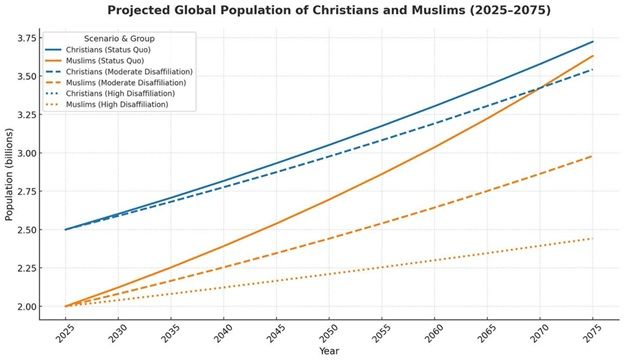
Graph created by ChatGPT; OpenAI, personal communication, 17 September 2025
Here’s the striking part: when you factor in the fragility of youth retention, the supposed inevitability of Islam surpassing Christianity begins to unravel. Pew’s baseline projections suggest Muslims could approach parity with Christians around 2075 if current fertility and retention rates hold, but those forecasts assume that Muslim youth will continue to remain highly religious across generations. If retention weakens even modestly, the pace toward parity would slow dramatically, and if disaffiliation rises sharply—as has happened elsewhere—the gap could actually widen again. The surface projections depend on a single untested assumption: that Islam’s extraordinary retention among youth will remain stable forever.
I also looked at a few key regions. Nigeria shows how higher Muslim fertility can shift demographics quickly, though it’s important to note that Christianity is also growing rapidly there, especially through Pentecostalism, which tempers the scale of Islam’s advantage. India shows the Muslim fertility gap narrowing fast as birthrates fall, and while the Muslim share is still rising due to a younger age structure, that rise is slowing. Iran shows what happens when retention collapses—fertility has already plummeted, and younger generations are abandoning Islam in droves despite the regime’s official numbers. Europe shows how migration can raise Muslim numbers in the short term, yet second- and third-generation secularisation steadily pulls many away from religious practice, casting doubt on the long-term durability of this growth.
When you combine these forces, Islam’s demographic momentum suddenly looks far more fragile than people assume. In short, while Islam’s rapid growth over the past century has been real, its future growth may prove brittle. Christianity’s center has shifted to the Global South, where high retention and vibrant community life have helped faith expand and endure, while Islam’s current growth rests heavily on demographic momentum that may not translate into lasting conviction among younger generations. Islam may still grow on paper, but it could easily become a demographic giant with a hollow spiritual core if these trends among young people continue.
These dynamics come into sharper focus when you examine specific countries, where the cracks in Islam’s growth engines—fertility, retention, and migration—are already beginning to show.
Regional Case Studies of Islam’s Growth
While global Muslim population projections anticipate steady growth, several regional case studies reveal that this growth is not guaranteed. Demographic momentum can erode when fertility declines, religious retention weakens, or secularization accelerates. The following case studies illustrate the diverse mechanisms driving Islam’s growth—and the vulnerabilities that could slow or reverse it.
Sub-Saharan Africa: Nigeria — Fertility Driving a Religious Shift
Nigeria, Africa’s most populous country, presents one of the most pivotal frontlines for religious demography. It is roughly split between a Muslim-majority north and a Christian-majority south.
For decades, the fertility rate among Muslims has been higher than among Christians, contributing to a gradual tilt in the national balance toward Islam. This is rooted in socio-cultural and economic patterns: northern Muslim communities tend to marry earlier, have larger families, and historically have had slower access to female education, all of which sustained higher fertility.
In 1999, several northern states formally adopted Sharia law, reinforcing Muslim identity and indirectly shaping family behaviours in ways that maintain higher fertility. Although Nigeria has also experienced explosive Christian growth, especially through Pentecostalism, demographers agree that differential fertility—more than conversion—has been the main driver of Islam’s expansion.
However, this trajectory is not assured. Fertility among both Muslims and Christians is now falling, and the gap is narrowing slowly. Younger generations in cities are showing signs of religious disillusionment, and rapid urbanisation tends to reduce both fertility and religiosity. If secularisation accelerates alongside urbanisation, Nigeria’s demographic momentum toward Islam could plateau or reverse within a generation.
South Asia: India — Narrowing Fertility Gaps and Early Secularisation Signals
India, home to the world’s second-largest Muslim population, shows a different dynamic. Historically, Muslims have had higher fertility than Hindus and Christians, fueling their relative demographic growth. Yet recent demographic data show that the Muslim fertility rate has been declining faster than that of Hindus, narrowing the gap dramatically (from 1.1 children in 1992 to about 0.3 in 2019).
This shift is closely linked to expanding female education, increased urbanisation, and rising socioeconomic mobility among younger Muslims. These same forces have previously triggered religious decline among other groups worldwide. Moreover, while religion still holds cultural weight in India, secular and humanist currents are increasingly visible among urban youth—including Muslims—driven in part by exposure to global media and online discourse.
Christianity’s growth in India has come mainly through conversion, especially among lower-caste and tribal groups, while Islam’s growth has been fueled primarily by natural increase. If Muslim fertility continues to fall and secularisation deepens among youth, Islam’s demographic advantage could erode rapidly, even as Christianity’s conversion-driven growth continues on a separate track.
Europe — Migration Growth Meets Generational Drift
Europe’s Muslim population has grown primarily through immigration and higher fertility among first-generation immigrants from the Middle East, North Africa, and South Asia. This has increased Muslim representation in countries like France, Germany, and the UK, often provoking public debates over integration and identity.
However, second- and third-generation Muslims show signs of religious loosening. While they may retain cultural Muslim identity, many do not pray regularly, attend mosque, or hold to orthodox beliefs. This pattern mirrors the secular drift once seen among Catholic and Orthodox Christian immigrant groups in earlier centuries.
Migration has given Islam a short-term numerical boost, but assimilation and secularisation are steadily reducing religious practice among younger generations. Christianity’s institutional presence in Europe has withered, yet small evangelical and immigrant-led churches are quietly growing, sometimes attracting disillusioned Muslim-background youth who find in Christianity a moral anchor amid cultural dislocation.
If secularisation continues to accelerate, Europe could see Muslim identity persist culturally while religious practice fades, following the same path Christianity once did.
United States — Hart–Celler Act Immigration and Assimilation Pressures
Islam’s growth in the United States has been driven primarily by immigration rather than fertility or conversion, and the 1965 Hart–Celler Immigration and Nationality Act was a pivotal turning point. By abolishing restrictive national origin quotas, it opened the door to large-scale immigration from Muslim-majority regions such as South Asia, the Middle East, and Africa.
As a result, the U.S. Muslim population became far more ethnically and culturally diverse and began to grow rapidly, especially after 1980, as immigration surged and immigrant families established themselves. Many of these newcomers had higher-than-average education levels and birthrates slightly above the U.S. average, which helped sustain community growth.
However, while first-generation immigrants tend to retain strong religious commitment, second-generation Muslims face powerful assimilation pressures. They are more likely to intermarry, adopt secular American norms, and disengage somewhat from mosque life. The broader U.S. religious landscape also accelerates this drift: the largest religious group among young adults is now the religiously unaffiliated (“nones”), indicating a powerful secularising current.
While some conversions to Islam occur—especially among African Americans—these are largely balanced by departures, and Muslims still make up only about 1.1–1.3% of the U.S. population. Pew (2017) also found Muslim retention in the U.S. is high (around 77%), comparable to Christian retention, but lower among those raised Muslim in secular contexts. If current assimilation and secularisation trends continue, the growth of Islam in the U.S. may plateau despite ongoing immigration.
Australia — Small Base, Rapid Growth, but Weak Retention
Australia has seen one of the fastest percentage increases in its Muslim population in the Western world, largely through immigration from Lebanon, Turkey, and, more recently, South Asia and Africa. Muslims now make up about 3% of the population, up from less than 1% in the 1980s.
This growth has been almost entirely immigration-driven, as fertility rates have converged with the national average and conversion rates remain minimal. Yet surveys consistently show that younger Muslims in Australia, while culturally attached to their heritage, participate less in mosque life and are more likely to adopt secular worldviews than their parents.
Given Australia’s highly secular society, the risk for Islam’s future growth there is not backlash but dilution: as younger Muslims assimilate into broader Australian culture, religious identity often weakens. Without strong religious retention, the Muslim population could stagnate or even decline over time despite continued migration.
Examples of Islam’s Decline
Iran: Collapse of Religious Retention
Iran may be the clearest case of collapsing religious retention undermining demographic momentum. While the regime claims that 95–99% of the population is Muslim, independent surveys (such as those by the Netherlands-based GAMAAN institute) suggest that less than half of Iranians under 30 now identify as Muslim, with as many as one in five identifying as Christian or spiritually seeking.
Iran’s fertility rate has plummeted to about 1.7—and continues falling—causing the population to age rapidly. This combination of very low fertility and mass disaffiliation is devastating for religious continuity. Within just one generation, Iran has moved from an Islamic revivalist fervour after 1979 to widespread post-Islamic scepticism among youth.
Iran’s trajectory shows that once the religious monopoly of Islam is broken, social transformation can happen quickly. If current trends hold, the country could experience not only demographic stagnation but a profound civilizational shift toward post-religious identity.
Albania: Post-Communist Secularisation and Religious Disengagement
Albania offers one of the clearest examples of a Muslim-majority country where Islam has been steadily declining. Historically, the Ottoman Empire’s rule left Albania with a Muslim majority, but decades of harsh state atheism under communism (1945–1990) shattered organised religion’s social presence. When religious freedom returned after 1990, Islamic identity resurged briefly as part of national heritage, but this did not translate into lasting religious commitment.
Today, while census data still report that over half the population identifies nominally as Muslim, surveys reveal very low religious practice: few Albanians attend mosque, fast during Ramadan, or raise children with religious instruction. Instead, rapid urbanisation, migration to Western Europe, and consumer-driven individualism have created a largely secular society.
Islam in Albania now functions more as a cultural marker than a faith system, and its share of active adherents continues to shrink, especially among youth. This suggests that once cultural Islam is detached from practice, it can wither within a single generation.
Bosnia and Herzegovina: Identity Without Transmission
Bosnia and Herzegovina, like Albania, has seen a weakening of Islamic practice despite a historically Muslim population. The Bosniak Muslim identity revived strongly during and after the 1990s wars as a marker of ethnic solidarity, but this surge was more cultural than religious. Over the past two decades, religious practice has declined significantly, especially among urban youth.
Postwar modernisation, integration with secular European institutions, and heavy emigration of young people to Western Europe have all contributed to this decline. Fertility rates are among the lowest in the world (around 1.3), which accelerates demographic contraction, and surveys show rising numbers of young Bosniaks identifying as non-religious or disengaged from organised Islam.
This shows how a religion can rebound temporarily due to identity politics yet fail to transmit itself spiritually to the next generation, leading to slow but steady erosion.
What These Regional Patterns Reveal
These case studies show that Islam’s growth is uneven and fragile. Where fertility stays high and retention holds (northern Nigeria, parts of rural Africa), Islam grows rapidly. But where fertility falls or disaffiliation rises (Iran, Turkey, the Arab world, second-gen Europe), the demographic engine stalls quickly.
Christianity, meanwhile, is still declining in the secular West but surging in Sub-Saharan Africa, Latin America, and even underground in China and Iran. This means its future growth is based less on birth rates and more on conversion and spiritual renewal—which, though slower, tends to be more durable when cultural pressures shift.
So, while it’s technically accurate that Islam could surpass Christianity in numbers by mid-century, the soul of the story is different: Islam’s expansion is largely demographic momentum, while Christianity’s future vitality is increasingly convictional. If disaffiliation among Muslim youth continues accelerating, those headline projections could collapse much faster than anyone expects.
___
Works Cited
- Leach, M. [Mark Leach]. (2025, September 28). This is what the Muslim preachers in Sydney are saying [Video]. Facebook.
- Licona, M. [David Wood]. (2020, December 27). David Wood discusses the present collapse of Islam [Video]. YouTube.
- Pew Research Center. (2015, April 2). The future of world religions: Population growth projections, 2015–2050 (updated April 5, 2017).
- OpenAI. ChatGPT. Personal communication. 17 September 2025.
- GAMAAN (Group for Analyzing and Measuring Attitudes in Iran). Iranians’ Attitudes toward Religion: 2020 Survey Report. GAMAAN, 2020.
___
Image courtesy of Adobe.
4 Comments
Leave A Comment
Recent Articles:

27 October 2026
1.5 MINS
Labor’s Digital Duty of Care Bill threatens free speech, empowers covert online surveillance, and imposes potentially burdensome regulations on Australian businesses.

27 October 2026
10.3 MINS
As Tasmania and Western Australia consider conversion therapy bans, a former LGBT+ ministry leader warns of threats to religious freedom, personal choice and Christian discipleship.

27 October 2026
4.9 MINS
Nine Christians have been killed in a terrorist attack on a Jordanian church, prompting fierce condemnation, demands for justice and renewed concerns about religious persecution.
27 October 2026
3.6 MINS
For 25 years, the Mount Moriah Trust has supported struggling Christians across the Holy Land, bringing practical assistance, encouragement and hope to believers facing hardship and persecution.
27 October 2026
3.1 MINS
As the disciples discovered through a huge haul of fish, we can trust Jesus for a net-breaking, boat-sinking catch of people.

26 October 2026
4.5 MINS
OECD chief Mathias Cormann warns Australia is losing its competitive edge, as excessive regulation, housing pressures, immigration challenges and declining public trust threaten national prosperity.

26 October 2026
3 MINS
Australia’s national resilience inquiry overlooks a critical weakness: decades of deindustrialisation have left the nation dangerously dependent on imports, unprepared for compounding threats and strategic disruption.



There is another element not mentioned here, and it puts the rise of Islam in a very dark place: inbreeding.
One significant difference between Catholic Europe and the Middle East (as well as many other places around the world) is that the Church banned cousin marriage a few hundred years ago. This contributed to the intellectual rise of Europe.
https://cosmosmagazine.com/people/society/the-west-won-out-when-cousins-stopped-kissing/
Why not first examine God’s words about Islam, apostate christianity,? Why focus on the “knowledge based on men’s research”.
Daniel 11 and 12 clearly documents the Kingdoms Nebuchamezzar’s dream . Daniel 2 says all these Kingdoms which impact on Israel will be destroyed by the uncut stone Yeshua who will establish Yah’s Kingdom on the earth forever.
we have seen more than 2000 years of Rome. We are coming to the 2000 year anniversary of the crucifixion, resurrection and ascension of Yeshua. if you study this chapter you can see the ministry of Yeshua 27 CE and his crucifixion 2031. You see that the vile Roman Emperor caused Messiah to be cut off.You can see conflicts between the Roman leaders and Islam ( Crusades, Holy Wars and current events). The statue had 2 legs of clay and iron, representing Radical Islam and adherents and the Papal system and apostates who follow Constantine’s changes to Yahweh’s words. Daniel 11:40 writes about the time of the end which is where we are. Radical Islam (king of the south) is attacking the Pope (king of North and apostates). 2014 ISIS declared war on the Pope who asks Obama to intervene. Thousands of believers are slaughtered. Mass migration of the people of the king of the south flooded western civilisations. 2025 the world is witnessing violent jihad everywhere. However Daniel 11:40 says the papacy and apostates will attack Islam “like a whirlwind “. Egypt will be defeated (Muslim Brotherhood?) but Edom, Moab and Ammon will be spared. The attack will move into the land of Israel but this king will be defeated by the uncut stone of Yeshua.
I am an ordinary citizen who seeks out truth. I know Truth Is found in Yeshua and Yah’s words – not in secular elitist intellectual Blay Blayney.
Where are so called leaders who know this truth?
westernisarion has imo totally destroyed Christianity fundamentally and is now attacking Islam too .
Christianity used to have the same prayer times as Islam ,used to ban music ,used to allow sex only for reproduction ,absolutely condemned it as recreation , basically was aligned to monks and nuns commitments to poverty chastity and obedience It’s all gone with the wind .
It’s just a shadow now imo used for political purposes Get to work, slave, and ve grateful you’re allowed to have a job, get married and have gave kids to replace yourselfs when your past your use
by date. .Slaves to industrialisation now being transformed into slaves to virtual reality .
All religions are doing it imo .
They just don’t like Christianity because it fundamentally stares that we are all the children of God ,and are the living flesh with the blood flowing in our veins as divine beings .
They hate that imo
You know back in genesis after eve tempts Adam and Gid discovers they know they’re naked ,and the lesser gods have said ,now that they have knowledge of good and evil ,then they will discover the Tree of Life at the centre of the Garden and become as God’s like us Plural .
That’s the key imo .
Islam, not Christianity is the biggest religion in the world: Impression needs correction
By Dr. Javed Jamil
If you ask anybody or google which are the largest religions in the world, the answer will be Christianity followed by Islam. But the truth is that the population of Muslims believing in the fundamentals of Islam is much larger than the population of Christians believing in the basic tenets of Christianity.
Pew Centre shows 2.2 billion Christians (32% of the world’s population), 1.6 billion Muslims (23%), 1 billion Hindus (15%), nearly 500 million Buddhists (7%) and 14 million Jews (0.2%) around the world as of 2010. Obviously, these are little older figures. Wikipedia gives the following percentage of the main religions:
Religion Adherence Percentage
Christianity 2.382 billion. 31.11%
Islam 1.907 billion. 24.9%
Secular/Nonreligious/Agnostic/Atheist 1.193 billion. 15.58%
But while the number of Muslims who are firmly committed to the fundamentals of their religion (One God, Muhammad the Last Prophet, Quran the Book of God, Hereafter) has been continuously growing, the number of Christians believing in the basic tenets of Christianity (Jesus as God or Son of God, Gospel the Divine book) continues to go down with every passing day. Interestingly, while Muslims firmly believe that Jesus was born as a divine miracle from a virgin mother Mary, a large number of Christians will be found rejecting or doubting this.
According to an article, titled “ A Majority Of Americans Think Jesus Is A Great Teacher Yet” (PRNewswire), “A new survey reveals that 52 percent of American adults believe that Jesus was a great teacher and nothing more.” This is despite the fact that the Christianity in America is stronger than in Europe and Australian continents.
An article, titled ‘Christianity as default is gone’: the rise of a non-Christian
Europe” by Harriet Sherwood published in Guardian says: “Europe’s march towards a post-Christian society has been starkly illustrated by research showing a majority of young people in a dozen countries do not follow a religion. The survey of 16- to 29-year-olds found the Czech Republic is the least religious country in Europe, with 91% of that age group saying they have no religious affiliation. Between 70% and 80% of young adults in Estonia, Sweden and the Netherlands also categories themselves as non-religious.”
An article on the situation in Australia titled “Most Australian young people open to change their religious views”says:
“Australian research company McCrindle recently released a study called The Changing Faith Landscape in Australia, which shows that 46% of Australians “identify with Christianity”. Furthermore, 13% defined themselves as unaffiliated believers; 33% of respondents said they were atheists or agnostic; and 6% practiced other religions.
Regarding the age, “younger Australians are less likely to identify with Christianity than their older counterparts”. Nearly three-quarters (73%) of the oldest generation still consider themselves Christian while just 38% of the Generation Z respondents said that.”
In contrast, Muslims are showing greater commitment to their religion, and this has continued to increase. An article about Muslims in America, “Non-Belief: An Islamic Perspective – Secularism and Nonreligion” by K Sevinç · (2018) says, “The rate of those who believe in God is 94.5% and those who self identify themselves as Muslim is 97%”.
The same is true of the whole Muslim world where the overwhelming majority of Muslims (95-99%) can be easily found as having firm belief in God, Muhammad and Quran.
If only 40-50 % (even less in many parts including Europe) of the so-called Christian world does not even believe in Jesus as prescribed in Christianity, why should their numbers be still counted as above 2.3 billion. The truth is that the number of Christians by faith is not more than 1.3 billion. There is absolutely no reason to doubt that Islam is the biggest religion of the world, and its percentage is expected to continue to increase at least in the next decade.
According to The New York Times, an estimated 25% of American Muslims are converts. In Britain, around 6,000 people convert to Islam per year and, according to a June 2000 article in the British Muslims Monthly Survey, the majority of new Muslim converts in Britain were women. According to The Huffington Post
HuffPost – Wikipedia
HuffPost (The Huffington Post until 2017; often abbreviated as HuffPo) is an American progressive[1][2][3][4] ne..
, “observers estimate that as many as 20,000 Americans convert to Islam annually.”
When it comes to the reasons why Islam is growing, the Western experts try to paint it mainly the effect of their having more children. First, the conversion to Islam is definitely much more than that to any other religion. Second, if Muslim fertility rate is slightly higher, the reasons are simple. First, the family system is still strong in Muslim societies whereas it has totally disintegrated in the so-called Christian or Western world. Second, Muslims are much less likely to abort than others, as they consider it a sin. On the other hand, in America and Europe, an overwhelming majority of pregnancies end up in induced abortions. Human Rights organizations do not care of the daily genocide which is going around the world without a break, resulting in the murders of more than 70 million unborn children every year. In India, female foeticide is very common in Hindu community with the Male/Female ration dropping to less than 100/80 in many states.
Muslims need to tell the world that support to promiscuity, homosexuality and abortions in the name of “Freedom of Choice” is nothing but a support to dismantling and destroying humanity on the earth, in terms of its physical as well as moral and social meanings. If the current trend continues, a time can come sooner than later when the very survival of mankind will be in danger. Those who support and practice these practices can hardly claim to be civilized. But what else can be expected in a world, which is dominated by what I call “Economic Fundamentalism” and where the interests of life, health and peace are only secondary to the interests of the market.
But the West-dominated media will continue to give the misplaced figures because this suits them. If they are showing this it does not mean that they have any love for Christianity. It is only because they think that Christianity in name rather than in its spiritual and moral forms is no threat to their system which commercializes all those practices that are considered immoral y most religions. They fear Islam more because they feel that the concept of fundamental prohibition is more emphatic in Islam
I need to emphasize here that if Christianity is losing sheen it makes me worried. Christianity needs to be serious about why it is losing to atheist ideologies of the world.
I have been arguing for decades that the challenge for religious in today’s world does not come from one another but from the ant-religion forces that dominate the world; and the religions need to unite to face this threat rather than fighting each other.
***
Dr Javed Jamil is India based thinker and writer and Chair in Islamic Studies & research, Yenepoya University, Mangalore.