


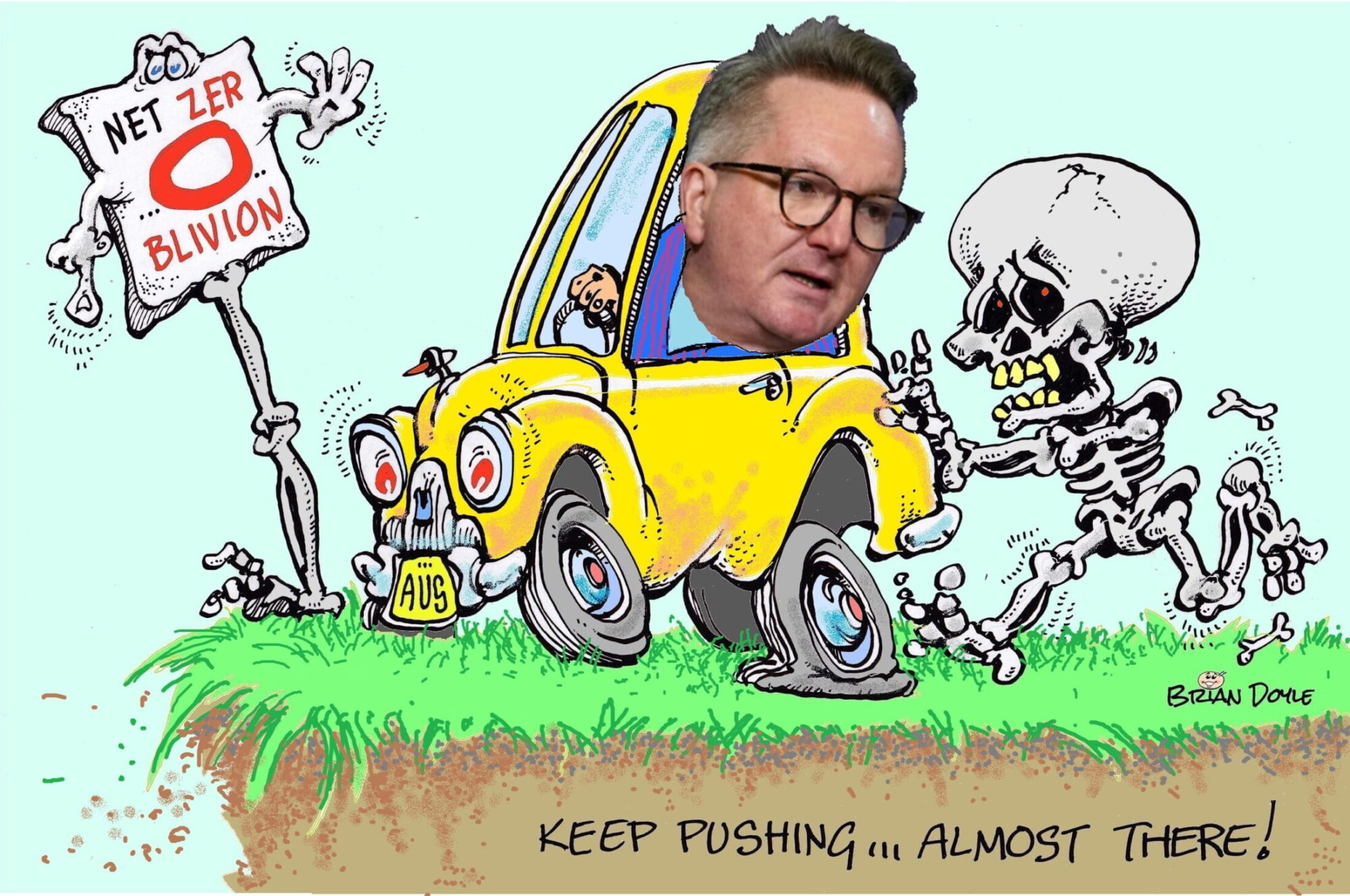
Fuel Crisis Severity Caused by Political Incompetence, Not Iran
The severity of the global fuel crisis hitting Australians, and that may well reverberate for years to come, is not because Iran shut the vital Strait of Hormuz. It is from decades of incompetent Australian political leadership. This was epitomised by Minister for Agriculture, Fisheries and Forestry Julie Collins saying of the current crisis that you can’t predict war.
Well, we can’t predict droughts, so we build dams to ensure water supplies. We can’t predict cyclones and bushfires, but we run resilience community exercises and provide a national disaster fund for Australians affected by natural disasters. We pay insurances to mitigate accidents and disasters.
When it comes to liquid fuel security, Australia has done nothing but demonstrate gross negligence despite many warnings, as Tony O’Brien describes here.
Pathetic reserves: Macrobusiness chief economist Leith van Onselen reveals that, of 27 Western countries, Australia comes last in terms of national liquid fuel reserves, only about 30 days. The next lowest is Turkey with 100 days, while the Netherlands holds over 400 days of reserves.
Australia’s oil exploration expanded after World War II and again after the 1970s oil shock. However, the mantra that there would be no future oil shocks, that free trade and “the markets” would guarantee imported supplies and that the nation could reliably run on renewables saw our refineries dwindle from eight in 2000, to just two today.
Now, Australia imports around 83 per cent of its liquid fuels (2022), or about 1.1 million barrels per day.
Almost all of this comes from refineries in Asia, in particular South Korea, Singapore, Malaysia and China. In turn, about 60 to 70 per cent of their crude oil originates in the Middle East, mostly through the blockaded Strait of Hormuz.
To conserve fuel for their own markets, China, Vietnam and Thailand have banned exports of refined products. South Korea imposed a cap on exports at 2025 levels. The United States may restrict/ban exports so Trump can keep U.S. petrol prices down in the run-up to November’s mid-term elections.
And if the crisis continues, then the effects on world oil supplies will be prolonged. Gulf states will be forced to shut down refineries when their storages are filled, and wells will also have to stop pumping. These cannot be easily switched back on again.
Restarting a refinery can take months to being back into production. Wells have to be cleaned and serviced before restarting, which can take months, while heavy crude wells can take years to restart.
How Foolish Are We?
Chris Bowen’s Department of Climate Change, Energy, Environment and Water (DCCEEW) admits that 90.7 per cent of Australia’s total energy use (electricity, vehicles and industry) comes from fossil fuels, with only 9.3 per cent from renewables. Yet Bowen’s Government pays endless homage to flawed renewables policies, while straitjacketing Australia’s vast underutilised energy resources.
These resources have been documented by Geosciences Australia:
14 per cent of the world’s coal: with enough in Queensland to fire all of Australia’s coal-fired power stations for hundreds of years, yet federal and state policies are to shut down all coal plants by 2050.
32 per cent of the world’s uranium: but federal and state governments have banned civilian nuclear-power plants. Yet European Commission President Ursula von der Leyen now confesses that curtailing Europe’s nuclear-energy sector was a fundamental “strategic mistake”.
Gas: Australia exports vast amounts of its plentiful gas, yet only Western Australia quarantines some of its reserves for domestic use. Further, the Federal Government axed subsidies for converting cars to gas a decade ago, while many service stations are quitting gas because of prohibitive requirements to test their tanks every five to ten years, forcing motorists to depend on imported oil.
Oil: Geosciences Australia says that Australia has only small domestic reserves of gas and other liquid fuels, by world standards (about 1 per cent). However, this has to be qualified. Australians don’t really know how much gas and oil reserves are commercially available.
Why? Because, in nominal dollar terms, exploration has crashed by 80 per cent since 2012, according to ABS data. In the year to September 2025, only $1.1 billion was spent on exploration, compared with $3.95 billion for minerals exploration (2024). Meanwhile, the federal Clean Energy Finance Corporation has a $32.5 billion fund – for renewables only.
Political forces skewing investment into renewables have collapsed oil and gas exploration, despite oil and gas supplying 65.4 per cent of Australia’s energy needs.
What Is To Be Done?
- Ration fuel and prioritise farmers, road transport and diesel trains that supply coal to power plants.
- Use Australia’s gas exports as a bargaining chip to keep liquid fuels coming.
- Beg the US to supply Australia before Trump curtails exports.
- Urgently restore World War II fuel storage depots and build large new storage depots across the country.
- Spend the necessary billions to restore, and build new, oil refineries capable of handling all grades of crude oil.
- Immediately announce attractive incentives for oil and gas exploration and for converting cars from petrol and diesel to gas.
Australians, prepare to get used to fuel rationing, working from home again, relying on public transport, interrupted food supply chains, and higher inflation and interest rates.
___
Republished with thanks to News Weekly.
11 Comments
Leave A Comment
Recent Articles:
21 September 2026
2.4 MINS
It is truly concerning that this sort of incursion into free speech can even be suggested. Labor's Digital Duty of Care Bill is about controlling the narrative online, and must be defeated.

18 September 2026
4.4 MINS
Up to 10,000 rallied in Sydney for a ban on sex-selective abortion. Twenty-four hours later, the NSW Legislative Council defeated John Ruddick's bill 21–16. The fight, says Dr Joanna Howe, is just beginning.

18 September 2026
4.9 MINS
The government's $75 million deradicalisation program isn't working — and some wannabe terrorists have left more radical. So it's announced a new plan — which forbids identifying what's doing the radicalising.

18 September 2026
2.1 MINS
"Trans women are women." Repeat it enough and it starts to feel true. That's not an argument — it's a propaganda technique. And Australia's courts are now enforcing gender ideology.

18 September 2026
5.2 MINS
Nike picked a fight with half its customers, endorsed a man in a sports bra, and defended China's slave labor. Now it's bleeding $200 billion in market value. Turns out customers have a choice.

17 September 2026
5.2 MINS
Surrogacy is often discussed through the hopes of adults seeking children. Meet the woman, born to a surrogate herself, who says the debate should begin instead with the experiences of surrogate mothers and children separated at birth.

17 September 2026
2.8 MINS
"A good mom if you strangle your kids — but lose custody for protecting your daughter from being castrated and mutilated by the gender lobby." That's Massachusetts today, where a Catholic couple lost their teenage girl for refusing to affirm her transgender identity.



Thanks Patrick for this article …much damage has been done by Aus Governments over 5 decades…i agree with your solutions
Patrick, such a balanced analysis. Brilliant! Thank you so much for your work. I think the most telling line in your piece is, “Chris Bowen’s Department of Climate Change, Energy, Environment and Water (DCCEEW) admits that 90.7 per cent of Australia’s total energy use (electricity, vehicles and industry) comes from fossil fuels, with only 9.3 per cent from renewables”.
It is fascinating to reflect on Mr and Mrs Jones’ perspective on these numbers. I think that ‘most Australians’ think that as we are the sunny, windy country we would probably be 60% renewables by now, and aren’t we good in showing the world how to do this!
I have another thought – this crisis is naturally going to boost the popularity and sales of electric cars (from China), result in bolstering the Green Agenda, we must not be dependent on dirty fuels!
Absolutely 100% common sense to deal with the issue.
And labor/greens have zero clue… so they need to scrap net zero while they are at it.
I am and continue to be furious at the situation we find ourselves in, despite many warnings. If possible I would like to see all green energy subsidies stopped to make funds available for the sensible solutions offered in the above article.
Kathy, you’ve nailed it! I agree. My fear is that the squandering of our taxes may ‘go up’ now as more people take ‘advantage’ of the subsidies!
Really great analysis dear brother!
It is no mere incompetence or complacency. While there may or may not be a lingering element of ‘lucky country, she’ll be right mate’ involved, what we are seeing manifested in real time is a major symptom of climate change/net zero psychosis that has been deliberately nurtured by the U.N. And government doesn’t want to antagonise the U.N. otherwise political careers will suffer, and political careers are of the utmost importance.
One thing that is not mentioned in Patrick’s otherwise excellent article is that the enormous rises in fuel at the bowser is all caused by the greed of the oil companies. The world price for a barrel of crude oil is about the same as it was during the last ‘crisis.’ They are making an absolute killing right now and so is the government who’s take of what we pay also rises with every price rise at the bowser. The fact that so many independent outlets are running dry is also caused by the oil companies refusing to supply them. It’s yet another case of not letting a crisis go to waste. The more fear is stoked the more the price will rise and more independent outlets will go to the wall. They won’t be likely to re-open and the price might go back to about $2.00 per litre and everyone will have been fooled yet again.
James, I think you are absolutely right! What perplexes me is that there is ‘no heart’ in the people to ‘make’ our representatives, represent the common sense, fair-go honest treatment of our fellow man.
Excellent article.. many thanks for the information. We are very incompetently governed and have been for quite a while. I do hope more people wake up.
Except for Pauline Hansen