


Australian Fuel Holdings: More Smoke and Foggy Mirrors
Back in July 2018, News Weekly warned that Australia’s imported fuel stocks were perilously low should any international crisis arise. Although our obligation under the International Energy Agency (IEA) agreement to hold 90 days’ fuel was not being met, the then Coalition federal government was not concerned because the Department of Energy advised that there had never been a fuel shortage in Australia.
The Department creatively claimed in its Liquid Fuel Security Review Interim Report, April 2019, that Australia had up to 80 days’ fuel (average for 2018) by counting fuel on the way to Australia, including fuel already loaded in ports of other IEA countries, or in tanker ships on the high seas.
We warned that the security of our fuels held in overseas locations such as South Korea and the United States as “oil tickets” was a mirage. Worse – in the event of a crisis, the host nation holding Australia’s “oil tickets” was not obliged to release our fuels.
Thankfully, the accounting of “our” fuel in IEA ports and on the high seas trick has been modified, and Australia no longer uses the “oil ticket” system.
The Russian invasion of Ukraine in 2022 caused fuel price increases worldwide, from $US97 a barrel on February 22 to $US127 a barrel by March 8. This prompted the then Morrison government to undertake a national fuel risk assessment; but three years later … nothing.
Fuel Stocks
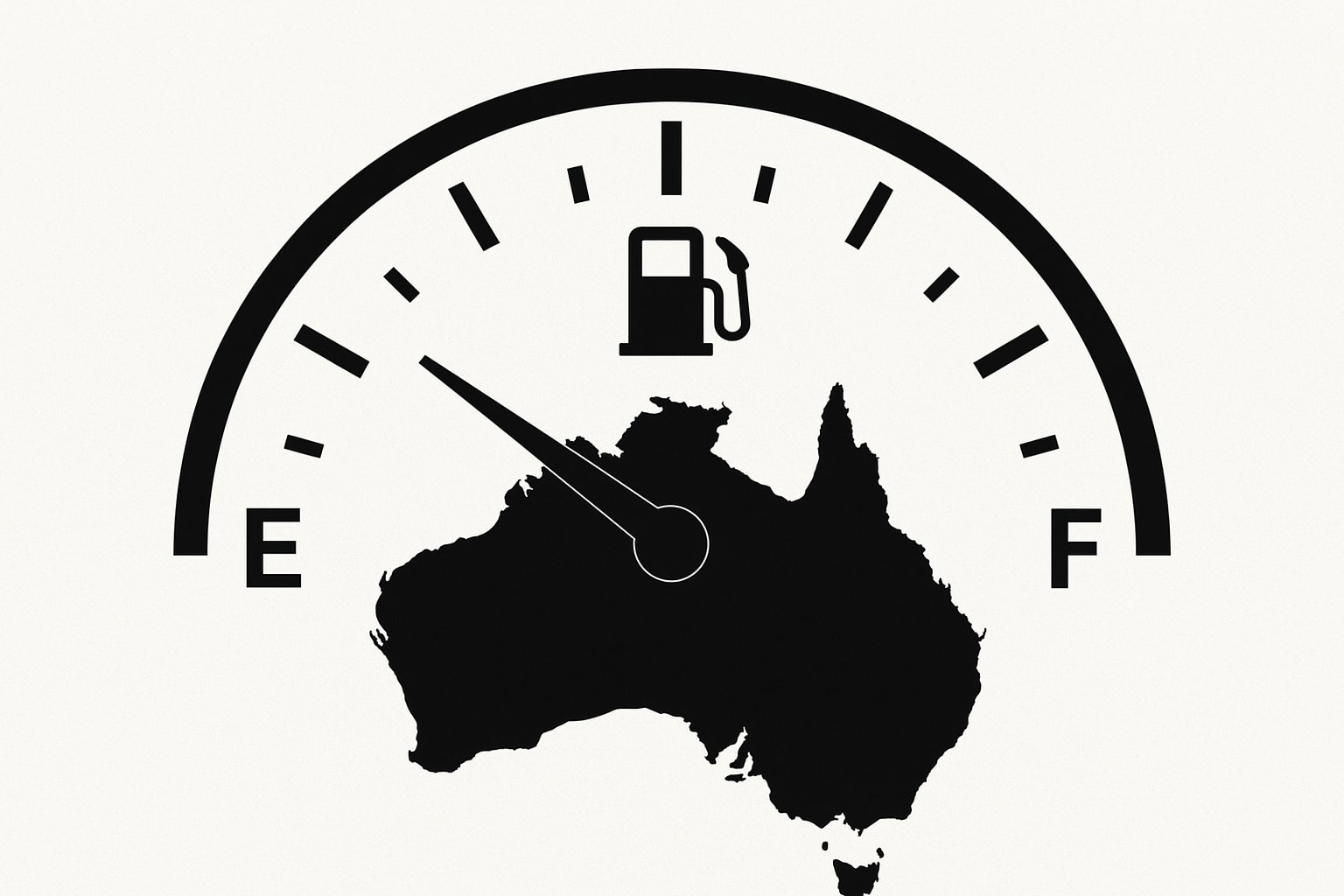
Australia is required to hold minimum fuel stocks to last 90 days so as to be in a position to manage energy disruptions and crises, such as war, cyberattacks on energy infrastructure, supply chain disruptions and extreme weather events. The IEA count fuels “onshore” and not on the water. Consequently, Australia on average in 2023-24, held fuel stocks equivalent to 53 IEA days, namely: 27 days of petrol; 21 days of jet (kerosene) fuel and 23 days of diesel – well short of the mandated 90 days.
Our stocks at the end of June 2025 were: jet fuel, 18 days; petrol, 27 days; and diesel, 23 days; for an IEA rating of 47 days. In reality, the published 23 days of diesel fuel may be an overstatement as there is a shortage of essential AdBlue additives as Australian diesel exhaust fluid manufacturers are wholly reliant on importing refined urea, until domestic manufacturing comes online, in mid-2027.
The Federal Government on July 1, 2023, enacted a national fuel minimum stockholding obligation (MSO), which guarantees a baseline level of domestic fuel stocks. The MSO’s smoke and mirrors accounting includes: fuels in pipelines and crude oil and certain unfinished stocks at refineries, plus refined fuel stocks on water within Australia’s Exclusive Economic Zone (EEZ) out to 200 nautical miles (370 kilometres) as … fuel “onshore”.
This means that the average figures in 2023-24 equated to: 39 days for petrol (78 per cent above the obligation); 32 days for jet fuel (103 per cent above the obligation); and 29 days for diesel (57 per cent above the obligation).
The obligation? Is that the IEA’s obligation or the MSO’s? Confused? You better believe it. IEA v MSO figures compare crab apples to Jonathan apples and deliver a lemon; not 90 days.
This means that, in a real crisis – where a hostile naval power or a natural disaster disrupts tankers bringing refined fuels into Australian ports – the impact will be immediate. History suggests that the first step will be restrictions and rationing imposed on the sale of all liquid fuels throughout Australia. Priority will be given to the armed forces, as occurred after 1941.
By way of comparison, at the outbreak of war in September 1939, according to S.J. Butlins’s War Economy 1939-1942, Australia had sufficient petrol for three months’ normal consumption. If a crisis struck tomorrow, the nation’s 27 days of petrol and 23 days of diesel will not last 90 days without a massive government intervention and disruption to the economy and our way of life.
In 1939, many Australian farmers used horse-drawn equipment to sow and harvest crops. Men bagged the harvests and shipped them to railheads, where steam locomotives hauled the produce to mills, warehouses, markets and ports.
Should rationing be implemented due to an international crisis in 2025, it would be catastrophic, as draft horses, railheads, many rural branch lines and steam locomotives powered by coal have long gone.
Impact
As this article went to press, Pat, a contract farmer, was preparing his five trucks and five headers to be ready by October to strip 8,000 hectares of wheat and canola. His annual consumption is 350,000 litres of diesel. If fuel supplies are disrupted, will the Government allocate the fuel to strip the crops and get them to a railhead? Will there be a locomotive to haul the grain to the mills or port? Will the flour be transported to bakeries and onto customers? With only 23 IEA days of diesel in country, it is unlikely.
An Australian fuel crisis will impact supply chains, all transportation – road, rail, air – and electricity supplies from coal-fired power stations that receive their fuel by rail and road. A food crisis will follow quickly, and the entire economy will grind to a halt.
There has not been a national energy security assessment since 2011, which means that the Albanese Government has no information on the current reality. There is no minister for national resilience.
An Engineers Australia report prepared for the Department of Defence in February 2019 entitled, Industry Responses in a Collapse of Global Governance, predicted that within one week of a major crisis, water treatment systems would degrade; by week two, there would be diesel shortages, and supply of goods and services would decline. After a month food supplies would begin to fail, liquid fuels would be exhausted and freight and passenger services cease.
Today, those predictions sound optimistic.
___
Republished with thanks to News Weekly. Image courtesy of ChatGPT.
2 Comments
Leave A Comment
Recent Articles:

11 October 2026
2.6 MINS
Jesus offers us intimate friendship, which produces great joy as we walk closely with him.

10 October 2026
4.1 MINS
When Jesus rebuked the Laodicean church, this was not a sign of his lack of love, but proof of it and how greatly he longs to reward and bless us. He is knocking — will we answer?

9 October 2026
5 MINS
During a recent dialogue between high profile legal experts, a top Australian constitutional law expert was asked if Australia should have a Bill of Rights. His answer may surprise you.

9 October 2026
1.3 MINS
Season 6 of The Chosen is releasing next month, and until 15 November, your church has the opportunity to host a free pre-release screening of Episode 1. Here's how.

9 October 2026
1.8 MINS
Pen Power Australia has been busy confronting antisemitism and double standards, lodging letters, pursuing accountability and celebrating several important wins along the way.

9 October 2026
3.3 MINS
New South Wales healthcare workers who object to abortion and voluntary assisted dying face growing pressure, raising serious questions about conscience rights, employment and moral injury.

9 October 2026
2.9 MINS
God is intensely relational, and he puts us into a community of believers so we can use our gifts in service of Christ's body.



The obligation? Is that the IEA’s obligation or the MSO’s? Confused? You better believe it. IEA v MSO figures compare crab apples to Jonathan apples and deliver a lemon; not 90 days. 🤠
This issue of fuel security in Australia is one that people have been aware of an intelligent people (e.g. John Anderson) have been attempting to draw attention to & raise awareness about, for a long time . Yet if anything , the issue has largely been ignored given as this article suggests that a genuine overview of the numbers indicates things are gradually getting worse rather than improving.
Given that commercial airline pilots were recently our countries ‘first line of defence’ when live firing drills were conducted by a not so friendly foreign power off our coastline , you have to wonder what else would actually get the governments attention to decisively act on addressing this critical issue.
This is a catastrophe in the making!
Wake up Australia!