


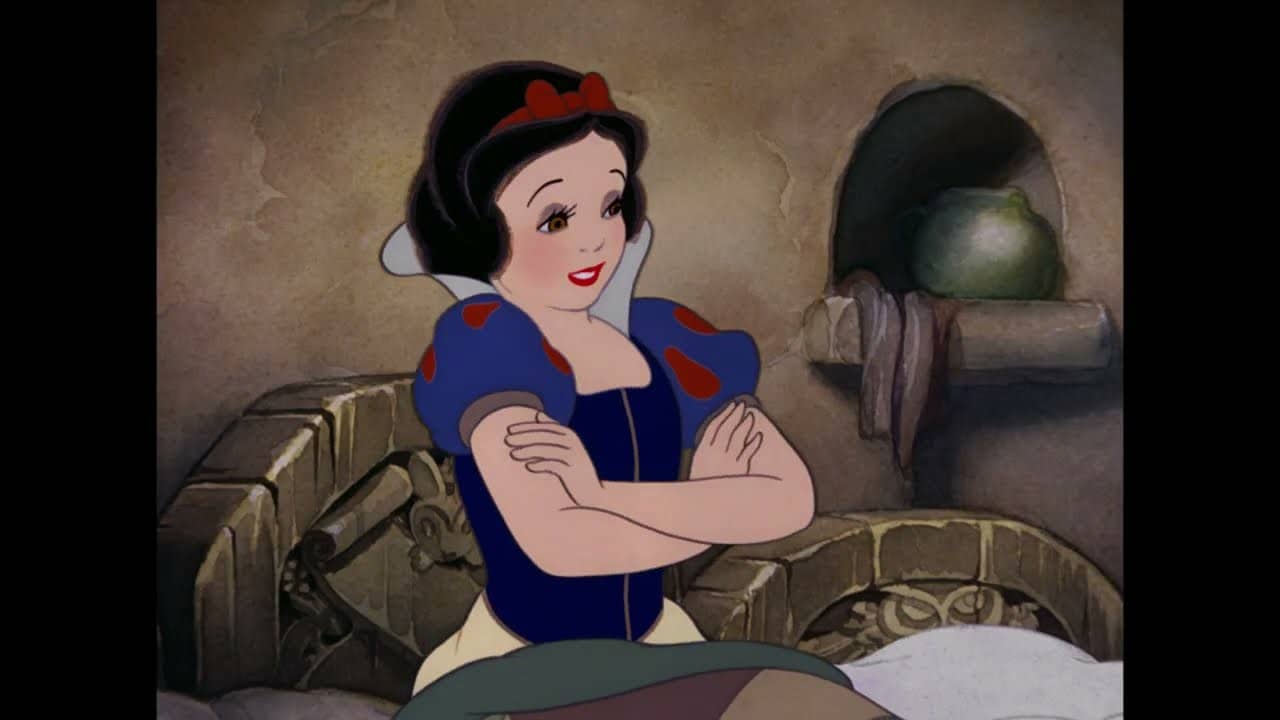
“Inconceivably Good and Bad”: C. S. Lewis’s Surprising Review of Disney’s Snow White
In a little-known letter, C. S. Lewis provides a humorous and controversial assessment of Walt Disney’s first feature film, Snow White (1937), contrasting the “genius” of its technical execution with the “vulgarity” of its characterisations.
In the beginning of 1939 — Wednesday 11 January, to be precise — the English literary critic and Oxford don C. S. Lewis wrote a curious letter to journalist and broadcaster Alfred Kenneth Hamilton Jenkin (1900–1980).
It is quite a lengthy letter by Lewis’s standards. In it, he expresses his regret at being unable to meet with Mr Jenkin over dinner due to the latter contracting “a fell disease” and discusses the particularly “fine old English winter” they are enduring.
He recalls a walking tour with his brother Warren (“Warnie”), which was called off due to a new fall of snow, and narrates the “rather fun” train journey they were forced to resort to.
In a very relatable passage, Lewis confesses that he is “tired of so many things — of weather, of work, of reading, of writing, above all of News.” In words that we can all relate to in light of the constant digital media cycle, the First World War veteran expresses frustration at the “state of the nation” and rumours of war from abroad.
Or, to be more specific, he expressed frustration at how people appeared unable to cope with negative news. “To be faced with wars and ruins is I suppose the normal state of humanity,” he explains, “did any people before lie shivering under it as we do?”
Lewis then apologises for writing such “a grand cheery letter” to “a sick man” and promptly turns to other matters.
“Almost Inconceivably Good and Bad”
Towards the end of the letter, Lewis asks Jenkin what he thought of “Snowwhite and the vii Dwarfs”, which was Walt Disney’s first full-length cartoon film and had been released just two years earlier in 1937.
Lewis had watched the film the week prior, and it was evidently still on his mind. He was determined to leave aside “the tiresome question of whether it is suitable for children” or not — Lewis says, in his characteristically nonchalant manner, “I don’t know and don’t care”.
Incidentally, Lewis records in his autobiography that he was raised with access to “endless books” — including “books suitable for a child and books most emphatically not”. This may have affected his attitude towards the question of whether or not a film was “suitable for children”.
“I thought it almost inconceivably good and bad,” is Lewis’s somewhat cryptic summary of Snow White. “I mean, I didn’t know one human being [here referring to Walt Disney, who he had little respect for] could be so good and bad.”
In general, Lewis was not a fan of what he judged to be Disney’s commercialisation of art, which he believed stripped it of its cultural and imaginative depth. In Snow White, the “winking dove” at the film’s opening is singled out for its particular “vulgarity”, but Lewis reserves his harshest judgement for Disney’s Dwarfs.
“Dwarfs ought to be ugly of course,” he observes, “but not in that way.” Nor is he a fan of the “dwarfs’ jazz party”, which he puts down to Walt Disney’s inability to imagine Dwarfs enjoying “any other kind of music”.
As Harry Lee Poe explains, Lewis’s reaction to Snow White is grounded in his appreciation of mythic literature.
In particular, his aversion to Disney’s dwarfs is explained by his love for Norse mythology — especially the illustrations of Arthur Rackham, found in William Heinemann’s English translation of the libretto to Richard Wagner’s opera cycle, The Ring of the Niblung (1910–1911).
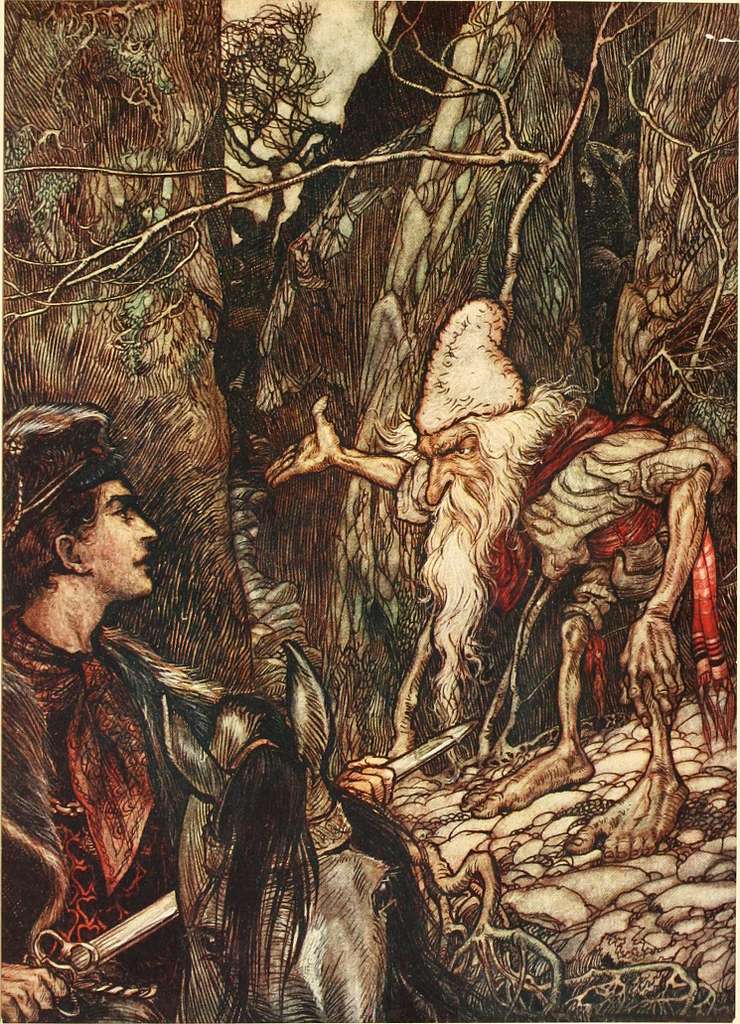
Arthur Rackham’s illustration of a dwarf. Image via Picryl.
“[To Lewis,] Disney had profaned the image of dwarfs created by Rackham, and such a desecration could not be forgiven. Disney’s dwarfs were comic figures, but the dwarfs of Wagner made visible by Rackham were dangerous, self-possessed creatures to whom the term ‘jolly’ did not apply.” (72)
Genius Squandered
Nonetheless, Lewis’s judgements on Snow White are not all negative. He praises the “terrifying bits” and describes the animals as “really most moving”. Indeed, from a technical perspective, he is overall very impressed — “the use of shadows (of dwarfs and vultures) was real genius.”
But he restrains himself from ending his review on a positive note.
“What might not have come of it if this man [again referring to Disney] had been educated — or even brought up in a decent society?”
Lewis’s letter to Alfred Jenkin provides a humorous and intriguing insight into the film tastes of one of the great literary figures of the twentieth century. One can only wonder what he would have thought of late twentieth and early twenty-first century films.
Bibliography:
- C. S. Lewis, Surprised by Joy (William Collins: 2016).
- C. S. Lewis, Letter to A. K. Hamilton Jenkin (Bod), 11 January 1939.
- Harry Lee Poe, Becoming C. S. Lewis: A Biography of Young Jack Lewis (1898–1918) (Crossway: 2019).
Image from YouTube via @cccinematicclips.
One Comment
Leave A Comment
Recent Articles:
28 October 2026
1.8 MINS
A candlelit performance of Mozart’s Requiem at Sydney Town Hall will honour 21 Australian Army nurses murdered in the Bangka Island massacre, along with generations of military nurses.
23 October 2026
3.1 MINS
As Western societies grow more hostile, could abandoning Christianity’s moral foundations be contributing to the rise of ideological extremism, political intolerance and violence?

21 October 2026
7.9 MINS
A collection of sobering reflections on Western civilisation’s decline, the loss of Christian foundations and the dangers of cultural complacency, ending with a message of enduring Christian hope.
20 October 2026
4.9 MINS
James McAuley’s legacy reaches far beyond Australia’s Catholic hymnals. Poet, convert and cultural warrior, he defended beauty, truth and faith in an age of changing values.
19 October 2026
12.4 MINS
Greta Gerwig’s "Narnia: The Magician’s Nephew" trailer raises questions about C. S. Lewis’s Christian vision and the faithfulness of the new Netflix adaptation. Here are my initial impressions and concerns.

15 October 2026
6.1 MINS
Historian Frank Furedi warns that the West is waging a war against its own past, censoring books, rewriting history and severing future generations from their heritage.

14 October 2026
5.3 MINS
Marco Rubio’s Athens speech celebrates the Greek, Roman and Christian foundations of Western civilisation, warning that cultural self-loathing and radical ideologies threaten its future.



First Disney picture I saw in 1948. Still love it as the best ever.