


From Convinced Atheist to Christian Apologist: The Untold Story of C.S. Lewis’s Conversion
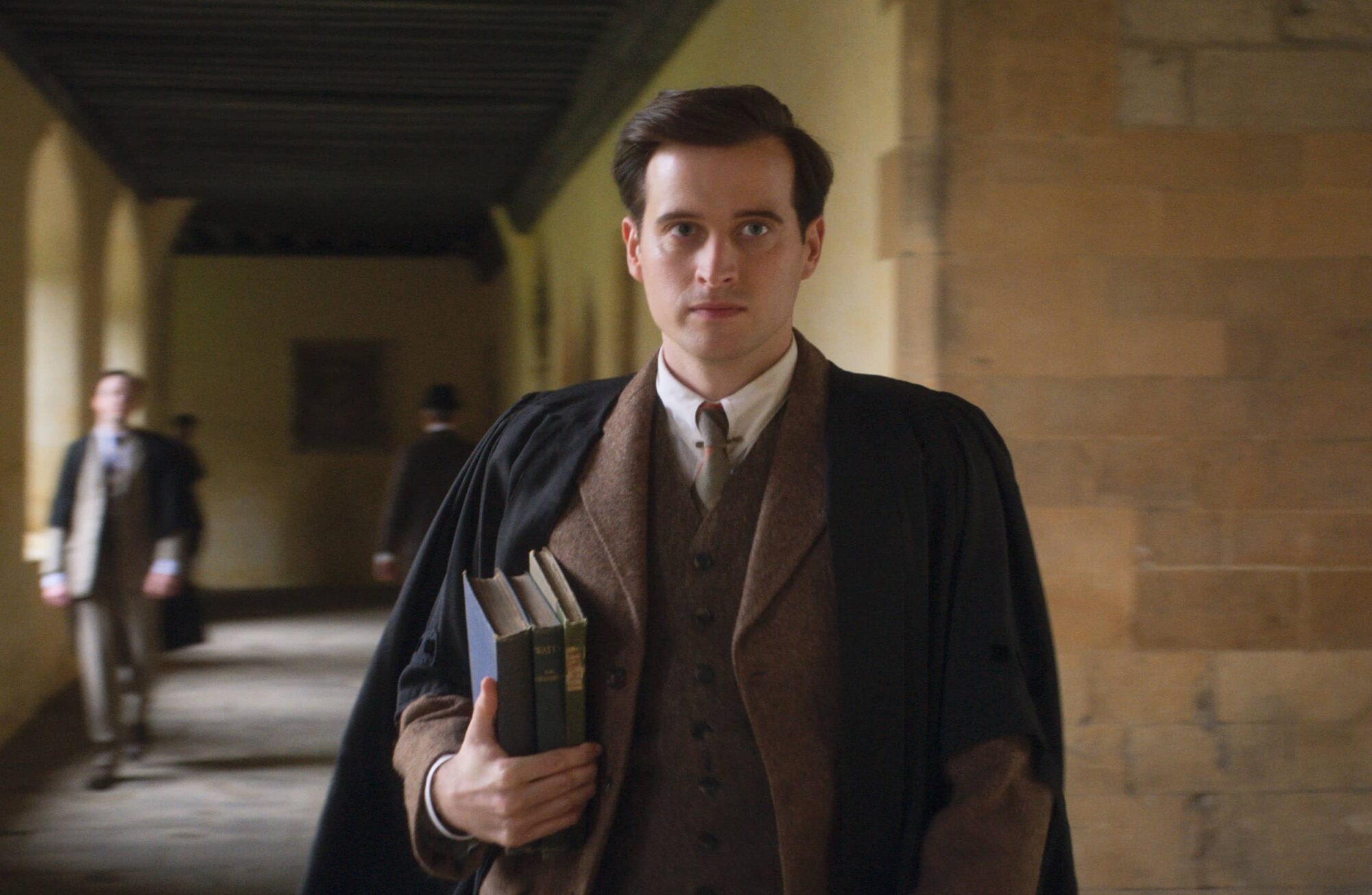
C. S. Lewis is one of Christianity’s most respected voices: whether as a fantasy writer whose stories have reached hundreds of millions or as an apologist and lay theologian who may be the most quoted Christian today. But what made the C. S. Lewis we all know and love? A film from the Fellowship for Performing Arts (FPA) tastefully and compellingly presents Lewis’s journey from convinced atheist to the titan of the Christian faith that he is today.
Clive Staples (C. S.) Lewis Today: His Lasting Legacy
There is little doubt that C. S. Lewis will go down as one of the most influential Christian writers and minds of all time — certainly of the past few hundred years.
His enduring impact is difficult to summarise.
Of course, Lewis is especially well known for writing the legendary Chronicles of Narnia, the seven-book high fantasy series which is among the most impactful book series of the last hundred years. In terms of sheer numbers (and depending on who is counting), The Lion, the Witch, and the Wardrobe (1950) alone is in the top eight, top ten, or top fifteen best-selling books of all time. It trails only religious texts like The Bible, The Qur’an, The Book of Mormon and The Little Red Book, masterpieces like A Tale of Two Cities (1859) and Alice in Wonderland (1865), and modern sensations like Harry Potter and the Philosopher’s (Sorcerer’s) Stone (1997).
The entire series has sold some 120 million copies.
Between 2005 and 2010, three of the Narnia books — The Lion, the Witch, and the Wardrobe, Prince Caspian, and The Voyage of the Dawn Treader — were made into blockbuster films on the same scale as The Lord of the Rings (with The Lion, the Witch, and the Wardrobe outperforming Harry Potter and the Goblet of Fire in the North American Box Office).
While Lewis may not have penned the most popular books of all time, he can lay claim to being a major influence on those who did. J. R. R. Tolkien’s The Lord of the Rings was rated the United Kingdom’s “most beloved book” in 2003, but famously, it was Lewis who pressed Tolkien to write the magisterial work.
As Alistair McGrath points out in his biography, C. S. Lewis—A Life: Eccentric Genius, Reluctant Prophet:
Too often, Lewis is seen simply as an author in his own right. The story of the completion of this classic work of English literature [Tolkien’s The Lord of the Rings] allows us to see him in quite a different light—as a literary midwife, who encouraged others to produce their masterpieces. In this case, some critics suggest, Lewis helped bring about a classic that would be greater than anything he himself would write. (p. 197)
Narnia’s influence on the author of the best-selling book series of all time has also been noted. I am, of course, referring to J. K. Rowling, the author of the seven book Harry Potter series.
Rowling says she “adored” the Narnia books as a child:
I found myself thinking about the wardrobe route to Narnia when Harry is told he has to hurl himself at a barrier in King’s Cross station – it dissolves and he’s on platform Nine and Three-Quarters, and there’s the train for Hogwarts. (J. K. Rowling)
In fact, the influence is such that several scholars have suggested that both series should be considered “Christian fantasy”1 and that they both “share a largely Christian viewpoint”.
But it is not just Narnia that has left an enduring legacy.
The Screwtape Letters (1942), an ingenious novel-style devotional book, arguably popularised a new genre — “demonic epistolary fiction” — and has sold millions of copies around the world. The Fellowship of Performing Arts also has plans to adapt the book to film, with production to begin in 2027.
In 2000, Christianity Today named Screwtape among its top 100 books of the century.
Not to be outdone, Lewis’s Mere Christianity (1952), adapted from Second World War BBC broadcasts, took the title of the “Book of the Century”. The short, systematic, and brilliantly accessible work of apologetics has been translated into thirty-six languages and sold over three and a half million copies globally.
According to the Christianity Today editors,
“By far, C. S. Lewis was the most popular author and Mere Christianity the book nominated most often. Indeed, we could have included even more Lewis works [in the top 100], but finally we had to say: ‘Enough is enough; give some other authors a chance.'”
As if Lewis’s literary and apologetics legacy is not enough, scholars are increasingly rediscovering his rightful place as a leading thinker — literary critic, historian, and public intellectual — of the twentieth century.
While they may not be everyone’s cup of tea, Lewis’s scholarly works are insightful, witty, and deeply researched, and he has left his mark on fields as wide-ranging as literary theory, linguistics and language, intellectual history, philosophy, Medievalism, and Milton studies. Works like English Literature in the Sixteenth Century (Excluding Drama) (1954), A Preface to Paradise Lost (1942) and The Allegory of Love (1936) deserve their place as seminal works of academic scholarship.
From Atheist Dogmatic to Christian Debater: C. S. Lewis’s Journey to Christ
While Lewis has a reputation today as one of the great Christians — writers, intellectuals, and apologists — of the twentieth century, it may surprise some to discover that the famous author was once a convinced atheist. Lewis lost his mother at a young age and experienced alienation from his father, who sent him to boarding school overseas when he was just nine.
By his early teens, Lewis had lost all remnants of the cultural Ulster Protestantism of his family. He had become a convinced atheist.
However, that is just where the story begins. In 2021, the Fellowship of Performing Arts (FPA), led by stage actor Max McLean, produced a dramatised feature film recounting Lewis’s journey away from, and then back towards, the Christian faith.
Predominantly based on Lewis’s memoir/autobiography Surprised by Joy (1955), The Most Reluctant Convert draws heavily from Lewis’s writings — including, besides Surprised by Joy, The Problem of Pain (1940), Mere Christianity, and Lewis’s magnificent sermon, “The Weight of Glory” (1941). This masterful strategy means that the viewer is in effect hearing C. S. Lewis’s story from his own mouth — in his own words.
The title of the production is based on a line from Surprised by Joy, in which Lewis recalls his conversion to theism, having had all of his intellectual objections decimated by the books he most enjoyed and the friends he most trusted:
You must picture me alone in that room at Magdalen, night after night, feeling, whenever my mind lifted even for a second from my work, the steady, unrelenting approach of Him whom I so earnestly desired not to meet. That which I greatly feared had at last come upon me. In the Trinity Term of 19292 I gave in, and admitted that God was God, and knelt and prayed: perhaps, that night, the most dejected and reluctant convert in all England. I did not then see what is now the most shining and obvious thing; the Divine humility which will accept a convert even on such terms. The Prodigal Son at least walked home on his own feet. But who can duly adore that Love which will open the high gates to a prodigal who is brought in kicking, struggling, resentful, and darting his eyes in every direction for a chance of escape? The words compelle intrare, compel them to come in, have been so abused by wicked men that we shudder at them; but, properly understood, they plumb the depth of the Divine mercy. The hardness of God is kinder than the softness of men, and His compulsion is our liberation. (p. 266)
McLean and the FPA have done a superb job capturing the spiritual, emotional, and intellectual journey on which Lewis embarked before finally coming back to faith in his early thirties. Over the next thirty years, before his death in 1963, Lewis would become one of the great defenders of the Christian faith he had so long resisted and attacked — a testimony reminiscent of the great St Paul (1 Corinthians 15:9-11).
Another strength of The Most Reluctant Convert is its raw presentation of the struggles of the pre-Christian Lewis. The fact is: Lewis had serious (and credible) struggles and objections to Christianity. One of the reasons he was so persuasive and compelling as an apologist is the fact that he had himself battled with the same intellectual and emotional issues that hold many people back from faith.
The film does not gloss over those challenges.
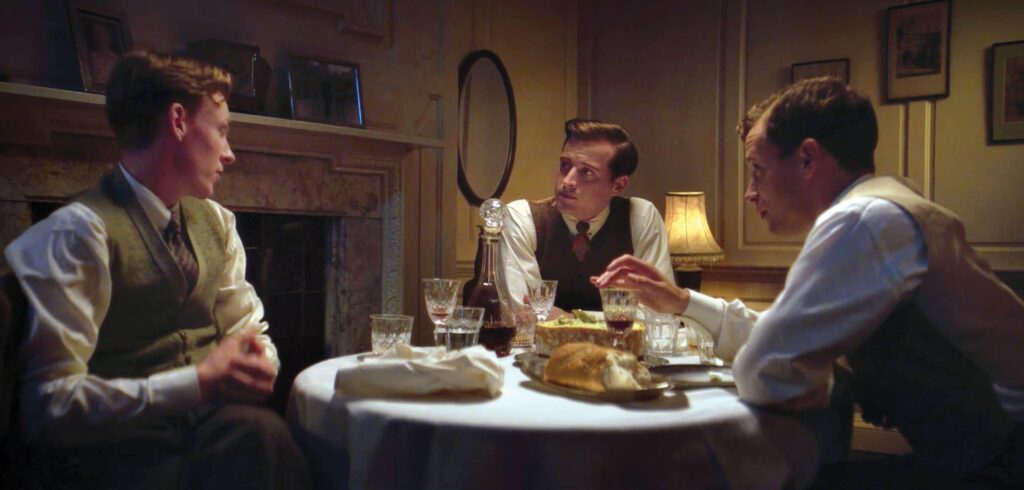
C. S. Lewis discussing Christianity with Hugo Dyson and J. R. R. Tolkien, both of whom were influential in his conversion
One of the other features of Lewis’s testimony which is compellingly brought out is the role that both great books and close friends played in challenging Lewis’s antagonism to Christianity. It is one of the reasons we need competent Christian scholars, writers, and intellectuals — to remove any obstacle that stands in the way of belief in God.
Lewis’s friends, including Hugo Dyson and J. R. R. Tolkien, sat with him, patiently answering his questions and objections, removing any reason or justification he may have had for disbelief in God.
It was only after his arguments had been demolished that Lewis finally felt he had no choice but to accept that God was God.
As the apostle Paul would put it:
For the weapons of our warfare are not carnal but mighty in God for pulling down strongholds, casting down arguments and every high thing that exalts itself against the knowledge of God, bringing every thought into captivity to the obedience of Christ… (2 Corinthians 10:4–5 NKJV)
Or to quote C. S. Lewis himself:
If all the world were Christian, it might not matter if all the world were uneducated. But, as it is, a cultural life will exist outside the Church whether it exists inside or not. To be ignorant and simple now—not to be able to meet the enemies on their own ground—would be to throw down our weapons, and to betray out uneducated brethren who have, under God, no defence but us against the intellectual attacks of the heathen. Good philosophy must exist, if for no other reason, because bad philosophy needs to be answered. The cool intellect must work not only against the cool intellect on the other side, but against the muddy heathen mysticisms which deny intellect altogether. Most of all, perhaps, we need intimate knowledge of the past. (“Learning in War-Time”, p. 58)
I commend to you the story of C. S. Lewis as told in The Most Reluctant Convert. His journey of faith is not everyone’s journey. But it is a testament to what God can do in the life of a rebel… any rebel. And in that sense, it is a story to which we can all relate.
Footnotes:
-
- Notably, Sarah Winters in Evil in the Christian Fantasy of C. S. Lewis and J. K. Rowling: From the White Witch to the Dark Mark (2025). ↩
- Lewis’s memory of the exact timeline has been challenged by some scholars, notably Alistair McGrath in C. S. Lewis—A Life, who suggests that Lewis was converted to theism later than he recalled in Surprised by Joy. ↩
Works Cited:
- Christianity Today, “Books of the Century: Leaders and Thinkers Weigh in on Classics that have Shaped Contemporary Religious Thought,” 2000.
- Lewis, C. S., Surprised by Joy: An Accidental Journey from Atheism to Christianity, William Collins, 2012.
- Lewis, C. S., “Learning in War-Time,” in The Weight of Glory: A Collection of Lewis’s Most Moving Addresses, William Collins, 2013.
- McGrath, Alistair, C. S. Lewis—A Life: Eccentric Genius, Reluctant Prophet, Hodder & Stoughton, 2013.
- Sharma, Swati and Aditi Dev, “Undertones Of Christianity In The Works Of C. S. Lewis And J. K. Rowling: An Analytical Study,” Journal of Language and Linguistic Studies, 2021.
- Winters, Sarah Fiona, Evil in the Christian Fantasy of C. S. Lewis and J. K. Rowling: From the White Witch to the Dark Mark, Lexington Books, 2025.
Images via The Most Reluctant Convert: The Untold Story of C. S. Lewis.
One Comment
Leave A Comment
Recent Articles:

20 October 2026
4 MINS
Olympic champion Stephanie Rice has faced a wave of online ridicule after revealing she resigned from her dream job following what she believes was God’s direction.
20 October 2026
4.9 MINS
James McAuley’s legacy reaches far beyond Australia’s Catholic hymnals. Poet, convert and cultural warrior, he defended beauty, truth and faith in an age of changing values.
20 October 2026
3 MINS
Scripture teaches us to pray the "prayer of faith", because without faith it is impossible to please God.
19 October 2026
12.4 MINS
Greta Gerwig’s "Narnia: The Magician’s Nephew" trailer raises questions about C. S. Lewis’s Christian vision and the faithfulness of the new Netflix adaptation. Here are my initial impressions and concerns.

19 October 2026
3 MINS
Paul prayed that we would be awakened to a deeper revelation of the Father and who we are in Christ, so that we will make Jesus known to others more passionately.

18 October 2026
2.7 MINS
Every season of life belongs to Christ, and we don't retire from discipleship as we grow older. In fact, our older years hold unique gifts for the younger generations.

17 October 2026
3.4 MINS
Seeking the face of God means surrender, laying aside our agenda and wants. Revival begins when we want God himself more than we want the outcome.



Wonderful ! I read Surprised by Joy when I was 16 and was so blown away by it. Although I grew up in the C of E religion, and I always knew that God exists, I felt that I had finally come across another person who felt the same way as I did – C. S. Lewis. This was more than 60 years ago … and I still feel wonderful. How lucky is every person on planet Earth who knows that God exists, that God is Love, and that the founders of the major religions of the world knew this.