


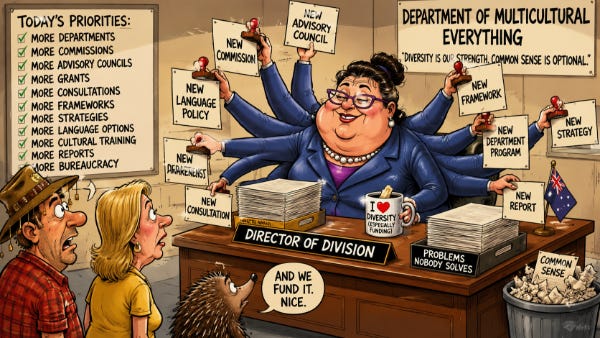
Multiculturalism’s Mask Slips
Nation First investigates how the government’s own report on multiculturalism exposes it as a taxpayer-funded identity machine, not the harmless food-and-festivals story Australians were sold.
No wonder Pauline Hanson wants to ditch multiculturalism.
If ordinary Australians sat down with the government’s own report on the subject, a lot of them would be stunned. Not because they hate migrants. Not because they dislike different food, different faces, or different accents at the shops. Most Australians are pretty relaxed about that. They live with it every day.
They would be stunned because the thing they thought they were being sold is not the thing Canberra is building.
Government Multiculturalism Report
Most Australians think multiculturalism means something fairly straightforward. People come here, they work hard, obey the law, learn English, raise their kids, join in, respect the country, and bring a bit of their old home with them. The local Vietnamese bakery. The Italian club. Greek Easter. Indian restaurants. Filipino families gathering at the park after Mass. A few cultural festivals here and there. That sort of thing.
Nobody sensible loses sleep over that.
But the Albanese Labor Government’s report, “Towards Fairness: A multicultural Australia for all”, is not really about that at all. It is not a warm little story about neighbours getting along over ethnic food and festivals. It is a blueprint for pushing multiculturalism into nearly every corner of national life: government departments, schools, media, grants, language policy, citizenship, health, aged care, disability services, public-sector hiring, sport, the arts and even faith communities.
According to the report, multiculturalism is not merely different ethnic groups living peacefully in Australia. It is a state-backed policy system that makes cultural identity, language, anti-discrimination, representation and government-funded inclusion central to how Australia understands itself and how its institutions operate.
It is clear from all of this that Canberra is building a machine.
The report says, right up front, that “Australia’s identity as a nation-state is inherently multicultural.” That is a huge claim. It does not merely say Australia has welcomed migrants, which is true. It does not say migration has shaped modern Australia, which is also true. It says the nation itself is inherently multicultural.
That conveniently shoves a lot of Australia’s actual inheritance to one side. British parliamentary democracy. The common law. The English language. Christian moral assumptions. Civic duty. Self-government. Military sacrifice. The fair go. Loyalty to one flag. All the things that made modern Australia recognisably Australia are suddenly treated as background material, while multiculturalism is pushed to the front as the great organising idea.
Then comes another line that should make people stop. The report says “our borders are permeable.” Yes, it is talking about older trade and migratory routes. That is the context. Still, what a thing to put in a government multiculturalism report while the country is already arguing about migration levels, housing pressure, social strain and whether Australia still controls its own front door.
“Our borders are permeable.”
At least they finally admitted it.
Multiculturalism and the Death of Australia’s Inherited Identity
The report also takes a swipe at Australia’s inherited identity. It talks about “violent attempts to eradicate anything deemed counter to Western Anglo society.” It says legal and political structures enabled “Anglo dominance” while reducing the significance of other cultures.
There it is, in the careful language of officialdom. The Anglo-Celtic inheritance of Australia, the civilisation that gave us our parliaments, courts, freedoms, language and public habits, is treated less like a foundation and more like a stain to be scrubbed out.
This is why the public debate around multiculturalism is so slippery. When politicians defend it on television, they talk about harmony, kindness, food and colour. They make it sound as if anyone who questions multiculturalism must secretly have a problem with the local Thai restaurant or Chinese New Year decorations.
Then you read the actual report.
It wants a “multi-decade multicultural framework.” It describes the project as a “once-in-a-generation reform agenda.” It says it needs a “whole-of-government and community approach.” With that kind of language, you can be sure it’s not just ethnic festivals they’re talking about.
The report’s own roadmap calls for a “Multicultural Australia Commission,” a dedicated Department of Multicultural Affairs, Immigration and Citizenship, a Multicultural Ministerial Forum, a Multicultural Community Advisory Council, a national language policy, a refreshed citizenship process, an “independent and diverse multicultural media sector,” and investment in cultural programs through the arts and sport to “drive social change.”
That phrase should not be skipped over: “Drive social change.”
There is another term for that. It’s called social engineering.
Bloating the Bureaucracy
Recommendation 11 calls for a “Multicultural Affairs Commission and Commissioner” and a “standalone Department of Multicultural Affairs, Immigration and Citizenship, with a dedicated minister.” A department, a commissioner, a minister, advisory bodies, forums, reports, funding streams, KPIs and public-sector controls. This is how a pleasant-sounding word becomes an empire with letterhead.
One of the most extraordinary parts is the citizenship test. The report recommends reviewing the test, including “considering providing the test in languages other than English.”
So, a person applying to become an Australian citizen may not even have to sit the citizenship test in the common language of Australia.
English is not some decorative extra. It is the shared language that allows a country of many backgrounds to operate as one. It is how people talk on a job site, understand the law, help their kids with schoolwork, deal with Centrelink, argue politics, speak to neighbours, vote, complain, and belong.
If even the citizenship test can be done in another language, what exactly is citizenship supposed to mean? Are people joining one nation, or are they being sorted into a government-managed patchwork of separate communities?
This is why Hanson’s argument has landed, no matter how much the usual crowd sneers at it. When she says she wants to move away from multiculturalism toward monoculturalism, her opponents pretend she is calling for some grim, grey country where everyone looks the same, eats the same food and has the same ancestry. That is rubbish, and most of them know it.
The point is much simpler. One people, in one nation, under one flag.
That does not mean migrants cannot keep family traditions. It does not mean people cannot worship differently, cook different food, speak another language at home or be proud of where their parents or grandparents came from. Of course they can.
It means Australia has a national identity of its own.
One public language. One law. One civic culture. One loyalty. One flag above every other flag. That used to be normal. Now it gets treated as if it is dangerous.
The report is obviously uncomfortable with ideas like this. It bristles at the concept of shared Australian values, integration and unity. It complains that government responses promoted “shared Australian values” that all groups were expected to follow. It says the move toward “social cohesion” included “assimilationist attitudes.” It even says social cohesion has become problematic “to the point where the term itself has become problematic.” That is mad.
Shared values are not the enemy of a successful migrant country. They are the only reason it can work. Without them, you do not get harmony. You get groups competing for recognition, funding and influence. Without English, people drift apart. Without loyalty to Australia first, a country starts to feel less like a nation and more like an airport lounge with suburbs attached.
Then there is this gem. The report says the word multiculturalism has been exploited by “far-right groups promoting xenophobic ideologies” under the guise of concerns, including “protecting ‘jobs for Australians’ against migrant ‘encroachment’.”
That should make working people sit up straight in bed.
“Jobs for Australians” is not some fringe slogan. It is a normal concern. Ask a young tradie trying to get ahead. Ask a truck driver watching wages get squeezed. Ask a family trying to find a rental while migration keeps pumping demand into an already broken housing market. Wanting Australian workers to be put first in Australia is not far-right. It is a basic national responsibility. But in this report, even that sort of concern is considered the language of xenophobia.
That is how this stuff works. Ordinary concerns get smeared. Normal questions get pathologised. People who want a country, not a managed collection of identity blocs, are made to sound dangerous.
The report also drags multiculturalism straight into the activist swamp. It calls for “continuously applying an intersectional, gender-equality lens to multicultural policy and services.” So multiculturalism is no longer just about migrants, culture or language. It becomes a carrier for intersectional gender politics.
Multiculturalism and Justification of LGBTIQ+
Then comes the section titled “Empowering multicultural LGBTIQ+ voices.”
The report says LGBTIQ+ people from multicultural and faith communities can be “robbed” of their place and belonging within those communities because of gender and sexual identity. It calls for “a paradigm shift in service provision across all sectors.” It says discriminatory attitudes and practices “within multicultural and faith communities” must be addressed.
Multiculturalism thus becomes a doorway for government-backed activism inside faith communities. Churches, mosques, temples and family networks are no longer simply allowed to exist with their own moral beliefs. They become places to be corrected, trained, funded, monitored and reshaped.
How many migrants were told this was part of the deal?
How many people came here for peace, work, safety and a better life, only to find the multicultural industry wants to lecture their families and places of worship about sexuality and gender?
Multiculturalism Homage
The report wants multiculturalism embedded in basic services, too. Its roadmap says government should “embed culturally responsive services including health, disability, education, aged care and housing.” On the surface, that sounds kind and harmless. Who objects to services being respectful? But read it in the context of the whole report, and you can see what is happening. Every ordinary service becomes another site for identity-based redesign.
Housing. Health. Schools. Aged care. Disability. Nothing is left alone.
It wants “cultural capability” lifted across the Australian Public Service. It wants departments held accountable for their diversity, equity and inclusion (DEI) plans. It calls for “key performance indicators” to be reported annually to the Commission and then tabled in Parliament. It calls for “Multicultural budget statements.” It says agency heads should have their performance managed against results, including reported increases in discrimination, racism or bullying.
So multiculturalism becomes a compliance regime. Public servants will not just deliver services. They will be trained, measured, monitored, and judged against multicultural outcomes. Departments will not just do their jobs. They will report to the multicultural machine.
The grants section is just as revealing. The report recommends reshaping multicultural grants and funding programs through “consultation and co-design” with state, territory and local governments and community stakeholders. It wants longer grant periods, funding certainty, micro-grants, translated application documents, dedicated allocations for smaller organisations and more co-design with community groups.
In plain English, it means there will be a lot of taxpayer money sprayed on a multiculturalism industry. More groups will be built around racial identity. More organisations will become dependent on big government. More money, power and influence will be attained by lawyers, consultants and those who know how to speak fluent bureaucracy.
Ordinary Australians thought multiculturalism meant living peacefully with people from different backgrounds. Canberra thinks it means funding an industry.
Then there is the media. The report calls for an “independent and diverse multicultural media sector.” It talks about SBS, ABC, community broadcasting, online media and the arts. It wants cultural programs to “drive social change through the arts and sport.”
Again, that is not neutral. Media, art, and sport become tools for changing public attitudes. The same taxpayers, struggling to pay for groceries, power bills, and rent, are expected to fund the machinery that lectures them about identity.
And all of this is wrapped in a version of Australian history that seems determined to make ordinary Australians feel guilty about the country they inherited.
The report talks about “systemic and institutional racism” being experienced today. It talks about “dismantling barriers.” It talks about “truth-telling.” It talks about “multicultural nation-building.” It treats Australian identity as something to be reimagined rather than defended.
There is very little affection in this document for the Australia most people recognise: the Australia of local footy clubs, RSL halls, Anzac Day marches, school assemblies, church fetes, surf clubs, meat raffles, small businesses, English as the common language and one flag over the town hall.
That Australia is not perfect. No country is. But it is real. It is what people came here to join.
The multicultural establishment seems to have forgotten that. Or maybe it remembers it perfectly well and wants to replace it.
That is why the backlash is coming. People can tell when they are being sold one thing and given another. They were sold neighbourly tolerance. They are getting departments, commissioners, grants, language regimes, gender ideology, media projects, public-service KPIs and lectures about “Anglo dominance.”
Hanson’s critics can sneer all they like, but the government’s own report makes her case for her.
If multiculturalism now means Australia must be rebuilt around competing identities, permanent cultural bureaucracies, multilingual citizenship, taxpayer-funded grievance groups and ideological training, then plenty of Australians will say they want no part of it.
Not because they hate migrants. Most do not. They will say it because they want migrants and native-born Australians alike to belong to the same country.
One people. One nation. One flag.
That should not be controversial. But after reading this report, it is pretty obvious why Canberra thinks it is.
___
Republished with thanks to Nation First.
Image via Nation First.
5 Comments
Leave A Comment
Recent Articles:
28 August 2026
1.4 MINS
When floods hit Nepal, killing dozens and leaving Australians missing, the Greens found their villain: Australian coal. A look at climate politics' newest ritual — the search for a sinner.

28 August 2026
3.5 MINS
Alice Springs' Greens-backed mayor had her car stolen — then refused to press charges. James Macpherson asks why the progressive answer to rising crime is to fix the narrative instead of the crime.
28 August 2026
5 MINS
Dolly Parton has died at 80, leaving behind a legacy of faith, generosity, and music. Tributes are pouring in from celebrities, politicians, and everyday fans she touched.

28 August 2026
2.8 MINS
A veteran Seattle Times sports columnist resigned after editors blocked his column defending Sophie Cunningham's stance on transgender athletes in women's sports, calling it a matter of journalistic integrity.
28 August 2026
2.6 MINS
Thomas Aquinas questioned Muhammad’s credentials to speak for God. His question remains uncomfortably relevant.
28 August 2026
5 MINS
Politics feels exhausting and toxic, but William Wilberforce's story shows why Christians shouldn't retreat from public life. His crisis of faith and calling offers a model for today.

27 August 2026
2.5 MINS
According to the bombshell report, the Biden administration told agencies to treat restrictions on these drugs as discrimination. The Trump administration now wants hospitals investigated.



Pure critical theory marxism, promoting a way of thinking that centres around thinking multiculturally first, and anything else is a heresy to be condemned.
Thanks, George, for interpreting this document so we k now what it truly means. Scary!!! Vote this government out before i can do ore damage!
Thanks George for opening our eyes to this disastrous report. It’s obvious that Labour wants bring about a major change in Australia. To get rid of our culture and values and replace it with one that made many leave their country/culture to come to ours. Some cultures are very different to our own. Some cultures don’t have an age of consent for marriage (thus we have that awful situation in the UK with hundreds of thousands of young girls abused). Do we want that here?
We need to pray, call our local member of parliament to voice our concern, and vote for One Nation, that could be our only hope. The other parties wont do anything about it.
Australia has a national identity of its own – a heritage built on the foundation of Godly principles.
Our current Government is Hell bent on doing all it can to erode this firm foundation.
Aussies arise!
The forced Cult of Multiculturalism is nothing but an expensive Waste of money , employing people we don’t need in our lives , whose main ” job ” seems to be to persecute us if we criticise this new “god” (= Multiculturalism ). It has done a great job of destroying the once happy-go -lucky , larrikin way of life of Australians. Define what is now an “Australian ” ? Time to kill Multiculturalism , and , revert back to Monoculture–one flag, Christian values, back to 8 hour day and weekend leisure, etc which is good for family life and one’s health. Monoculture does not mean that Indians can’t have their Diwali, or Chinese their New Year celebrations, or Greek and Italians, etc having their festivals as Anne Aly (a Muslim ) and others deliberately try to misinform the public. It is just that our loyalty and culture should be Australian as it was pre the Whitlam Labor Govt which was sacked by the Governor-General in 1975. Pity , we can’t now sack our Albanese government for its incompetence and waste !